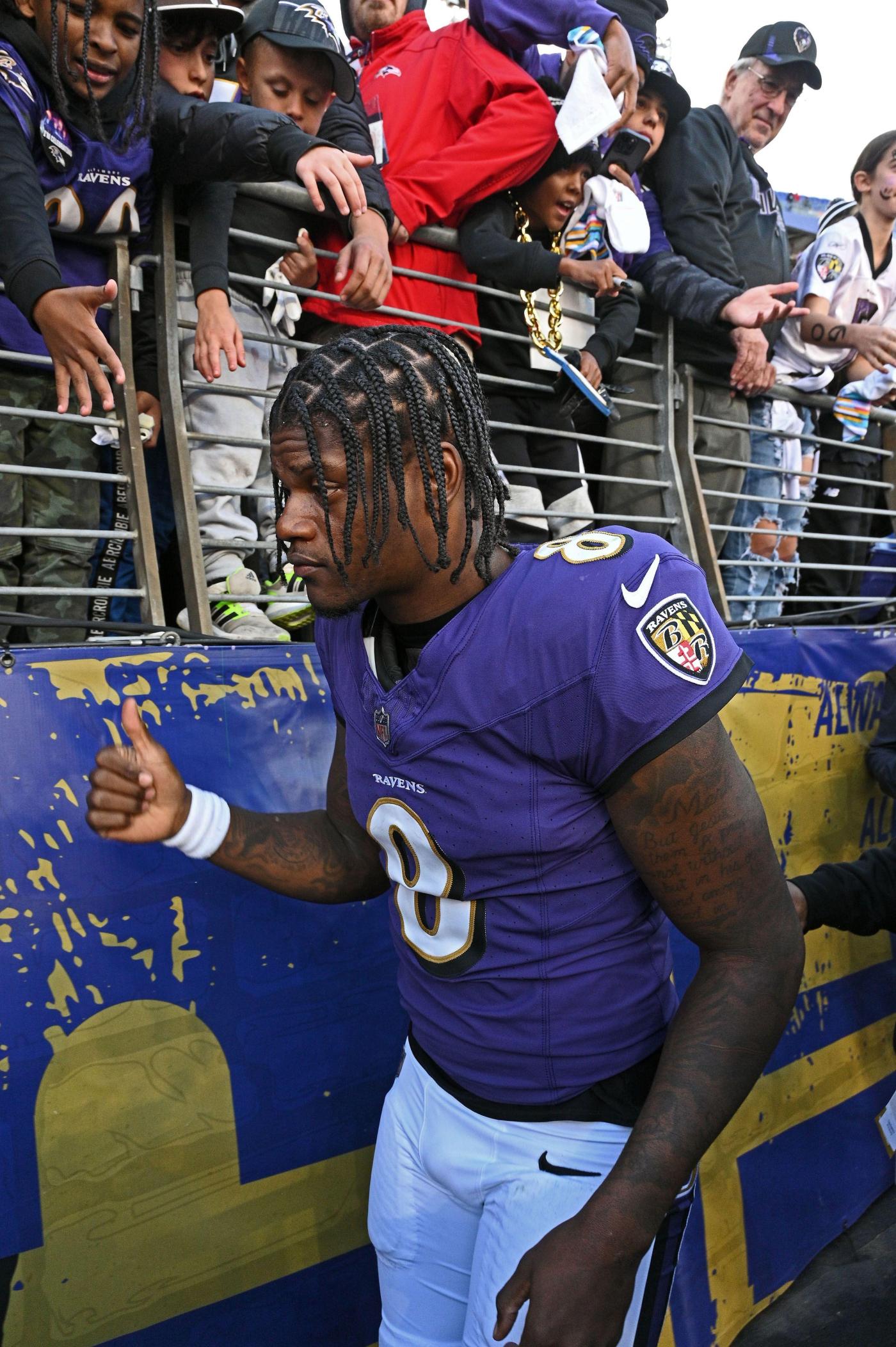
Mike Preston’s report card: Position-by-position grades for Ravens’ 38-6 win over Lions | COMMENTARY

posted in: News | 0

Here’s how the Ravens (5-2) graded out at each position after a 38-6 win over the Detroit Lions (5-2) in Sunday’s Week 7 game at M&T Bank Stadium:

Quarterback

Lamar Jackson completed 21 of 27 passes for 357 yards and three touchdowns. In the first half, he made plays by moving around in the pocket when the pass protection broke down. He made some excellent reads on run-pass options and threw some tight passes into small windows in the end zone. Jackson overthrew several receivers and held onto a handoff to running back Justice Hill, which resulted in a lost fumble, but he also ran for 36 yards on nine carries. He finished with a nearly perfect passer rating of 155.8. Grade: A

Running backs

The running game usually opens up the passing game, but this time it was totally different. Once Jackson started ripping up the Lions’ secondary, the passing game opened up big holes for the rushing attack. By the second quarter, the Ravens had started to impose their will. Gus Edwards had 64 yards on 14 carries and Hill had 46 on four attempts, including a long of 27 yards. Edwards also had an 80-yard reception in the third quarter. The Ravens finished with 146 yards on 27 carries, an average of 5.4. Grade: A-

Offensive line

Jackson made the offensive line look better than it really was in the first half because he was able to move in the pocket, escape pressure and complete throws. By late in the second quarter, the Lions had pretty much quit. The Ravens did a good job helping right tackle Morgan Moses chip on defensive end Aidan Hutchinson, but Moses worked leverage and was able to get under the 6-foot-7 Hutchinson’s pads. Guards Kevin Zeitler and John Simpson controlled the second level by the third quarter and left tackle Ronnie Stanley played perhaps his best game of the season. Grade: B+

Receivers

The Lions played extremely soft on the back end, perhaps believing they could get to Jackson before his receivers got downfield. That strategy proved ineffective and costly. Almost every receiver seemed open for the Ravens. Tight end Mark Andrews caught touchdown passes of 11 and 8 yards and rookie receiver Zay Flowers and veteran Odell Beckham Jr. were effective working the middle of the field. Beckham had five catches for 49 yards and Flower had four for 75. Even though Jackson threw for 255 yards in the first half, the Lions continued to play soft coverage in the second. Grade: A

Defensive line

The Lions came into the game ranked eighth in the league in rushing but had only 84 yards, including 13 in the lopsided first half. The Ravens’ starters — Justin Madubuike (three tackles, two quarterback hurries, one sack) and Michael Pierce (two tackles) — as well as reserves Broderick Washington and Brent Urban dominated the Lions, who were supposed to have one of the best offensive lines in the league. The Ravens got a lot of pressure up front, leaving quarterback Jared Goff with little room to step up in the middle and few escape routes. Grade: A

Linebackers

Middle linebacker Roquan Smith said he wanted the Lions to show him how good they were, and his defense showed them up. Smith had eight tackles to lead the way, but he excels just as much in pass coverage. Weakside linebacker Patrick Queen finished with five tackles. Once the Lions fell behind early, Goff became easy prey for the outside linebackers, especially Kyle Van Noy (five tackles, two sacks, two quarterback hurries). The Ravens finished with five sacks and consistently harassed Goff, who appeared to throw more passes away than he completed. Outside linebacker Odafe Oweh showed fresh legs. He hadn’t played since suffering an ankle injury in Week 2 but tallied three tackles, including a sack, to go with a quarterback pressure. Grade: A

Secondary

Where do the Ravens get these stopgap players? They aren’t starters, but guys like cornerback Arthur Maulet and safety Geno Stone step up every week. Detroit was supposed to have one of the best groups of receivers in the league, yet the Ravens allowed only 8.6 yards per catch. They did a good job keeping everything in front of them and coming up to make tackles. The Lions entered the game with 32 plays gaining 20-plus yards, but Detroit managed 337 yards of total offense, almost all of which came in the second half and trailing by multiple touchdowns. Both cornerback Marlon Humphrey and safety Kyle Hamilton played well. Maulet and Hamilton each had seven tackles. Grade: A

Special teams

Justin Tucker had one field goal of 32 yards but his “pooched” kickoff in the third quarter was questionable. Jordan Stout averaged 56 yards on two punts, which in itself tells how the Ravens dominated the game. Baltimore, though, did allow one punt to be returned 24 yards and a pair of kickoffs for 22 and 19. But at least there wasn’t a punt or extra point attempt blocked from an opposing player coming up the A-gap. Grade: B

Coaching

The Ravens have been criticized for allowing teams to get back into games, especially in the second half, but they outplayed the Lions for a full 60 minutes. Offensive coordinator Todd Monken came up with some new wrinkles on run-pass options and defensive coordinator Mike Macdonald turned in another stellar game plan. There was concern the Ravens might be fatigued after playing three straight games on the road and spending last week in London, but they showed more life than the Lions. The Ravens outhit, outmanned and thoroughly outplayed Detroit. Grade: A

()

Dress for success on your next job interview

posted in: Society | 0

In his masterpiece “Crime and Punishment,” author Fyodor Dostoevsky wrote, “We sometimes encounter people, even perfect strangers, who begin to interest us at first sight, somehow suddenly, all at once, before a word has been spoken.”

The great Russian novelist is referring to the fact that impressions can be made even before conversations begin. This is an important notion to grasp and can do a job seeker a world of good in every interaction during the hiring process, including the interview. Recruiters may have an understanding of you as an applicant from your resume and other correspondences, but it is during the interview – whether it’s in person or remote – that a hiring manager can really get a sense of your energy and professionalism.

While no one wants to be judged on appearance alone, what you look like and how you dress affect others’ first impression of you. Doing all you can to tip the scales in your favor may lead to favorable job outcomes.

The best outfit to wear on an interview varies depending on the company and the job, according to The Balance: Money. But there are some guidelines for dressing to make the best impression.

Follow the employer’s dress code. If you can gauge dress code in advance, dress to mirror what others are wearing and then take it up a slight notch. For example, while you wouldn’t wear a suit if you’re interviewing as a park ranger, you may eschew work boots and faded jeans for a collared polo shirt and khaki pants. For a tech start-up or creative company that favors casual wear, something that is more business casual may be appropriate for the interview.

Err on the side of caution. If you do not know the company dress code, it is always better to be overdressed than underdressed. A sports jacket and a button-down shirt for gentlemen and tailored pants and blouse for women may fit the bill.

Less is more. Distractions can derail an interview, and wearing too many accessories can be distracting to the interviewer and even candidates during the interview. Keep jewelry to a minimum and mute all alerts on a smartwatch and smartphone. If you have piercings, you may want to remove them until you learn more about which types of body art are acceptable at the company, which you should be able to discern when visiting the office. Distractions also can include heavy or drastic makeup and hair styles. Tone things down until you have a firm understanding of dress policies.

Choose neutral colors. Wear neutral or classic colors over more flashy options. You want to be judged on your qualifications, and neon shirts or a busy print dress could cause an interviewer to lose focus. During a remote interview, choose a high-contrast interview outfit so that you don’t blend in with your background.

Wear clean, tidy clothes. No matter how formal or informal the attire, it should be freshly laundered, free from wrinkles or damage, and fit properly. Interview attire can make or break first impressions, so attention should be placed on what to wear.


Pipes: Most Americans don’t want Medicare for All

posted in: News | 0

Progressives’ entire rationale for “Medicare for All” is based on a lie. Or rather, two lies.

They assert that Americans are both dissatisfied with the health insurance status quo and that a single-payer system would eliminate that dissatisfaction.

But according to recent polling, neither claim is true. Americans are broadly happy with the existing health insurance system. And single-payer would manifestly worsen — not solve — the problems Americans do face under the status quo.

Senator Bernie Sanders, I-Vt., aptly summarizes the progressive viewpoint. He recently described the current insurance system as “totally broken, dysfunctional and cruel.”

So he’d no doubt be surprised by the results of a new nationwide survey commissioned by my organization, the Pacific Research Institute, which found that 90% of Americans are “very” or “somewhat” satisfied with their current health insurance plan — an increase of four percentage points from last year’s poll. Asked to rate their coverage, three-quarters of respondents said it was “good” or “very good.”

Sanders has also argued that his Medicare for All Act is “legislation which ordinary Americans want” that “would make life a lot easier for the American people.” But in reality, just 16% of respondents say they would “definitely” support a switch to single-payer.

Among the minority of respondents who are dissatisfied with their current insurance, the top complaint is limited access to specialist doctors. The second-most common complaint was limited access to a primary care physician.

Such dissatisfaction would surge after a government takeover. Just look at the dysfunction in the Canadian and British single-payer systems.

Sanders and other progressives have long praised the healthcare system in Canada, where private health insurance for anything deemed medically necessary by the government is illegal. Yet nearly half of Canadians lack reliable access to a family doctor, compared to less than one-third of Americans. About 70% of Americans are confident they could access urgent care in an emergency. Only 37% of Canadians said the same. Overall, twice as many Americans as Canadians report having “comfortable” access to healthcare.

In Britain, meanwhile, fewer than three in 10 people say they are satisfied with the 75-year old government-run National Health Service. Britons pointed to long waiting times — 7.6 million people were on waiting lists for care in England as of June — and severe staff shortages as the main reasons for their dissatisfaction. Their concerns are well-founded, given that ongoing doctors’ strikes have caused the cancellation or postponement of nearly 1 million appointments.

Wait times for treatment are at an all-time high in Canada. Last year, the median wait between referral by a general practitioner and receipt of treatment from a specialist was more than 27 weeks. To clear the backlog, officials in several provinces are turning to private, for-profit  clinics that operate outside the conventional publicly funded system.

Some Canadians have begun traveling to the United States for urgent surgeries. In fact, health officials in British Columbia sent hundreds of cancer patients across the border to Washington state for treatment earlier this summer.

In Britain, private healthcare providers and insurers have recently experienced significant gains in popularity among those stuck on waiting lists for specialized treatments.

The American health insurance system is not perfect. But the proverbial grass is not greener north of the border — or across the Atlantic. A complete government takeover of the U.S. healthcare systems, a la Medicare for All, would make life significantly worse for American patients.

Sally C. Pipes is president, CEO, and the Thomas W. Smith fellow in healthcare policy at the Pacific Research Institute. Her latest book is “False Premise, False Promise: The Disastrous Reality of Medicare for All,” (Encounter 2020). Follow her on Twitter @sallypipes.

Letters to the editor

posted in: News | 0

“See something, say something”

I assume this very effective public safety saying no longer applies in the City of Boston (“Mass and Cass crisis worsens,” 10/19).

The picture I saw when I opened the paper was of a man shooting heroin on a city street. This is the part that puzzles me when deciding what should be done with Mass and Cass.

I assume by looking at this picture that the City of Boston is saying it is OK to shoot heroin on a public street or does that just apply to Mass and Cass?

My father used to say when laws are ignored or no longer enforced, chaos will win and it will mark the beginning of the end and that is what is happening to what was once a beautiful city!

Everyone knows exactly what needs to be done but political posturing and non enforcement of laws is how we operate in the city now, thanks Michele!

Michael Westen

Malden

Shooting gallery

I am beyond disgusted with the situation at Mass and Cass, in which you continue to  publish pictures of the people shooting up.  Please, as customers we know what is going on out there. I do not think
anybody needs to see these pictures.  Thank you.

Nancy M. Bower

Parsonsfield, Me.

Foreign aid

Taxpayers should realize that the money our government sends in support of other countries to support conflicts with other countries are real dollars paid into our government through payroll and corporate taxes. This is the only source of federal money used to fund our schools, roads and a myriad of other government funded projects. Assuming these countries are in need of international support, why couldn’t this financial support be supplied in the form of a loan rather than an outright donation. Some of these countries have been around hundreds of years before our country was even founded and should be self sufficient by now.

Jack Moon

Ipswich

Evil of Hamas

If anyone doesn’t believe what Hamas did in Israel isn’t evil, time for them to see a shrink. Growing up and listening to my Dad talk about the atrocities the Nazis did to the Jewish nation during World War II made me sick to my stomach and I prayed something similar to that evil never happen in my lifetime. Killing innocent people is just wrong and whatever Israel needs to do to try stop Hamas, I back 100%.

Tony Meschini

Scituate

Migrant influx

Boo hoo, Governor Healey, I wonder if the southern border states share the pain we are suffering here in the capital of NIMBYism. Not one word was uttered by our state legislature and our congressional delegation for over two years until the illegal immigrant fiasco started having an impact here in Massachusetts. The upside of that is the fact that it kept Senator Warren rantless, and Senator Markey only opened his mouth to change feet. Now, according to Sen. Warren, she and Sen. Markey are working around the clock to resolve the conflict in the Middle East. She would never make it as a stand up comic.

John Lucente

Lexington