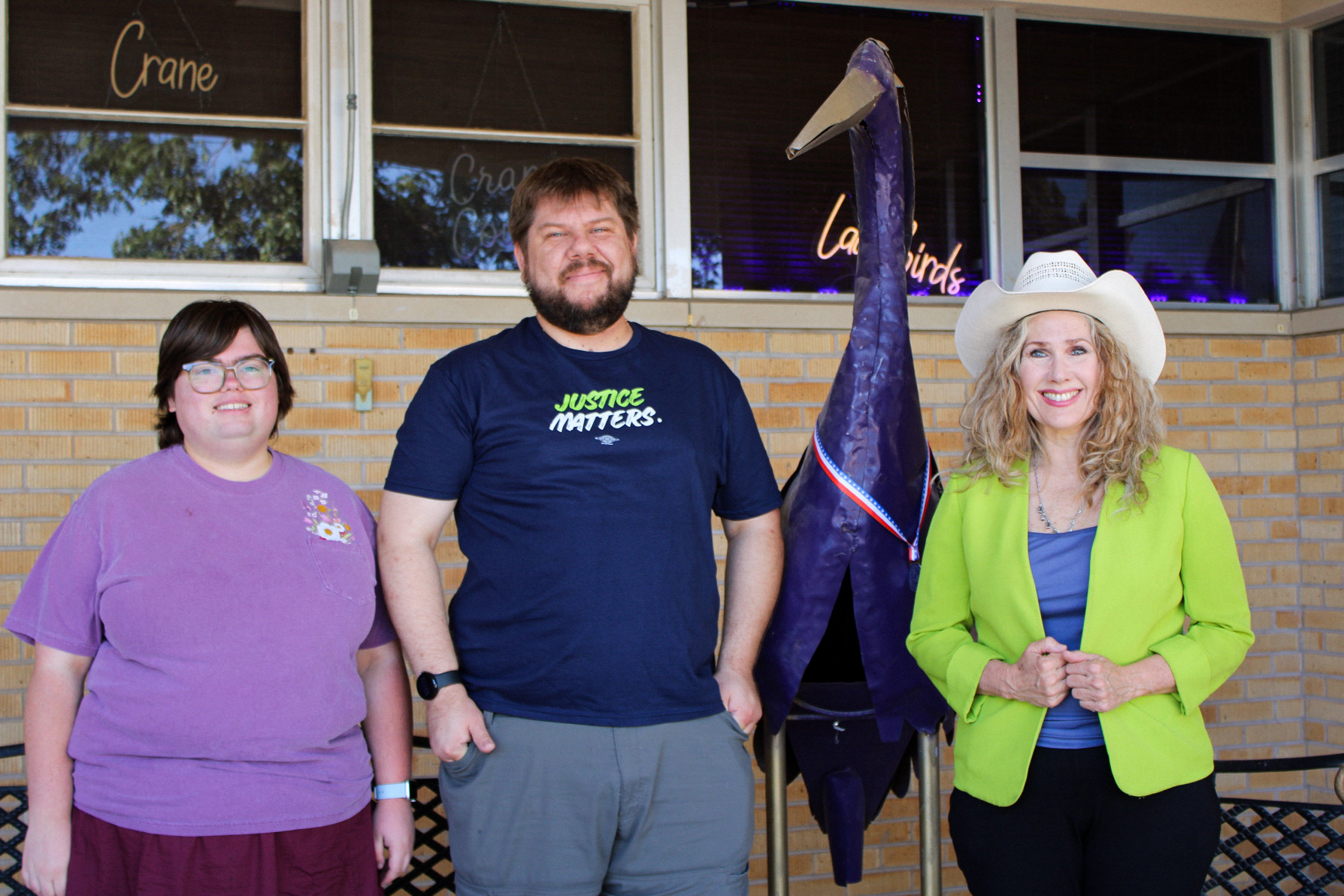
Permian Basin Democrats Tim McDaniel and Eli Hilbert took to the road on a Saturday in late August to knock doors in the small towns of Crane and McCamey. On either side of remote stretches of U.S. Route 385, pumpjacks bent their necks in perpetual motion and wind turbines spun slowly in the distance.
They were joined by Holly Taylor, the Democratic candidate for Place 9 on the Texas Court of Criminal Appeals, on their journey to connect with rural voters. Over the past year, Taylor has been on a mission to visit all 254 counties in the state—an ambitious goal for any statewide candidate, let alone one running for an oft-overlooked judicial slot—putting over 65,000 miles on her campaign car.
It was a serene and sunny morning when we arrived in the oil town of Crane, 30 miles south of Odessa and home to just over 3,000 people. The quiet was interrupted only by a rooster’s crow and barking chihuahuas. Hilbert, McDaniel, and Taylor knocked on doors but were often met by silence or a posted warning: “Texans don’t dial 911.” A handful of residents were eager to see a fresh face and air out their grievances without inviting any negative attention.
“Democrat! That’s like cussing around here,” one local resident told the crew. “I’m probably the only Democrat left.”
It’s those far-flung voters that could shrink the margins between Democrats and Republicans in November, and this year there’s a full slate of candidates running for seats in the Texas Legislature and U.S. Congress who are traveling far and wide with hopes of reinventing the party in the eyes of rural Texans. Dubbed the Texas Challengers, the party claims it’s the first time in modern Texas history that there will be a Democrat in every state and federal race. In West Texas—where Republicans often win at rates around 80-20—that means strengthening the Democratic Party’s rickety infrastructure and taking on politicians who have sunk comfortably into the highest seats of power during their long, often uncontested tenures.
“If you are a Republican and you want to hold public office in this state, you’re going to have to fight us for it,” Texas Democratic Party Chair Kendall Scudder said in an interview with the Texas Tribune after announcing the full slate of candidates last December. Recent polling also shows that the governor’s race and the senate race could be won or lost by just a few percentage points, and may be the closest Democrats have come to taking statewide office in 30 years. But despite the party’s achievements, it’s still a rough road for candidates in the vast expanse of West Texas where oil and cultural conservatism reigns, big donors are hesitant to invest, and being an open Democrat is ostracized.
“Rural voters are a huge part of the electoral firewall that the GOP maintains in Texas,” Joshua Blank, research director of the Texas Politics Project at the University of Texas at Austin told the Texas Observer. “For Democrats to be successful at the top of the ticket, they need Democratic candidates running competitive races down ballot all over the state.”
According to the Texas Politics Project, 61 percent of rural voters said they would vote for Governor Greg Abbott, while only 23 percent said they would vote for his Democratic opponent Gina Hinojosa. Furthermore, 38 percent of rural voters said they did not know or have an opinion of Hinojosa at all. Approval of the Democratic Party as a whole was critically low, with 53 percent of rural voters saying they hold a very unfavorable opinion.
“We do feel a little left out sometimes in the Democratic Party,” Tim McDaniel, president of the Permian Basin Young Democrats, told the Observer during a monthly meeting at their Midland headquarters. Just down the road, the city was celebrating National Petroleum Day with a tailgate, concert, and gala featuring local Republican officials.
Organizers like McDaniel and Hilbert have been fiercely devoted to progressive causes for years in the Permian Basin, an expansive region that contains much of West Texas and reaches into New Mexico, but maintaining a stable Democratic base is made difficult by the transient nature of jobs in the oil industry and the exodus of local Democrats to other parts of the state. “Everyone in this photo doesn’t live here anymore,” said Hilbert, looking back on a photo of a protest from 2022, “and neither does anybody else that I organized with at that time.”
Eli Hilbert and Tim McDaniel from the Permian Basin Young Democrats, in front of the Crane County courthouse, alongside Holly Taylor, the Democratic candidate for Place 9 on the Texas Court of Criminal Appeals. (Photo by Eden Shamy)
They also said it can be difficult to activate voters when Democrats hardly run for local office, and more prominent candidates frequently fail to make the journey out west. Oftentimes, the best option they have is to vote for “the lesser of the two evils in the Republican primary,” McDaniel said.
Indeed, like Democratic strongholds in places like South Texas, primaries are where most political battles in West Texas take place—most often between more traditional conservative Republicans and hardline right-wingers. This year, the Democrats in Congressional District 11 actually had a contested primary, one of only a few over the past three decades. An unexpected outsider came out on top.
Claire Reynolds lives over 300 miles away from Midland in the Central Texas suburb of Pflugerville, yet the mother and lawyer managed to handily beat West Texas native Pedro “Pete” Ruiz in the March primary. After the Republican gerrymandering of 2025, Reynolds said she woke up to find her home north of Austin had been plucked out of Democratic Congressman Lloyd Doggett’s district and tacked onto Congressional District 11—which stretches all the way to Odessa and beyond. The Republican incumbent Congressman August Pfluger is an Air Force veteran and San Angelo native. He hasn’t faced a Democratic opponent since he captured the seat in 2020.
Reynolds quit her job at the State Bar of Texas in December of 2025, days before the filing deadline to launch her underdog campaign for Congress. Every week, she drives hundreds of miles across the district to connect with voters and let it be known that there’s an Austin-area Democrat who cares about West Texas. “I’m not the lady from Austin coming down thinking I know more than them,” Reynolds said over a campaign lunch at Dos Compadres in Midland. It was the second-to-last stop on her five-day trek across all 20 counties in the district. “I’m just here to find out what they need in order to thrive.”
That includes protecting jobs in the energy industry, Reynolds reassured voters at the small cluster of tables at the Midland event. “My big problem is that August Pfluger has stock and owns stakes in several oil and gas companies, and I believe that it’s wrong to profit based on the laws that you write,” she said. “I have no interest in hurting oil and gas.”
Kyle Rable is another first-time candidate at the forefront of Democrats’ battle for West Texas. He’s a 30-year-old father, captain in the U.S. Army Reserve, and Texas Tech doctoral candidate also juggling a campaign for Congressional District 19. Rable is the first Democrat since 2020 to run for the district, which covers the South Plains region including Lubbock, Big Springs, and Andrews. After the crushing red wave of 2024, Rable said he looked at his pregnant wife and knew he needed to do more. Before the Democratic Party even launched the Texas Challengers, Rable decided he was going to run.
“I talked to pretty much every candidate that’s now running out in West Texas,” Rable said in an interview. “I told them that if they do it with me, and they’re within my congressional district, that we would do it together. We were able to recruit so many candidates by just the promise that you won’t do this alone.”
Rable considers himself a church-going, gun-toting, dirt road Democrat, and he’s knocked over 2,000 doors since January. He’s been advocating for greater investment in the region because he believes that the Democratic Party has left farmers and West Texans behind. In a speech before the general assembly at the Texas Democratic Convention in June, Rable said that Democrats owed West Texas an apology for failing to fight back against Republicans. He emphasized the importance of West Texas on the national stage, not only politically but for its cotton, cattle, and energy. “West Texas does matter because real people live there, because it feeds, clothes, and fuels this country!” Rable said.
In mid-July, he launched a campaign tour through the South Plains that was attended by nearly every statewide candidate—with the exception of James Talarico for U.S. Senate and Ben Flores for land commissioner. They rallied in Lubbock, Plainview, Big Springs, and Abilene. “I was able to call in favors, bully, and berate until everyone agreed to it,” Rable said.
Reynolds and Rable have tailored their platforms to focus on kitchen table issues with broad appeal: decreasing healthcare costs, protecting workers and farmers, and regulating powerful corporations like those in the data center and artificial intelligence industries.
Drew Landry, a government professor at South Plains College, said the growing controversy around money in politics, data centers, and Flock cameras can help Democrats get “a foot in the door” with rural Texans. Flock cameras stick out like a sore thumb in the vast, flat stretches of West Texas, and data centers have been popping up around the region. Democrats will have to target the 40 percent of rural voters who say they disapprove of how the state’s leaders have handled corruption, and the 44 percent who would strongly oppose a data center being built in their community.
“We do not want these things destroying our land. We don’t want them using up our water,” Rable said. “It’s already hard out here to grow cotton.”
(Courtesy of Rable campaign)
Rable and Reynolds said they have forged strong relationships with fellow first-time candidates, like Shiloh Salazar, a mother and former educator who is the first Democrat to run for House District 72 since 2004. She’s hoping to take down a nearly 20-year incumbent, Republican Drew Darby. They’ve teamed up with other challengers to campaign on the issues of affordability and data centers, such as Riley Rodriquez in Senate District 28 (sprawling across West Texas, held by Republican Charles Perry), and Malik Williams, who is challenging Texas House Speaker Dustin Burrows in his Lubbock-based district. Burrows’ last Democratic opponent, in 2020, got 20.7 percent of the vote; Landry, the professor, ran against him as a Dem in 2018, doing only slightly better with 22.7 percent.
There are some challengers, however, that appear to be little more than a name on a ballot. Ceasar Sanchez in House District 81, from Loving to Ector County, is practically a ghost. He has had no online presence or communication with local Democrats. The Republican incumbent, state Representative Brooks Landgraf, has comfortably held the seat for a decade and was only contested by a Democrat once before in 2018. Sanchez’ nonexistent campaign is indicative that, despite the party’s mass recruitment efforts, some races still fall through the cracks.
“Getting candidates is one thing. Getting them to do something is another,” Landry said. “I have a feeling a lot of them don’t really know what to do, or they don’t know how to ask for help.”
In the neighboring House District 82 resides the longest serving member of the Texas Legislature, Tom Craddick. The 82-year-old Republican, who once held the House speakership, has represented the district covering Midland, Martin, and Dawson counties for 57 years. When nobody would volunteer to run against him, stepped down from her position as the Democrat’s Midland County Chair to do it herself. (Like Rable, she didn’t need any prodding by the Texas Challengers initiative.)
Broadrick, a 68-year-old grandmother of six, saw firsthand the state’s transformation from blue to red. Her campaign strategy has been largely community focused, meeting with local women’s clubs, visiting churches, and working at food banks. However, her campaign has hit a snag due to her husband’s health issues, and she is planning to move out of the district to Georgetown, where she can be closer to family.
Even with the Texas Challengers initiative, candidates and local organizers told the Observer it can often feel like they’re charting a path through deep red, rural Texas on their own. Rable said he always carries a firearm because he has received threats. Taylor said she’s met local Democrats who’ve had their tires slashed. And McDaniel said they were forced to remove the sign from their Ector County headquarters after they were egged. Many have been told they can’t win, and donations would be better spent elsewhere.
One group that has sought to champion the cause of rural Texas Democrats is the 134 PAC, which is dedicated to helping Democrats in the 134 counties west of Interstate 35 get the resources and support they need to be competitive. Ramon Rodriguez is the PAC’s new Big Bend Regional Director, the first of more regional directors to come as the group seeks to expand its reach. He said they work closely with county chairs and candidates on everything from strategizing and providing campaign materials to helping them run for office, including paying filing fees.
“County chairs have this huge list of to-dos from the Texas Democratic Party,” Rodriguez told the Observer, “but we aren’t at that point where they have all the resources they need to get those done.”
State House candidate Diana Luna of Abilene, left; state House candidate Malik Williams of Lubbock, right. (Photos courtesy of Luna and Williams campaigns)
The day after door knocking in Crane and McCamey, the Permian Basin Democrats received a visit from Rodriguez at their Midland headquarters. He delivered signs and other campaign materials all the way from Austin for them to distribute throughout the area. Rodriguez said the PAC was founded in 2020 by former party chairs and leaders with grassroots support from rural Texans.
Still, he said that rural Democrats have to work three times as hard as incumbent Republicans in the region, who have a broad natural base of voters and plenty of financial resources. Congressman Pfluger currently has over $2.8 million cash on hand compared to Reynolds’ $46,790, the latest federal campaign finance reports show.
“You’re going up against a 500 pound gorilla,” Rodriguez said.
Both Reynolds and Rable have sworn off taking money from corporate PACs. Reynolds also said she wants to ban members of Congress from owning or trading stocks like Pfluger has over his six years in office. Pfluger recently supported the Stop Insider Trading Act, which prohibits new purchases of stocks but comes short of banning members from owning or selling their current stocks. Plfuger did not respond to a request for comment.
Reynolds invited Pfluger to a debate on October 5, hoping to challenge his record on stock trading and data centers. He accepted the challenge, making it the first confirmed debate of any federal candidates in Texas this election cycle.
Democrats in West Texas were all in agreement that it’s not just about winning in November. It’s about changing how Texans see the Democratic Party, recruiting volunteers, and building something for the next generation. Rable believes if Democrats can win in West Texas, they can win anywhere, and Reynolds is hopeful that the Texas Challengers is only the beginning.
“We should have been doing this 20 years ago,” Reynolds said. “The second best time is now.”
The post ‘Up Against a 500-Pound Gorilla’: Can Dems Make Inroads in Deep-Red West Texas? appeared first on The Texas Observer.
Leave a Reply