Sonja Vandagriff’s grief was private. She had spoken with a reporter only once in the 10 years since her 24-year-old daughter, Jackie Vandagriff, a nutrition student at Texas Woman’s University, was murdered by a stranger in September 2016. For years, the trauma would routinely overcome her. She’d lie in bed, unable to find a reason to get up now that Jackie’s slightly gap-toothed smile was gone from the Frisco home where she’d both grown up and lived for the last year of her life.
Jackie’s cat, a harlequin tabby named Shay, was clearly also traumatized by her owner’s sudden absence, often watching the front door or lying on Jackie’s old things. Vandagriff learned online that cats mirror human emotions—maybe, she thought, it could work in reverse too: Make the tabby happy, and her own spirits would lift. In 2023, she planted a native plant, the American beautyberry, outside her front window to attract butterflies and birds. She called it “Cat TV,” and it seemed to do wonders for Shay’s mood. And Vandagriff had stumbled on a new way to channel her grief, eventually deciding to expand from that first shrub to a full garden—a “homegrown national park” that became her new purpose.
“I was hanging by a thread for seven years, and when I started this garden, I used what I had to build it. And what I had was grief energy,” she told the Texas Observer in July, sitting under an umbrella on her small back patio, overlooking the garden she’d put years of this energy into. She luxuriated in her pocket of calm amid the beeps of garbage trucks, the shouts of construction crews, and other mainstays of the suburban soundscape.
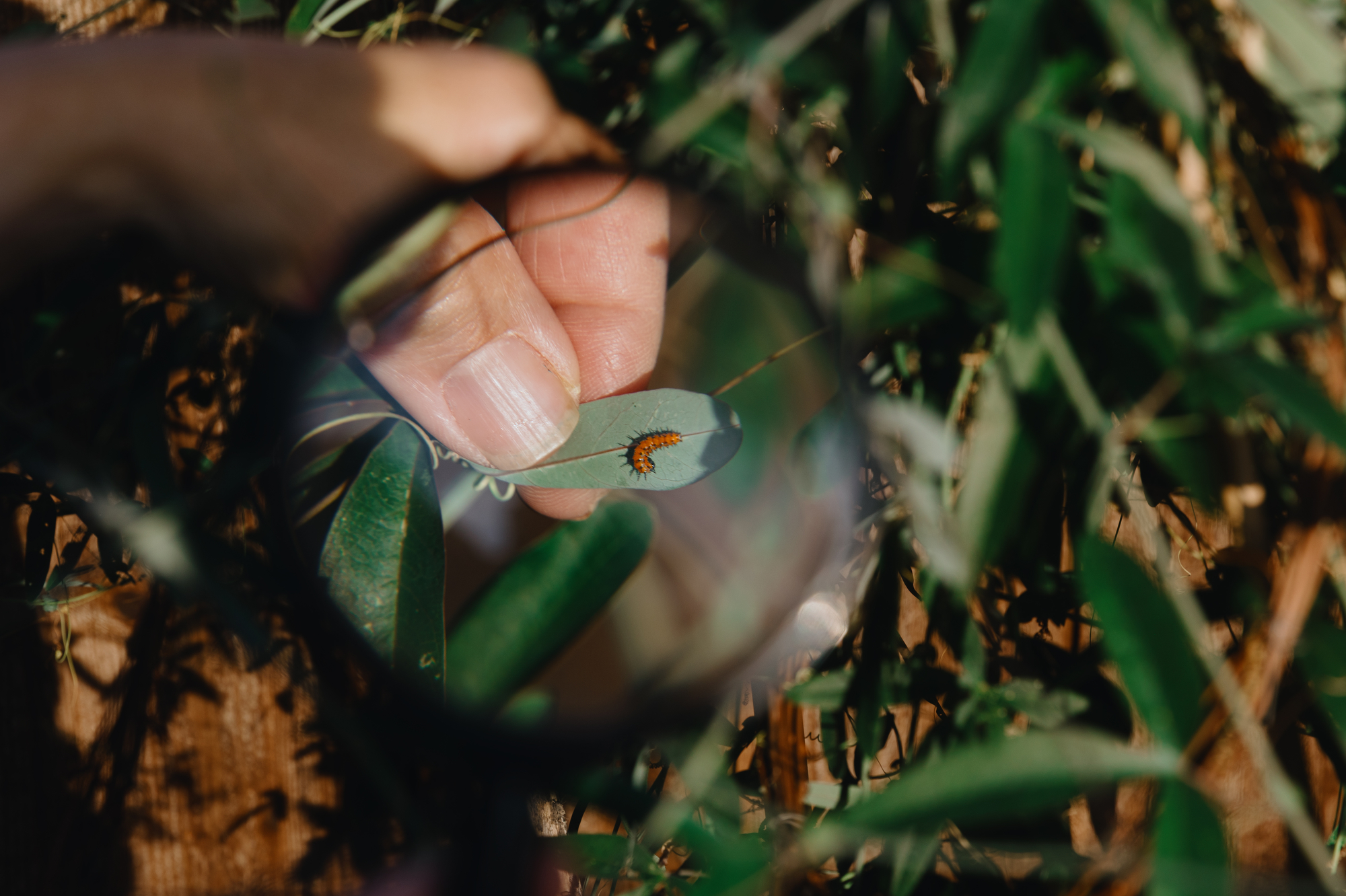
Sonja Vandagriff discovers Gulf fritillary caterpillars resting on the leaves of her passion flower vines in late September.
Her corner of North Texas is situated in the last remaining stretch of Blackland Prairie—much of it having been paved over and developed—where rich clay soil makes for perfect growing of Shumard oaks, sumac, sage, and wildflowers that attract pollinators. Here, suburban yards become home to raccoons, cottontails, great horned owls, blue jays, and Texas spiny lizards, among other species.
Vandagriff’s house, in the northern Dallas suburbs, sits in the middle of a large manicured neighborhood, but not far from a creek that feeds a lush stretch of trees, a massive ranch, and a city-managed 5-acre wildflower meadow. Up to this point, her backyard had been standard: a medley of grasses, an oak tree, and some partially inhabited planters. But she was suddenly galvanized. She ordered a heap of wood chips and began to build a native habitat.
The process instilled in Vandagriff a sort of evangelical zeal about native plants and animals, but still, she stayed under the radar, sharing her passion and story only with her small community. Her grief stayed private, but now it had a physical form, a place where she’d laid her energy and watched it transform into something beautiful.
She was content to keep quiet, until she learned her efforts could be threatened by a potential development 600 miles away. Now, she realized she had something to speak up about.
Earlier this year, Vandagriff learned of an ongoing court battle attempting to halt the federal government’s plan to give nearly 730 acres of public land to SpaceX, the aerospace company led by billionaire Elon Musk, to expand around its Boca Chica launch site, where it’s been operating since 2014. The land in question is currently part of the Lower Rio Grande Valley National Wildlife Refuge, home to myriad species: 1,200 types of plants, 300 butterflies, and about 700 vertebrates, according to its website.
The swath in question has degraded over the past decade, in part due to SpaceX’s activity in the area. Post-launch analyses have found that some rocket launches have caused debris including concrete and metal to rain down on the refuge.
The U.S. Fish and Wildlife Service (FWS), which manages the land, contends that it’s best to give the land over to the company in exchange for some of the company’s land in the area, which hasn’t been as affected by the rocket activity, to be part of a separate refuge—sort of like a homeowner handing over their keys to a destructive neighbor and moving down the street to a harder-to-access house.
“Through the proposed exchange, [FWS] would divest of lands likely to be impacted by SpaceX activities, and SpaceX would exchange land that includes desirable habitat for conservation,” the government agency explains on its website. In June, several nonprofits filed a federal lawsuit in an attempt to quash the land swap. A judge denied their request for a preliminary injunction to halt the swap in September, possibly clearing the path for the trade.
Vandagriff told the Observer she’s desperate for the deal to be stopped or reversed somehow, and she’s particularly worried about one species of visitor to her garden. In the fall, Vandagriff can sit in a chair on her patio in North Texas and see up to 50 monarch butterflies at once as they make their trip south. They love the milkweed Vandagriff has planted and the native mulberry tree that popped up on its own once she had restored the soil. She fears this development along the monarchs’ migratory path could threaten their survival. “I like my monarchs,” she said. “They’re the treat in my garden.”
Vandagriff stands in her garden.
The large orange-and-black butterflies are the state insect of Texas (and of several other states). They’re also one of the world’s longest-haul migratory species, making a trip from Canada to Mexico every fall, then back up every spring. They travel the middle of the United States along a path that has been repeatedly interrupted by climate change and development. The plants they need to reproduce are falling to herbicides, the trees they rest in during the winter are being felled, and roads and buildings are creating dangerous obstacles in their way. And a warming planet makes the butterflies vulnerable to infections. In 2024, the federal government proposed monarchs as a threatened species under the Endangered Species Act, meaning they’re likely to become endangered in the near future.
Kristen Baum, director of Monarch Watch, a project out of the University of Kansas, said it’s difficult to predict the implications of particular projects, but the Lower Rio Grande Valley “is important to monarchs in both the fall and spring.”
Because monarchs need food and places to lay their eggs as they journey, “nectar and milkweed availability in Texas is critical to the monarch’s annual cycle, and conditions in Texas can strongly influence the overall size of the monarch population in any given year,” she said.
FWS published an environmental assessment of the land swap and found that it would have “no significant impact,” while still acknowledging that threatened and endangered species could be at further risk “through reduction in foraging, dispersal, or breeding habitat quantity and/or quality; mortality due to vehicle collisions; displacement or alteration of behavior due to disturbances from light and/or noise; and exposure to hazardous chemicals from heavy machinery used during construction.”
The government further argued, according to court documents, that the development “will result in foreseeable and unavoidable consequences” but that there would be a “net conservation benefit.”
Vandagriff, however, sees writing on the wall. With the deal, she said, “I can start saying goodbye to my monarchs. And I’m going to have to say goodbye, again, to something that I love? I’m done saying goodbye to things I love.”
On July 23, I pull up in front of Vandagriff’s house in the North Texas suburb of Frisco as early as I can muster. She’s called the previous day to move our scheduled 10 a.m. interview up because of the heat. She gets up by 5 each morning, so we had plenty of time to work with. I arrive at 8, and the unsweetened, half-caf iced tea begins flowing.
“There’s no such thing as too much tea,” she assures me as she refills my glass.
Vandagriff, in her early 60s, has her hair pulled back in a ponytail. She’s wearing a color-blocked dress, an apron, knee-high knit socks, and bright red gardening boots.
Her childhood home was on a half-acre wooded lot in Beavercreek, Ohio. “It was like we lived in a park,” she says. In a sunny patch, her dad planted a garden that exploded with raspberries and tomatoes and strawberries. Vandagriff would help in the garden, then she’d assist with the haul. They’d can tomatoes and make jam. “In the dead of winter, we would open up a raspberry preserve jar, and summer would come back to us.”
While she and her husband raised their two daughters, Vandagriff worked as a professional cook, teaching culinary classes for kids and working as the resident chef at Market Street in McKinney. She always had herbs growing somewhere nearby, but she dreamed of expanding her garden.
For the most part, she’s self-driven and self-taught. She knows Turk’s-cap and lemon balm can grow harmoniously together, while the former will crowd out any other herbs she tries to plant nearby. She discovered this the hard way. She discovered something else, too, through trial, error, and observation: Nature likes paths. Ants march in lines, following pheromone trails. Monarch butterflies migrate by orienting themselves using the sun and magnetic field. Sometimes you can discern the path Vandagriff likes to walk in the house, because she’ll track dirt in from her garden.
Vandagriff noticed Shay would follow the same paths every time she went out into the garden. When she looked into why, she found out that trails are ubiquitous—her yard sits on a trail that connects to the nearby Panther Creek, and, of course, on the trail, the monarchs follow in their biannual pilgrimage.
“I discovered that the garden is really kind of an Airbnb for insects,” she says. “There are some that do live here, but most of the wildlife in my garden is just passing through. It’s just making a pit stop.”
She puts a lot of work into maintaining this waystation, but she also welcomes help. The garden has shown her she’s not as physically capable as she once was. She has to reckon with the realities of arthritis, frequent back injuries, and old aches flaring up.
Her daughter’s friends are among those who started coming over to help Vandagriff distribute rainwater, remove non-native plants, and deadhead spent blooms, all tasks that always need doing. It’s become part of a grieving process for all of them.
“They grew up in my house, they had sleepovers here, they’ve been my witnesses and my partners,” she says. “They’re healing too, because they’re devastated by Jackie’s loss.”
Jackie was a junior in college when she was killed by a man she’d just met—who was later caught and convicted—in an act of violence that left everyone shaken and unsure how to move forward. She’d been a compassionate, driven, and friendly young woman whose enthusiasm for wellness motivated her to pursue her major in nutrition.
Vandagriff says Jackie would be in the backyard helping too if she were still around. It would have aligned with her passion for health, and she would have loved to see her mom’s drive, which she took as inspiration in her own life.
“There is a twinge of like, ‘Ugh, Jackie would have loved this.’ She would have loved it,” she says. “My life is all about accepting the idea of bittersweet moments.”
By channeling her grief into her garden, Vandagriff is following a long tradition of finding solace in nature. Heidi Schreiber-Pan, psychotherapist and author of Nature’s Healing Power Unveiled, said that nature helps quiet bad thoughts and preoccupation because “there’s so much sensory-rich information. There’s colors, there’s movement, there is sound.”
Vandagriff’s garden helps ground her, but it also has reach. Vandagriff has grown several plants in honor of other mothers whose children have died, many of whom also have what they call “grief gardens,” where they work through their loss.
“We’re not gonna let these kids be forgotten,” she says. “We could do a statue, we could do a marker, but what about a plant? A living memorial.”
Vandagriff’s native garden, then, is a cat entertainment center, a reason to get out of bed in the morning, and a collection of life in honor of others who died too soon. Primarily, it’s a place where she can trade her grief energy for purpose, and she shares the space happily.
In her life, Vandagriff has experienced the cruelty of fate, the unfairness of living in pain as the result of someone else’s actions, someone who likely didn’t consider the ripple effects of his callousness. But the garden has given her a sense of agency—and urgency.
“If I have any control at all over not saying goodbye to the monarchs, then I use it,” she says. “I’m not going to say goodbye to them because someone decided that they weren’t worth it or that they didn’t count. What counts is one butterfly on one flower. That counts.”
The post Sun, Water, Sorrow appeared first on The Texas Observer.
Leave a Reply