Largest infrastructure project in Cottage Grove’s history will remove ‘forever chemicals’ from water supply

posted in: News | 0

The city of Cottage Grove recently broke ground on its largest infrastructure project to date: a $39 million low-zone water-treatment plant at the intersection of 110th Street and Ideal Avenue.

The new plant, which includes a new city well, will treat all the water in the city south of U.S. Highway 61, said Ryan Burfeind, the city’s public works director. It is expected to be operational by June 2025.

The new well will replace two wells contaminated with per- and polyfluoroalkyl (PFAS) “that are far removed from the main treatment plant,” Burfeind said. “It’s actually cheaper to drill a new well as opposed to laying miles and miles of pipe.”

The money for the construction of the plant is coming from the city’s share of the $850 million settlement reached in 2018 between the state of Minnesota and 3M Co., the company that made the PFAS substances that have leaked into water supplies across the metro area and worldwide.

The groundbreaking “signaled the start of the permanent solution, long-term solution to provide treated water for generations to come,” Burfeind said. “It was a very important day.”

Cottage Grove previously built five temporary treatment plants to handle the contaminated water, connected 183 homes to the public water system and laid almost 9 miles of pipes to make connections for clean water for a total cost of $37 million, Burfeind said.

“We’ve always had that commitment to provide safe drinking water, and we provide it now with the temporary plants,” he said. “Those are very important with our current operations, but this is our permanent solution.”

The city next year will begin construction on a permanent water-treatment plant that will treat all city water north of U.S. Highway 61, Burfeind said. That plant, designed to treat three times as much water as the plant south of U.S. 61, will be located behind the city’s Central Fire Station on 80th Street, according to Burfeind.

A cost estimate is not yet available, he said.

Mayor Myron Bailey at the groundbreaking shared that the city has been at the epicenter of the PFAS contamination in Minnesota since 2006. Residents have waited years for permanent drinking water facilities to be constructed, he said.

Bailey thanked the co-trustees of the 3M Settlement, the Minnesota Pollution Control Agency and the Minnesota Department of Natural Resources for their partnership on developing the conceptual drinking water supply plan. “Their leadership throughout this process has been key to making projects such as this treatment plant a reality,” he said.

Related Articles

Environment |


It’s been a century of learning and friendship for the Friday Study Club in Stillwater

Environment |


22 dogs seized from Andover rescue organization in investigation into dead dogs found in Cottage Grove

Environment |


Historic Courthouse in Stillwater getting a major makeover

Environment |


Eights dogs found in Cottage Grove died outside city, officials say

Environment |


Cottage Grove: Animal-cruelty investigation underway after eight dogs found dead

Bailey also noted that the Minnesota Department of Health has been a key partner for the community through their work in providing information on the evolving science and education of PFAS.

The Maplewood-based 3M Co. began making PFAS at a facility in Cottage Grove in the 1940s and historically disposed of PFAS wastes in four east-metro locations, the source of identified PFAS impacts in Washington County groundwater.

PFAS, also known as “forever chemicals,” do not break down in the environment and can build up in the human body, according to the Minnesota Department of Health. Immediate risks are believed to be low, but long-term exposure to the chemicals can result in immune suppression, changes in liver function and lower birth weight, according to state officials.


Starters or relievers? Orioles pitchers Tyler Wells, DL Hall enter offseason with questions about future roles

posted in: News | 0

After overcoming midseason adversity, Orioles pitchers Tyler Wells and DL Hall both said they believed the odysseys they trekked in 2023 would be good for them in the long run.

They both started the year as starting pitchers, took steps back to lower levels because of fatigue and ended the season as reliable relievers in Baltimore’s bullpen.

Despite the growth from their respective journeys in 2023, Wells and Hall will likely begin the 2024 campaign in the same murky roles they were in last spring training: as starting rotation candidates who are also attractive options to be moved to the bullpen.

The two pitchers might have overcome similar challenges in 2023, but their approaches to the rotation competition during spring training couldn’t have been more different. Wells didn’t want to talk about it, while Hall said he fed off the “doubt” from those who didn’t believe he could be a starter. They could be in the same position when they report to spring training in four months.

Orioles executive vice president and general manager Mike Elias said during his end-of-season news conference that he wouldn’t comment about specific players’ roles in 2024.

“I’m going to plead the fifth again,” he said when asked about Wells’ and Hall’s future.

However, Elias then acknowledged and praised them both for how they cleared their hurdles — Wells his second-half fatigue, Hall his early season velocity dip — to help the Orioles down the stretch.

As the Orioles spent most of the second half as the American League’s best team, it might have been easy to forget that Wells was an integral part of how they won so many games. In the first half, the 6-foot-8 right-hander was the club’s best starting pitcher and a legitimate candidate to make the All-Star team with a 3.18 ERA and MLB-best 0.927 WHIP, allowing two or fewer runs in 12 of his 17 first-half starts.

But the 104 2/3 innings he pitched before the All-Star break in early July were more than he’d recorded in a year since 2018 — the season before he underwent the Tommy John elbow reconstruction that altered the path of his career. He struggled once the second half began, as Elias later said he “hit a wall.” The Orioles demoted him to Double-A and he pitched only 14 2/3 innings over the next eight weeks, later transitioning to a relief role in Triple-A.

When he returned in late September, he was thrust into one of the highest-leverage moments of the Orioles’ season, saving their AL East-clinching win over the Boston Red Sox. He didn’t allow a run in seven appearances, the final three coming in the AL Division Series against the Texas Rangers.

“To get through that and then come up and then pitch like nails in a playoff race at a time when he was badly needed was inspiring to watch,” Elias said. “I wasn’t surprised. I mean, I know what he’s wired like, and I wasn’t surprised. We were counting on him, and he came through.”

Hall’s first half wasn’t as excellent as Wells’, as the left-hander pitched through diminished velocity that stemmed from his inability to weight train in the offseason because of lower back discomfort. That injury delayed his spring training, and Hall opened the year in Triple-A. In June, he took a step back to regain his velocity, going down to the team’s facility in Sarasota, Florida, to focus on building strength.

That strategy worked, and when he returned to the mound as a reliever, he had his old heater back. He was called up to aid the Orioles’ bullpen after closer Félix Bautista injured his elbow and went 3-0 with a 3.26 ERA in 19 1/3 innings, including pitching in both of Baltimore’s clinch victories and two scoreless outings in the playoffs.

“DL … going to Florida and just being off the grid and just getting it all together at the exact perfect moment when we needed him most, is one of the many things that I’m very proud of with this group of guys,” Elias said.

“We haven’t even discussed, honestly, DL’s role next year,” manager Brandon Hyde said. “I’m just so excited about how he threw the ball in September and how he threw the ball on the national stage. Whatever we decide to do with him, he’s going to be a huge part of our team next year.”

With Kyle Bradish, Grayson Rodriguez, John Means, Dean Kremer and potentially an offseason acquisition ahead of Wells and Hall on the pecking order, it could make sense to keep them both in the bullpen. At the same time, though, Wells’ success as a big league starter and Hall’s excellent pitch arsenal and top prospect status could make it difficult to relegate them to lesser roles.

One factor that will be different next spring is Bautista’s absence and the potential need of a closer. With Bautista out for all of 2024 after undergoing Tommy John surgery earlier this month, the Orioles will need to fill what Elias called a “massive hole.” If Baltimore doesn’t address the need in free agency or via trade, Wells and Hall could be options to step into Bautista’s large shoes.

Wells, a Rule 5 draft pick, was a reliever as a rookie in 2021 and served as the team’s closer in September. Hall saved one game last season and finished three others this year, but his high-90s mph fastball and wicked offspeed stuff could make him a viable candidate.

Either way, the roles the two pitchers serve and who closes games will likely be some of the biggest questions facing the Orioles next spring.

“It’s going to be tough to replace him,” Elias said of Bautista, “so we’re going to bring all of our brain power towards answering that question.”

()

Newsom: Israel-Hamas war ‘not intellectual any longer’

posted in: News | 0

HONG KONG — California Gov. Gavin Newsom said Monday that his visit to Israel over the weekend strengthened his sympathy for Israelis reeling from Hamas’ attacks earlier this month.

“It was at a deeper emotional level, just the trauma and the experience,” he told reporters in Hong Kong, where he arrived Sunday, in his first public remarks since his visit. “It allows me to absorb what’s happening there very differently now. It’s not an intellectual exercise.”

The Democratic governor met with Israeli Prime Minister Benjamin Netanyahu, Israeli President Isaac Herzog, other top Israeli officials and survivors of the Oct. 7 attacks during a 10-hour stop in Tel Aviv on Friday on his way to China for a weeklong trip on climate policy.

He said he met with a young shooting survivor and was shown graphic videos of beheadings that have been blocked in the West.

“The worst part about it — the actual video, I saw heads, beheaded people, their bodies, lay there, dead. To see someone’s eyes and mouth being poked to see if they were alive, to find out they were alive after being shot on the ground,” he said. “It connects to an understanding of the emotion of the Israelis about the atrocities that occurred, and about the 1,400 lives lost. It’s not intellectual any longer.”

The war is entering its third week, with more than 4,600 civilian deaths in Gaza as of Sunday. The attack from Hamas and Israel’s response have split Democrats, with some progressives, including Rep. Barbara Lee (D-Calif.), calling for a ceasefire.

Newsom said he didn’t have time to travel to Gaza but that he was working with U.S. officials and NGOs to get medical supplies to the region, “separately and above the aid we’re providing for Israel.”

When asked if he spoke with any Israeli leaders about a ceasefire, he said the trip was “limited in scope.”

“I wish I was president of the United States,” he said sarcastically, before clarifying that he was joking. “I could start doing all those things.”

Decline of rare right whale appears to be slowing, but scientists say big threats remain

posted in: Society | 0

By PATRICK WHITTLE (Associated Press)

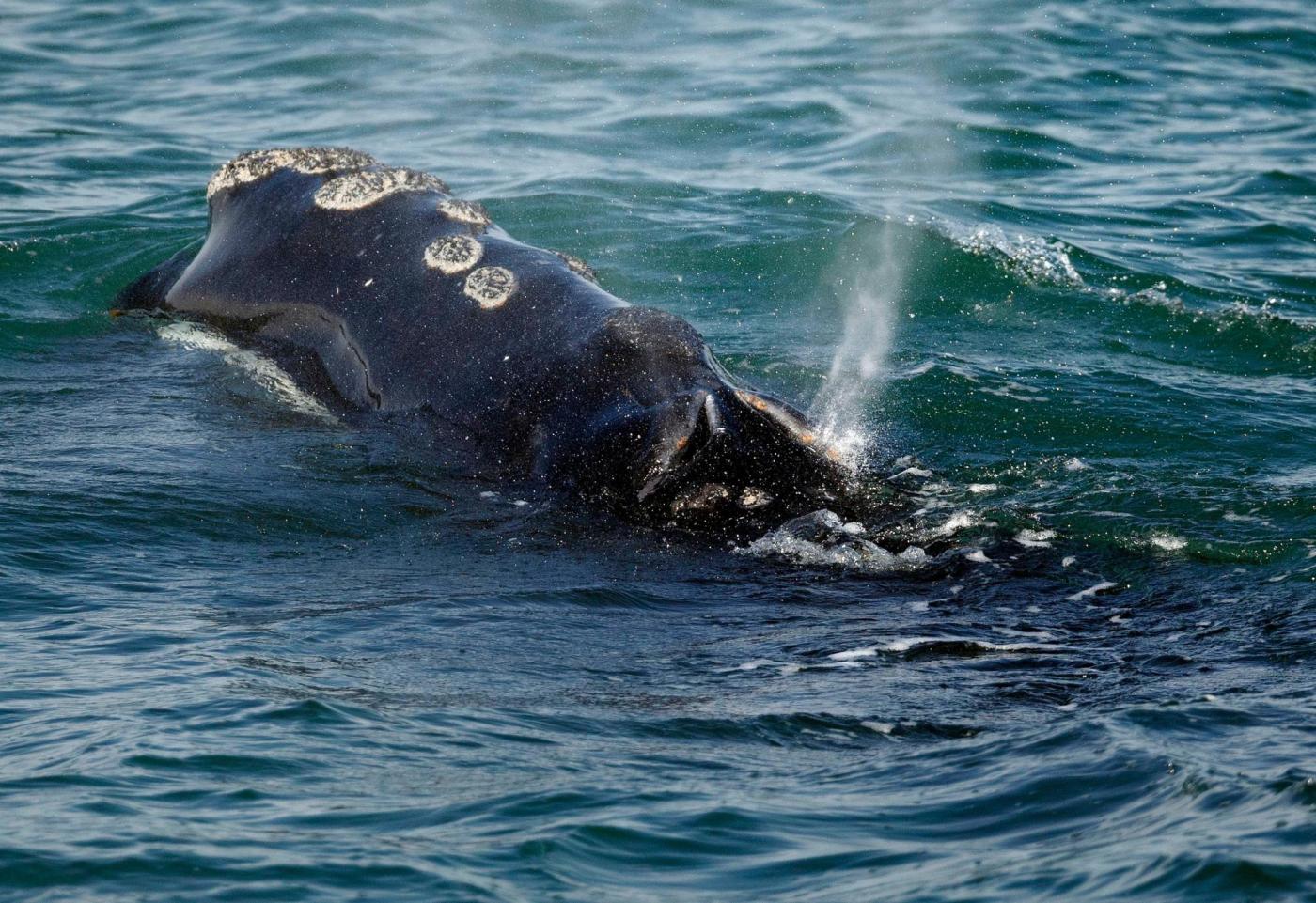
PORTLAND, Maine (AP) — The decline of one of the rarest whales in the world appears to be slowing, but scientists warn the giant mammals still face existential threats from warming oceans, ship collisions and entanglement in fishing gear.

The population of North Atlantic right whales, which live off the U.S. East Coast, fell by about 25% from 2010 to 2020 and was down to only about 364 whales as of 2021. Now the whales are at around 356 in total, according to a group of scientists, industry members and government officials who study them.

This suggests the population is potentially levelling off, as equal numbers of whales could be entering the population as are being killed, the North Atlantic Right Whale Consortium said Monday. However, getting an accurate count of the aquatic creatures involves certain ranges of error, which put estimates for 2021 and 2022 at roughly around the same number.

The whales were buoyed by a strong birthing year in 2021, when 18 calves were born into the population, the consortium said. However, consortium members cautioned that the high mortality faced by the whales from collisions and entanglement remains an unsustainable burden.

“The news is less bad than it has been. My heart is a little less heavy, but certainly not light or hopeful,” said Philip Hamilton, a consortium board member and a senior scientist at the Anderson Cabot Center for Ocean Life at the New England Aquarium. “It shouldn’t be dependent on the whales to give birth to enough calves to reverse what we’re doing to them.”

Tangled up in nets and heavy ropes, the gentle giants can drown when they’re unable to reach the surface, or they can suffer grievous, life-threatening injuries.

Once numerous, their populations were decimated during the commercial whaling era. They have been federally protected for decades.

Scientists say one reason the whales are now in decline has to do with warming oceans and climate change. The whales, which can weigh well over 100,000 pounds (45,359 kilograms), sustain themselves by eating tiny ocean organisms called copepods. They journey from calving grounds off Florida and Georgia to feeding grounds off New England and Canada every year.

As waters have warmed, the whales must wander outside protected areas of ocean in search of food. That has left them vulnerable to the collisions with large ships and getting trapped in commercial fishing gear, which are their biggest causes of early mortality.

Numerous lobster fishermen have opposed proposed fishing restrictions they fear would put them out of business rather than help whales. Dave Cousens, a past president of the Maine Lobstermen’s Association, has called the proposed rules “nonsensical.”

Conservationists want new rules to protect the whales. Federal authorities have said they anticipate final action on a proposed vessel speed rule this year. Proposed new fishing laws are also in the works, but they have led to a lengthy court battle.

“There is still hope for the species. Things are dire, that is true. But with the right things in place, like adjustments to the speed rule, there is still hope for the future,” said Katie Moore, deputy vice president for animal rescue with International Fund for Animal Welfare.

National Marine Fisheries Service assistant administrator Janet Coit said the agency launched a new tool on its website last week that is designed to allow the agency to monitor and share how effective speed regulations are at slowing down ships to reduce the threat of collisions. Coit said that is part of the government’s plan to “monitor the effectiveness of conservation efforts” to save the whale.

The right whale consortium said sublethal injuries to whales from collisions and fishing gear are also a major concern for the remaining population. Badly injured or sick whales are less likely to reproduce.