Twins announce spring training broadcast schedule

posted in: News | 0

FORT MYERS, Fla. — Twins spring training games begin next week, but it will be almost a month until fans can watch a game on Bally Sports North, which was announced earlier this week as their television partner for the upcoming season. The Twins released their spring training broadcast schedule on Thursday and there will be radio or television coverage for most games.

The first televised game will be a simulcast from Bally Sports Detroit on March 12. Seven more games will be televised after that, with new television play-by-play announcer Cory Provus calling three games near the end of spring training. Analysts Justin Morneau and LaTroy Hawkins will provide color commentary alongside Provus.

On the radio side, the Treasure Island Baseball Network will air 20 broadcasts, with 14 also carried on News Talk 830 WCCO and 102.9 The Wolf. Kris Atteberry, who took over radio play-by-play duties for Provus, and longtime color commentator Dan Gladden will call those games.

The first radio broadcast will be on Feb. 23 when the Twins take on the University of Minnesota in their first game of the spring. That game will start at 5:05 p.m. C.T.

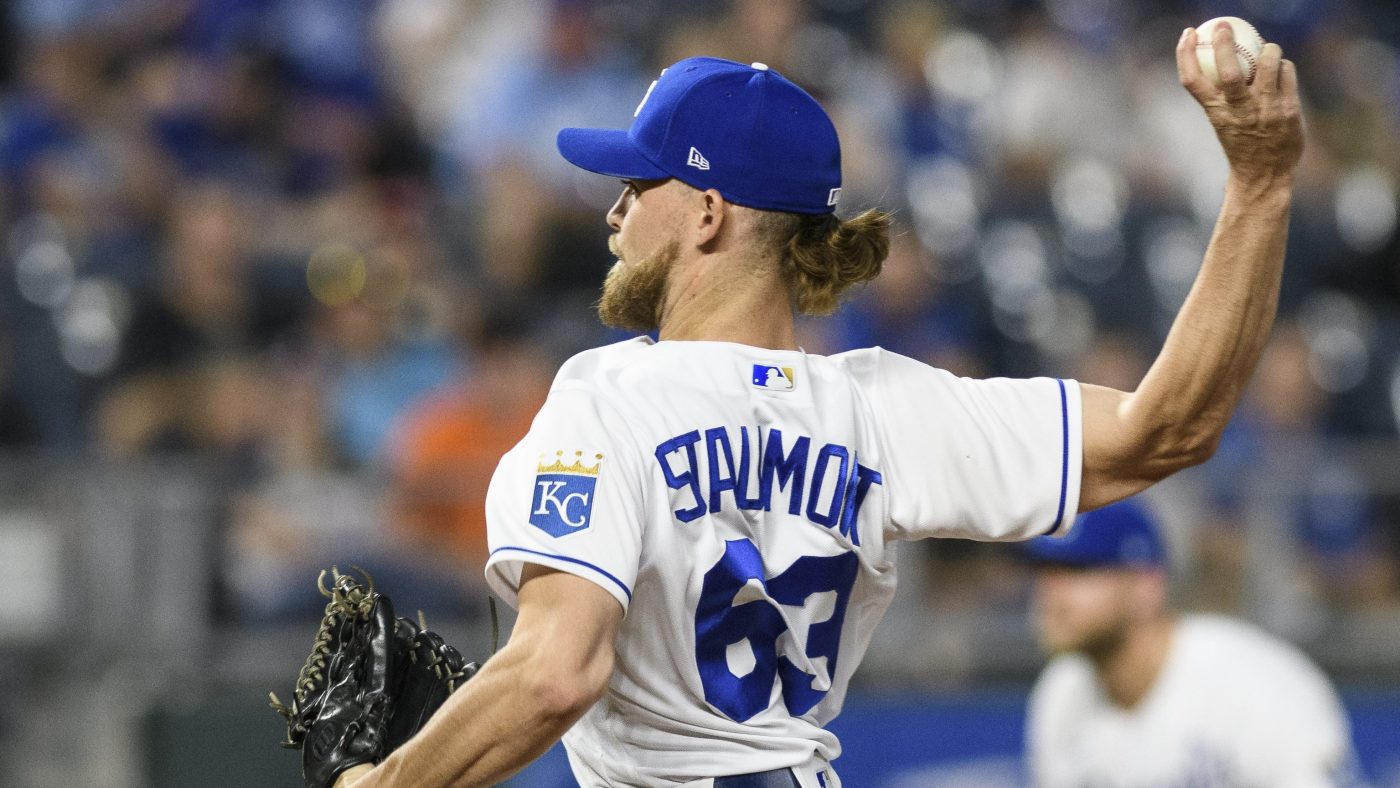
Staumont 100 percent

Josh Staumont, 30, spent between a year to a year and a half trying to figure out what was plaguing him. Once his surgeon finally opened him up, the answer, he said, was clear.

“It was blood flow in a vein going down the arm,” Staumont said. “It’s caused by extra musculature in that area, the scalene muscles, so once they removed that first rib and those muscles, it had a huge impact.”

The relief pitcher, who had thoracic outlet syndrome surgery last July, said he started throwing about a month after procedure and he’s been 100 percent for a couple of months now, coming into spring training healthy and ready to go.

In the time between then and now, he was let go by his long-time team, the Kansas City Royals, and picked up by the Twins on a one-year deal where he’ll be in the mix for a spot in the Twins’ bullpen.

Earlier in his career, Staumont was a highly-effective reliever for the Royals — during the pandemic-shortened 2020 season, for example, he posted a 2.45 earned-run average and struck out 13 batters per nine innings — before injuries disrupted both of the past two seasons.

He likened thoracic outlet syndrome to a boiling pot —sometimes, he said, if you let it go and leave the lid on too long, it just overflows. That’s when he felt it and it started to affect him on the mound.

But now he’s healthy and, with that behind him, his aim is on replicating his early-career success.

“Knowing that we’re going to do our job on the back end, the surgical side of that has actually been closed and solved, so a lot of it is just kind of getting that ball rolling,” Staumont said.

Briefly

Star shortstop Carlos Correa was among the players who reported to camp on Thursday. All position players must report by Saturday, though most have already shown up in Fort Myers.

Related Articles

Minnesota Twins |


New Twins starting pitcher Anthony DeSclafani finally healthy, looking to recapture 2021 success

Minnesota Twins |


What to know as Twins’ spring training gets underway in Florida

Minnesota Twins |


Brooks Lee, David Festa among Twins’ non-roster invites to spring training

Minnesota Twins |


Twins back on Bally Sports North for 2024 season on one-year deal

Minnesota Twins |


Twins trade Nick Gordon to Miami for reliever Steven Okert

Lisa Jarvis: A cure for some kinds of hearing loss? Gene therapies are getting closer

posted in: News | 0

Every once in a while, modern medicine can feel like a bit of magic. Like when a vaccine is shown to eliminate cases of cervical cancer among young women or gene editing allows someone with sickle cell disease to live without constant pain. Or when an experimental gene therapy allows a deaf 11-year-old boy to hear.

Aissam Dam is now able to hear sound for the first time in his young life. The treatment he received, developed by Eli Lilly & Co. subsidiary Akouos Inc., is aimed at fixing the underlying cause of his congenital deafness.

As someone who has followed this field for many years, watching drug after drug for various types of hearing loss fail, reading about Dam’s experience gave me goosebumps. Finally, some momentum.

Until now, the options for addressing hearing loss have been limited to devices — a hearing aid can amplify sound for people whose ears can still detect and transmit it, whereas a cochlear implant bypasses damaged parts of the ear to stimulate the auditory nerve.

The current advance can’t help the millions of people in the U.S. experiencing some level of hearing loss — or even most of the people with common forms of congenital deafness. But the path to treatments suddenly looks clearer.

“It’s very exciting,” says Nancy Young, who founded the Lurie Children’s Cochlear Implant program. “It’s the beginning of the future.”

“Beginning” is an important word for families wondering if this treatment or another like it could someday be available to their children with congenital deafness. It’s very early days, and there are some caveats to consider.

The first is that Dam had a very rare form of congenital hearing loss. The gene therapy corrects a mutation that prevents cells in the ear from making a functional form of a protein called otoferlin, variants of which are found in just 1%-8% of infants born without the ability to hear.

People with this form of hearing loss have all the right architecture in their ear. Their cochlea is fully formed and all the thousands of sensory cells that line it, called hair cells, are intact. Those hair cells just can’t send a signal to the brain.

That differs from most other forms of genetic deafness, in which those hair cells die off, sometimes as early as in the womb. That’s a much harder problem to fix because we don’t make new hair cells — what we’re born with is all we’ve got. Damage to those cells is the main reason why hearing loss is so common as we age. (Let this serve as your reminder to turn down the volume on your headphones and carry earplugs to your next concert.)

A gene therapy for more common forms of congenital hearing loss — or really most kinds of hearing loss — likely will need to coax the body into making new hair cells. That’s a tall order, and the one prominent attempt to do so, a gene therapy developed by Novartis and tested in adults, did not pan out.

But there’s also reason to think that what is being learned from efforts to treat otoferlin-mediated hearing loss could inform the development of more complex treatments. While the biology of each form of congenital hearing loss is unique, the way the therapies are delivered is a critical part of inventing other drugs, says Emmanuel Simons, chief executive officer of Akouos and senior vice president of gene therapy at Lilly.

That might not sound like a big deal, but a chronic challenge for all gene therapies is delivering enough of the genetic material to the right cells. In Dam’s case, doctors at the Children’s Hospital of Philadelphia used a special procedure to drip a relatively modest dose of the therapy — a type of hollowed-out virus stuffed with many copies of the genetic fix — directly into his inner ear. That represents significant progress.

Lilly isn’t the only one making progress, either. Researchers from the Eye & ENT Hospital of Fudan University and Shanghai-based Refreshgene Therapeutics said they’d developed a similar gene therapy that restored hearing in 5 of 6 children. The kids who enrolled in the small study, published recently in The Lancet, ranged from 1 to 6 years old. Four of them had a cochlear implant in one year.

That last bit is important. While Dam, who grew up in Morocco and never benefited from cochlear implants, is able to hear for the first time, the chances that he will develop spoken language at 11 are small. Most of those critical neuronal connections related to spoken language are made during the first three years of life, says Dana Suskind, director of University of Chicago Medicine’s Pediatric Hearing Loss and Cochlear Implant program.

“Like milk feeds the body, language feeds the developing brain,” adds Suskind, who is an expert in language development. So any intervention, whether a cochlear implant or a gene therapy or both, will be most effective in that short window.

There’s still so much more to learn about what this advance could mean for children with hearing loss. One day in the distant future, it could give parents of deaf children more options than they have now. But even at this early stage, it’s worth celebrating a leap forward in science that could help so many.

Lisa Jarvis is a Bloomberg Opinion columnist covering biotech, health care and the pharmaceutical industry. Previously, she was executive editor of Chemical & Engineering News.

America, Texas Spar over State Deportations Law

posted in: News | 0

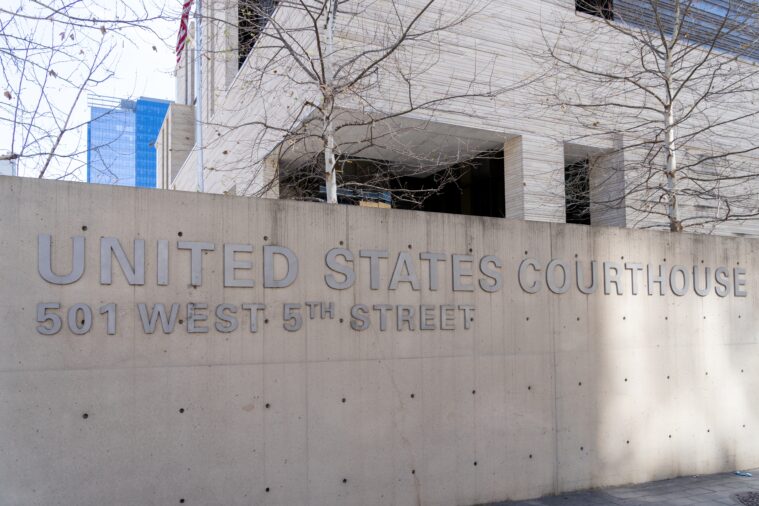
In a packed federal courtroom in downtown Austin Thursday morning, attorneys for the United States government squared off with attorneys for the State of Texas over the fate of the latter’s Senate Bill 4, an unprecedented anti-immigrant law creating a state deportation scheme, which is set to take effect March 5 unless the court halts it.

During a three-hour hearing, U.S. District Judge David Ezra, a Reagan appointee, appeared to favor the United States’ position that the law is likely unconstitutional and should be blocked. Ezra peppered Texas’ lead attorney Ryan Walters with constant skeptical questions and criticized the bill as sloppy, saying that “A little more care, in fact maybe a lot more care, could have gone into the drafting of this statute.” Ezra also said the bill could portend each state having its own immigration system, which would “turn us from the United States of America to a confederation of states”—precisely what the Civil War prevented, he noted.  

“It just slaps the federal immigration law right in the face.”

The judge also said, regarding one of SB 4’s provisions: “It just slaps the federal immigration law right in the face.”

At the hearing’s conclusion, Ezra said he would decide on enjoining the law “as quickly as [he] possibly can” and well before the March 5 deadline. (Anand Balakrishnan for the American Civil Liberties Union also argued before the court Thursday, as a separate lawsuit that organization filed had been consolidated with the government’s.)

SB 4 creates state-level crimes for illegally entering or reentering the country in addition to inaugurating a state deportation scheme. At present, the federal government enforces criminal entry and reentry statutes at its discretion and is the sole arbiter of deportation decisions. The Texas law constitutes an unprecedented transfer of exclusively federal power to a state and challenges 150 years of jurisprudence on immigration. Some, including Judge Ezra, argue it challenges the United States’ very cohesion as a single nation.

SB 4 makes it a misdemeanor crime for non-U.S. citizens to improperly enter Texas from another nation—for example, by wading across the Rio Grande from Mexico. To avoid prosecution and a possible six-month jail sentence, alleged border-crossers may agree to a judicial order to return to the country from which they came. If convicted, they’ll still face an identical removal order upon completing their sentence. Refusal to comply with these orders is a separate felony offense. (What happens exactly if Mexico refuses to accept these state deportees, many of whom will be non-Mexican, remains to be seen; an affidavit by a Texas Department of Public Safety official says troopers would escort migrants until they are seen to “cross to the Mexican side of the international bridge.”)

Judge David Ezra said he would decide on enjoining SB 4, Texas’ controversial immigration law, “as quickly as [he] possibly can.” Shutterstock

The law also makes it a crime to reenter or be “at any time found” in Texas after having been previously removed from the United States under SB 4 or by the feds. Unlike the comparable federal crime, SB 4’s reentry provision makes no exception for deportees who receive permission from the U.S. government to return. SB 4’s crimes may be enforced anywhere in Texas—where 20 percent of residents are foreign-born—including months or years after a person arrived. They may be enforced by state or local police. Unlike other anti-immigrant statutes in the Lone Star State and elsewhere, the law does not prohibit racial profiling in enforcement. It also does not exempt people in the process of seeking asylum.

“Texas cannot run its own immigration system,” the United States argued in its complaint, which it says it filed to preserve “the federal government’s exclusive authority to regulate the entry and removal of noncitizens.” 

Department of Justice Attorney Brian Boynton echoed the written complaint at Thursday’s hearing, during which he received only occasional and mild pushback from the judge.

SB 4 would not only violate the balance of federal and state powers, the feds argued, but also the constitutional edict that the national government may “establish an uniform Rule of Naturalization.” Further, it undermines the United States’ ability to control foreign relations—as evidenced by Mexico’s swift condemnation of SB 4 and stated rejection of “any measure that allows state or local authorities to detain and return Mexican or foreign nationals to Mexican territory.”

The government’s case relies heavily on a 2012 U.S. Supreme Court ruling, Arizona v. United States, in which a five-justice majority struck down most of a notorious anti-immigrant law in Arizona and reaffirmed the federal government’s “broad, undoubted power over the subject of immigration and the status of aliens.” SB 4’s specifics differ from the Arizona law, but it broaches the same fundamental question of the states’ ability to control international migration. If anything, “SB 4 undermines federal immigration law even more directly than Arizona’s law,” the United States claims.

Prior to SB 4’s passage in a chaotic fourth special legislative session late last year (see Ezra’s comment about sloppy drafting), both Texas Governor Greg Abbott and Attorney General Ken Paxton voiced a desire to overturn the Arizona precedent—with the Supreme Court having shifted right during Trump’s presidency—a goal for which SB 4 is now the potential legal vehicle. The law is also an escalation of Abbott’s three-year-old border scheme, Operation Lone Star, during which he’s relentlessly tested the bounds of state power and purposely provoked the Biden Administration for political gain.

In its written response to the federal complaint, Texas argued that its law actually does not run afoul of Arizona since the details of Arizona’s anti-immigrant law were different. The state also said (wrongly) that its law should stand because it merely “duplicates” federal statutes. In doing so, the state is attempting to drastically curtail the prevailing interpretation of the Supreme Court’s Arizona holding. 

Bigger-picture, Texas argued in its response brief and at Thursday’s hearing that, essentially, all legal bets are off because the Biden Administration has abandoned the Lone Star State to face “a full-scale invasion of transnational criminal cartels across our southern border.” 

“Under no reasonable understanding can irregular migration or criminal cartels’ smuggling activities amount to an ‘invasion’ justifying Texas engaging in ‘war.’”

This argument hinges on an obscure constitutional clause, which has lately come in vogue on the political right, outlining that states may not engage in war “unless actually invaded.” Many legal experts, citing the Constitution’s drafting history, have pointed out that even a large number of unarmed asylum-seekers and economic migrants do not constitute an “invasion.” Ian Millhiser, a senior correspondent at Vox and Supreme Court expert, has written that the claim “is, to put it mildly, a terrible legal argument.” Such rhetoric is also plainly dangerous, as racist killers like the 2019 El Paso mass shooter have echoed it before carrying out xenophobic atrocities. Yet Texas’ leaders persist in repeating it.

In its brief, Texas argued that the governor’s declaration of an “invasion” legally justifies SB 4 and that his decision is unquestionable. “There is no basis to second-guess Governor Abbott’s determination that a sudden and unprecedented influx into Texas of hostile non-state actors … justify Operation Lone Star’s initiatives, including the enactment and implementation of SB4,” the state said. 

“Texas is empowered to take all necessary steps to repel the cartel invasion at our southern border by ‘engag[ing] in War.’”

Responding to Texas, the United States argued bluntly that, “Under no reasonable understanding can irregular migration or criminal cartels’ smuggling activities amount to an ‘invasion’ justifying Texas engaging in ‘war’”—noting, in passing, that SB 4 is not an act of war anyway.  

At Thursday’s hearing, Ezra appeared to dismiss the invasion argument. “I really do not see any evidence that Texas is at war, although that rhetoric has been used by some Texas politicians,” the judge said, adding that even if a temporary invasion existed it would not justify a permanent statute like SB 4. 

If he enjoins the law, Ezra strongly suggested he would not temporarily stay his own injunction, as has sometimes happened in other cases. He also said he expects his decision to be appealed to the Fifth Circuit and, ultimately, “It would not surprise [him] at all that this case would find its way to the U.S. Supreme Court.”

In gravy or on mac & cheese, biscuits offer a warm Southern welcome

posted in: News | 0

Gretchen McKay | (TNS) Pittsburgh Post-Gazette

Is there anything more glorious and deeply satisfying on a visceral level than a humble fresh-baked biscuit?

I’d venture a resounding “no,” especially when the fluffy squares or circles of dough are super-sized to allow a generous canvas for building breakfast and lunch sandwiches, or paired with a creamy, hangover-curing southern-style sausage or red-eye gravy.

Lancaster native Carolyn Roy definitely decided bigger is better when she and her former husband and now business partner, Jason, opened their first Biscuit Head eatery in Asheville, North Carolina in 2013.

The couple had worked in various restaurant settings for years after meeting in Colorado in the early aughts — everything from fine dining to breweries to catering gigs. They moved to Asheville 15 years ago after seeing how much fun family and friends were having there.

Known for its vibrant arts scene, exciting beer culture and a myriad outdoor activities in the Blue Ridge Mountains, Asheville “had the same great vibe and funky feel of Boulder,” says Roy, but was much less expensive. That suited the couple’s long-held desire to one day open their own restaurant. Jason, who trained to be a chef at the Art Institute of Atlanta, designed and executed the menu.

When the pair took the actual plunge 11 years ago, they decided to go for something as fun, welcoming and big-hearted as the town itself — a breakfast restaurant centered around Southern-style “cathead” biscuits, so called because of they’re as large as a cat’s head.

“We had a young son young at the time, and working places open at night, it was getting really hard for family life,” says Roy. “So we honed in on breakfast.” That way, they could open early in the morning and close by mid-afternoon.

They chose to feature drop biscuits — so named because they can be made in a flash by dropping dough onto a pan instead of rolling or cutting it due to greater liquidity in relation to fat and flour in the bowl — because they’re faster and more efficient to make. “And they have a really great texture that just soaks up gravy,” she says.

The restaurant was a hit almost as soon as its doors opened. Two more locations soon followed, along with a fourth restaurant in Greenville, South Carolina. To this day, the original location on Haywood Road in West Asheville still draws lines that sometime stretch around the block.

Their cookbook “Biscuit Head: New Southern Biscuits, Breakfast and Brunch” hit store shelves in 2016. In addition to the recipe for its title character, it includes recipes for many of its homemade jams, gravies and infused butters. It also offers instruction on how to use biscuits as the base for all kinds of knife-and-fork sandwiches.

“It might sound simple, but we believe cathead biscuits are magical,” the couple writes in the book’s forward. “They are humble but delicious, and they are wonderfully versatile as the base for a menu.”

More rustic than their flaky rolled-and-cut counterparts, cathead biscuits are a staple in Appalachian cuisine. People have been known to make them as early as the late 1700s, according to Southern food historian John Egerton in “Southern Food: At Home, On the Road, In History,” with pearl ash from fires used as a leavening agent.

The couple has continued to tweak their original recipe over the years, and have also grown a pretty substantial line of jams and hot sauces to go on top, which at their restaurants are always at the ready at a self-served jam bar. They also offer a packaged mix of both their buttermilk and gluten-free biscuits featuring grains milled in North Carolina. In 2022, the buttermilk version — originally sold in mason jars with instructions attached on a ribbon — won Garden & Gun magazine’s Made in the South Award in the food category. You can find it online at biscuitheads.com.

And when you’re ready to roll up your sleeves and make a batch? Roy has a couple expert baking tips.

One of the easiest ways to take a wrong turn when it comes to biscuits is to overmix the dough. “We are always careful to just mix it just enough so you don’t see powdery chunks,” she says.

The biscuits should also be snuggled beside each other in a cast-iron pan or lined up like soldiers, shoulders touching, on a baking sheet before they go into the oven. That assures they’ll rise high in the pan by pushing against each other. At Biscuit Head, they use an ice cream scoop to portion, but you can also gently roll them into a ball by hand or use two spoons.

“It’s just one of those comforting, feel-good foods,” says Roy. “[Biscuits] are homey and I feel like almost everyone likes them because you can dress up them up or have it plain.”

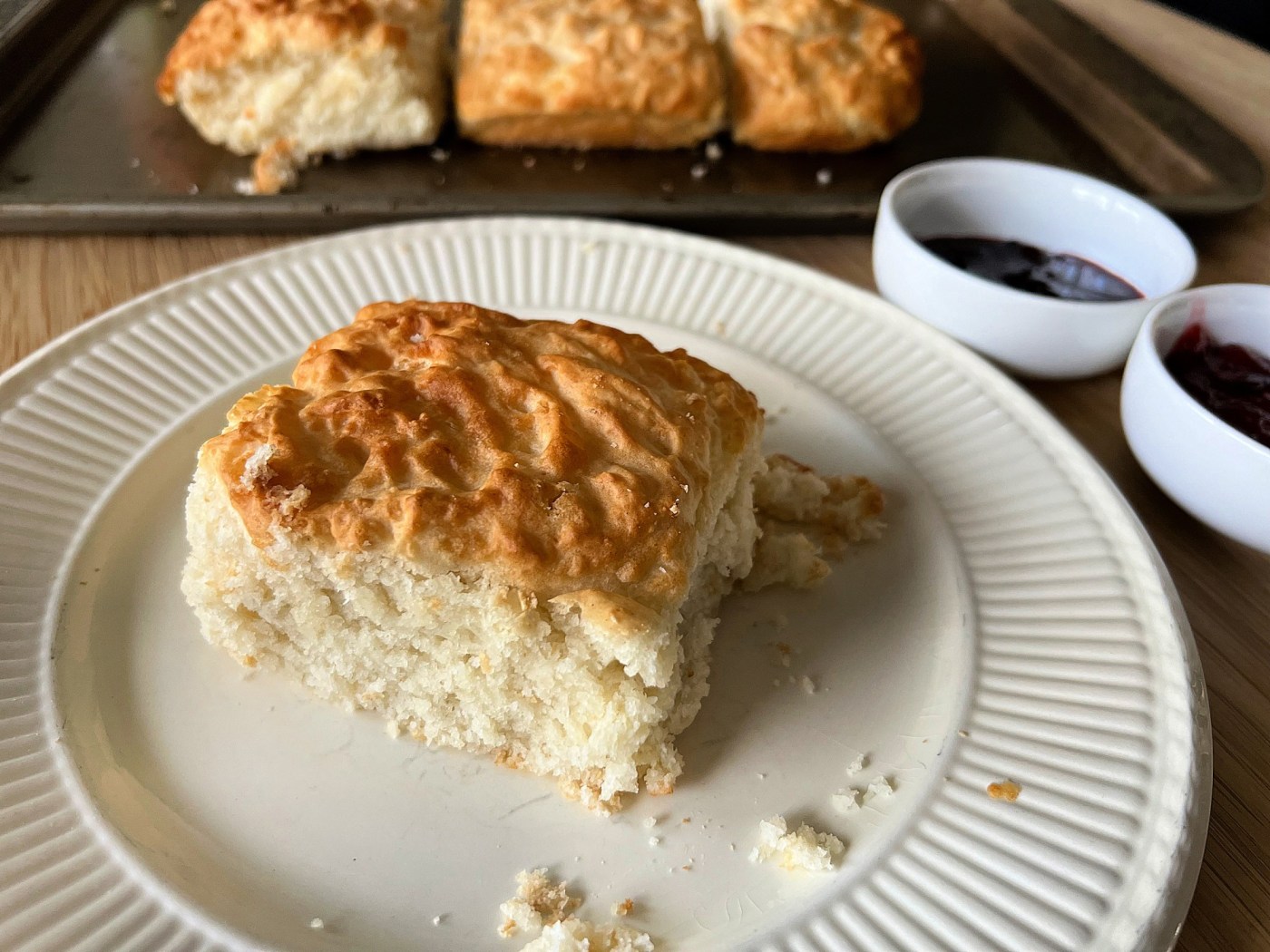
A staple of the South, drop biscuits can be made quickly in a cast-iron pan and serve as a delicious base for all kinds of sandwiches.(Gretchen McKay/Pittsburgh Post-Gazette/TNS)

Classic Cathead Biscuit

PG tested

If you can stir together pancakes, you can make these traditional drop biscuits. Their name refers to the size of a biscuit; scooped onto a baking sheet instead of rolled and cut, they’re as large as a cat’s head. For fluffy layers, be sure to use very cold butter and don’t overmix; add flour bit by bit, just until it reaches a workable dough.

For a gluten-free version, substitute 5 cups Bob’s Red Mill gluten-free all-purpose flour.

2 1/2 cups all-purpose flour

2 1/2 cups cake flour

3/4 teaspoon kosher salt

1 tablespoon baking powder

8 tablespoons (1 stick) butter, chilled and cut into small cubes

2 cups whole buttermilk

Preheat oven to 375 degrees, making sure you have one of the racks in the middle of the oven. Grease a baking sheet or cast-iron skillet.

In large mixing bowl, combine both kinds of flour, the salt and the baking powder. We strongly recommend sifting the dry ingredients to combine them.

Cut into the butter with a sharp knife and then “snap” it in by rubbing the butter between your forefinger and thumb with a snapping motion. (This makes thin sheets or ribbons of butter that will fold into the dough perfectly and then rise in the oven in beautiful layers.)

Add the buttermilk and stir gently to fold in. Take care not to overmix!

Scoop the dough into your pan or skillet, making sure to keep the dough scoops right next to each other on the pan. (A large ice cream scoop works well.)

Bake the biscuits for 20 to 25 minutes, or until they are golden brown and fluffy.

Makes 6 large (5-ounce) biscuits.

— “Biscuit Head: New Southern Biscuits, Breakfasts and Brunch” by Jason and Carolyn Roy.

When poured over warm biscuits, pork sausage gravy makes a hearty and satisfying breakfast. (Gretchen McKay/Pittsburgh Post-Gazette/TNS)

Biscuits with Pork Sausage Gravy

PG tested

For a vegetarian version, replace the sausage with 1/2 cup butter.

1 pound breakfast sausage, hot or mild

1/2 cup all-purpose flour

4 cups whole milk

1/2 teaspoon kosher salt

2 teaspoons black pepper

1/2 teaspoon red pepper flakes

Pinch of finely chopped fresh thyme, optional

4 cathead biscuits

In a saucepan or large skillet over heat, cook the sausage all the way through. Continue to cook until the meat browns slightly. Remove the sausage with a slotted spoon and transfer to a bowl or plate. Leave the grease in the pot.

Still over medium heat, whisk the flour into the sausage grease until a doughy paste has formed (a roux).

Slowly whisk the milk into your roux. Pour only about 1 cup of milk at a time and whisk well before adding another cup.

Lightly simmer for 3-5 minutes while stirring continuously. This will cook out the taste of the flour.

Return the sausage to the gravy, and finish by adding your salt, pepper, red pepper flakes and thyme, if using. Bring this mixture to light simmer then remove from heat.

Pour over a fresh-from-the-oven biscuit and serve.

Serves 4, with leftover gravy,

— “Biscuit Head: New Southern Biscuits, Breakfasts and Brunch” by Jason and Carolyn Roy.

Chile Garlic Honey

PG tested

This garlicky, slightly spicy sauce is the perfect topping for a fried chicken biscuit.

1 cup honey

1/4 cup sambal oelek

Juice 1/2 lime

1 clove garlic, minced

Combine all ingredients in a small saucepan and cook over low heat for 5 minutes. Pour into a Mason jar to serve or store with a tight-fitting lid. This honey keeps at room temperature for up to a month.

Biscuit Head Macaroni and Cheese

PG tested

Has anyone ever said no to a bowl of homemade macaroni and cheese? This comforting dish benefits from a crunchy topping of crumbled biscuits. It’s easily adapted for those with wheat allergies. I made a gluten-free version by using leftover gluten-free biscuits, chickpea macaroni and Bob’s Red Mill gluten-free all-purpose flour for the roux.

1/2 pound elbow macaroni

1/4 cup bacon grease or butter

6 tablespoons all-purpose flour

1 cup whole milk

1 cup heavy whipping cream

1 teaspoon salt, plus extra for pasta water

1 tablespoon hot sauce

2 1/2 cups sharp cheddar, shredded, divided

2 leftover biscuits, crumbled

Preheat oven to 400 degrees and grease a large casserole pan.

Boil the elbow macaroni in salted water until al dente. Drain the pasta and set aside.

Heat a medium-sized stockpot or large skillet over medium heat and add the bacon grease or butter. Stir in the four slowly. Let this roux cook for 1 minute while stirring with a whisk.

Slowly add the whole milk to mixture while continuing to stir. Once milk is fully incorporated with the roux, stir in the cream. (This is now a béchamel, or cream sauce.)

Add salt, pepper and hot sauce, then slowly stir in 2 cups of the shredded cheese, saving 1/2 cup of cheese for the topping. If the sauce seems too thick, add a little more milk or water to desired consistency.

When the sauce is smooth and all the cheese is melted, stir in your cooked pasta. Once everything is well mixed, pour the mac ‘n’ cheese into your greased casserole pan.

Top with the crumbled biscuits and remaining 1/2 cup of shredded cheese and bake in the oven for 20 minutes, or until golden-brown and delicious.

Serves 6-8.

— “Biscuit Head: New Southern Biscuits, Breakfasts and Brunch” by Jason and Carolyn Roy.

___

©2024 PG Publishing Co. Visit at post-gazette.com. Distributed by Tribune Content Agency, LLC.