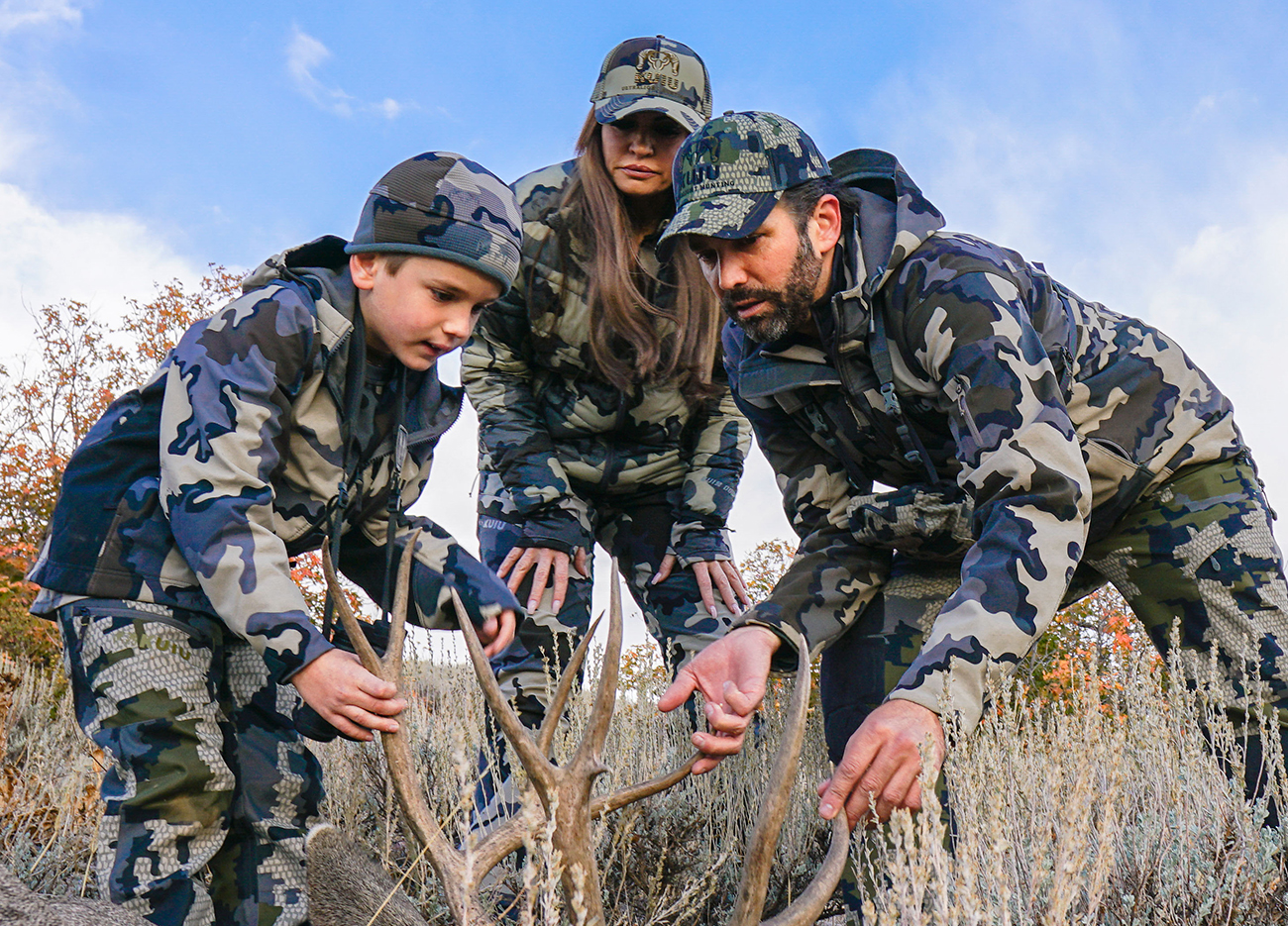
Every chance he gets, Donald Trump Jr. disappears from the campaign trail into the great outdoors.
“If I’m in Colorado doing an event, I’ll sneak off for half a day and go fly fishing,” he said in an interview. “Today, I had a pretty crazy day of conference calls, but I’m literally in the car, banging all of those out. I’m gonna go do a quail hunt in upstate Florida before I have to drive back down to Palm Beach to have a business dinner at Mar-a-Lago. … That’s my decompression from the five-speaking-events-a-day general lifestyle that will be my next, let’s call it year.”
It’s not just his decompression anymore, though: In 2021, Trump Jr., 46, launched a hunting- and outdoors-focused lifestyle media brand with a few friends called Field Ethos. The quarterly print magazine and website — which was well reviewed by, of all places, the left-leaning Slate — and website are full of striking landscape photos accompanied by pieces about Cape buffalo hunts in Botswana or spearfishing in the Caribbean, plus gear reviews. There’s a shop selling flannels and travel mugs, and a travel agency business, Outrider, which helps customers arrange their own trips and offers organized outings (e.g. a “Cowboy Camp” in California with “unlimited wild hogs” for $3,600 per person). The overall aesthetic of the brand is like a rugged, gun-loving version of Kinfolk, the Portland-based cottagecore hipster quarterly.
It might seem like an odd endeavor for Trump Jr. Since before Donald Trump became president in 2016, his eldest son and the most politically engaged Trump child has been his father’s chief culture warrior. Starting in the early days of the 2016 election, Trump Jr. carved out his own role in lobbing insults on social media and mocking media outlets. While his sister Ivanka positioned herself as a White House insider capable of appealing to the establishment, Trump Jr. stayed on the outside, a soldier in the MAGA meme wars posting images of his dad as Pepe the frog and attacking insufficiently loyal Republicans.
Today, he is still throwing bombs online as well as hosting his podcast “Triggered” on Rumble, a platform that has positioned itself as a free speech-friendly competitor to Big Tech companies. In 2021, he founded Winning Team Publishing, which has published books by MAGA luminaries such as Charlie Kirk, Judge Jeanine Pirro and Rep. Marjorie Taylor Greene (R-Ga.). He has also invested in Public Square, an online shopping platform that seeks to be an alternative to retailers such Amazon, one of the “woke” conglomerates he has said he wants to compete with. And he is still serving as a surrogate on TV and social media for his father’s third presidential campaign.
For Trump Jr., Field Ethos is mostly a passion project, and he said he thinks of it as totally separate from his political work. “It’s probably one of the least political things I do,” he told me when I asked how Field Ethos fits in with his other right-leaning business ventures. In his publisher’s note from the second issue of the magazine in 2022, Trump Jr. struck a wistful tone at the prospect of the politics-filled year ahead, portraying Field Ethos as a haven from the campaign fray: “The next 12 months are going to be interesting for me and my family ,and it’s great to know I can pick up one of our journals when I just need a break from it all.”
But a deeper dive into the project shows that the campaign trail runs right through those journals.
It’s not hard to find signs of the publisher’s anti-“woke” sensibilities and his “unapologetic” — a word that comes up frequently in conversation with his co-founders — delight in tossing partisan bombs. The Field Ethos online shop is full of meme-y merch (for $20, you can purchase three rubber bracelets that ask: “What Would Roof Koreans Do?”, a reference to the Korean business owners who shot at looters during the 1992 Los Angeles riots), the podcasts regularly feature MAGA politicians such as South Dakota Gov. Kristi Noem and, especially recently, Trump Jr.’s publisher’s notes have included culture war-inflected diatribes against Joe Biden, drag queen story hours and “taxpayer-funded mass migration” on the southern border.
As much as Trump Jr. presents Field Ethos as a break from his political work, it’s part of a bigger project that’s been ongoing on the American right of building a conservative parallel economy and bringing the culture wars of politics to consumer habits. Rather than building and protecting an apolitical space with Field Ethos, if you look a bit closer, it’s clear that Trump Jr.’s magazine is an extension of his father’s political strategy to business and almost everything else.
Trump Jr. was introduced to the outdoor life by his maternal grandfather, Milos Zelnicek, an electrician who took the young New York-born Trump on camping trips in then-communist Czechoslovakia. Trump’s passion grew when he was at boarding school in Pennsylvania, where some friends taught him how to use a shotgun and took him deer and pheasant hunting.
“I literally just fell in love with it; I read every book there was on the subject,” Trump Jr. said, including Ernest Hemingway and the author and big game hunter Robert Ruark. (Hemingway’s great-grandson, Patrick Hemingway Adams, now contributes to Field Ethos.) “All of those things, I think, are getting lost in today’s instant gratification society. You know, kids sit there on a video game. Everything’s … instant gratification.”
Field Ethos co-founder and CEO Jason Vincent had a similar story — an outdoors-loving grandpa who introduced him to the lifestyle, and in his case, also introduced him to the kind of publications, like National Geographic, that would later inspire and serve as a foil for Field Ethos. Vincent went on to work as a game warden and then as an editor at Sporting Classics, a marquee brand in the hunting and outdoors media. Vincent called it a “classic outdoorsman’s magazine,” one that “had an older demographic, and I didn’t feel like anybody was really speaking to my demographic.” The idea for Field Ethos emerged in casual conversations with Trump Jr. The two had met via hunting circles and become friends.
The target demographic for Field Ethos, per Vincent, is men between the ages of 25 and 55, though he, Trump Jr. and Chief Operating Officer Mike Schoby all emphasized in interviews that a quarter or more of their audience is female. “That may really just come from the fact that there’s still kind of a draw to that unapologetic male mindset,” Vincent said. “That may be why we’ve built the female following that we have … it doesn’t feel like it’s being watered down to try to get traction with them.”
The specificity of Field Ethos’ branding is what gives it a coherent aesthetic and point of view. In an era of endless content that can all seem to blend together, a media brand can differentiate itself by intentionally limiting its scope to aficionados and those wishing to be like them. In this case, those aficionados, judging by the trips and products highlighted, are affluent globetrotters — a younger, richer segment of the outdoor market, one that can afford pricey international big-game hunts and fishing expeditions.
“It’s not for everybody, I fully admit that,” Schoby said. According to the U.S. Fish and Wildlife Service’s annual National Survey of Fishing, Hunting and Wildlife-Associated Recreation, American hunters skew middle-class, with a median household income of $59,000. They support a multibillion dollar industry, spending over $45 billion on hunting-related expenses in 2022.
“But there’s plenty of other magazines that fill those niches and go, ‘Hey, you want to buy a deer rifle for under $500 … here’s a great choice for that,’” Schoby continued. In contrast, Field Ethos’ print quarterly recently highlighted a Springfield Model 2020 Redline Rifle costing $2,299 as a “practical” choice that “performs like custom guns costing 3x as much.”
In general, its founders say they never try to be explicitly political, except where politics intersects with issues they have an inherent interest in, like gun rights. “Yes, Don is involved. He’s part of our group of friends and our team at Field Ethos,” Vincent said. “But … Field Ethos is really designed to be a place people can go when they’re kind of sick of that.”
Vincent also emphasized that those politics are “sensible,” middle-of-the-road, emphatically not far-right. “The extreme right is not our brand,” Vincent said. “We see ourselves as speaking to a sophisticated audience that is smart enough to not find themselves at the extreme of either side.”
The magazine’s scope also closely aligns with a pet issue of Trump Jr.’s that is directly politics-related: getting hunters to vote. This is apparently something many hunters don’t do, since the whitetail deer season in November coincides with election time.
Keith Mark, the founder of Hunter Nation, a nonprofit that also has a 501(c)(4) political arm and that Trump Jr. has done work with in the past, told me in an interview that “by and large, hunters, depending on the state you look at, vote [at] less than 50 percent, sometimes less than 40 percent. And a third of them aren’t even registered to vote.” Polls of American hunters and anglers have also shown that they are mostly, but not overwhelmingly, Republican — a 2022 poll reported this number at 39 percent, compared with 27 percent identifying as Democrats — and that they feel strongly about both gun rights and conservation.
“They have not been sort of wooed or brought out to vote,” Trump Jr. said. “Organizations like Hunter Nation do a great job with this — understanding that, if you turn out those people, it’s going to generally [benefit] conservatives, but they have been very inactive relative to what you would actually think. And they happen to also populate a lot of the key swing states.”
If these are the more “sophisticated” politics that Field Ethos would rather be associated with, though, there is also a strong strain of the exact opposite coursing through the magazine.
Poring over the stories, headlined “We Beat the ATF” (about the ATF’s ban on pistol braces, which has since been blocked by a federal judge) and “Socialism Sinks Ships,” and perusing the trolly merchandise on offer, it’s hard to avoid the conclusion that Field Ethos would have a hard time appealing to liberals or even moderates. Despite the obvious effort to appeal to a slightly more affluent, younger demographic than the average Trump voter, Trump Jr. continues to use the same red-meat language and tactics to make a play for them.
One full-page ad in a recent issue features a Thompson gun with “President Trump” engraved on one side and “Save America 45th” on the other.
A satire piece from October featured an imaginary dual interview with Trump Jr. and Hunter Biden (“Have either of you ever slept with your brother’s wife? Don: No Hunter: Yes”). Trump Jr.’s publisher’s note from a recent print issue is a diatribe against a Biden administration move to cut funding to the National Archery in Schools Program. “Forget the Biden Administration’s dangerous open border debacle, its relentless attack on the Second Amendment, environmental scams that restrict land use and sound wildlife management practices, and its insistence on indoctrinating kids with demented drag queen sexuality for a minute … ” Trump Jr. wrote. The note wouldn’t be out of place in any number of hard-right media outlets, warning that “anything Democrats see as a threat to their agenda of complete control over the American people must be censored, destroyed, canceled, or sabotaged by any means possible.”
It’s worth noting that on the subject of restricting land use, Trump Jr. and President Joe Biden align on at least one important policy. Both opposed Pebble Mine in Alaska, a proposed gold and copper mine that both environmentalists and many hunters and fishers believed would irreparably harm one of the largest salmon spawning grounds in the world. Trump Jr. went up against his father’s administration on the issue, which ultimately reversed its support for the project. Biden’s administration also blocked the project. But recognizing that kind of common ground is not Trump Jr.’s goal on the campaign trail, and neither, it seems, is it his goal with the magazine.
In this sense, the business strategy of Trump Jr. here looks a lot like the political strategy of his father: Divide the market, identify the loyal base and appeal directly to it.
This strategy means that Field Ethos, which has a print circulation of about 25,000 subscribers, according to Vincent (though he said the brand boasts 250,000 email subscribers and over 100,000 Instagram followers), might miss out on a large proportion of the available market share. Take a look at some of the outlet’s competitors in hunting media, like older brands Petersen’s Hunting or Field & Stream, the latter of which has a sizable circulation of 650,000. These are much more staid institutions that keep themselves at a remove from political back and forth. Or consider a publication like Garden & Gun, which covers southern culture, including hunting, and appeals to a smaller, 350,000-circulation audience of readers but a broader cross section of them, 47 percent of whom are women. Garden & Gun has a much larger average income of $332,000 compared to Field & Stream’s $53,000 and also does not cover politics.
In recent years, the space has also seen a less traditional crop of hunting media, like MeatEater, a TV show hosted by former Brooklyn resident Steven Rinella, who has become a major voice advocating for responsibility and conservation in hunting. MeatEater’s emphasis on hunting as a source of food rather than just pure recreation has appealed to a variety of demographics, including farm-to-table cooks and environmentalists. Rinella said in 2021 that his show attracted 100 million YouTube views and 5 million podcast downloads a month.
This approach is anathema to the Field Ethos crew, who defend hunting just for fun and scoff at the critics who view as irresponsible expeditions like the Trump brothers’ infamous 2012 safari that resulted in images of Trump Jr. with a dead elephant’s severed tail. While MeatEater aims to making hunting culture more environmentally- and socially-minded, Field Ethos appears to do the opposite, aiming for a smaller, more targeted readership that shares the founders’ “unapologetic” views.
“We’ve decided to be very honest … that we hunt for adventure, for heritage, for a connection with nature, downtime and the outdoors,” Schoby said. Field Ethos is defining itself against that “apologetic” “PC culture” streak in today’s hunting community, he continued.
Field Ethos, along with Rumble and Public Square, are all part of a broader Trump Jr. project of creating an alternate conservative market for almost everything. This is of a piece with manly-man, conservative-coded brands that have gained popularity in recent years such as Black Rifle Coffee Company. These companies aren’t explicitly political. But there’s a certain disdain for “woke” pieties that underlies their appeal — much like how Trumpism itself works by converting cultural conflict into political energy. They’re a foil for the mainstream brands which have increasingly taken political positions over the last several years, often angering conservatives.
I asked Trump Jr. about his involvement with right-leaning companies like Rumble and Public Square.
“It’s not even ‘right-leaning,’ it’s more freedom economy,” Trump Jr. said. “Having your dollars go to … a small business that shares your values, as opposed to some woke conglomerate that’s donating to whatever leftist causes and literally weaponizing people’s hard-earned money against them … I’m all for that.”
These companies aren’t literally in the business of politics, but they show the extent to which the political has seeped into everyday life: the things we buy, the hobbies we take part in, the books we read.
They also show the extent to which Trump Sr.’s playbook doesn’t just succeed in politics. That same strategy can be used in business and could ensure that Trumpism continues in some form long after Trump Sr.
Even in Trump Jr.’s rhetoric when he discusses Field Ethos and his other projects, it’s easy to see the same promises his father makes on the campaign trail reformulated for consumers rather than voters.
“Creating an alternate viewpoint for the Americans who felt like they’ve been left behind who don’t want to support those things,” Trump Jr. said about Field Ethos and the other “freedom economy” companies he’s involved with, “that’s a big part of the focus.”
Even when it’s applied to jet-setters looking to book a multi-thousand dollar expedition to hunt big game in far-flung places, a defense of the “left behind” is still powerful.