Should Texas public school students learn about the Bible?
Yes, they should—but not in the way Texas education officials are going about it.
In June, Texas became the first state to require all public school students to read religious texts, as part of a newly approved list of nearly 200 readings—from “Hickory Dickory Dock” to Hamlet—mandated for all Texas public school students, Kindergarten through 12th grade. But what makes the new list especially controversial is that all of its religious readings come solely from a single text: the Bible. The list excludes texts sacred to faith traditions other than Christianity and Judaism—despite the fact that about one-third of Texans belong to neither of those religions.
This requirement that students read only the Bible, as I also argued in a recent report for Rice University’s Baker Institute for Public Policy, does a tremendous disservice to students, parents, and teachers. The “Bible-only” list doesn’t meet the need to learn about the major religious traditions that make up Texas and the nation today. It could impair public schools’ ability to serve a religiously diverse population. Worse, it threatens to turn non-Christian and non-religious Texans into outsiders in their own public schools.
The list, which takes effect in 2030, was developed by the Texas Education Agency (TEA), and, after contentious public hearings and some revisions, was approved by the State Board of Education in June.
In all, the mandate includes 14 biblical selections—about one Bible passage for every 13 required texts. Among the many selected passages are readings about Jonah and the Whale (Grade 1), Moses and the Burning Bush (Grade 5), eight of Jesus’ Beatitudes (Grade 7), full chapters from Ecclesiastes and Lamentations (Grade 8), and 16 chapters from Job (High School). That’s a lot of Bible—even when spread out over twelve grade levels.
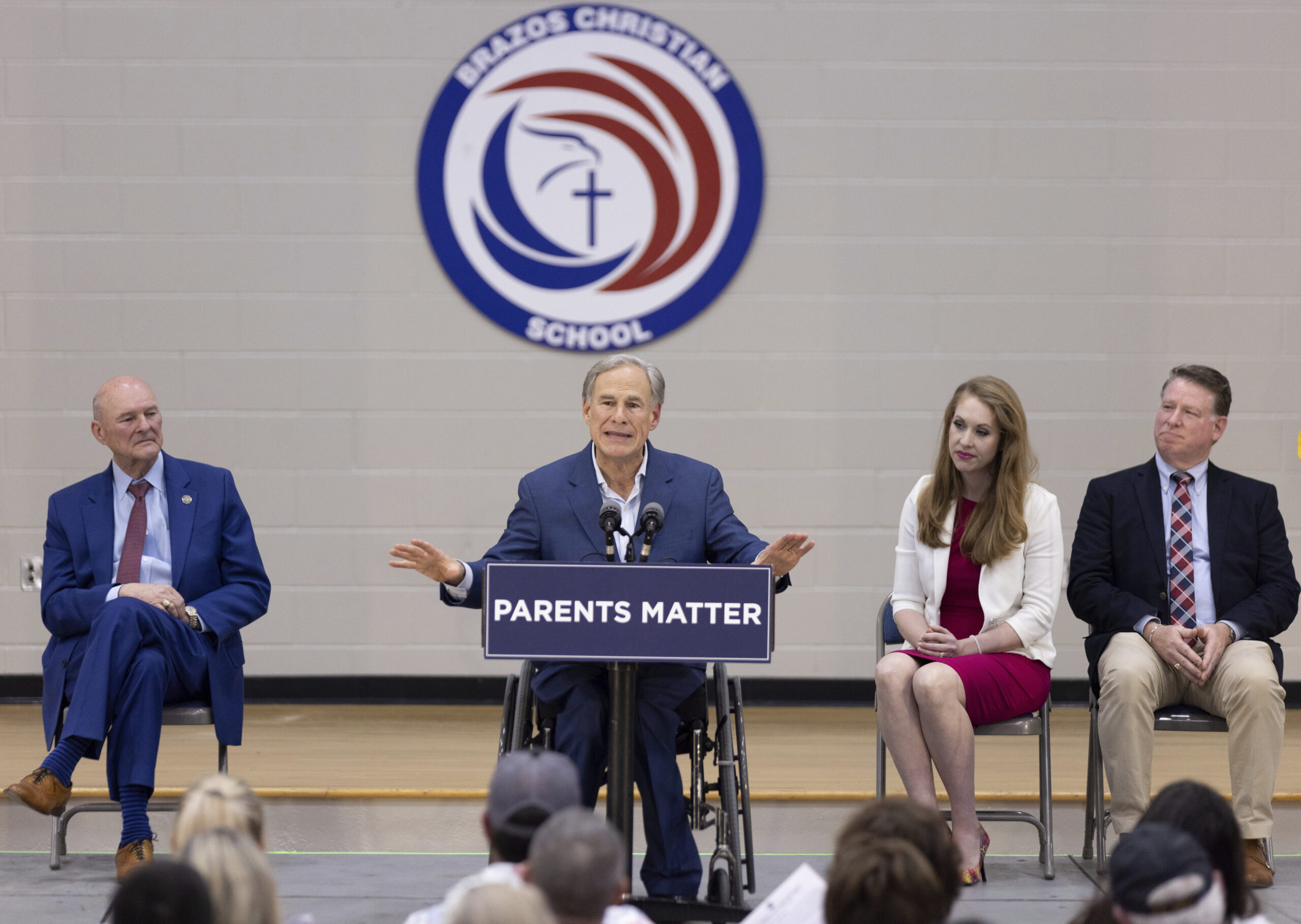
Governor Greg Abbott speaking at a Christian school in Bryan in 2023 (Logan Hannigan-Downs/College Station Eagle via AP)
TEA justified the biblical content by citing a 2007 statute requiring schools to offer an “enrichment curriculum” incorporating “religious literature, including the Hebrew Scriptures (Old Testament) and New Testament, and its impact on history and literature.”
However, nowhere does that statute dictate that only the Bible be included. Yet that’s the road Texas education officials opted to take, despite criticism from numerous scholars pointing out the problems with so one-sided a canon. For instance, University of Texas history professor Steven Mintz criticized the list’s “overemphasis on the Christian tradition without providing the kind of contextualization and analysis that religious texts require.”
The new canon does have its defenders. The Atlantic’s Adam Kirsch argues that omitting the Bible from “young people’s education” leaves them “ill-equipped to understand America’s past, and therefore its present and future.” Similarly, Garion Frankel considers the Bible “indispensable to understanding the United States—and, frankly, the entire English language”; Texas students should graduate with “a strong working knowledge of [the Bible’s] stories, language and influence.”
Largely, I agree with Kirsch and Frankel. The Bible has had a substantial influence on Western culture and the American story. Students should indeed learn about it, and about the two religions that venerate it.
But teaching students only about the Bible does more harm than good.
For one thing, the Bible-only list doesn’t reflect today’s Texas. If you live in the cities or suburbs, you’re likely aware that Muslim, Sikh, Hindu, and Buddhist worship centers are springing up across the state, joining churches and synagogues on the religious landscape. (Indeed, this is a source of anxiety and even hostility for some Texans—and a wedge issue in the current election cycle.) Since 2007, the Christian share of the state’s population has declined from 84 percent to 67. One of every 17 Texans now belongs to a religion other than Christianity. And Texans who don’t identify with any particular religious tradition now make up just over a quarter of the state’s population.
Scholars and education professionals have long argued that for students to succeed in a religiously diverse society, they need basic instruction in the religions they’re likely to encounter.
Yet scholars also agree that such instruction must be religiously balanced (not privileging any religion over others) and nonconfessional (not promoting any religion). Public schools are not churches or missionary organizations: their job is to educate, not proselytize (something Texas’ governor, who says he opposes “indoctrination” in schools, would seem to understand perfectly well). In fact, both the United States and Texas constitutions prohibit government—including public schools—from favoring any religion over others.
Clearly, the Bible-only list lacks balance. It designates one religious text, sacred to only two religions, as essential student learning. This is especially regrettable since it would not be all that difficult to bring at least a modicum of religious balance to the list. For instance, alongside Psalm 23, which is required reading for 7th graders, students might also read the Holy Qur’an, Sura 1, which expresses similar feelings of loving dependence upon the divine. Alongside Jesus’ mandated teachings about anxiety, 6th graders might also explore some of the many passages in Hinduism’s Bhagavad Gita that deal with calming the “restless, turbulent” mind.
The Bible-only list also fails the nonconfessional test. True, it does not explicitly promote the Bible, Christianity, or Judaism. Nor does it mandate some of the most Christocentric Bible passages, such as John 3:16 or John 14:6. That said, the list’s one-sided focus on the Bible opens the list “to a charge of proselytizing students,” as I wrote in in my recent report, since it “implies that the Bible is more important, more deserving of attention, and perhaps more authentically American than other faith traditions.”
For those who follow Texas politics, it should come as no surprise that state policymakers are privileging Christianity’s sacred text. The new list is only the latest move in a decades-long campaign to inject religious, and particularly Christian, content into public education. For instance, Texas officials recently mandated the posting of “In God We Trust” and the Ten Commandments in public schools, required school boards to decide whether to offer a daily period for prayer and scripture reading, and authorized the “Bible-infused” Bluebonnet Curriculum.
The cumulative effect of these policies, combined with the new reading list, is to put a thumb firmly on the scales in favor of one tradition over others.
Four decades ago, Supreme Court Justice Sandra Day O’Connor, a Republican appointed by President Ronald Reagan, warned of the consequences of official religious favoritism. In a 1984 decision, she wrote that government endorsement of any religion “sends a message to nonadherents that they are outsiders, not full members of the political community, and an accompanying message to adherents that they are insiders, favored members of the political community.”
That dynamic is perhaps the most disappointing aspect of Texas’ Bible-only list: It threatens to turn non-Christian and non-religious students, parents, and teachers into outsiders in their own schools.
Since the list doesn’t take effect until 2030, there’s still time for Texas education officials to prevent this from happening. It is my hope that officials will correct the list’s imbalance and create a canon that will ready students to flourish in the religiously diverse Texas we call home.
The post The State’s Bible-Only Reading List Is a Disservice to Texas Kids appeared first on The Texas Observer.
Leave a Reply