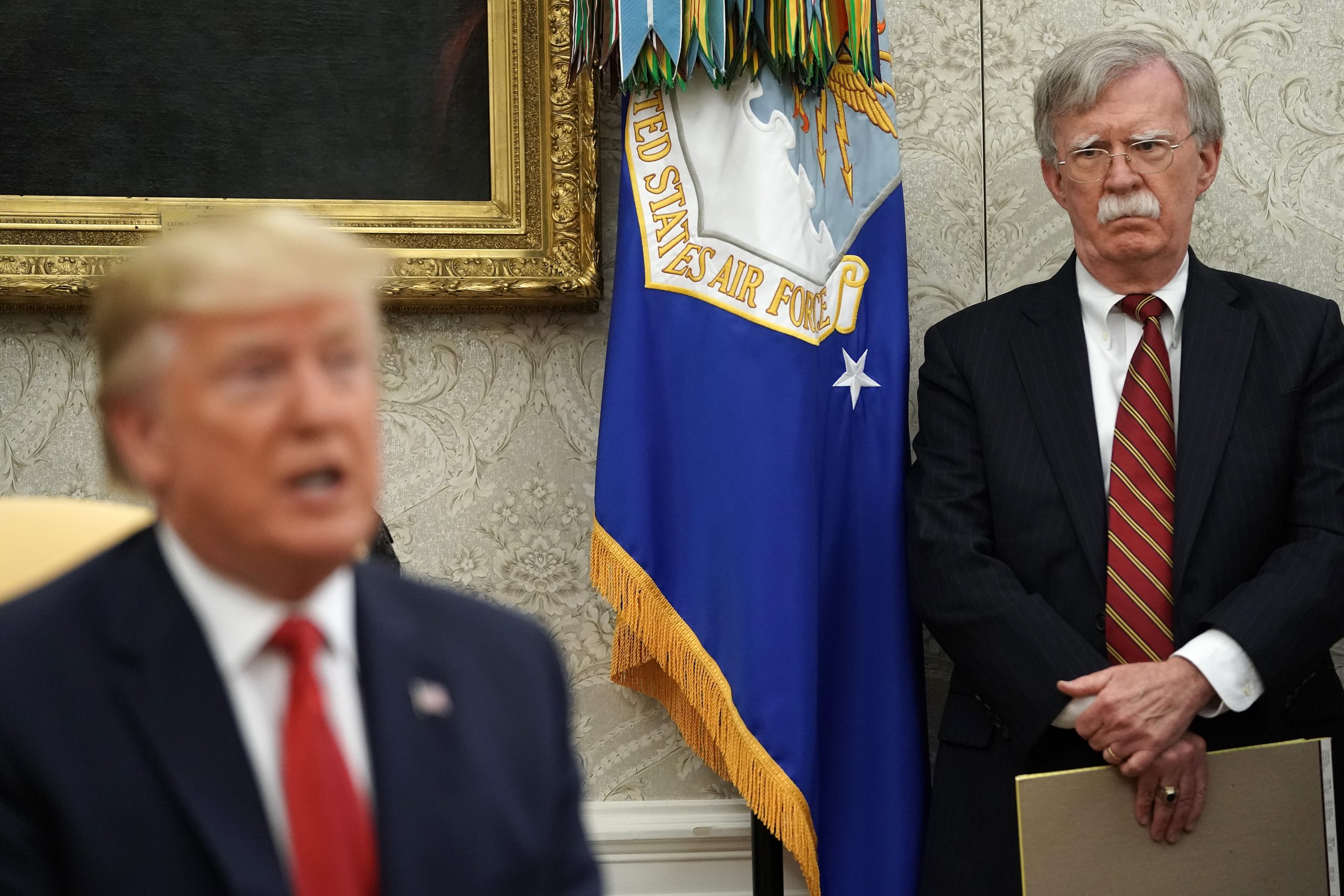
John Bolton doesn’t really buy Donald Trump’s story about telling an unnamed head of state he would encourage Russia to do “whatever the hell they want” to countries that didn’t meet NATO’s defense spending standards.
But he does think the former president’s threats — and his desire to abandon the alliance — are chillingly real.
“Look, I was there when he almost withdrew, and he’s not negotiating,” said Bolton, who served as Trump’s national security adviser. “His goal here is not to strengthen NATO, it’s to lay the groundwork to get out.”
Bolton, one of the loudest critics to emerge from the Trump White House, has long expressed dismay at Trump’s tenure. In his post-mortem book, “The Room Where it Happened,” he portrayed Trump as unfamiliar with basic facts and driven, above all, by a desire to win another term. In Bolton’s telling, it’s no different with Trump’s recent comments about NATO. That doesn’t change the reality that Trump wants out of the alliance that has helped ground the U.S.-led global order for decades. And Bolton wants Trump’s defenders to recognize that.
“I think there are some Republicans who support Trump out there saying, ‘Oh, it’s, you know, it’s not a big deal. He’s not going to do it, so on and so forth.’ I’m telling you, I was there in Brussels when he damn near did it,” Bolton said.
And if Trump does destroy NATO, he warned, the consequences would be dire.
This interview has been edited for length and clarity.
What was your first impression when you heard Trump’s comments about NATO?
At the NATO summit in 2018, he came very close to withdrawing from NATO right there at the summit. So each of these comments, as he makes them now over six years, to me simply reinforces that the notion of withdrawing from NATO is very serious with him. People say, “Well, he’s not really serious. He’s negotiating with NATO.” Look, I was there when he almost withdrew, and he’s not negotiating — because his goal here is not to strengthen NATO, it’s to lay the groundwork to get out.
We have been telling NATO allies for decades that they had to increase their defense spending. And those of us who have been doing this for a long time have done it to strengthen NATO so that the U.S. can be more flexible around the world. When Trump complains that NATO allies are not spending enough on defense, he’s not complaining to get them to strengthen NATO. He’s using it to bolster his excuse to get out.
So you don’t think Trump would stop threatening allies if they just met the NATO goal of spending 2 percent of their GDP on defense?
For many of these allies — take Germany in particular — it’s not just saying, “OK, well, we’ll start spending more on defense.” The commitment that all this turns on — at the NATO summit at Cardiff, Wales, in 2014 — was that over a 10-year period, all NATO members would end up spending 2 percent of their gross domestic product or more on defense, and that hasn’t happened. Spending has increased in recent years. And a good part of the reason for that is Trump.
But again, looking at Germany, the second-biggest economy in NATO — it is still clobbering along at 1.2, 1.3 percent, somewhere in there. What Trump says is, Look, number one, Europeans pay billions of dollars to Russia each year for natural gas. Number two, he says, the Europeans screw us in trade negotiations. And then number three, they don’t spend enough to meet their NATO commitments. So even if people started increasing on that, I don’t think that would change his mind.
Congress has enacted new restrictions that could limit a president’s ability to leave NATO. Would that tie Trump’s hands?
Well, it’s never been definitively adjudicated, whether a president can unilaterally withdraw from the treaty, but it has happened repeatedly throughout American history. I myself have participated in several examples: George W. Bush withdrawing from the 1972 Anti-Ballistic Missile Treaty, Trump withdrawing from the Intermediate-Range Nuclear Forces Treaty and from the Open Skies treaty with Russia. Congress doesn’t like it, but I think the constitutional logic is, it’s entirely in the president’s hands. So this statute won’t restrain him.
I think if it were tested in court, it would be declared unconstitutional. But even if I’m totally wrong, and Trump announces that he’s withdrawing from NATO, somebody sues under that statute, and you litigate it for two or three years — imagine the damage that’s done to NATO, while Trump is openly attacking it.
What are the implications that would come with Trump pulling the U.S. out of NATO? What would that mean for the country and the world?
It would mean the end of NATO. We are the leader of NATO, and what would survive would be remnants of some European Union kind of structure, but it would have implications beyond Europe and North America. I think it would be catastrophic for U.S. credibility around the world. If we’re willing to throw NATO over the side, there is no American alliance that is secure. A lot of people, for instance, say Trump would be so much better for Israel than Biden has been. Well, if Trump is willing to knife NATO, what makes anybody think he wouldn’t knife Israel if it suited his purposes?
What would that mean for U.S. security, if the U.S. were unable to form alliances that other countries could trust?
It would be devastating, and part of this desire to get out of NATO is that Trump has no idea about what alliance structures do and how beneficial they can be. He spent four years as president, he didn’t know anything about it when he entered the Oval Office, and he didn’t know anything about it when he left. So he has no idea the damage that withdrawing from NATO would do. He may be the only figure in American politics who thinks that — there are some nutcases around who don’t care, frankly, what the effect would be, but they’re a very distinct minority.
Is there any incentive for these countries to actually start increasing the amounts they’re spending on defense?
It will never be enough. For some of these countries, it’s close to doubling their defense spending. And you just can’t snap your fingers or turn on a light switch and make that happen. So in two years, a number of them still would not be at 2 percent, and all of the pressure — with the threat of Russia in Europe, with the turmoil in the Middle East, with the threat being posed by China — all of the pressure is increasing defense spending.
For example, the Japanese only spend about 1 percent of GDP, and when Prime Minister [Fumio] Kishida was here in Washington a couple of months ago, he pledged that Japan would double its defense spending to 2 percent of GDP over a five-year period, which is a pretty rapid buildup. And if you consider that if you expect Japan’s economy to grow in the next five years, it’s obviously more than a doubling in real terms. So that’s a pretty dramatic step for Japan to take, and that would still only bring them up to 2 percent if they can fulfill that pledge.
Why should voters care about this?
Well, if they want to secure a country, having alliances that help reinforce our power around the world is critical. You know, the world doesn’t have a natural order. And what order there is, is basically supplied by the United States and its alliances. We’re not doing that out of charity. We’re doing it because it’s in our national interest, to have trade and investment and everything that goes with the world that’s not threatened by hostile, belligerent, aggressive nations. It’s true that probably most allies are free-riding to an extent on U.S. power — and they should pay more. But the answer when they don’t is not to cut off your nose to spite your face.
How can Trump’s opponents make voters pay attention to this?
I think political leaders in both parties have not done a good job for 30 years-plus, since the fall of the Soviet Union and the victory in the Cold War, to explain to people that what happens internationally can threaten our economy and our way of life over here. People talked after the Soviet Union collapsed about the “end of history.” And everybody said “it’s the economy, stupid,” as if international affairs didn’t mean anything.
Well, I think people are waking up, and that’s important and that needs to be encouraged. But political leaders have to explain to voters and justify to them why these threats require an American response. My response is Ronald Reagan’s approach of peace through strength, and that requires spending money to have a bigger defense. But if political leaders don’t explain it to the American voter, it’s no surprise that they wonder why they’re being asked to do it.
Does the conversation he recounted sound real to you?
I never heard him saying anything like that, and the way the way the conversation goes doesn’t sound real. You know, he makes up a lot of conversations where people are always calling him “Sir.” You know, maybe his subordinates are calling him sir, because that’s the right thing to do. But foreign leaders don’t call him sir. They either call him Mr. President or Donald, number one. But number two, the fact that it’s an imaginary conversation that makes Trump look very good — as all of Trump’s imagined conversations do — doesn’t mean that he doesn’t believe what he’s saying.