Republicans block Senate bill to protect nationwide access to IVF treatments

posted in: Politics | 0

By MARY CLARE JALONICK and STEPHEN GROVES (Associated Press)

WASHINGTON (AP) — Senate Republicans have blocked legislation that would protect access to in vitro fertilization, objecting to a vote on the issue Wednesday even after widespread backlash to a recent ruling by the Alabama Supreme Court that threatens the practice.

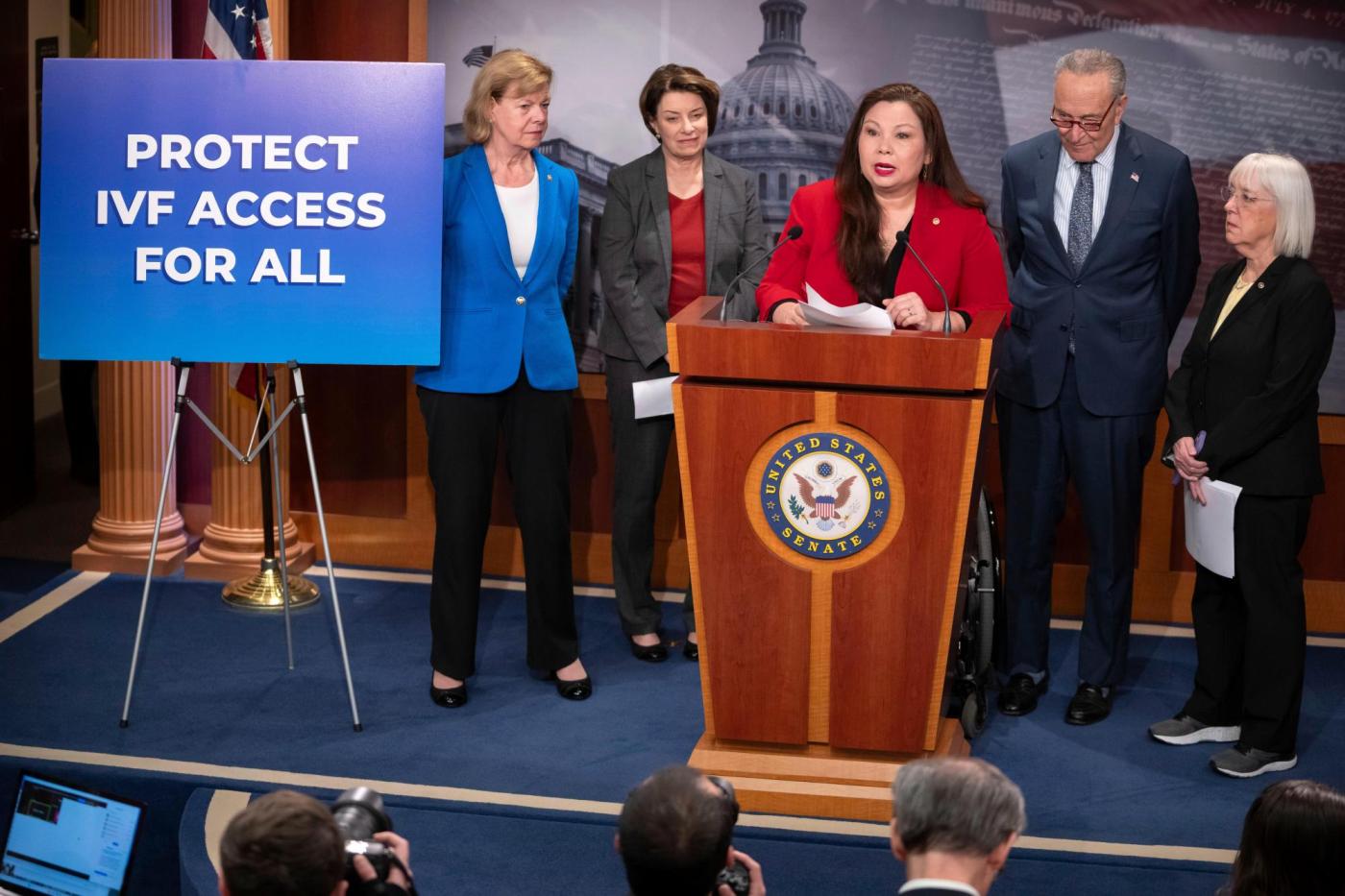
Sen. Cindy Hyde-Smith, a Mississippi Republican, objected to a request for a vote by Sen. Tammy Duckworth, D-Ill., who used IVF treatments to have her two children after struggling with years of infertility. Duckworth’s bill would establish a federal right to the treatments as the Alabama ruling has upended fertility care in the state and families who had already started the process face heartbreak and uncertainty.

Several clinics in the state announced they were pausing IVF services as they sort out last week’s ruling, which said that frozen embryos can be considered children under state law. The court said that three Alabama couples who lost frozen embryos during an accident at a storage facility could sue the fertility clinic and hospital for the wrongful death of a minor child.

Democrats have immediately seized on the election-year ruling, warning that other states could follow Alabama’s lead and that other rights could be threatened as well in the wake of the U.S. Supreme Court’s decision to overturn Roe vs. Wade and the federal right to an abortion in 2022. Congress passed similar legislation in 2022 that would protect the federal right to same-sex and interracial marriages.

“Mark my words, if we don’t act now, it will only get worse,” Duckworth said.

Abortion opponents have pushed laws in at least 15 states based on the idea that a fetus should have the same rights as a person.

Hyde-Smith defended the Alabama Supreme Court decision that found frozen embryos can be considered children under state law. She pointed out that it originated with a pair of wrongful death cases brought by three couples who had frozen embryos destroyed in an accident at a fertility clinic.

“I support the ability for mothers and fathers to have total access to IVF and bringing new life into the world. I also believe human life should be protected,” Hyde-Smith said.

At the same time, three providers in Alabama have paused the often-used fertility treatments while they sort out the legal implications. Alabama lawmakers are scrambling to find ways to protect the treatments. And former President Donald Trump, the front-runner for the GOP presidential nomination, said he would “strongly support the availability of IVF.” Trump called on lawmakers in Alabama to preserve access to the treatment.

Many GOP lawmakers also reinforced their support for IVF services.

Soon after the decision, Alabama Sen. Katie Britt made calls to fellow Republicans, including Trump, to argue for the importance of supporting the treatments, emphasizing that they are pro-life and pro-family, according to a person familiar with the calls.

In a statement after the ruling, Britt said that “defending life and ensuring continued access to IVF services for loving parents are not mutually exclusive.”

Other Republicans agreed. Texas Sen. Ted Cruz, one of the more vocal opponents of abortion in the Senate, said he supports IVF and believes it is “entirely life affirming.” Kansas Sen. Roger Marshall, a former obstetrician, said he’d referred patients for IVF treatments for 25 years in his practice. “We are the pro-family party, and there’s nothing more pro-family than helping couples have a baby,” Marshall said.

Still, this is the second time Republicans have blocked Duckworth’s bill. By Bringing it up again, Democrats said they are challenging GOP senators to display real support for IVF access after many this week issued statements criticizing the Alabama ruling. Democrats held the Senate floor for 45 minutes Wednesday with a series of speeches deriding the overturn of Roe v. Wade.

Senate Majority Leader Chuck Schumer said on Tuesday that Republicans who have denounced the Alabama ruling “are like the arsonist who set a house on fire and say, why is it burning?”

For Duckworth, the bill holds deep personal significance. After she was seriously injured while piloting a Black Hawk helicopter in Iraq, she became an amputee and was only able to have her own children, ages 5 and 9, through IVF.

“After a decade struggling with infertility after my service in Iraq, I was only able to get pregnant through the miracle of IVF,” Duckworth said on the Senate floor. “IVF is the reason I get to experience the chaos and the beauty, the stress and the joy, that is motherhood.”

She called her infertility “one of the most heartbreaking struggles of my life. My miscarriage more painful than any wound I ever earned on the battlefield.”

___

Associated Press writer Kim Chandler contributed from Montgomery, Ala.
Stephen Mihm: What Biden could learn from Ike’s leadership during the Suez Crisis

posted in: News | 0

As Israel’s Gaza offensive has grown ever more deadly and destructive, President Joe Biden has equivocated: condemning the civilian death toll while simultaneously sending more arms to Israel. This position, though perhaps politically expedient at the outset of the conflict, has become untenable.

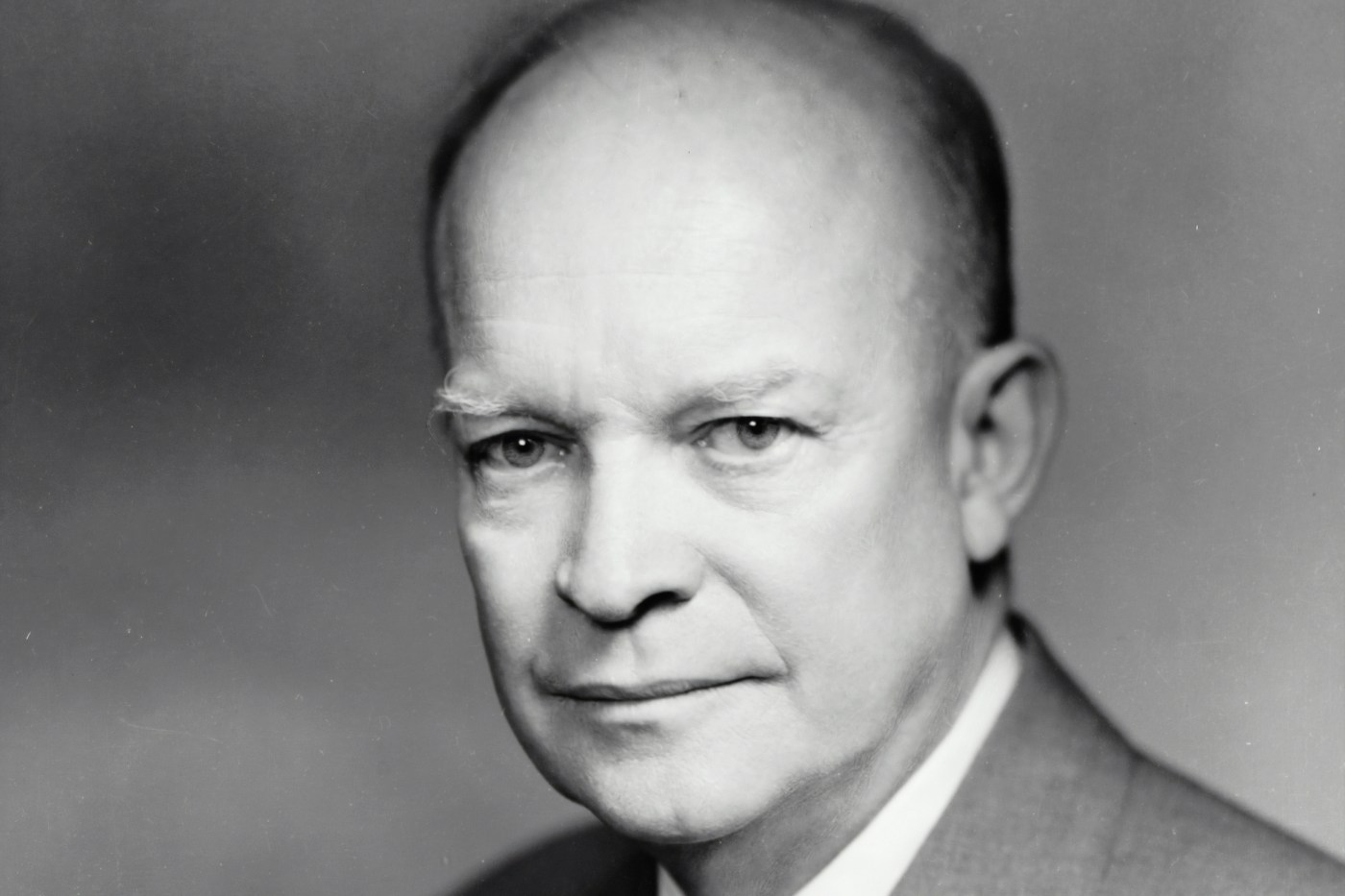
Now, as the war threatens to destabilize the entire region, Biden should take a more forceful stance, much as one of his predecessors did. In 1956, President Dwight “Ike” Eisenhower successfully defused the Suez Crisis, forcing Israel and its allies — as well as the president’s own political rivals — to back down. Eisenhower’s willingness to confront Israel offers a model, however imperfect, for today.

At the beginning of 1956, the Suez Canal remained in the hands of British and French interests, much as it had been for nearly a century. That summer, though, Egypt’s president, Gamal Abdel Nasser, seized control of this critical conduit, effectively cutting off the flow of Middle Eastern oil to Europe. The move also hit Israel, denying its ships passage through the canal.

Nasser’s act, the culmination of rising tensions between Egypt and European powers, set off a major crisis. Britain and France, eager to reclaim some of their former influence in the region, forged an alliance with Israel, which had already clashed with Egypt in 1948. Together the three nations crafted a plan dubbed “Operation Musketeer”: Israel would invade Egypt’s Sinai Peninsula, as well as Gaza, which was then under Egyptian control. Britain and France would then land troops in the canal zone in a bid to overthrow Nasser.

News of the plan left Eisenhower aghast. Though the president counted all three countries as allies, he had cultivated relations with the newly independent Arab nations as well, in part to check Soviet influence in the region. Eisenhower, who had previously warned Britain against using force in the region, resolved to curb his Cold War allies if they proceeded with the plan.

This was not without risk: a direct confrontation with Britain, France, and Israel could backfire not just internally, but also closer to home. With the presidential election set to take place a week later, Eisenhower could ill afford to alienate pro-Israel voters in key states, particularly because his opponent, Adlai Stevenson, had tried to make Eisenhower’s foreign policy a campaign issue.

Israel and its allies undoubtedly expected that these considerations would sideline Eisenhower and proceeded with their plan. Israel moved first, invading Egypt on October 29. When Eisenhower pushed for a United Nations resolution calling for Israel to withdraw, Britain and France vetoed the measure — again, expecting that this would settle the issue.

It did not. Instead, Eisenhower delivered a national address on October 31 declaring that the U.S. would not countenance the invasion. “In all the recent troubles in the Middle East, there have indeed been injustices suffered by all nations involved,” Eisenhower said. “But I do not believe that another instrument of injustice — war — is the remedy for these wrongs.”

Eisenhower understood that eloquence alone wouldn’t force a withdrawal, particularly as Britain and France made it clear they would proceed with the plan. Ike now played hardball, informing the Brits through back channels that the U.S. would no longer help prop up the value of the pound sterling, which was already in freefall. The gambit worked: in the face of potential economic crisis, Britain had no choice but to back down and soon withdrew its troops. France followed suit, furious but unable to proceed without Britain by its side.

Israel, though, refused to withdraw. Eisenhower was not pleased. He turned again to diplomatic back channels, this time to threatening to support a UN resolution that would ban all public and private aid to Israel, including the tens of millions of dollars the nation received from the U.S. each year. At first, Israel refused to budge. But Eisenhower was unwavering — even as Democrats in Congress, led by future president Lyndon Baines Johnson, threatened to revolt.

As the year came to a close, Eisenhower combined the stick with a carrot: reassurances that the U.S. recognized Israel’s right to defend itself should Nasser take any measures to threaten the nation. By March of 1957, Israel bowed to reality and withdrew its forces, ceding control of the territory it had captured. Egypt reopened the canal the following month, and while tensions over free passage of cargo persisted, the Suez Crisis had come to an end.

What can Biden learn from this episode? While it’s tempting to suggest that he should simply emulate Eisenhower, the reality is more complicated. Egypt’s seizure of the Suez Canal wasn’t anywhere near as deadly or abhorrent as the attacks launched by Hamas. Moreover, Israel today is a far more powerful and established country than it was in 1956, and quite mindful of the fact that the U.S. failed to honor Eisenhower’s commitment a decade later, a betrayal that helped set the stage for the Six-Day War.

Still, Eisenhower’s bedrock belief — that the U.S. should put stabilizing the Middle East ahead of propping up its allies — remains relevant today. If Israel proceeds with an invasion of Rafah, it will unleash a refugee crisis that could rupture the tenuous peace Egypt and Israel currently enjoy. Eisenhower would not have let such a thing happen. Neither should Biden.

Biden may wish to reread what Eisenhower wrote in his diary at the height of the Suez Crisis, as the words are eerily prescient. The U.S., Ike concluded, “must be friends with both (Arab and Israeli) contestants in that region in order that we can bring them closer together. To take sides could do nothing but to destroy our influence in leading toward a peaceful settlement of one of the most explosive situations in the world today.”

Stephen Mihm, a professor of history at the University of Georgia, is coauthor of “Crisis Economics: A Crash Course in the Future of Finance.”

Supreme Court sets April arguments over whether Trump can be prosecuted for election interference

posted in: Politics | 0

By MARK SHERMAN (Associated Press)

WASHINGTON (AP) — The Supreme Court on Wednesday agreed to decide whether former President Donald Trump can be prosecuted on charges he interfered with the 2020 election and set a course for a quick resolution.

The justices’ order maintains a hold on preparations for a trial focused on Trump’s efforts to overturn his election loss. The court will hear arguments in late April, with a decision likely no later than the end of June.

But even with a timetable that is much faster than usual, the court action calls into question whether a trial for Trump, assuming the justices deny his immunity bid, can be scheduled and concluded prior to the November election.

Trump’s lawyers have sought to put off a trial until after the voting.

By taking up the legally untested question now, the justices have created a scenario of uncertainty that special counsel Jack Smith had sought to avoid when he first asked the high court in December to immediately intervene. In his latest court filing, Smith had suggested arguments a full month earlier than the late April timeframe.

Spokespeople for Trump and Smith did not immediately respond to a message seeking comment.

The court said in an unsigned statement that it will consider “whether and if so to what extent does a former President enjoy presidential immunity from criminal prosecution for conduct alleged to involve official acts during his tenure in office.”

The Supreme Court has previously held that presidents are immune from civil liability for official acts, and Trump’s lawyers have for months argued that that protection should be extended to criminal prosecution as well.

Lower courts have so far rejected Trump’s novel claim that former presidents enjoy absolute immunity for actions that fall within their official job duties. A panel of appellate judges in Washington ruled earlier in February that U.S. District Judge Tanya Chutkan, who would preside over the election interference trial, was right to say that the case could proceed and that Trump can be prosecuted for actions undertaken while in the White House and in the run-up to Jan. 6, 2021, when a mob of his supporters stormed the U.S. Capitol.

The issue reached the high court because the appeals court refused to grant the delay that Trump has sought.

The case is separate from the high court’s consideration of Trump’s appeal to remain on the presidential ballot despite attempts to kick him off because of his efforts following his election loss in 2020. During arguments on Feb. 8, the court seemed likely to side with Trump. A decision could come any time.

The high court also will hear an appeal in April from one of the more than 1,200 people charged in the Capitol riot. The case could upend a charge prosecutors have brought against more than 300 people, including Trump.

The election interference case in Washington is one of four prosecutions Trump faces as he seeks to reclaim the White House. Of those, the only one with a trial date that seems poised to hold is his state case in New York, where he’s charged with falsifying business records in connection with hush money payments to a porn actor. That case is set for trial in March 25, and a judge this month signaled his determination to press ahead.

A separate case charging him with illegally hoarding classified records is set for trial on May 20, but a pivotal hearing Friday seems likely to result in a delay. No date has been set in a separate state case in Atlanta charging him with scheming to subvert that state’s 2020 election.

State wrestling: With a chip on its shoulder and ‘no regrets,’ Simley takes aim at a sixth straight title that won’t come easy

posted in: News | 0

Danny Martin was not ranked in the top 10 in the state for most of last season as a junior for Simley wrestling at 170 pounds.

He finished with a 29-22 record, and won a match in his individual state tournament bracket.

But Simley needed more Martin — literally — if the Spartans were to chase a sixth-straight Class 2A team state title.

“I told him, ‘You have to get big enough to wrestle at 189, because we don’t have another guy (at that weight),’” Simley coach Will Short recalled Wednesday. “ ‘And you have to be a force for us at 189.’ ”

Done, and done. Martin, a senior captain, bulked up and is now the sixth-ranked 189-pound wrestler in Class 2A, according to The Guillotine. He’s a 40-match winner this winter.

“It took a lot of time in the weight room, eating the right food, but also just trusting my coaches who were helping me along the way,” Martin said.

The right food?

“Sometimes it wasn’t as clean as I would’ve liked,” Martin said with a laugh. “I was just eating whatever I could. But especially in wrestling season … I was giving up unnecessary food that’s just bad for you. I’ve been trying to eat more clean, (and) I definitely have felt the results.”

Fellow senior captain Derrick Dahmen was slated to wrestle at 160 pounds this season. But Simley has lost three wrestlers this winter — JJ Salas, Amilio Salas and Derek Buck — to season-ending injuries.

To compensate for the major losses and fill up the reconfigured lineup, changes needed to be made. Simley had an adequate 160-pound reserve in Judah Heeg. It had no varsity-ready options at 145 pounds.

So Dahmen went down. And, after winning 24 matches a year ago, he’s a 30-match winner and individual state tournament qualifier this year at 145.

And therein lies the true magic of Simley wrestling.

Yes, the Spartans have stars in the lineup. Turner Ross (107 pounds), Austin Grzywinski (114) and Raymond (152) are all ranked No. 1 at their respective weight classes entering this week’s state tournament.

And Simley did receive an injection of talent when the Heeg family moved into the Twin Cities. Eighth-grader Justus Heeg is a rising star at 133 pounds. Judah, a sophomore, wasn’t expected to be a varsity contributor this year, but has grown into that role out of necessity.

But the program sustainability is born out of the development of others. You don’t compete for a sixth-straight state title — which would be a new program record — without a complete lineup.

Simley (20-1) is the top seed in the Class 2A team tournament, which will play out throughout the day Thursday in St. Paul, starting with a quarterfinal match against Little Falls (19-4), and potentially ending with a state title match at 7 p.m., where Kasson-Mantorville or Totino-Grace likely will be waiting.

Which maybe isn’t something Short would have forecasted a year ago. Because this Simley team isn’t as flush with top-tier talent throughout the lineup. The Spartans of recent years won every match because they were far superior to their opponent.

This year’s team is proving it can be just as successful through different avenues.

Guys are moving around weight classes and raising their games from good to great. Others are performing admirably to simply give Simley a shot at certain weight classes — as Parker Davis and Brandon Kropuenske have done at the heaviest weights.

“The fact that we’re competitive, that we can compete at those weights, wasn’t something that we were sure we could do on a regular basis,” Short said. “We thought we were going to take a long year. But we’ve done a pretty good job at developing guys, and that’s the key.”

That’s how you compete for state titles every year and sustain for the long haul. Simley has been a top-10 team throughout the entirety of the past four decades. Short is committed to maintaining the Inver Grove Heights school’s standard.

Simley currently has 65 kids in its elementary school wrestling program, 30 at the middle school level and 55 in high school.

Those 55 high school wrestlers consist of the varsity and the junior varsity. Short and his coaching staff are constantly making sure the JV kids are getting ample time around the varsity wrestlers so they can see the level of work required to maintain a certain level of excellence.

“Everybody around you is doing the right thing,” Martin said. “If you’re slacking off, it’s really obvious to everyone around you. The coaches will call you out on it, and not only that, some of the guys will be like, ‘Hey, you’ve got to pick it up.’ ”

Short noted for those who are willing to enter that room and go about things in the proper manner, “there is a map and a pathway” for athletes to reach the highest level.

“I think right now, it’s a strong program,” Short said. “And when you have a strong program, you can turn out another set of guys.”

Could Simley win another state title this year? Absolutely. Is that a foregone conclusion? No. It was in past years, but because the talent gap simply doesn’t exist, anything could happen Thursday at Xcel Energy Center. Short loves that. He’s the ultimate fan of the state tournament, but noted it’s an earned experience.

His athletes have done it the hard way. There was a point after all of the injuries that Short could feel his team — and, frankly, even himself — thinking that a sixth-straight title may not be in the cards. That was right around the team’s lone dual-match loss to Mounds View in late January.

“We kind of just sat down and we just made a decision that we were going to commit to taking the guys we’ve got and still achieving our goals,” Martin said. “Just because we lost a few key guys doesn’t take away from anything we have.”

Ever since then, it’s been onward and upward for the Spartans. Short describes this group with a palpable excitement in his voice. He’s giddy about the progress and sacrifice each individual has made for the betterment of the collective.

“We’ve just had a lot of guys step up and make major improvements. I’m really proud of this team. I’m more proud of these guys than I ever have been,” Short said. “This group of guys has really impressed me this year about who they are as people. How Derek and Danny have said, ‘We’re going to be in this, we’re not giving up and we’re going to go try to win a state tournament.’ They’re focused and committed.”

For the first time in awhile, Short said the Spartans have a chip on their shoulders. They’re entering Thursday ready to wrestle, knowing they’ve given themselves the best possible chance to succeed.

“We’ve got no regrets at Simley right now. No one is going to be sitting on the bench going, ‘I wish I’d done this.’ These guys have given everything they’ve got. They’re truly committed to try and win, and they’re going to go put it on the line against every team,” Short said. “They have a little bit of swagger right now and a little bit of a chip on their shoulder like, ‘Hey, you think we’re done? Well, we’re not done.’ ”

Related Articles

High School Sports |


State wrestling tournament primer