Equal education, unequal pay: Why is there still a gender pay gap in 2024?

posted in: News | 0

By Claire Savage, Associated Press

CHICAGO (AP) — Not even education can close the pay gap that persists between women and men, according to a recent U.S. Census Bureau report.

Whether women earn a post-secondary certificate or graduate from a top-tier university, they still make about 71 cents on the dollar compared with men at the same education level, Census Bureau research found.

Related Articles

Business |


With medical debt burdening millions, a financial regulator steps in to help

Business |


Q4 data: Home buyers chilled by high prices and rates

Business |


Why was my mortgage application denied? Common reasons underwriters don’t approve loans

Business |


6 ways to save money in Paris during the Olympics

Business |


Wedding loans: How to finance wedding costs

That difference is coming into stark view on Equal Pay Day, and in spite of the fact that women comprise more than half of college-educated workers and participate in the labor force at record rates.

Rather than comparing full-time working men to full-time working women, the Feb. 22 Census Bureau report juxtaposes men and women with the same education caliber: graduates of certificate degree programs and those who hold bachelor’s degrees from the most selective universities, explained economist Kendall Houghton, a co-author of the research. The report also includes graduates who may have opted out of the labor force, such as women taking on child care responsibilities.

“The main point here is that there’s a substantial gap at every single level,” added Census Bureau economist and co-author Ariel Binder.

Field of study, choice of occupation and hours account for much of the discrepancy, but not all. Field of study, for instance, contributes to the pay gap much more for top graduates (24.6%), but for less selective degree holders accounted for only a sliver (3.8%). And the number of hours and weeks worked affect the pay gap more for certificate earners (26.4%) than selective bachelor’s degree earners (11.3%), suggesting there is a bigger gender difference in work participation for certificate holders, Binder said.

At the same time, about 31% of the gap for each education level remains unexplained, suggesting less easily measured factors such as gender stereotypes and discrimination may be at play.

Chantel Adams says she isn’t surprised that the gender pay gap persists even among men and women with the same level and quality of education, or that the gap is wider for Black and Hispanic women.

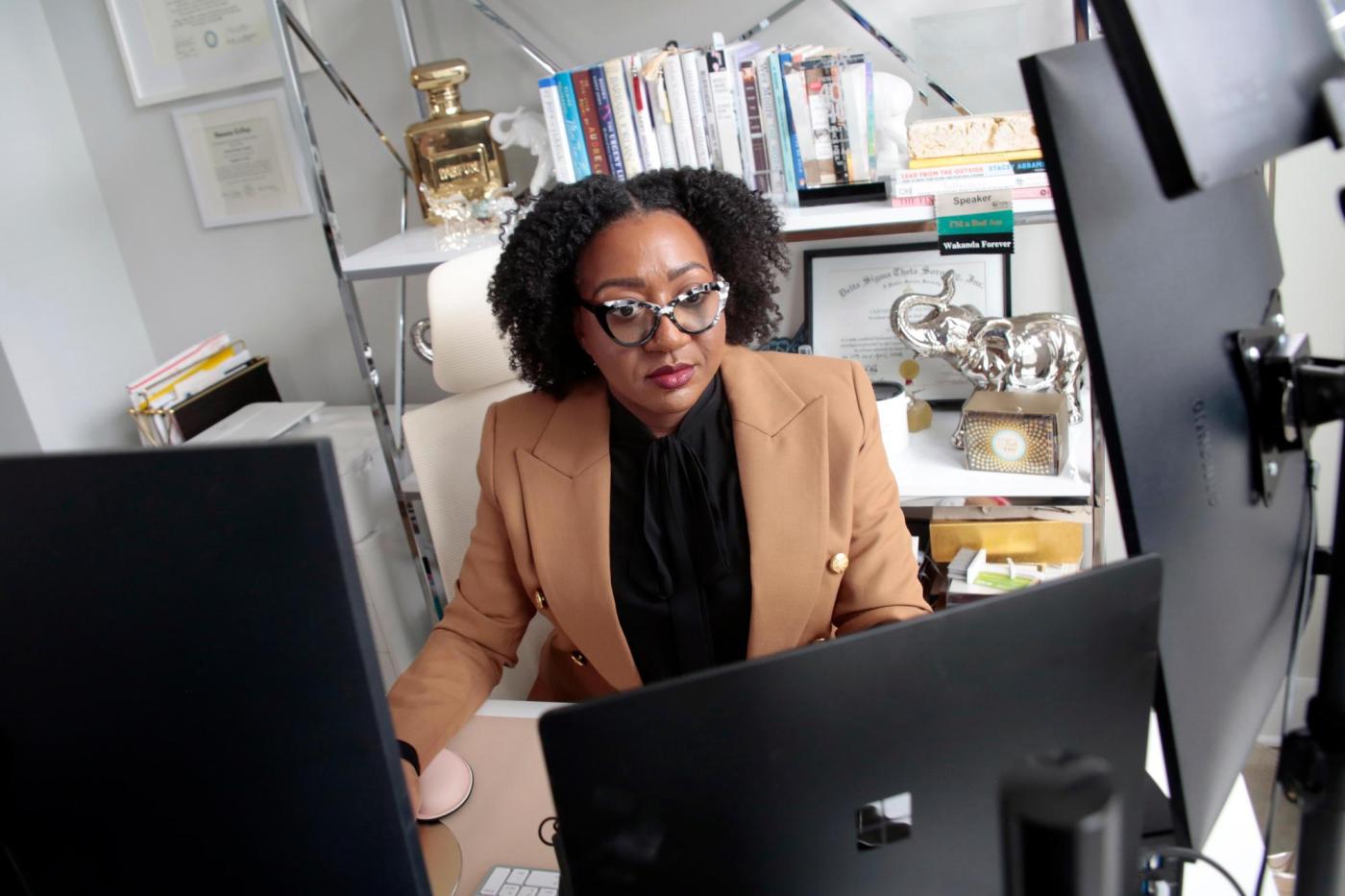
Chantel Adams, a senior marketing executive, poses in her home office Thursday, March 7, 2024, in Durham, N.C. Adams says she isn’t surprised that the gender pay gap persists even among men and women with the same level and quality of education, or that the gap is wider for Black and Hispanic women. (AP Photo/Chris Seward)

A senior marketing executive who holds an MBA from University of North Carolina’s Kenan-Flagler Business School, Adams said her qualifications aren’t enough to counteract the headwinds she faces in her career as a Black woman.

Despite taking on extra responsibilities and an undisputedly strong performance, Adams said she was turned down for a promotion because she was told that “I was so articulate and sharp that it was intimidating to some people.”

“I have nearly $300,000 of post-high school education. It would be surprising if I weren’t articulate and sharp,” said Adams, who is based in Durham, North Carolina.

She said her peers at the company — one of whom did not have an MBA — were promoted while she was held back two years in a row.

“It’s unreasonable and unfair to hold someone’s strengths against them,” Adams said. “I would consider that as something that is race-based.”

Broadly, younger women are closer to wage parity with younger men, according to Carolina Aragao, who researches social and demographic trends at Pew Research Center. But the gap widens between the ages of 35 and 44, which coincides with when women are most likely to have a child at home.

“That does not play out the same way for men,” Aragao said, adding that there is actually an opposite phenomenon known as the fatherhood premium, in which fathers tend to earn more than other workers, including men without children at home.

Despite women making vast gains in C-suite and high-earning industry representation, wage gap improvement has stalled for about 20 years, Aragao said. Uneven child care and household responsibilities, falling college wage premiums, and overrepresentation in lower-paying occupations are all contributors to why the pay gap stubbornly remains.

For Adams, the best strategy to overcome them has been to keep changing jobs — six times in 10 years, across multiple states in her case.

“I knew that I needed to be intentional and move with urgency as I navigated my career in order to work against that headwind,” she said. “When those opportunities were not afforded me within one company, I’ve gone elsewhere.”

Chantel Adams, a senior marketing executive, poses in her home office Thursday, March 7, 2024, in Durham, N.C. Adams says she isn’t surprised that the gender pay gap persists even among men and women with the same level and quality of education, or that the gap is wider for Black and Hispanic women.(AP Photo/Chris Seward)

Adams said job coaching, mentorship, and support from Forte Foundation, a nonprofit focused on women’s advancement, have been instrumental to her success, while salary transparency laws — and even salary transparency within social circles — could help alleviate the significant pay gap challenges women of color face.

But corporate diversity initiatives have been subject to a growing list of lawsuits ever since the Supreme Court struck down affirmative action in college admissions. Adams said she worries that without affirmative action, corporate racial diversity could decrease, too.

“The big question that is looming over my head and probably many other executive leaders is: What does that do to the pipeline of diverse candidates that we may or may not have 10 years from now?” Adams said.

The Associated Press’ women in the workforce and state government coverage receives financial support from Pivotal Philanthropies. AP is solely responsible for all content. Find AP’s standards for working with philanthropies, a list of supporters and funded coverage areas at AP.org.

Editorial: We can’t help but be happy for long-suffering Detroit Lions fans

posted in: News | 0

Yes, the Detroit Lions are in the Chicago Bears’ division. Yes, the Bears play them twice a year.

But we can’t help but root for the Lions as they make their improbable way through the NFL playoff gauntlet and are one win away from their first-ever Super Bowl appearance.

Chicagoans can relate. Lions Nation is one fan base that has seen almost nothing but failure in the nearly six decades that make up the Super Bowl era. One measly playoff win in all that time.

The Bears put their fans through a lot of disappointment on the field, verging on abject embarrassment sometimes. But we at least can (and do) continue to bask in the brutal majesty of the 1985-86 Bears. Lions fans have Barry Sanders highlights on YouTube, and that’s pretty much it.

Also, as fellow Upper Midwesterners, we ought to have each other’s backs, with the obvious exception of the Green Bay Packers, who’ve won quite enough, thank you very much.

The Lions’ success this year is sort of a football version of when the Cubs finally won it all in 2016, some 108 years after last doing so. Watching Lions fans, young and old, celebrate the two playoff victories in their own stadium reminded us a little of the multigenerational delirium that took hold when that Cubs team broke through at last.

It’s a lovely thing to see people bond over something shared, a phenomenon sports at its best promotes more often than just about anything else in this fractious age.

So have your day, Detroit! A lot of us are enjoying seeing folks in our neighboring state experience something for the first time even if they have more than a little gray in their hair.

If the Lions win it all, we will be glad for you. But that pledge is good for this season only.

Join the discussion on Twitter @chitribopinions and on Facebook.

Submit a letter, of no more than 400 words, to the editor here or email letters@chicagotribune.com.

()

Men’s basketball: Dawson Garcia leads three Gophers honored as all-Big Ten

posted in: News | 0

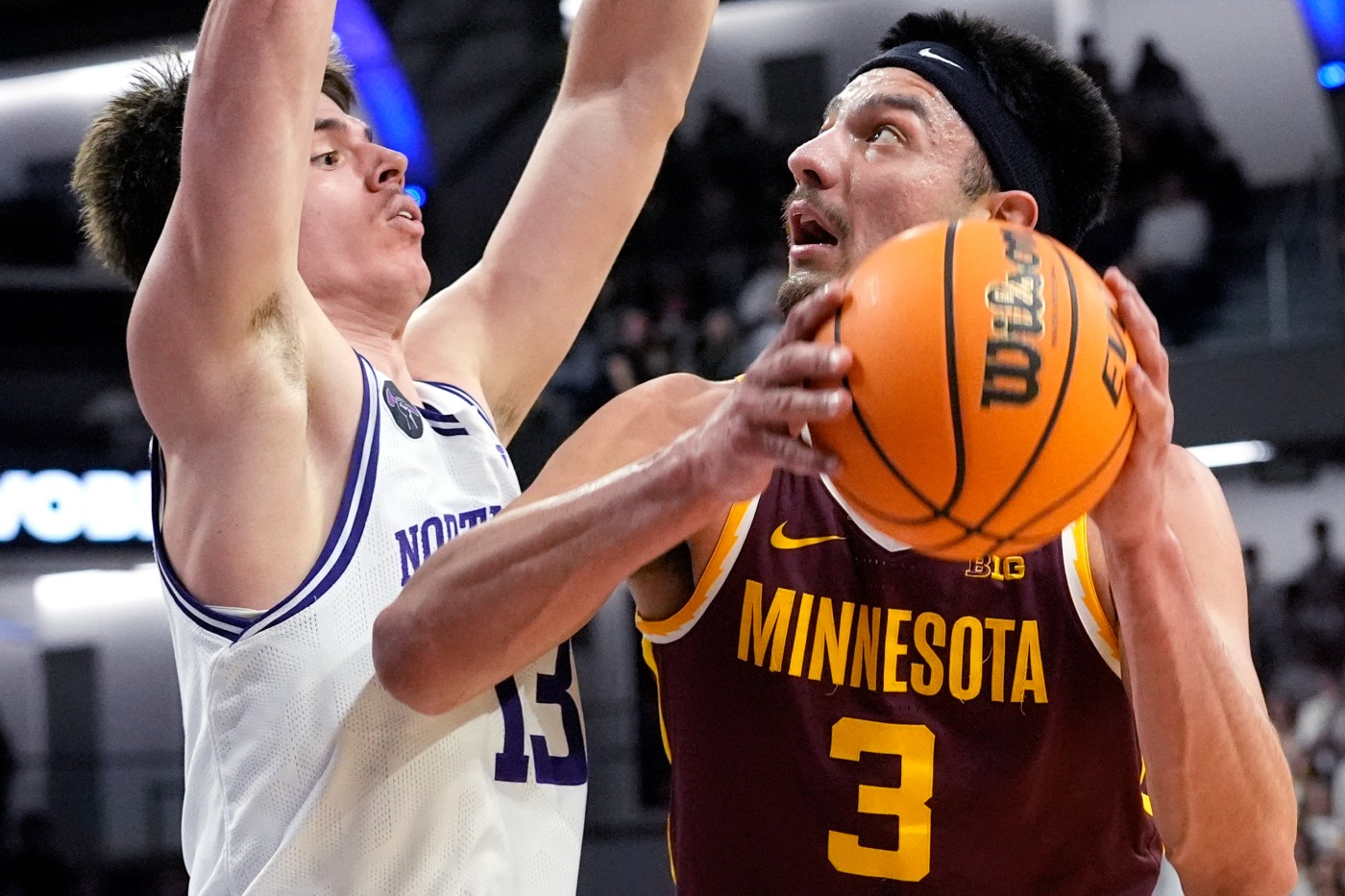
In another sign of the improvement of the Gophers men’s basketball team this season, three players were honored as all-Big Ten Conference performers on Tuesday.

Forward Dawson Garcia was named to the all-Big Ten second team by media members and third team by conference coaches; point guard Elijah Hawkins was honorable mention all-Big Ten by both coaches and reporters, and shooting guard Cam Christie was named to the all-Big Ten freshman team.

Last season, only Garcia was honored by the conference, with the Savage native earning honorable mention nods from both coaches and reporters.

“I’m really proud of them, and I want them to be (proud),” head coach Ben Johnson said. “We had multiple guys that could have had an opportunity to be all-league. Dawson is very deserving of that. Cam is very deserving of being on the all-freshman team. Elijah is very deserving of being honorable mention. Hopefully some other guys are hungry to get some of those next year.”

Garcia leads the Gophers with averages of 17.7 points and 6.7 rebounds per game. Christ was second in scoring at 11.3 points per game, including 40 percent shooting from 3-point range. Hawkins led the U with 7.5 assists per game. He also averages 9.4 points per game.

Forward Parker Fox, who overcame two season-ending knee injuries, also received the U’s sponsorship award. Fox has averaged 4.7 points and 3.1 rebounds in all 31 regular-season games.

The ninth-seeded Gophers (18-13, 9-11 Big Ten) will play eight-seeded Michigan State (18-13, 10-10) at 11 a.m. Thursday in the second round of the Big Ten tournament at Target Center. The winner will play top-seeded Purdue (28-3, 17-3) at 11 a.m. Friday.

Related Articles

College Sports |


Men’s basketball: Gophers fall for fourth time in five games to end regular season

College Sports |


What happened to Gophers forward Josh Ola-Joseph?

College Sports |


Gophers fizzle in home finale, a 70-58 loss to Indiana

College Sports |


Will core of Gophers men’s basketball roster return next season? Ben Johnson hopes so.

College Sports |


Men’s basketball: Gophers overcome awful start, rally to beat Penn State

Democratic protest vote movement over Israel-Hamas war spreads to other states

posted in: News | 0

By Joey Cappelletti, Associated Press

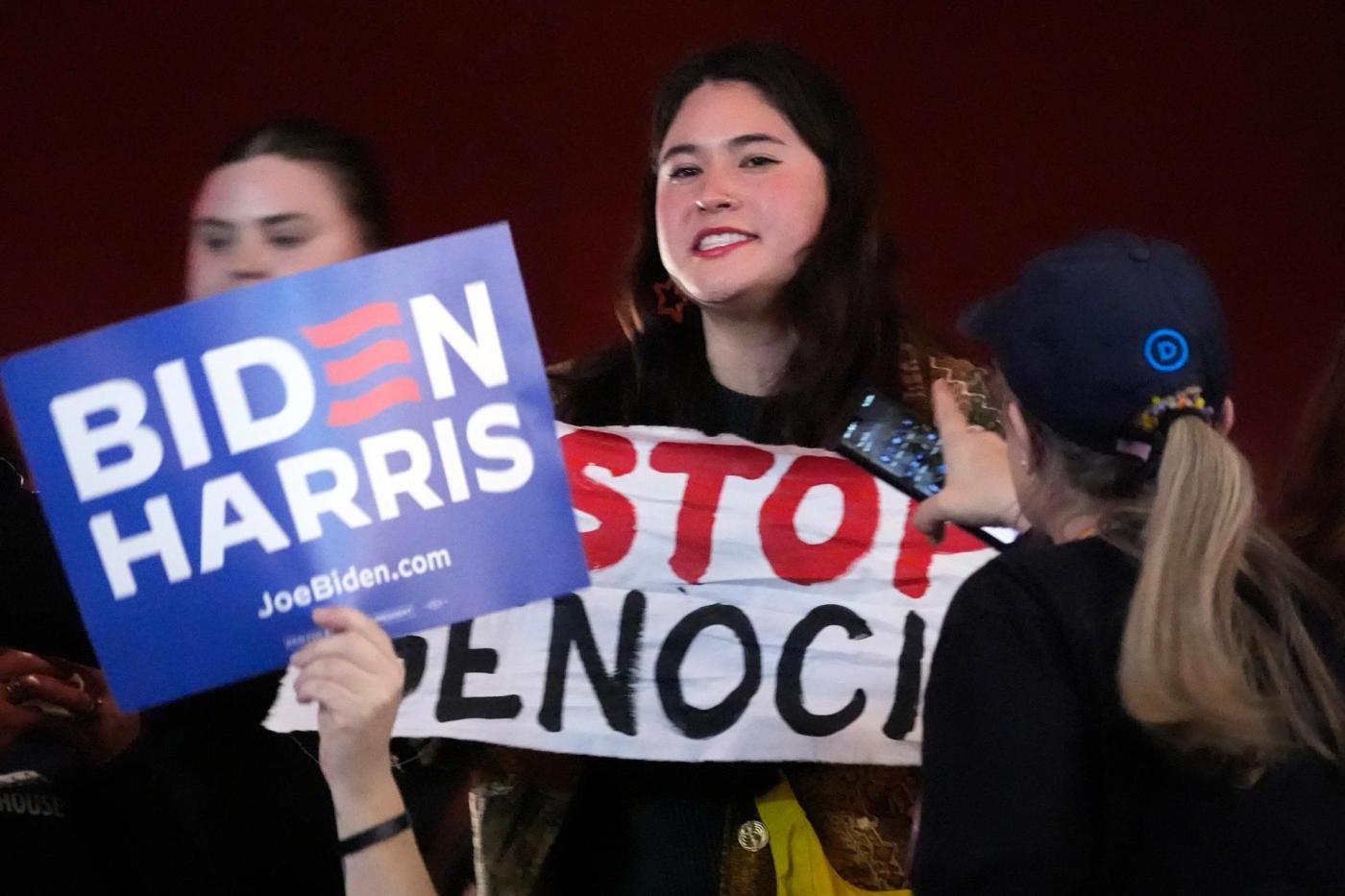
LANSING, Mich. (AP) — The protest-vote movement over President Joe Biden’s handling of the Israel-Hamas war has spread to several states and raised more questions about whether a small but significant number of Democrats angry at Biden might abandon him in November.

A week after 101,000 Michigan voters chose “uncommitted” on their ballots, so did roughly 263,000 voters in the five Super Tuesday states where similar ballot options were available. Minnesota, which had the most organized effort outside of Michigan, saw 1 in 5 Democratic voters mark the “uncommitted” option, a higher percentage than the 13% who voted uncommitted in Michigan.

Organizers are watching the state of Washington’s primary on Tuesday to see how many voters select “uncommitted.” And a “Leave It Blank” campaign has formed for Georgia’s Tuesday primary that’s intended to have the same effect, as is a “uninstructed” vote in Wisconsin’s April 2 primary.

FILE – Pro-Palestinian demonstrators march during a visit by President Joe Biden in Warren, Mich., Feb. 1, 2024. An “uncommitted” campaign protesting President Joe Biden’s handling of the Israel-Hamas war is seeing success in other states after 100,000 Michigan voters chose the option in the Feb. 27 primary. Almost 263,000 voters in the five Super Tuesday states where “uncommitted” or similar options were available did the same.(AP Photo/Paul Sancya, File)

Supporters of the protest argue anger over the war could endanger Biden’s chances in swing states like Michigan against former President Donald Trump in their likely rematch. Biden’s allies believe disaffected Democrats will return to the president’s fold when faced with a choice between him and Trump, who the president’s campaign has argued is a threat to democracy and is planning a sweeping set of policy changes that would attack liberal priorities.

While the reasons for voters favoring unpledged delegates over Biden may differ, the choice has been increasingly pushed as a protest vote against Biden’s handling of the conflict in Gaza, where more than 30,000 people have been killed, two-thirds of them women and children, in Israel’s offensive following Hamas’ Oct. 7 attack that killed 1,200 people.

“We wanted to show that these voters not only morally matter but politically matter as well. Because if they sit out the election, which it seems like many of them might, that would have severe consequences for Biden,” said Waleed Shahid, a Democratic strategist who first organized the effort in Michigan.

Lauren Hitt, a Biden campaign spokeswoman, said following the Super Tuesday primaries that the president “believes making your voice heard and participating in our democracy is fundamental to who we are as Americans.”

“He shares the goal for an end to the violence and a just, lasting peace in the Middle East. He’s working tirelessly to that end,” Hitt added.

As Biden’s supporters are quick to point out, the “uncommitted” vote isn’t a historical anomaly. In 2012, over 400,000 people cast their ballots as “uncommitted” or “no preference,” expressing discontent with then-President Barack Obama’s reelection. Biden has won every state’s primary contest so far and is on track to clinch the nomination this month.

Still, the single-issue campaign has alarmed some of Biden’s closest allies.

Related Articles

National Politics |


Biden’s budget proposal for a second term offers tax breaks for families and lower health care costs

National Politics |


Donald Trump wants New York hush money trial delayed until Supreme Court rules on immunity claims

National Politics |


Who is Robert Hur? A look at the special counsel due to testify on Biden classified documents case

National Politics |


Biden: Netanyahu ‘hurting Israel’ by not preventing more civilian deaths in Gaza

National Politics |


Biden calls out ‘shrinkflation’ as part of a broader strategy to reframe how voters view the economy

“Obama’s results were just randomized. This is showing that there are particular groups of our coalition that are upset,” said Rep. Ro Khanna, a Biden surrogate and cease-fire supporter.

In late January, Shahid circulated a seven-page memo to nearly 100 pro-Palestinian leaders and organizations nationwide with a plan to leverage Michigan’s substantial Arab American population to create maximum electoral disruption.

Michigan’s dual role as an early primary state and a pivotal swing state in November provided an ideal situation for attracting national media attention and influential political figures. Coming less than a month before Michigan’s Feb. 27 primary, the Jan. 29 memo proposed a plan requiring a budget of approximately $237,000 to “politicize and electoralize discontent” for Biden’s support of Israel.

Over 100,000 people voted “uncommitted” on Feb. 27, far exceeding a 10,000 vote goal that had been intentionally set low. Khanna, the California congressman, said Biden’s recent references to a potential cease-fire were a “direct result” of the grassroots movement in Michigan.

Biden announced at his State of the Union speech that the U.S. would build a floating pier to deliver aid to Gaza as Israel has restricted the flow of food and other goods at land ports.

While the state’s primary was a success for organizers, Shahid said his memo “had nothing beyond Michigan.”

Hoping to capitalize on the momentum generated in Michigan, small “uncommitted” campaigns on shoestring budgets began to pop up across the country.

In Minnesota, organizers began making phone calls to voters just five days before the state’s Super Tuesday primary, operating on a $20,000 budget. The last-minute push secured 46,000 “uncommitted” votes, comprising 19% of the total vote share and earning 11 delegates bound for the Democratic national convention.

Minnesota voter Sarah Alfaham voted in the state’s Democratic primary — as she has for many years — but opted to mark “uncommitted” on her ballot.

“Joe Biden has not done enough to earn my vote and not done enough to stop the war,” said Alfaham.

Marcus Casillas, 29, was one of the 51,000 people that voted uncommitted in Colorado’s March 5 primary. The aerospace engineer was inspired by Michigan voters, and chose “uncommitted” rather than another Democratic candidate because “being part of a more organized protest vote seemed appropriate.”

“I firmly believe that in order for me to vote for someone, they need to earn the vote,” he said.

The largest effort outside of Michigan has taken place in Washington state, which is set to hold its primary Tuesday. The biggest labor union in Washington, the chapter of the United Food and Commercial Workers, has endorsed voting “uncommitted” in the primary, as have some local Democratic leaders.

The impact of Washington’s uncommitted movement could be blunted by the fact that its primary is mostly conducted by early mail-in ballots. Close to a million ballots had been turned in as of Thursday, according to the Washington Secretary of State.

But organizers in different states say they feel they’ve already exceeded expectations.

“One of the coolest comments that I’ve read is people saying this is the most organized they’ve seen Democrats in a really long time,” said Asma Nizami, a spokesperson for Minnesota’s “uncommitted” campaign. “We’re doing it across state lines and we’re doing it together.”

Associated Press writer Jesse Bedayn in Littleton, Colorado, and Associated Press videojournalist Mark Vancleave in Bloomington, Minnesota, contributed to this report.