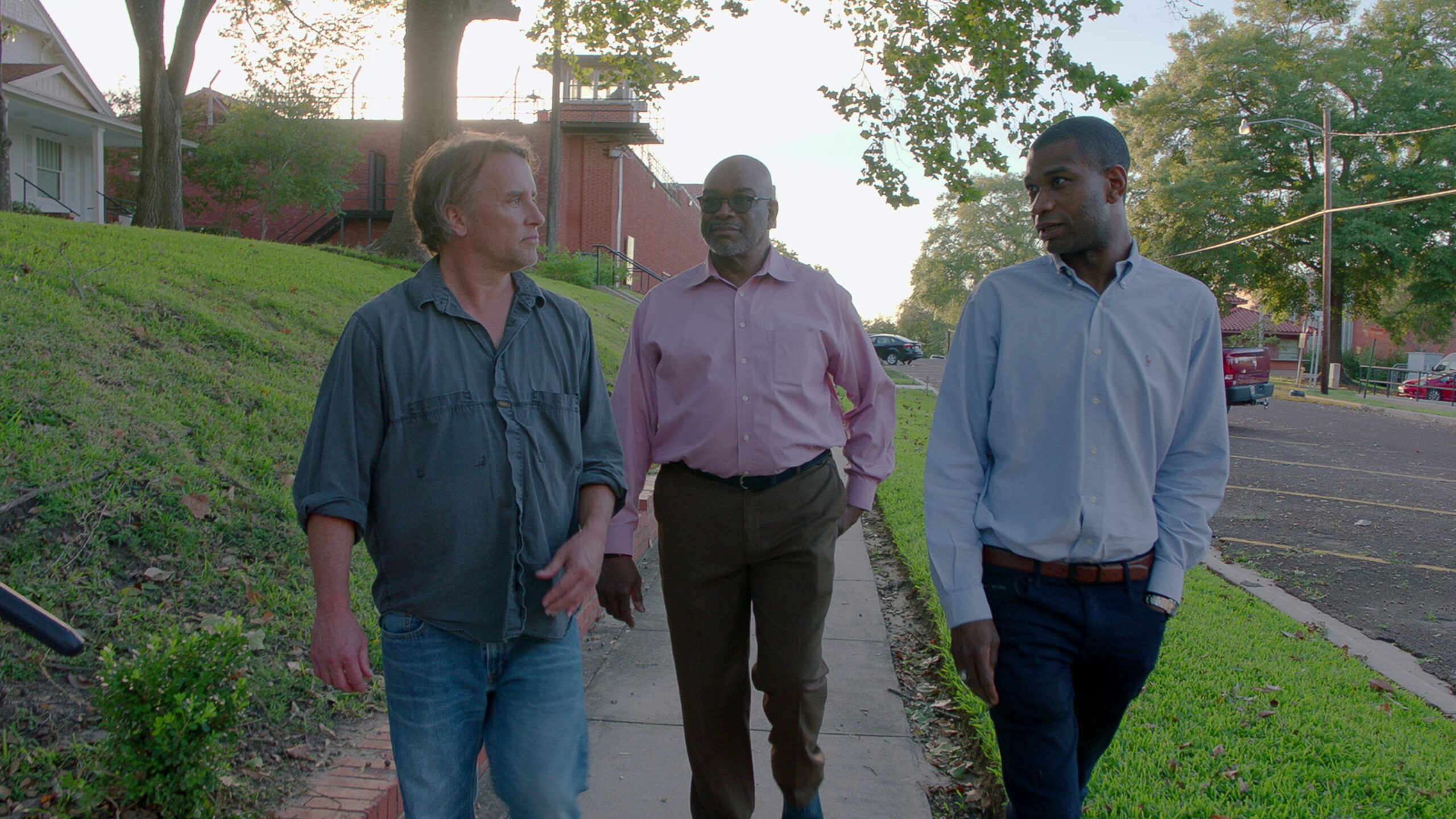
An Open Letter to Richard Linklater on Our Texas Death Penalty

posted in: News | 0

Dear Richard,

Your movie “God Save Texas: Hometown Prison,” which debuted recently on HBO, was joyfully upsetting for me. Kudos to you for loving Huntsville, the complex setting of your formative high school years. Kudos for not moving on, for coming back time and again to the life and culture there in your many films. Kudos for loving the people there but not looking away, bringing your unflinching lens to the things they find hard to see. Spoiler alert: This is a movie review about the human subjects of your film.

Working as a postconviction capital defense attorney for almost three decades, I drove through Huntsville many times a year en route to visit clients on death rows at the nearby Ellis and Polunsky units. Ultimately, upon entering the town on U.S. 190, I would veer off to the north on parallel streets to avoid passing and having to look at your hometown prison, the Walls Unit, where some of my clients had been killed. Unlike the many Huntsville residents who drive daily by the Walls, paying it no attention, I chose to avoid it as an aspect of my self-care.

Others who have taken into their minds and hearts what goes on in the Walls have reacted differently. In your film, when Fred Allen, the former execution tie-down team guard, says he’s opposed to the death penalty, you flash a black-and-white photo of a silver-haired man whose name is David Atwood. Dave, a Catholic peace activist who recently died, is the only person I know who has committed an act of nonviolent civil disobedience at the Walls. Dave frequently traveled from Houston to protest at the Walls on execution days. In November 2004, when a man named Anthony Fuentes was being killed, Dave found himself standing next to Anthony’s grandmother who was shaking from cold and fear. Her husband was inside witnessing their grandson’s death, and, when she said she’d like to get closer to the building, Dave and his wife Peggy accompanied her to the yellow crime scene tape that the guards spread in front of the unit on execution days. Dave suddenly felt he needed to do more. He gave his wallet, keys, and phone to his wife, and he crossed under the tape. After he was arrested, when he was offered no community service or probation for his trespass offense, Dave chose to serve five days in the Walker County Jail rather than pay a fine.

“The death penalty takes one tragedy, a murder, and expands the pain and suffering to include so many others.”

You also captured my friend Dennis Longmire, the bearded Sam Houston State University professor standing as a witness outside the Walls where he has stood on 90 percent of execution days since Texas reinstated capital punishment in 1973. Dennis is compassionate and intelligent, a prolific author of studies on the death penalty and violence.  “Moral disengagement” is one of the subjects he’s explored, “the cognitive restructuring of harmful actions or behavior as good or moral through mechanisms of moral justification, drawing palliative or advantageous comparisons to harmful acts of others, and the euphemistic labeling or use of euphemistic language in regard to harmful conduct.” Although “execution” and “murder” are both the premeditated killing of a human being, we take great care to make execution look nothing like murder. We ritualize and medicalize the procedure. We embrace it as somehow less violent than the crime being punished. 

Near the end of the film, you interview Dennis. He shares how, every time he stands at the Walls, he keeps “the victims as well as the offenders” in his prayers, and he imagines the conversations between the parents and children in the cars driving by. “The ultimate measure of the justice of what we do,” he suggests, “is, ‘Can we rightly explain it to our children?’” 

Then there’s Gloria Rubac, who is just as determined as my other friends to be at the Walls for every possible execution. She always carries her bullhorn, through which she tries to awaken consciences in passersby, loudly accusing the State of Texas of murder. More than once I have lectured Gloria about how if she calls the governor a “murderer” he won’t be able to hear her. Offending him, I tell her, won’t awaken his conscience. And it’s the law itself that is the murderer, not the governor. The law’s designed to kill; it’s the labyrinth that we have tragically built to trap ourselves. All of us. We are all in this thing that we built with no exit and even Governor Ann, a saint among Texas liberals, was as caught up in it as the boys. In the face of all my protests, Gloria is quite unrepentant, just as she appears in your film. She is all about exposing “moral disengagement” without excuses. I’m for that too.

Richard, your mother dated Bill Habern? I knew Bill, an attorney legendary for his expertise on parole issues. With most of my clients in no danger of being paroled, I had spotty interaction with Bill. On one occasion, however, with his help, I and one of his firm’s lawyers collaborated to help a prisoner’s mother have a last visit before her son was executed. The mother had been accused of trying to introduce contraband into the Polunsky death row unit and, as a consequence, she had been banned from the prison under Texas Department of Criminal Justice (TDCJ) rules. Last visits between family members and the condemned are held in the Polunsky visiting area before the prisoner is transported to the Walls. Shortly prior to the execution date, the prison was refusing to let the mother see her son. While Bill’s colleague was negotiating his way through the TDCJ bureaucracy, I drafted a civil rights lawsuit to file if diplomacy failed. It was like the suit Bill describes in your movie: I had next to no idea what I was doing, but it needed doing. As I typed at my computer, the mother lay slumped over a desk on the other side of my Austin office in a catatonic state, surrounded by family rubbing and soothing and cooing, trying to elicit a response from her. Ultimately, TDCJ relented and allowed the mom a noncontact visit surrounded by guards before her son was whisked away.

It is more than interesting to me that you share the story of Bill rescuing Darrell Shaw, who was expelled from Huntsville High School for declining to be paddled by the principal.  

Over the last half-century, American society has moved away from corporal punishment in tandem with its move away from the death penalty. Now, none of the states that have abolished the death penalty allow corporal punishment in the public schools. States that continue to have the death penalty but have abolished corporal punishment are responsible for only 7 percent of all modern executions. I suggest this is no coincidence. Unfortunately, the U.S. Supreme Court largely has limited its investigation into “evolving standards of decency” to questions about the acceptable severity of court-ordered criminal punishments under the Eighth Amendment. However, if the court were to take a broad view of the “evolving standards” as reflected in our changing laws, it would be easy for the court to see that the restrictions on and ultimate abolition of the death penalty fall right in with the strong social and legal currents in our society moving us away from male dominance and justified violence within the family and in society.  

Evolving standards of decency are tantamount to the decline of patriarchy. The author bell hooks defined patriarchy as “a political-social system that insists that males are inherently dominating, superior to everything and everyone deemed weak, especially females, and endowed with the right to dominate and rule over the weak and to maintain that dominance through various forms of psychological terrorism and violence.” This definition essentially describes the law as it stood two centuries ago. Adult white men had a monopoly on rights, wealth, power, everything. But, unquestionably, American and Texas law have evolved, and we have evolved with it. Husbands and fathers may no longer legally treat their wives and children as property nor terrorize them with impunity. Women are no longer prohibited from voting and the male-dominated political, academic, artistic, sports, and business spheres have been flooded with women demanding to be treated equally. 

My mother was born before women could vote. In 1963, she gained the federal right to equal pay. In 1974, she gained the federal right to open her own bank account without a male co-signer. In 1994, Texas finally removed the “marital rape exception” from the law, dissolving a legal shield that had allowed husbands to assault their wives with impunity. Government child protective services began in the 1960s responding to a rise in awareness of the detrimental mental health and social effects of child abuse in the home. By 2005, in this world of rising rights for women and children, the U.S. Supreme Court decided it made no sense to maintain the death penalty for crimes committed by children.

You’ll notice that many prosecutors and politicians who still promote the death penalty as somehow “necessary” are attached to the old patriarchal world. They are likely to support “traditional family values,” with the husband in charge, and to embrace corporal punishment. They believe that respect for authority in society is built upon violence. When your friend Ed, a warden troubled over participating in executions, sought guidance from his pastor, he was told not to worry about God’s chastisement because the law allows capital punishment. Doubtless, the same pastor would refuse to conduct a gay marriage, although the law allows it. He’d say that’s an ungodly law, so he mustn’t follow it. What I think he was really telling Ed is that God requires a measure of necessary violence, that Ed needed to subordinate the feeling he had “when one minute the guy was fine and the next he was deceased” to the righteousness of necessary violence. Long ago, when we built the trap for ourselves that is the death penalty, we buttressed it in Texas with patriarchal religion that promotes domination—children obey your fathers, wives obey your husbands, slaves obey your masters—and the measure of violence perceived as needed to maintain that order. The trap barred compassion.

Richard Linklater with Ed Owens and Trey Owens Courtesy of HBO

Yet, when Fred Allen, your high school football teammate who later served as a captain on an execution tie-down team, met Karla Faye Tucker, she opened the door of compassion to him. There in the holding cell next to the death chamber, while Karla was waiting to be killed by Fred, she asked Fred, “Are you doing okay?” Karla knew that Fred felt troubled and she spoke straight to him and held him tenderly with her words in a time of distress for him. He wasn’t aware of the distress. In other movies, Fred has dramatically described what happened to him when he became aware a couple of days later. Sitting in his shop at home, he heard a news account of Karla’s execution and he began shaking uncontrollably, sweating, and shedding tears.  He saw Karla in front of him and, then, he began to visualize the scores of men he’d led to execution sitting in their holding cells, one right after another. Karla opened the trap in Fred’s mind that had enabled his moral disengagement.

Karla was my client. When Fred was executing her, my co-counsel (George McCall Secrest, lead counsel, and David Botsford, Mac’s co-counsel and my boss) were at the Walls Unit and I, exhausted after a final string of litigation, was alone in our Austin office fielding calls from concerned people as far away as Australia asking about her. Karla was the real thing. The scores of people who visited her at the Mountain View Unit to get spiritual advice recognized that. I’m not aware if she studied Martin Luther King Jr. or Gandhi. But she daily practiced the active nonviolence of Jesus that King and Gandhi articulated. It resulted in the transformed lives of others, like Fred and like me. Some evangelical Christians, of the sort that hawk a gospel of afterlife and normalize systems of oppression, laid hold of Karla as an exemplar. I felt as though they turned her into a tool to advance their proselytizing. I want to correct the record on that. Karla was way more. She held a key to the labyrinth. She was walking with Jesus and when she touched Fred, the captives were released.

Richard, we’ve had common contact with so many people. We also share, I think, a love of place, a sense of duty to our place and people. In discussion with the writer Lawrence Wright, whose book inspired your movie, you talk about Huntsville “radicals” who have the option to move but choose to stay. Wright describes them as cherishing the place they come from in order to help it become something better. I don’t know if you consider yourself one of those radicals, but in my opinion you are. You keep coming back to the place in movie after movie, studying the people, loving the people, being present, looking for understanding, going toward the root. The thing that I intentionally have avoided looking at, in order to manage my own trauma, you portray in almost every other scene: the red-bricked Walls from all sides and the air.  You examine how its architecture of cruelty holds your friends and high school mates. When you come to your conclusion in voice-over as to why you oppose the death penalty, you let them know that you see them in the way Karla let Fred know she saw him. I felt seen too. That is why the film was joyfully upsetting for me. The subject matter is deeply upsetting. But there is no greater joy than to be seen.  

You say, “The death penalty takes one tragedy, a murder, and expands the pain and suffering to include so many others, all the people involved in the legal and criminal appeals process that get dragged slowly to the death chamber, all the obligatory witnesses, and all the people with various jobs in the system.” Then you lay bare the moral disengagement that leads to moral injury: “The Eighth Amendment to the U.S. Constitution specifically prohibits cruel and unusual punishment, but what could be more cruel, certainly unusual, than to have to play a part in or witness another person’s murder, however state-sanctioned?” The U.S. Department of Veterans Affairs defines moral injury as occurring when “in traumatic or unusually stressful circumstances, people … perpetrate, fail to prevent, or witness events that contradict deeply held moral beliefs and expectations.” That is all of us who have any real contact with Texas’ death penalty system. The ones most damaged by the moral injury inflicted by capital punishment are those ensnared in the outworking of the lethal law, whether we are killing or rescuing or bystanding, whether we are aware of the damage or not.

The death penalty is mental torture as defined by the United Nations Convention against Torture. Everyone in contact with the tortured prisoner or the system doing the torturing is subjected to the same threat that constitutes the torture. Richard,  beautifully you put it: We all are “dragged slowly to the death chamber.” We live in a State of anticipatory homicide.


Autopsy: Willmar man died of head injury after being shocked with Taser during eviction attempt

posted in: Society | 0

WILLMAR, Minn. — The death of a Willmar man after a sheriff’s deputy shocked him with a Taser during an attempted eviction in January has been ruled a homicide by the Midwest Medical Examiner’s Office.

According to medical examiners, 75-year-old Michael Yanacheak’s death was caused by blunt-force head injuries suffered when he fell after being shocked with the stun gun.

The Minnesota Bureau of Criminal Apprehension is investigating the matter. The BCA previously identified Yanacheak and Kandiyohi County Sheriff’s Deputy Riley Kampsen as the officer who deployed his Taser.

The BCA previously stated two Kandiyohi County sheriff’s deputies and two Willmar police officers went to Yanacheak’s apartment on the morning of Jan. 29 to perform a court-ordered eviction. Law enforcement tried to persuade Yanacheak to open his door, but he did not respond.

After about an hour, the property manager pried open the door and officers entered to find Yanacheak in a bedroom, where law enforcement agencies stated he picked up a kitchen knife and began to walk toward the officers.

According to the BCA, officers attempted to retreat, but at one point, Kampsen deployed his Taser. Sheriff Eric Tollefson stated in an initial news release that officers provided lifesaving medical care at the scene until Yanacheak could be taken to a hospital.

Kampsen and the two Willmar police officers involved were wearing body cameras. The BCA previously said all available video would be reviewed as part of the investigation. Upon completion, the BCA will present its findings to the Kandiyohi County Attorney’s Office for review.

Yanacheak grew up in Willmar and graduated in 1968 from Willmar High School. He served in the Army during the Vietnam War, according to his obituary. He later worked as a security officer at the Minnesota State Capitol in St. Paul and returned to Willmar following his retirement.

Related Articles

Crime & Public Safety |


In a first, goat in west-central Minnesota tests positive for avian influenza virus

Crime & Public Safety |


Homelessness down 7% in Minnesota since 2018, study says

Crime & Public Safety |


Minnesota court rules pharmacist discriminated against woman in denying emergency contraception

Crime & Public Safety |


Walz seeks $16 million to support struggling EMS providers in greater Minnesota

Crime & Public Safety |


MacKenzie Scott donates $18 million to 9 Twin Cities nonprofits

F.D. Flam: Not even Antarctica could stop COVID. It’s a crucial lesson.

posted in: Society | 0

COVID-19 wasn’t supposed to get to Antarctica. If any place had a hope of keeping the virus out, it would be a continent with no permanent residents and an annual visiting population of only 5,000. And every control measure was in place — testing, a strict quarantine of everyone visiting, as well as lots of deep sanitation, masks and social distancing.

And yet the virus got there in December 2020, less than a year into the pandemic. It arrived at the Chilean base first, spreading to at least 36 people. It later reached the Belgian base, and the Argentinian base, as well as French and British outposts. In 2022, there was a big outbreak at the U.S. McMurdo station, one at New Zealand’s Scott base and even a few cases at the South Pole.

Four years after the start of the pandemic, the frozen continent holds a lesson for the world in how much control we ever had over COVID. Back in March 2020, leaders worldwide talked about getting things under control, without thinking through what this entailed.

COVID in Antarctica “tells us a lot about human arrogance in terms of being above nature and being able to manage all that happens in nature,” said Daniela Liggett, a social scientist at the University of Canterbury who studies Antarctic politics and environmental management. “We couldn’t even lock away this one piece of the planet where nobody lives and protect it from the virus.” She explored the situation and its implications in a paper earlier this month in the journal Science Advances.

Humanity can control what we dump into the environment and emit into the atmosphere. We can exert some control over activities that might transfer animal viruses to humans. But after the fact, it’s nearly impossible to hoover up plastic pollution or cool our artificially warmed planet or control a virus that’s already spread far and wide.

By the end of March 2020, COVID had reached every continent on the planet except for Antarctica, where the summer research season was underway. Before that season was over, most research and tourism to the continent was paused. Scientists scheduled to continue experiments or collect field data were kept out. As months went by, Antarctica went into its dark, cold winter season, and its small skeleton crews remained isolated.

When the next summer research season began in late 2020, however, some researchers and support staff were allowed to return following a strict quarantine. To get to the New Zealand base, people had to be tested and then hole up alone in a hotel room for two weeks, Liggett said, while continuing to undergo daily testing. Once vaccines became available to the general public, the US programs and others required everyone to be up to date on their shots.

Despite all this, disease found a way to sneak in and spread.

That doesn’t mean that Antarctica’s policy was a failure. (I couldn’t find a record of any deaths.) It showed the futility of going for total containment or elimination by cancelling activities and then using quarantines, testing and masks. But rejecting all those measures would have increased the number of cases and the odds that people would die. Before the vaccines became available, it wasn’t all that rare for seemingly healthy people to get a severe case. Such cases would be more likely to turn deadly in a remote outpost far from a hospital.

The decision to resume Antarctic research activity struck a balance between the risks of disease and the benefits of conducting research that can’t be done elsewhere. The few Antarctic regions not covered in ice are full of lakes where scientists have found improbable life forms, giving them clues to the way life might survive on other worlds. Some scientists are monitoring the effects of global warming on the ice sheets, and others are monitoring the accumulation of microplastics and PFAS (forever chemicals) on the Antarctic ice and in the surrounding seas. Others study ghostly particles or astrophysical phenomena.

Shutting down everything even for part of one season had consequences. Careers were derailed, said Liggett, because researchers couldn’t get to the continent to finish field studies or experiments. For young investigators in competitive fields, that could make the difference between getting established and starting over.

Now, she said, researchers in Antarctica don’t spend all that much time worrying about COVID. They’ve moved on — because that’s what everyone is doing worldwide. And doing research in such extreme conditions has always required some appetite for balancing risk and reward.

Today, fact checkers, ignoring the complexity of the real world, try to argue that the virus is “under control” in the U.S. despite a continued weekly death toll in the hundreds. But what counts as “under control” is inherently subjective and often politically malleable.

We can’t control what’s already unleashed. Perhaps the best we can hope for is finding a balance, imposing some precautions but also accepting some risk.

F.D. Flam is a Bloomberg Opinion columnist covering science. She is host of the “Follow the Science” podcast.

Related Articles

Opinion |


Jay Ambrose: The test Biden can’t pass

Opinion |


Thomas Friedman: What Schumer and Biden got right about Netanyahu

Opinion |


F.D. Flam: Do you really want to find out if you’ll get Alzheimer’s?

Opinion |


Stephen L. Carter: What leash laws for dogs tell us about humans

Opinion |


Andreas Kluth: Don’t fear AI in war, fear autonomous weapons

Developing St. Paul’s Midway: A new hotel, office building, 90-foot-wide loon …

posted in: News | 0

The primary structures of a sizable new playground are now in the ground by Allianz Field, the professional soccer stadium in St. Paul’s Midway.

A sculpted loon measuring some 35 feet in height, with a wing span 90 feet across, will roll in from Los Angeles this summer and land, permanently, at the southeast corner of Snelling and University avenues, arriving in as many as 40 pieces and four truckloads.

On April 1, the St. Paul Board of Zoning Appeals will host a public hearing on a series of variance requests related to two single-story food pavilions proposed along the eastern edges of United Village’s “Great Lawn.” The pavilions, with covered outdoor dining terraces, will host both a full-service restaurant and more casual dining between extensions of Asbury, Simpson and Spruce Tree streets, just south of an eight-story, 160-unit hotel and adjoining parking ramp planned along University Avenue.

As for the longstanding McDonald’s on University Avenue, its lease ends in December. Demolition could follow.

A rendering depicting the pedestrian plaza that would connect two single-story food pavilions along the east end of the Great Lawn, the greenery at the center of the United Village area surrounding Allianz Field in St. Paul’s Midway. (Courtesy of Snelling-Midway Redevelopment)

‘Superblock’

After years of waiting for real estate development to fill in the empty lots of the 35-acre Snelling-Midway “superblock,” neighborhood advocates are cautiously optimistic that United Village will become reality.

On the horizon, at least in concept drawings, is some $200 million in private real investment, on top of upwards of $6 million in contributions from Dr. Bill McGuire’s family foundation for the new all-abilities playground and the acre-sized sculpture garden.

“Allianz Field has many great features,” said McGuire, owner of the Minnesota United soccer team, addressing neighborhood residents last week during a community forum at Allianz Field. “One of them is its architecture … but its greatest feature is how it works for people. That’s the reason it was voted the No. 1 experience in any stadium in North America, and I think this represents an opportunity to do very similar things in the community.”

McGuire, who recently paid $54 million to buy 10 parcels of land from former property owner RK Midway, has now taken the lead in redeveloping the 35 acres once associated with the former Midway Shopping Center and a blighted bus storage lot.

More than ever, it’s put him front and center in discussions about the future of not just the stadium, but the well-being of the surrounding Midway neighborhood, which has lost a series of anchor restaurants and retailers over the past four years.

A rendering showing the future layout of the United Village area surrounding Allianz Field in St. Paul’s Midway. (Courtesy of Snelling-Midway Redevelopment)

A chain-link fence that separated the empty lots near Snelling and University avenues from the community was not his idea, said McGuire, responding last week to a question from the audience. He pinned blame squarely on the city and the Minnesota Department of Transportation.

“We should get our facts straight,” he said. “Bill McGuire had nothing to do with that fence. I neither asked for it nor condoned it.”

He hopes to turn the perception of blight around, but even if financing comes through this summer, construction of four new buildings will take 14 to 16 months, he said.

“Our intent is to do them all together,” he said.

Goodbye, McDonald’s — unknowns ahead

Creation requires destruction, and the lease held by the superblock’s last remaining commercial tenant — the drive-through McDonald’s — ends at the end of December, setting the stage for demolition and then hotel construction about a year from now. Asbury Street will be extended through the center of what had been the fast food restaurant, completing the street grid.

An architectural rendering of a proposed eight-story hotel to be built by the Allianz Field soccer stadium in St. Paul, with a south wall entrance facing the “Great Lawn” and a north wall entrance set back several dozen feet from University Avenue to accommodate a passenger drop-off loop running the length of the building.(Courtesy of Snelling-Midway Redevelopment)

McGuire informed residents that the proposed parking structure adjoining the hotel will feature a public restroom with outside access from the Great Lawn, an amenity that many see as important toward elevating the green space into a true community asset.

There are still many unknowns. If McGuire has a hotel partner in mind, he’s staying mum. For the two food pavilions, “exact operators have not been selected,” reads the supporting materials behind the variance requests, which mostly center on ground-floor windows and door openings.

It’s unclear if the management behind Minnesota United will relocate from Golden Valley and move into an airy, four-story office building, depicted in conceptual renderings with large glass windows and wide-open work areas.

Ground-level restaurants and retailers also are expected in the hotel and office building, but those partners haven’t been chosen, either. McGuire said he had no interest in big-box retail or national chains and was courting smaller, locally-driven ventures. He said he was excited about “the opportunity (United Village) represents for the community and for the city to express itself and bring new and interesting things to the area. … I think it remains up in the air what the retail will ultimately be. You all can look around and see that retail has a lot of empty space.”

Other challenges ahead

There are other challenges ahead. Finding financing for the hotel, office building and two food pavilions has been a difficult slog, in part due to interest rates that have risen to “8 1/2% or 9% if they like you,” McGuire said. “This a terrible market … globally for financing, getting debt and finding investors in particular projects. That is a full-time occupation and a half, and not easy.”

Nevertheless, “I remain confident that we have the people in this that will step forward,” he added. “They have committed to that, and I expect them to be there. Hopefully, we can be shoveling, at least moving some dirt around in a few areas, specifically the office building and the restaurants in late summer.”

Some residents have expressed concern that the proposed buildings will be situated to present their back doors to the surrounding neighborhood. McGuire said the goal is to form a ring around the Great Lawn, elevating the space as a center of activity while promoting foot traffic, almost like the quad of a college green.

“Virtually every street (will be) bounded by sidewalks in a world where there was once no sidewalks,” McGuire said. “These are 12- and 15-foot sidewalks, which are very large, I suspect larger than any sidewalks you could find in the Twin Cities almost.”

As the four buildings come online, street improvements and other public amenities will be paid for in large part through property tax incentives known as tax increment financing, which the St. Paul City Council approved in 2021. The $209 million “TIF” district effectively redirects payments that would otherwise flow to city, county and school district tax coffers over the course of 26 years, focusing them instead on on-site land improvements.

“The city is making a real commitment in TIF, but it is spread out for years to come,” McGuire said. “If the buildings don’t happen, TIF doesn’t happen.”

The March 14 community discussion was hosted by the Hamline Midway Coalition and Union Park District Council.

Related Articles

Local News |


Ooey, gooey, delicious: Six of the best hot cheese dishes on Twin Cities restaurant menus

Local News |


St. Catherine University appoints veteran college administrator as new president

Local News |


Prosecutors: St. Paul officer’s fatal shooting of man, 65, was legally justified

Local News |


Mother of 23-year-old fatally shot in St. Paul: ‘There will be justice for Devon’

Local News |


St. Paul man pleads guilty to stabbing wife to death during Bible study