The progun shibboleth that “The only thing that stops a bad guy with a gun is a good guy with a gun” has become so commonplace that it’s easy to forget its grisly origin.
In 2012, after a 20-year-old with severe mental illness who was raised by a gun-loving mother killed 20 first graders at a Connecticut elementary school, National Rifle Association (NRA) President Wayne LaPierre made the phrase his opening salvo in what would become a successful campaign to derail national gun control legislation. Only “properly trained, armed good guys,” he claimed, stand between America’s vulnerable children and its “genuine monsters.”
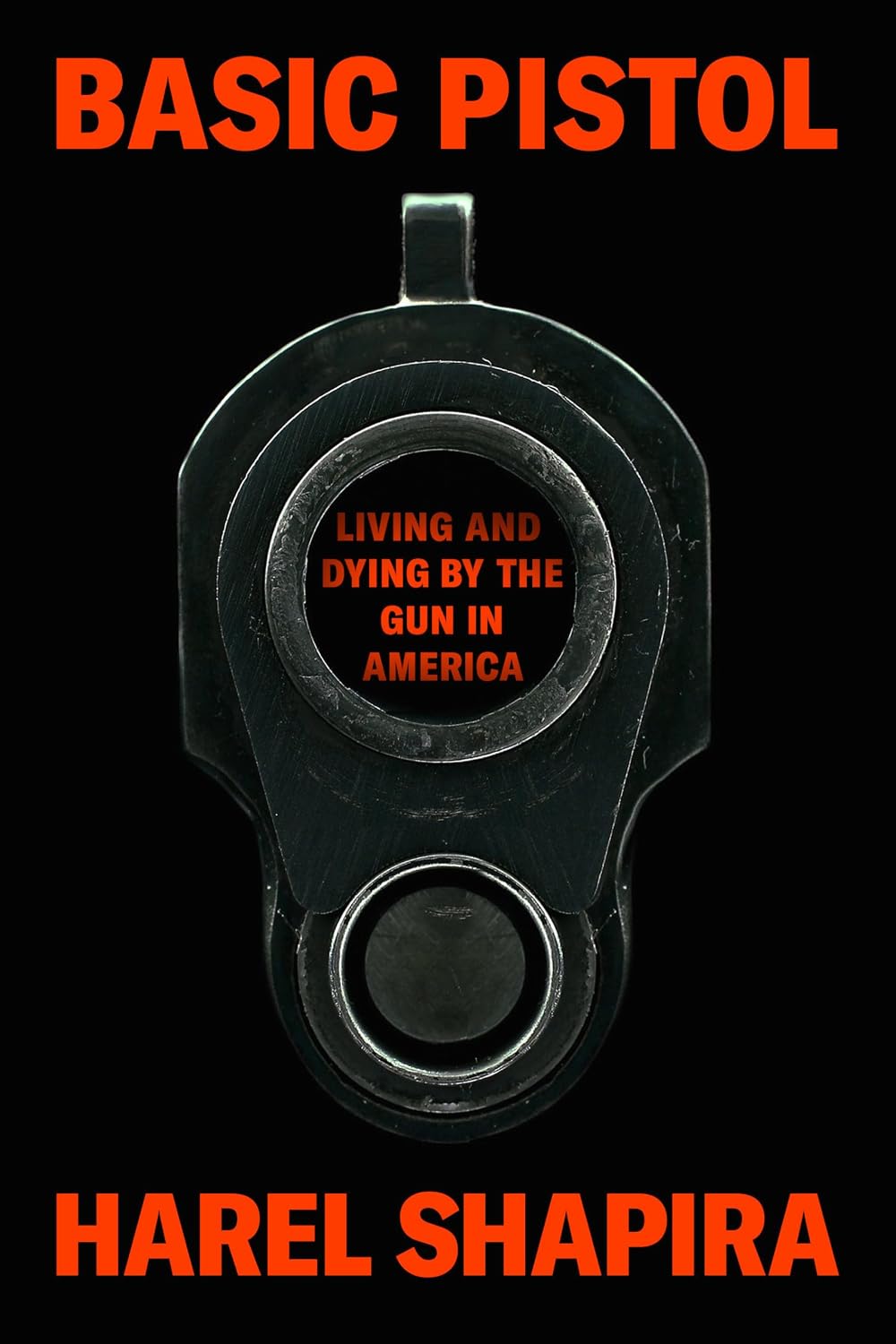
The year after Sandy Hook, sociologist Harel Shapira took an academic appointment at the University of Texas at Austin and began spending time where many of America’s gun-owning “good guys” are ostensibly being forged: the firearms training center. While his new book-length culmination of that research, Basic Pistol: Living and Dying by the Gun in America, briefly mentions the time he spent at schools in crunchy Portland, Oregon, and liberal suburban Massachusetts, the bulk of Shapira’s narrative unfolds in the rural middle of the Dallas-Houston-San Antonio triangle, where Shapira participated in a legion of courses at a center he pseudonymizes as “Tactical Training.”
While Texas is often typecast as “the mythic heart of American gun culture,” Shapira argues that it is more bellwether than avant-garde. In 1995, under then-Governor George W. Bush, it became the 22nd state to pass a concealed carry law, which gave Texans the right to carry a handgun in public, provided they completed a training course. Firearms classes boomed and increasingly specialized in training citizens in armed self-defense, a once-rare rationale for gun-owning that would soon eclipse hunting or sport as the dominant justification. They became settings where Texans were inculcated not just with the rudiments of gun use but with a whole way of life.
“I guess you could call it a church,” Tactical Training’s main instructor admits to Shapira, while another teacher jokes that while his wife “carries a rosary … I carry a gun.”
Basic Pistol: Living and Dying by the Gun in America
The comparison is apt. In this book, there are fire-and-brimstone preachers and enthusiastic converts. (Apostates are much rarer.) There is an agreed-upon catechism and points of dogmatic dispute, such as the NRA’s recommendation to always keep your gun unloaded, which Shapira’s instructor ignores, declaring that doing so is an undue burden. There is a sly mingling of faith and commerce, wherein the exhortation to believe tends to be followed by the injunction to open your wallet. There are patron saints and pilgrimages to holy sites, like the school of a famed instructor who brags about his former students who have been involved in self-defense shootings. Above all, there is an intensely felt moral Manichaeanism: The armed and virtuous elect must prepare to enact righteous violence against the evil perpetrators who seem to lurk around every corner.
Tactical Training’s main instructor, whom Shapira pseudonymizes as “Tom Krone,” claims that self-defense is a natural evolutionary instinct, “something humans have been doing since the dawn of time.” But Shapira’s book clearly depicts how firearm training centers assiduously cultivate a hair-trigger sensibility. The good guy with a gun is made, not born, and he is made through fear.
Basic Pistol is full of descriptions of macabre role-playing games, often requiring students to imagine how they might react to witnessing a loved one’s rape. An instructor says he even brought his own daughter to act in a scenario in which she is sexually assaulted. Tactical Training’s lessons also routinely foreground mentally disabled people, who are portrayed as “irrational forces of violence” incapable of feeling pain, giving the student with a gun no choice but to wield it.
Shapira’s instructors claim to be cribbing their confected scenarios from real-life stories in the news. Their training, they argue, simply reflects the violent reality of a world where, as one instructor puts it, “evil is everywhere.” But Shapira punctures the pretensions of this hard-bitten realism. In one revealing example, the students are presented with a scenario in which a restaurant owner is closing up shop and comes across a deranged drunk person, who violently attacks. Shapira reads the corresponding newspaper clipping and learns that the owner had simply encountered a homeless man who’d come into the restaurant after it closed, looking for food and a bathroom. The exchange was completely nonviolent. In the dog-eat-dog world of Tactical Training, however, such an encounter with a stranger is no occasion for dialogue, let alone mercy.
The result of this social conditioning is that many of Shapira’s fellow students live in what he calls “a never-ending loop of risk perception and reduction.” Workaday encounters with fellow citizens, such as eating at a restaurant or filling up on gas, become freighted with mortal peril. In one darkly comic scene, Shapira has a video call with an instructor who demonstrates how he keeps his gun at the ready while sitting on a public toilet. (It’s more complicated than you might think.) Shapira writes that his instructors wanted him to draw, aim, and fire so frequently—including by practicing at home without live ammo, like Travis Bickle in Taxi Driver—that it became “automatic, instinctual.”
A few months into his time at Tactical Training, one of Shapira’s instructors confronts, in real life, the kind of scenario that firearm classes are designed for. Early one morning, a young Black man whom Shapira calls “Isaac” breaks down the front door of an instructor he calls “Michael.” After yelling at Isaac to leave, Michael shoots him five times, including once in the back, killing him. He refuses a request from his 911 dispatcher to check if Isaac is alive. “’Cause I am thinking, ‘Dude’s got friends,’” he tells Shapira.
Isaac turns out not to be a burglar trailed by shadowy accomplices, but rather a young man suffering from severe mental disabilities who, seemingly in distress, had run out from a nearby home for people with special needs. He is the sort of person routinely dehumanized by Tactical Training’s instructors as both subhuman and superhuman, and, in the wake of the killing, the instructors vilify him in familiar terms. Krone calls him “a crazy person who doesn’t feel pain”; another describes him as “retard strong.” The police deem the shooting a justifiable homicide.
Debates about gun violence, whether committed by private citizens or police, tend to narrow the aperture to the moment of the shooting alone, to focus on the question of what was in the gunman’s mind when he pulled the trigger: Did he fear for his life? Shapira deems such questions secondary. Isaac’s shooting was, he argues, “not a split-second decision but rather the outcome of a long process.”
More important are the ways American gun culture has socialized millions of people to believe in the necessity of carrying machines designed to kill—and in the righteousness of using them against subjectively perceived threats. Michael himself articulates his pride at how “mechanically proficient” the killing was; he compares it to how, for an academic like Shapira, typing on a computer must become second nature.
The gun control movement is animated by the tragedy of deaths like Isaac’s, and rightly so. But Basic Pistol also suggests a deeper tragedy wrought on the relationships of trust and mutuality that make American democracy possible in the first place. The gun lobby likes to claim that an “armed society is a polite society.” But Shapira’s sobering book reveals more of a Hobbesian war of all against all, one in which our neighbors appear as so many potential threats to our lives and liberty, rather than equal members of a shared democratic project.
The post Why Texans Live and Die by the Gun appeared first on The Texas Observer.
Leave a Reply