Authorities in Gardner locate murder suspect’s car in wooded area

posted in: News | 0

Investigators have located the vehicle belonging to the Gardner man accused of killing his wife in their home Sunday.

Police were looking for 33-year-old Aaron Pennington, who is wanted in connection with Sunday’s homicide of 30-year-old Breanne Pennington in Gardner. (Massachusetts State Police photo)

A bow hunter on Monday night located a white BMW abandoned in a wooded area at Camp Collier, a camp that according to the Boy Scouts Troop 54 website serves Boy Scouts expeditions. Worcester District Attorney Joseph Early Jr. confirmed the vehicle belonged to Aaron Pennington, 33, who is accused of killing his wife, Breanne Pennington, 30, in their Cherry Street home in Gardner Sunday.

“The vehicle was located by a hunter. So we’re asking anyone with trail cams, any hunters, any people with video cameras at their houses, please give it to the police,” Worcester District Attorney Joseph Early Jr. said in a press conference Tuesday afternoon. “It’s incredible how often that these tips help us solve crimes, find people. So we’re asking the public for all of their help right now.”

Gardner Police Chief Eric McAvene said at the same press conference that the areas authorities are most interested in seeing cam footage “in the old county area of Ashburnham, out to the Route 101 area.”

He said that anyone with footage or information to share should contact Gardner Police by calling 978-632-5600 or by contacting the Massachusetts State Police Detective Unit for Worcester County at 508-832-9124.

The Pennington children are in the custody of the Department of Child and Family Services, Early said.

Early said that authorities are working under the assumption that Aaron Pennington is armed and dangerous and that professionals are tracking him “with an abundance of caution” and urged that “no one in the public go out and try and look for this guy.”

This is a developing story.

31 cities, regions selected as federal tech hubs for AI and biotechnology

posted in: Politics | 0

By Lorraine Mirabella, Baltimore Sun

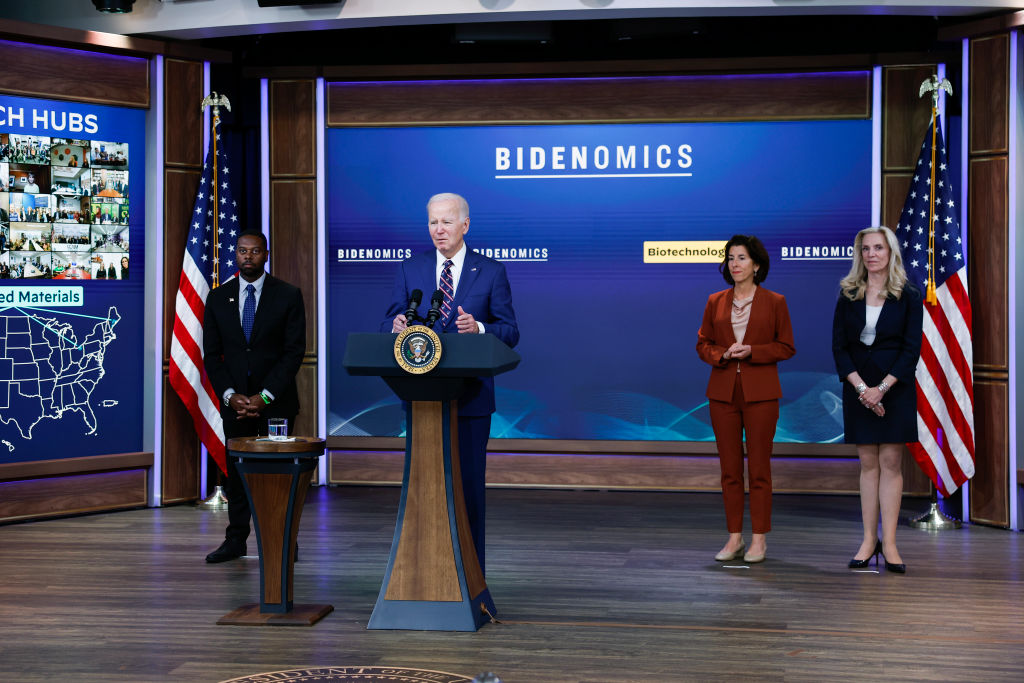
Thirty-one cities and regions have been awarded federal designation as national tech hubs. President Joe Biden announced the hubs Monday, part of a program designed to invest in high-potential U.S. regions and make them globally competitive in emerging technologies.

The $10 billion federal initiative, approved as part of the CHIPS and Science Act of 2022, aims to spur technology-related manufacturing and commercialization in parts of the U.S. with potential to become globally competitive and create jobs in 10 years.

The program aims to diversify technology investment and development beyond Silicon Valley, Boston and New York, which currently attract 80% of tech funding.

The 31 hubs — located across 32 states and Puerto Rico in urban and rural regions — were selected from nearly 400 applications. Hubs are organized around eight general categories, such as autonomous systems, quantum computing, biotechnology, precision medicine, clean energy advancement and semiconductor manufacturing, with each hub specializing in specific technologies.

U.S. President Joe Biden listens as Mark Anthony Thomas, the President & CEO of the Greater Baltimore Committee & Baltimore Tech Hubs coalition, introduces him at an event at the South Court Auditorium in the Eisenhower Executive Office Building at the White House on October 23, 2023 in Washington, DC. During the event Biden spoke on how his administration’s “Bidenomics” agenda would invest in technology for people in the United States. (Photo by Anna Moneymaker/Getty Images)

Each of the 31 designated hubs will be eligible to move on to a second phase to apply for funding for specific projects. An initial pool of $500 million of the $10 billion has been allocated to distribute among all hubs in the first phase. Hubs are able to apply for $40 million to $70 million each.

A closer look: Baltimore tech hub

The Baltimore region, which includes Baltimore and seven surrounding counties, was selected for the federal Tech Hubs Program, putting the area in line for a share of $10 billion in federal funding over five years, including $500 million appropriated for the initial round.

Mark Anthony Thomas, president and CEO of the Greater Baltimore Committee, joined other designees for the announcement at the White House. The GBC organized the region’s bid, which was developed by a 38-member consortium of business and technology leaders.

“This designation will catalyze a transformative era of growth, innovation, and equitable economic opportunity for our region,” Thomas said in a news release.

The designation is expected to generate $4.2 billion in economic impact and 52,000 jobs by 2030, according to GBC estimates.

The regional hub plans to focus on artificial intelligence and biotechnology, a combination still in the early stages of adoption. It refers to the use of artificial intelligence and machine learning on health data for applications such as diagnostics and drug development.

“By harnessing the power of data science and biotechnology, we stand poised to become pioneers in predictive health, with positive impacts on individual patient well-being and community health,” said Dr. Mohan Suntha, president and CEO of the University of Maryland Medical System and chair of GBC’s board. “The possibilities for our region are limitless.”

Members of Maryland’s congressional delegation said Monday that they expect the program to jump-start high-tech industries and entrepreneurs across the Baltimore region.

“This is about creating new jobs and emerging industries for the long term,” said a statement from the delegation’s Democratic members, including Sen. Ben Cardin, Sen. Chris Van Hollen and Reps. Dutch Ruppersberger, John Sarbanes, Kweisi Mfume and David Trone.

The designation will bring national and even international attention to the Baltimore region’s potential and its place at the forefront of tech innovation, said Gov. Wes Moore, also a Democrat.

It “will help grow a more equitable economy that will expand opportunity, lead to better outcomes for our residents and make us an internationally leading innovation hub,” Moore said in a statement.

Baltimore submitted its application in August to the U.S. Department of Commerce’s Economic Development Administration. A group of area businesses, colleges and universities, workforce development experts, and state and local government officials are expected to work together to develop the hub.

The bid touted the Baltimore region as an established home to more than 400 tech startups with access to federal and academic research and development spending and more than a dozen accelerators supporting companies. The region also has a history of commercialization in medical diagnostics, health care analytics, medical devices, and gene and drug therapeutics, the application said.

“For years, the city of Baltimore and the entire region have been nurturing a growing tech industry and welcoming Baltimoreans from all walks of life to help shape the future of tech,” Baltimore Mayor Brandon Scott said in a statement.

The official designation will help accelerate that work, spur new innovation and attract residents, the mayor said.

Baltimore County Executive Johnny Olszewski Jr. called the planned hub creation a “game-changer” for the region.

He said he expects the designation to help “provide the support, resources, and opportunities we need to create jobs, grow communities and transform the entire Baltimore region into an innovative hub that create the tools of tomorrow.”

Baltimore’s hub will look to combine artificial intelligence, machine learning and autonomy with biotech, medical technology, genomics and synthetic biology, and to commercialize technologies that can improve health at individual, community and national levels.

The technology can be used in areas such as clinical decision-making, bioethics, development of personalized medicine and new therapeutics. Other goals include developing advanced biomanufacturing capabilities and advanced med-tech manufacturing.

The Baltimore consortium has identified 40 tech-related projects requiring $700 million in funding.

Other hubs that will focus on “advancing biotechnology: precision and predication” like Baltimore include the Wisconsin Biohealth Tech Hub, the Birmingham Biotechnology Hub, the Minnesota MedTech 3.0, and the Greater Philadelphia Region Precision Medicine Tech Hub, which will focus on end-to-end precision medicine in Pennsylvania, Delaware, Maryland and New Jersey.

Another neighboring hub includes the Advanced Pharma Manufacturing Tech Hub in Virginia.

How to plan for a potential inheritance

posted in: News | 0

The amount of wealth millennials and Gen Xers stand to inherit from their parents and grandparents almost defies comprehension: According to Cerulli Associates, a Boston-based research and consulting firm, $84.4 trillion in wealth will be transferred between 2021 and 2045, primarily from baby boomer households to younger generations.

Inheritances aren’t just for the rich: Less than half of the total volume of transfers is expected to come from high-net-worth households.

“It’s a really unique point in history because of the amount of wealth,” says Chayce Horton, senior analyst on the wealth management team at Cerulli. “It’s something we haven’t seen before.”

As a result of that magnitude, inheritance recipients might not know what to do with one, and whether to count on the windfall before it arrives.

If you’re wondering whether to broach the topic of a potential inheritance with your own parents or grandparents, here are some guidelines financial experts recommend:

Talk about inheritance early

“If parents haven’t brought it up with you, you need to bring it up with them,” says Isabel Barrow, director, financial planning at Edelman Financial Engines, an independent financial advisory firm. “We know if you don’t talk about it ahead of time, there are going to be problems.” She says these can include fights between family members, confusion over what to do with the money or even uncertainty about where to find the most updated version of a family member’s will.

Barrow suggests raising the topic while the entire family is together at holidays or birthdays when everyone is in a good mood. “That might be an opportunity for you just to mention, ‘Hey, I’m doing my financial planning and they suggested I talk to you about your plan,’” she says.

Mitch Mitchell, products counsel with Trust & Will, an online estate planning company, says it can be helpful to tell your parents that you are trying to plan for something that is going to be hard for you. He suggests saying something like, “It would be a gift if you can map this out.”

Respect cultural differences

Some cultures and generations are less comfortable talking openly about money than others, says Leo Chubinishvili, a wealth advisor at Access Wealth in East Hanover, New Jersey. Respecting those differences can help prevent unnecessary tension and discomfort. “It depends on the cultural setting of your family and how you were brought up,” he says.

While Chubinishvili says all families should talk about money in some capacity, some families might take longer to warm up to the subject or might benefit from the help of a financial professional leading the conversation.

Make sure the money is safe

Another benefit to talking about a potential inheritance with your parents is that it gives you the chance to offer assistance, should they need it. “Every parent should start disclosing assets and accounts to their kids for multiple reasons, but number one, for safety and security,” says Walter Russell, chief executive of Russell and Associates, an investment firm in New Albany, Ohio.

“As parents start aging, they might forget about an account,” Russell says, and seniors are also targets for scam artists. If you know more details about your parents’ finances, then you can more easily notice discrepancies and help keep their money safe.

Plan to spend it wisely

Whether it’s $5,000 or $500,000, an inheritance can open up possibilities that you hadn’t previously considered, like a vacation or dream home. But financial experts recommend first focusing on less exciting financial expenditures, like paying off debt and shoring up savings.

“You can start cleaning up your financial house if you’ve paid off debt and build yourself a good emergency fund with six to 24 months of living expenses,” Barrow says. After that, she suggests thinking about funding your intermediate and longer-term goals around housing, cars, education and retirement. She adds that using part of an inheritance to celebrate your loved one’s life in some way, whether it’s a trip or nice dinner, can also be a way to honor them.

Don’t bank on it

“The market could turn, the family business could go bankrupt. You don’t want to plan your retirement or entire financial plan on that inheritance,” says Laurie Smith, a partner at Wiss, an accounting and tax firm in New Jersey.

There’s also the possibility that your parents will need that money while they’re still living. “What if, 10 to 15 years from now, one of your parents has dementia and needs to go into a nursing home? You’re talking $200,000-plus a year that the parent might need to be using. Or your parent might decide to leave their money to their favorite charity,” Barrow says.

In other words, an inheritance is never guaranteed. That’s why it makes sense to talk with your parents about their plans while continuing to make sure your long-term goals — such as saving for retirement — don’t rely on a windfall, since one may never come.

This article was written by NerdWallet and was originally published by The Associated Press. 

Kimberly Palmer writes for NerdWallet. Email: kpalmer@nerdwallet.com. Twitter: @kimberlypalmer.

As Trump glowers, Michael Cohen takes the stand against him

posted in: Politics | 0

NEW YORK — Michael Cohen, Donald Trump’s onetime loyal aide turned vocal antagonist, took the witness stand Tuesday to testify against Trump in a $250 million civil fraud trial, telling the judge that the former president ordered Cohen to falsify financial documents.

In measured tones, Cohen testified that when he worked for Trump as his lawyer and fixer, Trump directed him to modify documents that represented Trump’s net worth so that they reflected the number Trump desired.

“I was tasked by Mr. Trump to increase the total assets based upon a number that he arbitrarily elected,” Cohen said, “and my responsibility, along with [former Trump Organization CFO] Allen Weisselberg, predominantly, was to reverse engineer the various different asset classes, increase those assets in order to achieve the number that Mr. Trump had tasked us.”

As Cohen delivered that testimony, Trump, who was seated at the defense table, grew red in the face and shook his head. Trump didn’t look at Cohen as he entered the courtroom, but as Cohen spoke on the witness stand, Trump trained his eyes on him and either crossed his arms or leaned forward over the defense table.

Cohen didn’t look at his former boss as he testified, instead directing his attention entirely to the lawyer from the New York attorney general’s office who was questioning him.

Cohen is one of the central witnesses in Attorney General Tish James’ case against Trump, which accuses him, his adult sons and his business associates of inflating his net worth in order to obtain favorable terms from banks and insurers.

Cohen’s testimony Tuesday marks a fresh front in his efforts to take down Trump after years of defending him. That defense ended five years ago, when Cohen pleaded guilty to federal campaign finance crimes that he and federal prosecutors said Trump directed him to commit, and Cohen began speaking publicly about his former boss as a coward and a “con man.”

In the intervening years, the two traded endless barbs — with Trump calling Cohen a liar and a “rat” — but hadn’t had a face-to-face standoff until Tuesday.

“Well I haven’t seen him in years, and you know his record, his record is a horrible one,” Trump told reporters during a break in testimony. “But they’re just starting, but you’ll see how it ends up. It’s not going to end up very good for him.”

He added: “We’re not worried at all about his testimony.”