Chicago Bears working on a deal to hire Shane Waldron as their new offensive coordinator

posted in: News | 0

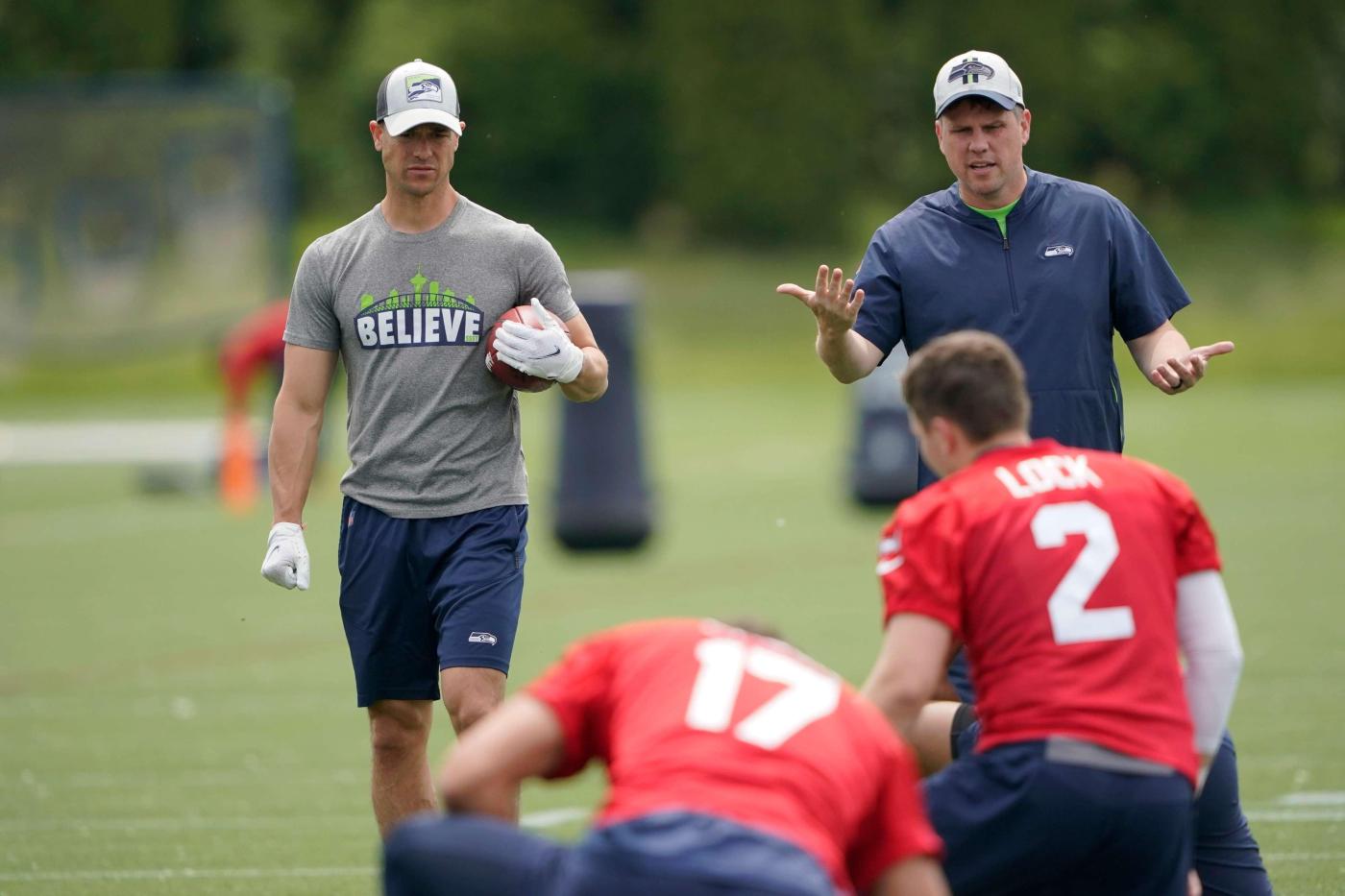
The Chicago Bears are working on a deal to hire Shane Waldron as their new offensive coordinator, multiple league sources confirmed Monday morning.

Waldron has been the Seattle Seahawks offensive coordinator for the last three seasons and helped quarterback Geno Smith to a comeback season in 2022. Before that, Waldron spent four seasons with the Los Angeles Rams as the passing game coordinator, quarterbacks coach and tight ends coach.

He is well-respected inside league circles as a young, energetic coach on the rise and a strong teacher with a creative mind and — especially important to the Bears — three seasons of play-calling experience.

NFL Network first reported the Bears are planning to hire Waldron.

The Bears reportedly interviewed at least nine candidates for the opening, including San Francisco 49ers passing game coordinator Klint Kubiak, former Baltimore Ravens offensive coordinator Greg Roman, former Carolina Panthers offensive coordinator Thomas Brown and former Arizona Cardinals head coach Kliff Kingsbury.

Waldron would replace Luke Getsy, whom coach Matt Eberflus fired earlier this month after two seasons at the helm of the Bears offense. In the search for Getsy’s replacement, Eberflus emphasized his desire to find a new offensive coordinator who is a “great teacher.”

“That’s important because you know he has to coach the coaches to coach the position, and I think that’s the No. 1 trait of any great coach,” Eberflus said. “You have to be able to have the innovation to really look at the players you have and be able to help enhance and put those guys in position to succeed and to get explosive (plays) and to move the ball down the field.”

Waldron would take over a Bears offense that has major decisions ahead this offseason at quarterback. General manager Ryan Poles must decide whether to use the No. 1 draft pick to select a quarterback — potentially USC’s Caleb Williams — or to stick with Justin Fields, the Bears starter for the last three seasons.

Poles said he expected to ask candidates for their plans to coach different kinds of quarterbacks.

“I love it because what are you going to do for these four different types of quarterbacks,” Poles said. “I want to hear that, and I think it’s really important to hear the versatility and adaptability in their teaching, in the way they implement a plan, scheme, adjust. It actually makes it pretty dynamic in terms of the interview process.”

Waldron called plays in 2021 for a Seahawks offense piloted by Russell Wilson. In 2022, after Wilson was traded to the Denver Broncos, the Seahawks pivoted to Smith and won nine games while earning a wild-card berth.

Smith, in his 10th NFL season, was honored as the league’s Comeback Player of the Year after throwing for 4,282 yards and 30 touchdowns. Both marks would be single-season franchise records for the Bears.

This season the Seahawks ranked 21st in total offense (322.9 yards per game) and 14th in passing (230 ypg). They averaged 21.4 points, ranked 17th. That was down from 2022, when they averaged 351.5 yards (13th) and 23.9 points (ninth).

The Seahawks staff is looking for new jobs after the organization and coach Pete Carroll parted ways after a 14-year union.

In addition to working closely with Wilson and Smith, Waldron worked with quarterback Jared Goff for three seasons with the Rams.

Waldron served as an offensive assistant with the New England Patriots (2008-09) and Washington (2016) and worked in operations with the Patriots early in his career. He also has coached in college, high school and the UFL.

Waldron and the Bears must hire assistants to coach the quarterbacks, wide receivers and running backs after the team dismissed Andrew Janocko, Tyke Tolbert and Omar Young earlier this month. Offensive line coach Chris Morgan and tight ends coach Jim Dray remain on the staff.

The Bears also are seeking a defensive coordinator, and NFL Network reported Monday they will interview Tennessee Titans defensive pass game coordinator Chris Harris. Harris played safety in the NFL for eight seasons, including two stints with the Bears, and started for the 2006 Bears team that went to the Super Bowl.

More Bears news

Bears Q&A: Did GM Ryan Poles miss a chance at a big-name coach? How desirable are the coordinator openings?
Column: Keeping Jaylon Johnson is paramount for the Bears — but will they make him the NFL’s highest-paid cornerback?
5 player decisions besides QB facing the Bears, including Jaylon Johnson’s contract and Darnell Mooney’s future
Bears GM Ryan Poles staying ‘open-minded’ as he evaluates whether to keep Justin Fields or draft a QB at No. 1
Caleb Williams declares for the NFL draft — and the Bears, picking No. 1, ‘can’t be scared of the unknown,’ analyst says
Column: How can GM Ryan Poles fix the cycle that has plagued the Bears forever? Pick the right quarterback.
Bears President Kevin Warren says building a ‘magnificent’ downtown stadium remains a possibility

Biden’s money machine, Trump’s legal bills and other takeaways from the 2024 money race

posted in: Politics | 0

Former President Donald Trump is as strong a fundraiser as ever. But he is bleeding money on legal expenses.

Meanwhile, President Joe Biden has no shortage of political liabilities going into November, but new campaign finance filings show he is building a formidable cash machine.

Both men raised tens of millions of dollars in the last quarter of 2023, according to campaign finance reports filed Wednesday with the Federal Election Commission. But they’re spending that money in very different ways as they head toward a likely rematch.

Biden spent months slowly building his campaign operation before ramping up significantly at the end of the year. Across his various committees and fundraising vehicles, Biden entered the year with more than $117 million in cash, even after spending more over the final three months of 2023 than in the first nine months combined.

Trump’s filings, on the other hand, show that while trying to fend off his Republican rivals for the nomination, he’s had to fund his various legal defenses, including efforts simply to keep his name on the ballot amid pushes to boot him under the Constitution’s 14th Amendment.

The reports shed a little light on former South Carolina Gov. Nikki Haley’s campaign as the GOP’s final Trump alternative, though they only cover activity through the end of 2023 and don’t include any of the immediate run-up to the Iowa caucuses or New Hampshire primary. Haley and her super PAC became favorites of Republican big donors late last year, though it’s not clear whether that will be sufficient to sustain her past the Feb. 24 South Carolina primary.

In Senate races, the new reports showed the parties’ respective establishments are unafraid to get involved in primaries and provided clarity entering the final sprint before primaries next month in races from Ohio to California.

Here are five takeaways from the latest reports with the Federal Election Commission:

Trump can raise a ton of money. His legal expenses are costing him even more.

Trump’s joint fundraising committee, the primary fundraising vehicle for his presidential campaign, brought in a whopping $75 million in the second half of the year. The former president’s strength continues to be with small-dollar donors, who accounted for more than one third of that total.

But Trump’s campaign and his affiliated groups are burning through cash at an even faster rate than he can fundraise. Across five connected groups, Trump spent more than he raised in 2023. And that spending is driven in large part by his legal woes. Two of his political committees spent a combined $50 million on legal expenses in 2023 – his biggest single expense category, with more spent on legal than advertising, payroll or other typical campaign expenditures.

MAGA Inc., a super PAC supporting Trump’s campaign, had to refund tens of millions of dollars to his leadership PAC to help cover those legal expenses, underscoring how legal challenges draw from money that could have been used to boost Trump as a candidate (although the group was still able to spend nearly $44 million on independent expenditures in 2023).

Trump still has plenty of cash in the bank and the ability to raise more of it. But the legal spending highlights a real challenge for the former president entering the election year: he is diverting an increasing share of his resources from the campaign to address his legal woes. And that is likely to keep being costly.

Biden has the money, but his spending so far hasn’t moved the needle.

Between his campaign, other PACs and the Democratic National Committee, Biden entered this year with roughly $117 million in cash on hand, though that’s significantly less than Trump’s campaign and the Republican National Committee had combined going into 2020 ($174.8 million).

Biden accelerated his spending over the final three months of 2023 — with little to show for it. His campaign spent $19.3 million in the fourth quarter of last year, more than the first three quarters of the year combined (just over $14 million).

Of that spending, some $12 million was on advertising. The Biden campaign has engaged in a sustained ad campaign across seven battleground states — Arizona, Georgia, Michigan, Nevada, North Carolina, Pennsylvania and Wisconsin — since last August. But during that time, polls from the battleground states generally show him falling behind Trump.

Biden and his allies have the money to stay on the air. Just this week, Future Forward PAC, the Biden-blessed super PAC, began reserving what it said will be $250 million worth of ads for the fall. Last month, Future Forward officials said the group raised $208 million in 2023 alone between the super PAC and its nonprofit arm, which funnels money into the super PAC without disclosing its donors.

Haley’s campaign had a disciplined budget. But she can’t match Trump’s small-donor enthusiasm.

There are a lot of reasons the former U.N. ambassador is the last Republican standing in the primary against Trump. But an underrated one is that she has the money to do so. Compared to some of her now-departed rivals, like Florida Gov. Ron DeSantis, Haley spent conservatively in the early months. Her campaign raised $17.3 million and spent $14.3 million in the final quarter of last year, and she entered January with another $14.5 million in the bank.

A lot has happened since then, but that kind of cash is one of the reasons Haley can make her case to stay in the race through the Feb. 24 primary in South Carolina and even Super Tuesday.

But how Haley has raised her money also says a lot about her campaign — and why she is struggling to catch Trump. Across her campaign committee and her joint fundraising committee, Haley has raised roughly $10.6 million from donors giving less than $200, according to a POLITICO analysis. That’s just a fraction of the small-dollar support Trump received over the same period.

Small-dollar support is not only an important fundraising tool — small donors can give again and again — but can be indicative of where the party’s most fervent supporters lie. Trump’s continued strength with small donors reflects the grip he has on the Republican Party’s base, an advantage he maintains over Haley headed into the next set of primaries.

Republican Senate primaries drew early spending — from both parties.

Both parties have adopted interventionist stances in Senate primaries — specifically Republican primaries. The 2024 Senate map heavily favors the GOP, but the party has a history of nominating weaker or more extreme candidates who’ve lost otherwise winnable races.

That’s led Democrats to attack Montana Senate candidate Tim Sheehy, a political newcomer who’s the preferred candidate of the National Republican Senatorial Committee in one of 2024’s most competitive races. In its filing on Wednesday, Last Best Place PAC, which is opposing Sheehy, disclosed that all of the $2.1 million it collected in 2023 was from Majority Forward, a nonprofit group closely linked to Senate Majority PAC, a top Democratic super PAC.

The spending serves a dual purpose of trying to define Sheehy negatively early ahead of a possible matchup with Democratic Sen. Jon Tester — and also possibly softening up the first-time candidate for a potential primary matchup with Rep. Matt Rosendale, who’s mulling a run. Last Best Place PAC has been the top spender so far on the Montana airwaves, according to AdImpact data.

Republicans, meanwhile, are also done sitting on the sidelines after a number of cycles with a hands-off policy — including the NRSC’s laissez-faire approach in 2022 under then-Chair Rick Scott (Fla.). In a sign the party apparatus is firmly behind Sheehy, the NRSC began running hybrid ads with his campaign this week.

Another example from Wednesday’s filings: In early December, Senate Leadership Fund, the super PAC with close ties to Senate Minority Leader Mitch McConnell (Ky.), sent $895,000 to Conservative Americans PAC, which is supporting West Virginia Gov. Jim Justice’s Senate bid. The contribution came about a month after Democratic Sen. Joe Manchin’s retirement. Republicans will be heavily favored to flip the seat, whether the party’s nominee is Justice or GOP Rep. Alex Mooney.

Favorites emerged in other Senate primaries.

The new reports brought some definition to other competitive Senate primaries, particularly those that will be decided during the first half of this year.

In Ohio’s March 19 GOP primary to face Democratic Sen. Sherrod Brown, businessperson Bernie Moreno was the top spender during the fourth quarter, doling out $3.8 million — most of it before Moreno landed Trump’s endorsement in December, which could give him a leg up over Secretary of State Frank LaRose and self-funding state Sen. Matt Dolan.

Democratic Rep. Adam Schiff had another strong fundraising quarter ahead of California’s March 5 Senate primary, collecting $6.3 million and growing his cash-on-hand figure to a presidential-level $34.9 million. He’s been spending big since the start of the new year — running TV ads in the pricey Los Angeles and San Francisco markets — and has the cash to do it.

Fellow Democratic Reps. Katie Porter and Barbara Lee are lagging behind, as each vies with Republican Steve Garvey for the second spot in the November general election. Porter, notably, saw her typically strong fundraising decline slightly in the final three months of 2023: She raised $3 million, down from $3.4 million in the previous quarter.

In New Jersey, Tammy Murphy, the wife of Democratic Gov. Phil Murphy, got off to a strong start, bringing in $3.2 million. But many of Murphy’s donors have already “maxed out” — given the maximum $6,600 allowed under federal law — compared to Democratic Rep. Andy Kim, who is relying heavily on smaller donors. Those small donors are more expensive to cultivate — Kim outspent Murphy roughly two-to-one for the quarter — but can potentially give the three-term congressman more money through this year.

Around the Southland: Bears mascot delights students in Tinley Park

posted in: News | 0

Bears mascot delights students in Tinley Park

A special friend stopped by last week at the Lt. Joseph P. Kennedy School for Exceptional Children in Tinley Park to help everyone shake off the winter blues.

Staley Da Bear, the official team mascot for the Chicago Bears, danced his way through a crowd of cheering students and staff, exchanging high fives with a multitude of raised hands.

“You ready to have a dance party?” his handler asked above the roar. “Let’s go!”

School administrators invited Staley to stop by the school to help motivate students as they settle into the second half of the school year.

About 70 students attend the therapeutic day school, including students from Thornton Township District 205, Thornton Fractional District 215, Plainfield Community Consolidated School District 202, Crete Monee District 201-U, Consolidated High School District 230 and Flossmoor District 161.

Oak Lawn library, Tinley book store reunite for RomCon

Fans of romantic literature will be swooning Feb. 17 as the Oak Lawn Public Library presents RomCon, an afternoon event dedicated to the genre. Independent bookstore Love’s Sweet Arrow, in Tinley Park, is teaming up with librarians to produce the free mini-convention featuring eight romance authors along with book signing, author panels, raffles, trivia and book sales.

Love’s Sweet Arrow owner Rosanne Backlin recruited a diverse group of authors to visit the library, including Danielle Jackson, Kelly Farmer, Tinia Montford, Tamara Jerée, Rien Gray, Hanna Earnest and Sara Fujimura. Author Olivia Dade will be doing a virtual visit to the event.

Dade, who lives in Sweden, is the author of Avon bestsellers “Ship Wrecked” (2022) and “Spoiler Alert” (2020) and she has a new novel coming out, “At First Spite” in 2024. Bettcher says,

“It’s a really big deal for us to have her participate in RomCon,” said fiction librarian Emily Bettcher.

Oak Lawn’s RomCon is from 1 to 4:15 p.m. Feb. 17 from 1-4:15 p.m. Register in advance for updates and a special treat on the day, at 708-422-4990 or cal.olpl.org/event/10993047.

Hidden Oaks Nature Center to close for most of 2024

The Forest Preserves of Will County’s Hidden Oaks Nature Center, 419 Trout Farm Road, Bolingbrook is about to be transformed, but the process will require the facility to be closed for most of the year starting Feb. 19. 

FPD officials said Hidden Oaks Preserve also will close on occasion for outdoor renovations during the year, as necessary, but the renovations will not affect Hidden Lakes Trout Farm, which is in the northern part of the preserve. 

The interior and exterior work at Hidden Oaks Nature Center is designed to convert the former Bolingbrook Park District site, which was purchased by the Forest Preserve in February 2022, into a nature center tailored to Forest Preserve-type exhibits and activities. 

Officials said the renovation will provide new design features throughout the first floor and a new permanent live animal tank for the nature center’s resident turtles, and an elaborate indoor bird-watching lookout deck will be installed.

Oak Forest High School earns diversity award

Oak Forest High School has earned the College Board AP Computer Science Female Diversity Award for achieving high female representation in AP Computer Science A. Schools honored with the AP Computer Science Female Diversity Award have expanded girls’ access in AP computer science courses, according to a news release from the School District 228.

Oak Forest High School was one of 225 institutions in the country recognized in the category.

“We are so proud of the unique perspective our female students bring to the fields of Math and Science,” said Oak Forest principal Jane Dempsey. “This is a recognition of our belief that anyone can succeed in any field. Our graduates are a testament to the impact created by opening doors to women.”

Oak Forest Raiders chosen to lead Fleadh

The Oak Forest Raiders instructional tackle football and cheerleading program for boys and girls ages 5 to 14, which has been operating in the area for more than 50 years, was chosen as grand marshals for the 15th anniversary edition of the Oak Forest Fleadh.

Players, families and coaches will lead the parade, which steps off at 11 a.m. March 2 at 151st and Central Avenue and heads to the Oak Forest Park District. The parade will be preceded at 8:30 a.m. by the CNB Oak Forest Fleadh 5K race, which starts and finishes at 155th Street and Betty Anne Lane. More than 500 people are expected to participate. Activities also are planned before and after the race at Fire Station 1, 5620 Jame Drive. Street closures are planned for the race and for the parade. More information is at www.oak‐forest.org.

Visitor’s Bureau video highlights Southland attractions

The Chicago Southland Convention & Visitors Bureau has launched its interactive destination video for visitors’ vacation and residents’ staycation ideas.

The video displays footage of Chicago Southland amenities with their corresponding logo and website link synced on the side of the screen. Users can also scroll through the vertical list of all amenities in descending order of appearance.

“This interactive video helps our tourists and residents peruse and visit many of Chicago Southland attractions in one source,” said Jim Garrett, president/CEO of the bureau. “The video includes nature centers, art galleries, restaurants, breweries, museums, sports facilities, golf courses, and performing arts centers to name a few.”

The CSCVB interactive video is available at www.visitchicagosouthland.com/#clicktivated.

Send news to communitynews@southtownstar.com.

()

Editorial: The 78 is a fabulous site for White Sox baseball and much else

posted in: News | 0

When Chicago was selecting sites for a new casino in 2022, we endorsed the bid that would have landed the giant entertainment center on the plot of land known as The 78, the name being a concise riff on Chicago having 77 official neighborhoods.

Why? For starters, The 78, which is bordered by Roosevelt Road to the north, Clark Street to the east, 16th Street to the south, and the South Branch of the Chicago River to the west, is an enviable, shovel-ready site for development.

Its selection for the casino would not have, ahem, displaced anybody and at considerable expense. It offered river frontage, leading us to envision lovely waterfront bars and restaurants that would not attract the free-and-clear objections and lawsuits that applies to lakefront projects and that could, in essence, extend the trajectory of Chicago’s successful River Walk to the North. There is room to breathe within this 62 acres of former railroad land, now owned by developer Related Midwest, and The 78 is supremely well served by existing modes of public transportation. That would be especially the case once the long-planned new CTA station is built at 15th Street.

All of those arguments would apply just as well to a development that included a new stadium for the Chicago White Sox.

But that wasn’t the most important reason why we were, and are, so enthusiastic about The 78.

Right now, it’s a barren barrier, a dead zone undermining the potentially symbiotic relationship between Chicago’s Loop and the South Side.

If The 78 were developed, and done right, it could relink the South Loop with Chinatown and Bronzeville and could radiate economic development out from the business district to the south, filling the kind of hole that the West Loop entertainment district has plugged to the west and that the Gold Coast residential neighborhood long has provided to the North. Get rid of that no man’s land and just maybe the huge success of Millennium Park, another railroad-related project, from two decades ago could be emulated in a section of the city with a greater need.

The 78 is a huge, fallow asset and, given how well suited it is to entertainment, a casino or (better yet) a new sports stadium is what it needs. For a sense of what this could look like, all you have to do is look at Tiger Stadium in Detroit, with its lively eateries and relationship to a reignited downtown, or to the huge pedestrian area around Allegiant Stadium in Las Vegas or, of course, at Wrigleyville.

Guaranteed Rate Field is, frankly, unloved and unlovely. It’s too harsh, isolated, steep, hemmed in and fan-unfriendly. The neighborhood often has been resistant when it comes to developing the surrounding parking lots into fan amenities. Despite its relative youth, it’s a relic of a time when the stadium still was just the stadium. Now, as we well know, sports teams don’t so much hope to spark development as to control (and ideally own) what goes on down the street, where fans stay, eat and play.

Unlike the NFL, which plays few games a year, Major League Baseball plays all summer long with scores of home games each season. Office workers could walk to the new stadium from the Loop, potentially a carrot when it comes to getting workers back downtown.

We understand, as tourism officials well know, that the Cubs and the Sox are very different propositions when it comes to economic development. The Cubs attract huge numbers of out-of-town fans who stay in hotels and cite Cubs games as the anchoring reason for their weekend visit. The Sox fan base is primarily local, spinning off far less secondary spending. But that does not have to remain the case. The site where the games are played is a big factor.

We’ve long been on record believing the days of handing over taxpayer funds to hugely profitable sports franchise owners should be over. We’ve said many times that the Chicago Bears, still playing the long game of chicken or persuasion or whatever, should pay for their own stadium, being a private business planning to operate in a private facility.

We feel that same way about the White Sox, although that view doesn’t preclude city and state governments from working with the team (or with the Bears, for that matter, if they’re serious about staying in Chicago) to make any move as hospitable and supportive as possible. It’s not unreasonable to chip in on infrastructure and the public areas, especially if the site also is going to include housing, parks and the like. Even Ald. Nicole Lee, 11th, whose ward long has been home to the White Sox, has said she is impressed with the plan.

No doubt tax increment financing will be needed, which some would call a form of public financing. Philosophically, in terms of insisting on private investment, the devil is in the details there — TIF money can go to public improvements that arguably a private developer might otherwise shell out for. We note the current mayor’s queasiness on TIFs, given the city’s cash-strapped situation. He ought to make an exception here if the public and private interests are properly aligned. And we don’t see a big problem with basically transferring the existing 2% hotel tax to this project, since that already is dedicated to a similar use.

The fate of Guaranteed Rate Field has to be part of this discussion, of course, and it’s unlikely that site would satisfy the Bears, for most of the same reasons that the White Sox don’t want to stay, even if there were a new stadium. But an empty concrete shell by the side of the Dan Ryan Expressway would not be acceptable. Part of the package should include redevelopment plans: housing, sports facilities for the community, a stadium for the Chicago Fire if they are interested, playing fields and other benefits appropriate for a facility built with public money and owned by the Illinois Sports Facilities Authority.

All of those debates are to come. But of all the sports shenanigans we’ve written about these last few years, the idea of the White Sox at The 78 is far better than most. We cannot overemphasize the strategic importance of that connective tissue from an economic development point of view.

The 78 could make the Sox, South Loop, Bronzeville and Chinatown big winners, and that’s without having to stuff a slot machine or throw a pair of dice.

Join the discussion on Twitter @chitribopinions and on Facebook.