Chicago Bears zero in on Chris Beatty — DJ Moore’s college position coach — as their wide receivers coach

posted in: News | 0

Chicago Bears wide receiver DJ Moore could reunite with his former college coach.

The Bears are working to hire Chris Beatty to be their wide receivers coach, though it was not yet official Tuesday morning, a source confirmed. Beatty was Moore’s position coach for two of his three seasons at Maryland, including 2017, when Moore was the Big Ten wide receiver of the year.

Beatty would join the Bears after three seasons as the Los Angeles Chargers wide receivers coach, his first NFL stint after 15 years coaching in college.

He would replace Tyke Tolbert, whom the Bears fired along with offensive coordinator Luke Getsy and three other offensive staffers earlier this month. ESPN first reported the news of the expected hire.

Along with his time at Maryland, where he was promoted to associate head coach and co-offensive coordinator, Beatty was a position coach at Pittsburgh, Virginia, Wisconsin, Illinois, Vanderbilt, West Virginia, Northern Illinois and Hampton. He was the co-offensive coordinator and quarterbacks coach under Tim Beckman during his lone season with the Illini in 2012.

A former wide receiver at East Tennessee State and in the Canadian Football League, Beatty started his coaching career at the high school level.

He would be tasked with coaching a wide receivers group that Bears general manager Ryan Poles might look to bolster after it lacked production beyond Moore in 2023.

In his first season with the Bears and quarterback Justin Fields, Moore had a career-high 96 catches for 1,364 yards and eight touchdowns.

But Darnell Mooney had his worst season with 31 catches on 61 targets for 414 yards and a touchdown. And rookie Tyler Scott had a bumpy first season, finishing with 17 catches on 32 targets for 168 yards.

Beatty would be the fifth Bears coaching hire this offseason. They previously hired offensive coordinator Shane Waldron, quarterbacks coach Kerry Joseph and defensive coordinator Eric Washington and are hiring Thomas Brown as passing game coordinator. They also need to hire a running backs coach.

()

Thomas Friedman: Inside America’s shadow war with Iran

posted in: News | 0

It’s often been said that the most dangerous hot spot in the world is the waterway between Taiwan and mainland China, where the Chinese navy and air force flex their muscles every day to try to intimidate Taiwan — while the U.S. Navy patrols nearby. I wonder. There is actually a stable balance of deterrence there right now. You could hold a friendly regatta in the Taiwan Straits compared to where I just visited.

I spent two days last week hopscotching in a CH-47 Chinook helicopter among seven U.S. military bases in western Jordan and eastern Syria with America’s senior Middle East Centcom commander, Gen. Michael Kurilla. There is no equilibrium here. What you have, instead, is the other Middle East war that began shortly after the tragic Israel-Hamas war that broke out on Oct. 7.

This other Middle East war pits Iran and its proxies — the Houthis, Hezbollah and Shiite militias in Iraq — against both the small network of U.S. bases in Syria, Jordan and Iraq established after 2014 to destroy the Islamic State group and against the U.S. naval presence in the Red Sea and Gulf of Aden that keeps the vital shipping lanes there secure and open.

These Iranian-armed Shiite militias in Iraq and the Houthi fighters in Yemen may not look or seem like lethal threats, but do not be fooled. They have learned to arm, build, adapt and deploy some of the most sophisticated precision weaponry in the world. That weaponry, provided by Iran, can hit a 3-foot-wide target 500 miles away.

The young U.S. soldiers and sailors arrayed against them cut their teeth on video games, but now find themselves playing the real thing, deploying with software and cursors the world’s most sophisticated countermeasures and interceptors to swat away almost every rocket and drone the Iranian proxies have been throwing at them.

In short, Americans may not know they’re at war with Iran, but Iran’s Revolutionary Guard know for sure they are in a shadow war with America through their proxies.

And if one of these Iranian proxies gets “lucky” and creates a mass casualty event by striking a U.S. warship or the barracks of one of the U.S. bases in Jordan or Syria — something akin to the Marine Corps barracks bombing in Beirut in 1983 — the U.S.-Iran conflict would surely come out of the shadows and become a direct shooting war in the region the world most depends on for its oil.

Just thought I’d let you know.

This other Middle East war kicked into high gear on Oct. 17, 10 days after the attack on Israel by Hamas, Centcom officials explained to me, when Iran clearly took a decision to rev up all its proxies. Under the cover of the Israel-Hamas war and tempted by the anti-American sentiment it has generated, Iran tried to see if it could significantly degrade the U.S. network of facilities in Iraq, eastern Syria and northern Jordan, or perhaps dislodge U.S. forces altogether.

I suspect Tehran also had another goal in mind: to intimidate America’s Arab allies by showing them the damage Iran could inflict on their U.S. protector.

What I know for sure, though, is that this is the most dangerous game of chicken going on anywhere on the planet today, for three reasons.

Sheer volume

The first is the sheer volume of rockets, drones and missiles that Iran’s proxies have deployed — particularly the Houthis in Yemen and the Shiite militias in Iraq. According to Centcom, hundreds of warheads carried by Iranian-supplied land-to-sea rockets, cruise missiles, ballistic missiles, attack drones, suicide speedboats and unmanned underwater vehicles have been fired since Oct. 17 by Iran’s proxies at U.S. bases, warships and commercial vessels in the Red Sea.

Fortunately, despite the volume of attacks, the U.S. has managed to destroy or deflect most of the incoming with interceptors and a growing electronic forest of radars and countermeasures being deployed at the bases and on U.S. warships. This is no easy task; several rockets and drones have gotten through, injuring more than 180 U.S. personnel so far, Centcom said, and I saw the physical damage they did at several bases we visited.

These U.S. bases are not luxury compounds. Many started as ramshackle Islamic State-controlled bases or small towns that the U.S. and its Kurdish allies took over beginning in 2014 after intense firefights with the Islamic State group in a war that threatened the governments of Syria, Iraq and Jordan all at the same time.

Today, they consist of prefab living quarters surrounded and separated by hundreds and hundreds of concrete blast walls imported by the U.S. to limit the damage of any incoming warheads. Spotty wireless enables soldiers to FaceTime with families and follow sports. Spartan kitchens serve corn dogs, chicken nuggets and the like, and at some of the “nicer” facilities, maybe even a daily selection of fresh fruit — though when you’re a 70-year-old visitor carrying around 50 pounds of body armor and a helmet, it’s amazing how good a big fat corn dog from an Army mess in the Syrian desert can taste.

But because these bases were designed and situated to block the Islamic State group from reconstituting its supply lines and critical mass, they were never meant to deter or attack the vast modern rocket arsenals of Iran and its proxies.

Which is why on Jan. 28, a one-way Iranian attack drone with a 20-pound warhead, launched by a coalition of Iranian-backed Shiite militias called the Islamic Resistance in Iraq, hit a U.S. facility, Tower 22, in northeastern Jordan.

I visited Tower 22 with Kurilla’s team last week. The blast killed three U.S. soldiers, who were blown right out of their bunks, and injured 47. Fortunately, the modular living quarters there were separated by blast walls. A soldier in the bunkhouse right next to the one hit told us he was talking to his wife on FaceTime when the drone struck; protected by a thick cement barrier, he emerged shaken but unscathed. Watching live, his wife thought he was dead when he disappeared in smoke but he was able to contact her three hours later and assure her otherwise.

Deterrence and its limits

I was surprised to learn just how aggressive the Iranians have encouraged their proxies to be, which is what leads to the second, extremely dangerous aspect of this war.

It was what Kurilla dryly described to me as a deterrence “conversation” Centcom had with Iran after the Tower 22 attack to make clear to Tehran that it was playing with fire.

On Feb. 2, the U.S. launched airstrikes against the whole Iranian proxy network in Iraq and Syria, and the next day against Houthi sites in Yemen, hitting more than 100 targets overall, with a combination of long-range B-1 bombers out of Texas, and cruise missiles and fighter bombers launched from the Eisenhower carrier group in the Red Sea. Some 40 people were reported to have been killed in the U.S. retaliatory strikes.

The operation was then capped off on Feb. 7 when the U.S. decided to demonstrate to Iran and its proxies what kind of combined intelligence/precision warfare the U.S. can deploy by killing Abu Baqir al-Saadi, the specific commander from Kataib Hezbollah who the U.S. determined was in charge of drone attacks on its bases in Iraq, Jordan and Syria.

Al-Saadi was hit while driving on a Baghdad street by the same kind of drone-fired Hellfire missile that killed senior Revolutionary Guard commander Qassem Soleimani in 2020. It was equipped with six swordlike blades that once it penetrates a vehicle slice and dice anything in their path like a blender, which is why the missile has been nicknamed the “Flying Ginsu.”

This American response clearly got the Iranians’ attention, and Iran’s proxies have been observing an undeclared cease-fire on land ever since, which certainly helped ease my mind as we flew around in helicopters and a C-130 all over the ungoverned spaces of eastern Syria, too close for my comfort one day near the joint Russian-Iranian base on the western side of the Euphrates.

This informal cease-fire, though, has not been embraced by the Houthis, who have declared that they will not stop firing at international ships, the U.S. Navy or Israel, at least until there is a cease-fire in Gaza. Last weekend, the Belize-flagged cargo ship Rubymar, which the Houthis hit with an anti-ship ballistic missile on Feb. 18, became the first vessel to entirely sink in the Bab el-Mandeb Strait, as a result of a Houthi missile attack. It created a huge ecological mess of leaked fuel and the fertilizer it was carrying.

Seconds to decide

And that leads to the third dangerous aspect of this shadow war.

At every base we visited there was a top-secret room journalists could not go into, called the combat integration center. Inside, young American soldiers (and sailors on Navy vessels) stare at screens, try to identify the myriad objects flying toward them and decide by its radar and visual signature whether to engage one, ignore another or let a third go by, figuring it is going to miss and land harmlessly. Discipline is important when you’re firing $200,000 interceptors at $20,000 Iranian drones, a Centcom officer told me.

These operators often have less than 90 seconds to make up their mind whether to engage an incoming drone with a Coyote drone-interceptor that can detect and destroy attack drones at very close range and can be launched from ground vehicles, helicopters or surface vessels.

In other words, every day is pregnant with a low-probability-but-high-consequence event. And the first, and often last, line of defense is usually a 20-something U.S. soldier or sailor squinting at a computer screen, trying to decide with software within seconds what is coming his or her way and engaging the right countermeasures.

Amid all of this, I should add, we also visited Al Hol detention camp in the middle of nowhere in northeastern Syria, where some 43,000 people — mostly Islamic State “brides” and their children — are being held in tents and prefabs under Kurdish guards until they can be deprogrammed and returned to their home countries. It is pretty strange to talk to an American or British woman who got drawn into the Islamic State cult and hear that she has five or six kids by three or four different Islamic State combatants, all of whom were killed by the U.S.-led coalition. Judging from the number of rocks some of the kids threw at our armored convey, the deprogramming process has a way to go.

So why stay?

Given all the risks and open sores out here, it’s worth asking: Why stay?

First let me describe a scene, and then offer an answer.

The scene: Kurilla’s team was visiting the Tanf garrison, a small logistics support base inside Syria, near where Syria, Iraq and Jordan meet. Kurilla took the opportunity to do a battlefield promotion, from second lieutenant to first lieutenant, for a medical platoon leader stationed there. We were standing in an alley and around us were all just different shades of brown — the desert, the buildings, you name it.

Kurilla first asked for someone to get him an American flag and a couple of minutes later two platoon members showed up with a small one and held it up at shoulder level, framing Kurilla and the young officer being promoted.

“Our Army is unique in the world,” Kurilla said to the young man. “We don’t swear an oath to a person or a king, we swear an oath to an idea, embodied in the Constitution and ingrained in our democracy, that all men and women are created equal. We swear an oath to defend that idea.”

Kurilla then administered the oath that every U.S. soldier — this one an enlistee who had worked his way up — repeats as he or she rises in rank. His oath complete, the newly minted first lieutenant slapped on a cap displaying his new rank and then gave a shoutout to each member of his platoon.

There was something about that scene that hit me: the two soldiers holding up their little Stars and Stripes that provided the only color in this vast brown tableau, and the oath of allegiance to an idea, not a king, muffled by the protective blast walls of this far-flung base in a region that has mostly known only the opposite.

During the post-Cold War era, from the early 1990s to the 2010s, I thought it might actually be possible to bring more consensual politics and pluralism to this part of the world — thanks to the Oslo Accords, the Jordanian-Israeli peace treaty, the Arab Spring uprisings and the greater integration that was resulting from globalization.

But it did not happen. Rather than the spread of democracy this region experienced metastasizing disorder and failing states. At the same time, the big divide in the world became no longer between democracy and autocracy, but between order and disorder.

The best case for U.S. forces remaining in eastern Syria, Iraq and the Red Sea is precisely so that the disorder “over there” — from the likes of the Islamic State group, failed states like Syria and the eating away of nation-states by Iranian proxy militias — doesn’t come “over here.”

It is not a pretty or heroic mission — living in body armor all day in a harsh and hostile environment, with all the corn dogs you can eat as one of the few pleasures — but it’s probably worth it. That said, we should have no illusions about the risks because the shadow war playing out there could come screaming out of the shadows at any moment.

Thomas Friedman was born in Minneapolis and raised in St. Louis Park. He writes a column for the New York Times.

Related Articles

Opinion |


Robert Pearl: 3 surprising lessons for U.S. medicine from around the world

Opinion |


David French: The Supreme Court just erased part of the Constitution

Opinion |


Trudy Rubin: 4 ways the US should help Ukraine right now

Opinion |


Noah Feldman: Supreme Court buries the fantasy of keeping Trump off the ballot

Opinion |


David Brooks: The GOP reverts to a bad old mood

Five-ingredient peanut butter noodles, a weeknight (or midnight) win, and more

posted in: News | 0

Less is more: These are words to live by in the kitchen, especially midweek between 5 and 8 p.m. There are no trophies for the most time spent toiling on dinner after work, no awards for the most elaborate dishes sailing off your stove on a Tuesday evening.

I love a particularly ingenious less-is-more recipe, which is why I’m excited about Eric Kim’s new five-ingredient recipe for peanut butter noodles — a Parmesan-tossed classic in the making.

Eric’s noodles, and four other stunningly simple recipes, are below.

1. Peanut Butter Noodles

Peanut butter noodles. This is easy cooking – a satisfying dish assembled from just a few brilliant pieces, and you can use either instant ramen or spaghetti for the noodles. Props styled by Sophia Eleni Pappas. Food styled by Sue Li. (Linda Xiao/The New York Times)

This nutty midnight pasta is a dream to cook, as it requires just a handful of pantry staples and one pot. Peanut butter (the less fancy, the better) anchors a creamy sauce swathed in umami. Accentuated by a good, salty Parmesan, these noodles recall those cheesy peanut butter sandwich crackers. They make an ideal dinner for one, but the amounts can easily be doubled or quadrupled as needed. For an equally gripping vegan alternative, try swapping out the butter for olive oil and the cheese for nutritional yeast.

By Eric Kim

Yield: 1 serving

Total time: 20 minutes

INGREDIENTS

Salt
4 ounces spaghetti or 1 individual package instant ramen (seasoning packet saved for another use)
2 tablespoons creamy peanut butter
1 tablespoon unsalted butter
1 tablespoon finely grated Parmesan, plus more for serving
1 teaspoon soy sauce

DIRECTIONS

Bring a pot of water to a boil (and salt it, if using spaghetti). Cook the noodles according to package instructions. Reserve 1/2 cup of the cooking water, then drain the noodles and return to the pot. Turn off the heat.
Add the peanut butter, butter, Parmesan and soy sauce. Vigorously stir the noodles for a minute, adding some reserved cooking water, a tablespoon or two at a time, until the sauce is glossy and clings to the noodles. Season to taste with salt.
Top with more cheese, if you’d like, and serve immediately.

2. One-Pan Crispy Chicken and Chickpeas

One-pan crispy chicken and chickpeas. Add spices to the chicken if you like, but definitely serve the dish with yogurt, hot sauce or both, as Yossy Arefi recommends. Food styled by Simon Andrews. (David Malosh/The New York Times)

This speedy, no-fuss meal comes together in one pan with a minimal ingredient list — and barely requires any chopping. The chicken skin crisps as it roasts, and the chickpeas, garlic and spinach soak up any juices at the bottom of the pan. A squeeze of fresh lemon juice at the end brightens up the whole dish. Make sure to stir the chickpeas and spinach together gently at the end to avoid breaking up the chickpeas too much. For added flavor, you could dust the chicken with smoked paprika, ground turmeric or your favorite spice blend before cooking. Serve this dish with yogurt and hot sauce on the side, and flatbread, if you like.

By Yossy Arefi

Yield: 4 servings

Total time: 45 minutes

INGREDIENTS

4 bone-in, skin-on chicken thighs (about 1 3/4 pounds)
Kosher salt and pepper
2 teaspoons olive oil, plus more as needed
2 (15-ounce) cans of chickpeas, rinsed
4 large garlic cloves, thinly sliced
4 (packed) cups or 1 (5-ounce) package baby spinach
1 large lemon, halved
Yogurt and hot sauce (both optional), for serving

DIRECTIONS

Heat oven to 400 degrees with a rack in the center.
Pat the chicken dry and season both sides with salt and pepper. Heat 2 teaspoons of olive oil in a large cast-iron skillet over medium-high heat. Put the chicken thighs in the skillet, skin-side down, and cook for 4 to 5 minutes, until light golden brown. Flip and cook for 2 more minutes. Transfer the chicken to a plate.
Add the chickpeas and garlic to the skillet and stir to coat in the oil and juices. If the pan seems at all dry, drizzle in a bit of olive oil. Season with salt and pepper.
Place the chicken on top of the chickpeas, skin side up, in an even layer and transfer the pan to the oven. Bake for 30 minutes or until the chicken is deeply golden and cooked through.
Remove the chicken to a clean plate, put the pan back on the stovetop over medium heat and add the spinach to the chickpeas in the pan, one handful at a time, stirring it until just wilted. Add the chicken back to the pan and squeeze a lemon half over the top; cut the remaining lemon half into 4 wedges. Serve the chicken, chickpeas and spinach with the lemon wedges on the side, and yogurt and hot sauce for serving, if you like.

3. Orange-Glazed Baked Salmon

Orange-glazed baked salmon. The fish is drizzled with an orange-honey glaze and then gently cooked; reserved glaze is then tossed with olive oil and greens for a breezy salad. Food styled by Hadas Smirnoff. (David Malosh/The New York Times)

Baking salmon gently at a low temperature is a low-effort approach that results in a flaky, moist piece of fish. This simple preparation utilizes oranges, but lemons would work nicely, too. You’ll reduce some fresh orange juice in a skillet to concentrate its flavor, then whisk in some honey to sweeten. The glaze gets drizzled over the salmon before baking but also doubles as a dressing for salad greens. Keep this dish simple, with just its side of greens, or pair this easy weeknight meal with cilantro rice or olive oil mashed potatoes.

By Farideh Sadeghin

Yield: 2 to 4 servings

Total time: 30 minutes

INGREDIENTS

1 (2-pound) piece skin-on salmon fillet
Salt and freshly ground black pepper
2 oranges
2 tablespoons honey
5 ounces salad greens
2 tablespoons olive oil

DIRECTIONS

Heat the oven to 325 degrees. Place the salmon in a baking dish, skin-side down, and season the top with salt and pepper.
Finely zest one of the oranges onto the salmon then squeeze its juice into a small skillet along with the juice of half of the other orange. Bring to a boil over high and cook until reduced by half, about 2 minutes. Let cool, then whisk in the honey. Drizzle half of the glaze on the salmon; reserve the remaining.
Thinly slice the remaining orange half into circles and lay on the salmon in an even layer. Bake until salmon is just cooked through and slightly flaky, about 20 minutes.
In a medium bowl, toss the salad greens with the reserved glaze and the olive oil. Season with salt and pepper and serve with the salmon.

4. Roasted Broccoli With Shrimp

Roasted broccoli with shrimp. This is an extremely quick and tasty Melissa Clark recipe. Food styled by LIza Jernow. (Tara Donne/The New York Times)

Here is a fast, delicious one-pan supper that could not be simpler or tastier. Just coat your ingredients with a generous amount of olive oil, season well with kosher salt and freshly ground black pepper, and place them on a baking sheet. Put it in the oven at a high temperature (in this recipe, 425 degrees) and let the heat do the work. The vegetables will soften and caramelize, offering real depth of flavor. Here, we add shrimp at the end, which cooks quickly, to deliver an easy weeknight meal.

By Melissa Clark

Yield: 4 servings

Total time: 30 minutes

INGREDIENTS

2 pounds broccoli, cut into bite-size florets
4 tablespoons (1/4 cup) extra-virgin olive oil
1 teaspoon whole coriander seeds
1 teaspoon whole cumin seeds
1 1/2 teaspoons kosher salt
1 teaspoon freshly ground black pepper
1/8 teaspoon hot chile powder
1 pound large shrimp, shelled and deveined
1 1/4 teaspoons lemon zest (from 1 large lemon)
Lemon wedges, for serving

DIRECTIONS

Preheat oven to 425 degrees. In a large bowl, toss broccoli with 2 tablespoons oil, coriander, cumin, 1 teaspoon salt, 1/2 teaspoon pepper and chile powder. In a separate bowl, combine shrimp, remaining 2 tablespoons oil, lemon zest, remaining 1/2 teaspoon salt and remaining 1/2 teaspoon pepper.
Spread broccoli in a single layer on a baking sheet. Roast for 10 minutes. Add shrimp to baking sheet and toss with broccoli. Roast, tossing once halfway through, until shrimp are just opaque and broccoli is tender and golden around edges, about 10 minutes more. Serve with lemon wedges, or squeeze lemon juice all over shrimp and broccoli just before serving.

5. Cheesy, Spicy Black-Bean Bake

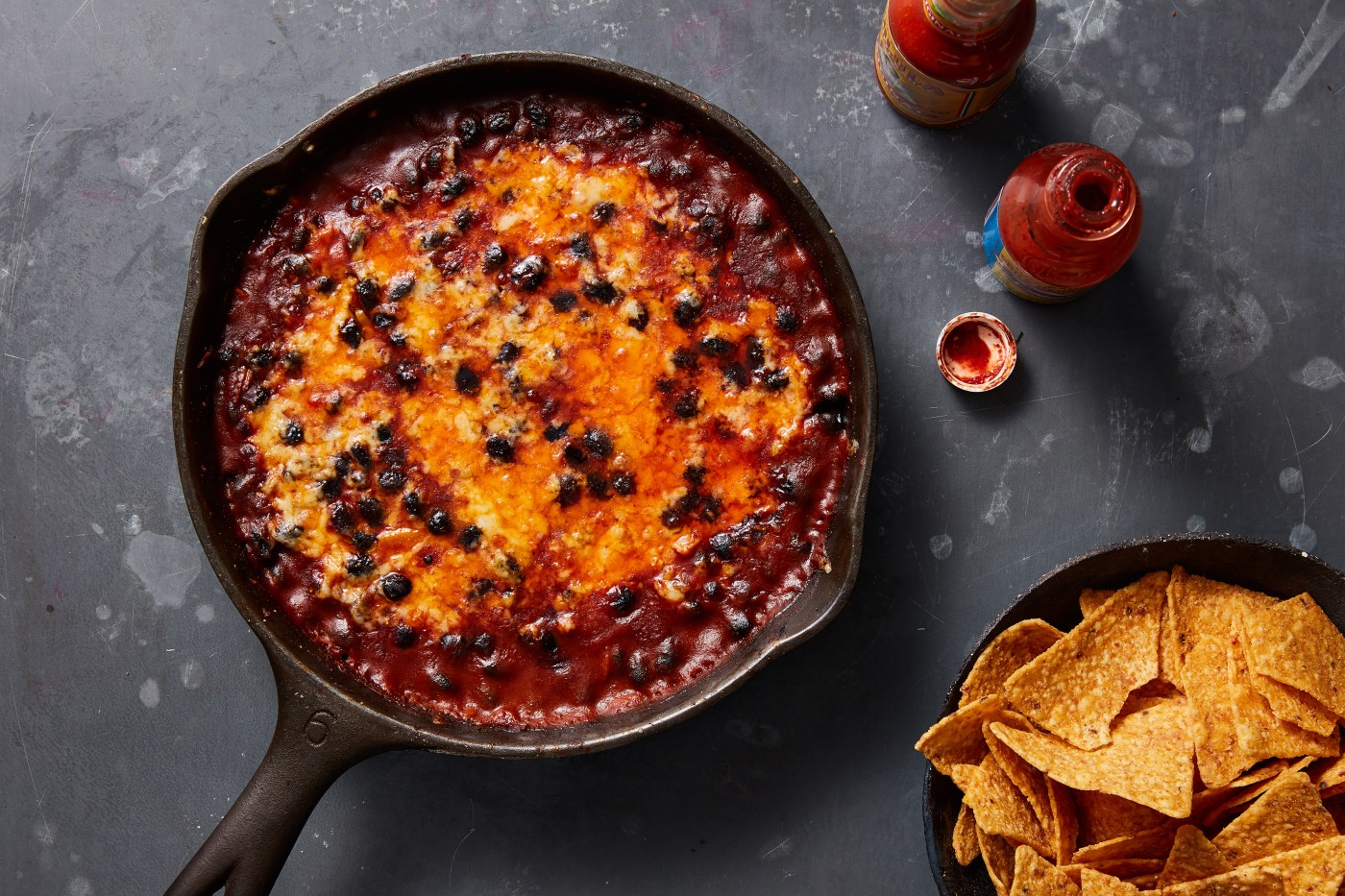
Whether or not you’ve fallen for this cheesy white-bean tomato bake, we’d like you to meet its bolder counterpart, smoky and spiced, with lots of melty cheese. Black beans shine in a deep-red mixture of fried garlic, caramelized tomato paste, smoked paprika and cumin. The whole skillet gets coated in a generous sprinkling of sharp cheddar or manchego cheese, then baked until melted. The final result is what you hope for from a really good chili or stew, but in a lot less time. For a spicier rendition, add a pinch of cayenne with the paprika or douse the final skillet with hot sauce. Serve with tortillas, tortilla chips, rice, a baked potato or fried eggs.

By Ali Slagle

Yield: 4 servings

Total time: 15 minutes

INGREDIENTS

3 tablespoons extra-virgin olive oil
5 garlic cloves, peeled and sliced
1/4 cup tomato paste
1 1/2 teaspoons smoked paprika
1/4 teaspoon red-pepper flakes
1 teaspoon ground cumin
2 (14-ounce) cans black beans, drained and rinsed
1/2 cup boiling water
Kosher salt and black pepper
1 1/2 cups grated cheddar or manchego cheese (from about a 6-ounce block)

DIRECTIONS

Heat the oven to 475 degrees. In a 10-inch ovenproof skillet, heat the olive oil over medium-high. Fry the garlic until lightly golden, about 1 minute. Stir in the tomato paste, paprika, red-pepper flakes and cumin (be careful of splattering), and fry for 30 seconds, reducing the heat as needed to prevent the garlic from burning.
Add the beans, water and generous pinches of salt and pepper, and stir to combine. Sprinkle the cheese evenly over the top then bake until the cheese has melted, 5 to 10 minutes. If the top is not as browned as you’d like, run the skillet under the broiler for 1 or 2 minutes. Serve immediately.

Related Articles

Restaurants, Food and Drink |


Recipes for 3 hearty vegetarian stews that don’t take hours on the stove

Restaurants, Food and Drink |


Trader Joe’s chicken soup dumplings recalled for possibly containing permanent marker plastic

Restaurants, Food and Drink |


St. Paul barbecue restaurant Hickory Hut marking 30th anniversary with giveaways, raffles

Restaurants, Food and Drink |


Check out Allianz Field’s new food items

Restaurants, Food and Drink |


At North Loop’s new Dario, handmade pasta is the star

Chicago Bears and schools are $100M apart on tax value of former Arlington Park, complicating stadium proposal

posted in: News | 0

The Chicago Bears and local schools are $100 million apart on the property tax valuations of the former Arlington International Racecourse, where the team wants to build an enclosed stadium.

The huge gap means that the two sides are likely to have difficulty reaching a compromise on the value and further complicates the team’s plan to move to Arlington Heights.

The ongoing issue came up Tuesday during a meeting of the Cook County Board of (Tax) Review.

The Bears presented two appraisals of the 326-acre property, for $60 million and $71 million, board of review officials said. The key to the Bears’ appraisal was categorizing the property as vacant residential land, which gets taxed at 10% of market value.

The local school districts have had the land valued at $160 million.

The Palatine Community Consolidated School District 15 appraisal classified the land for commercial use, which puts it into a 25% tax bracket.

In a tri-yearly assessment in 2023, Cook County Assessor Fritz Kaegi raised the appraised value from $33 million to almost equal to the $197 million the Bears paid for the land last year.

District 15, Arlington Heights-based Township High School District 214, and Palatine-based Township High School District 211, reached an agreement last year with the former owner, Churchill Downs Inc., to value the site at $8 million.

But Churchill Downs, which closed the racetrack to concentrate more on casinos, was eager to be rid of the property, and had to negotiate just one year’s valuation. The Bears are looking at a process that could set a baseline for the tax value for the property for years to come.

To lower the value of the site, the Bears demolished the racetrack last year to turn it into vacant land. But Kaegi then significantly increased the value of the land, which typically stays fairly stable.

“There’s no documentation or justification for such a substantial increase,” Cook County Board of (Tax) Review Chairwoman Samantha Steele said. “My concern is not that it’s the Bears or Arlington Park, it’s that each taxpayer needs to be treated fairly and make a prediction of what the tax bill will look like.

“They both have compelling arguments,” Steele said. “It’s in both parties best interests to come together. It’s like two children arguing, you want to figure it out before you go to Mom and she takes (the decision) away.”

Board Commissioner Larry Rogers, Jr. also was critical of the assessor’s valuation, forming a potential vote in the Bears’ favor.