What is the State of the Union? A look at some of the history surrounding the annual event

posted in: Politics | 0

WASHINGTON — The U.S. Constitution spells it out clearly in Article II, Section 3: The president “shall from time to time give to the Congress information of the state of the union, and recommend to their consideration such measures as he shall judge necessary and expedient.”

But the modern State of the Union address — the pageantry, the televised address and the agenda-setting message — is a far more recent tradition.

A look at some State of the Union history as President Joe Biden prepares to give his address to Congress at 8 p.m. Central Time on Thursday:

Who delivered the first State of the Union address?

George Washington on Jan. 8, 1790, in New York.

Does it have to be a speech?

No. For his first address on Dec. 8, 1801, Thomas Jefferson sent written copies to both houses of Congress to be read by each chamber’s clerks. Jefferson wanted to simplify what he believed was an aristocratic imitation of the British monarch’s speech from the throne, which he thought ill-suited for a republic. The practice of sending written copies to Congress continued for more than a century.

Woodrow Wilson later resumed the tradition of delivering the annual message in person on April 8, 1913. He’s also credited with transforming the speech from a report on executive branch activity into a blueprint for the president’s legislative agenda for the year.

When did it become known as the “State of the Union” address?

Franklin D. Roosevelt applied the constitutional phrase “State of the Union” to both the message and the event. It became the popular terminology from then on.

How has the speech been affected by technology?

Calvin Coolidge delivered the first speech broadcast on radio in 1923. Harry Truman’s address in 1947 was the first broadcast on television. Lyndon B. Johnson recognized the importance of having a national audience when he moved the speech from midafternoon to 9 p.m. in 1965 to attract the largest number of TV viewers. George W. Bush’s 2002 speech was the first available as a live webcast on the White House website.

Is there a State of the Union speech every year?

No. Recent presidents — Reagan in 1981, George H.W. Bush in 1989, Bill Clinton in 1993, George W. Bush in 2001, Barack Obama in 2009, Trump in 2017 and Biden in 2021 — did not give an official State of the Union address their first year in office. That speech would have come soon after their inaugural addresses. However, many of them still gave a major speech to Congress soon after their inauguration.

Has it always been delivered in person since Wilson resumed it?

No. Truman sent his final message in print, as did Eisenhower in 1961 and Carter in 1981. As Eisenhower recovered from a heart attack in 1956, he prepared a seven-minute, filmed summary of the message from his retreat in Key West, Florida, that was broadcast nationwide. Richard Nixon sent a printed message in 1973; his staff said an oral message would have come too soon after his second inaugural address.

Which presidents didn’t deliver a State of the Union message?

William Henry Harrison, who died 32 days after his inauguration in 1841, and James A. Garfield, who was assassinated in 1881 after 199 days in office.
___
Sources: Congressional Research Service, White House.

Related Articles

Politics |


Noah Feldman: On bump stocks, the Supreme Court is divorced from reality

Politics |


Lisa Jarvis: Going ‘California sober’ may be bad for your heart

Politics |


Thomas Friedman: Inside America’s shadow war with Iran

Politics |


Bret Stephens: The new rape denialism

Politics |


David French: The Supreme Court just erased part of the Constitution

Noah Feldman: On bump stocks, the Supreme Court is divorced from reality

posted in: News | 0

Every so often, a Supreme Court oral argument is so divorced from reality that even a seasoned court-watcher like myself finds it jaw-dropping. The court’s consideration of whether the Bureau of Alcohol, Tobacco, Firearms and Explosives was right to define guns equipped with bump stocks as machine guns was exactly that shocking.

The justices spent almost the entire time debating the technical workings of bump stocks and the meaning of the words “function” and “trigger” in the federal law that bans machine guns. No one, justice or lawyer, bothered to mention the real-world consequence of permitting bump stocks: They let mass shooters turn their semiautomatic assault rifles into effectively automatic weapons that fire up to 800 rounds a minute.

The whole sorry spectacle reminded me of the long-running debate about whether to allow television cameras into the Supreme Court to cover oral argument. Court insiders have long commented wryly that, if the cameras were allowed, the public would soon discover just how technical, dry and boring oral arguments really are.

But if the public had bothered to tune in to watch the bump stock argument, they might have done more than change the channel. They might have stormed the court in outrage that the justices seemed unable to address the real reason the ATF under then President Donald Trump redefined bump stocks as machine guns after the Las Vegas mass shooting in October 2017. In that horrific event, still — for now — the worst such carnage in U.S. history, the shooter killed 60 people and wounded 413. (More than 400 more were injured while desperately trying to get to safety.)

You might think the culprit in the Supreme Court’s failed oral argument is just lawyers being lawyers. After all, the technical legal issue before the court was not the Second Amendment and gun rights but rather a question of statutory meaning: do guns modified with bump stocks count as machine guns?

It is worse than that. As it turns out, there is a perfectly respectable theory of how to interpret statutes that would begin — and end — with the real-world question of the purpose of the law. Since the obvious purpose of the machine gun law is to protect the public against the dangerous effects of weapons that can fire bullets at incredible speed without having to pull the trigger every time a bullet fires, the clear and logical conclusion is that yes, guns with bump stocks are machine guns.

The trouble is that none of the justices was prepared to say that the way to get the right meaning of the statute is to ask its purpose. That’s because the justices, over the last couple of decades, have fallen into the thrall of a truly dysfunctional theory of statutory interpretation, one known as textualism.

Textualism, brainchild of the late Justice Antonin Scalia, sounds plausible on the surface. It asks what the words of the statute mean, which is always a good place to start any act of interpretation, legal or otherwise. What’s wrong with textualism is that it purports to ignore altogether the question of what the legislature’s purpose was in enacting the law. That question is, obviously, the most important second question to ask whenever interpreting any speech act by anyone.

You first ask what they meant.

Then you ask what they meant to achieve.

Taking those two together, you can understand what they were telling you.

Scalia hated the question of what the legislature intended or what its purpose was, supposedly because judges asking those questions would have the opportunity to inject their own views into the meaning of the statute. The trouble is that, if you ignore legislative intent and purpose, that gives the judges even more power to ignore the genuine meaning of the law. Instead of restricting judicial power, Scalia expanded it.

Over time, even some of the more liberal Supreme Court justices, like Elena Kagan, came to think of themselves as textualists. Astonishingly, Kagan referred to herself as a textualist during the bump stock oral argument — this despite the fact that she recently expressed her dismay at what textualism has become in the hands of the conservative majority.

Stephen Breyer, now retired, was the last justice to state openly that he believed in the central importance of legislative purpose. His former law clerk, Justice Ketanji Brown Jackson, ought to openly take up that mantle now. She did her best in the oral argument, focusing on the word “function” and claiming that the word should be understood broadly. But she didn’t seem to be convincing anyone else, mostly because she seemed to be focusing her argument on the meaning of the word “function” rather than on the function of the word in the context of the obvious legislative purpose.

The takeaway is that textualism is killing common-sense statutory interpretation. That’s bad when it comes to environmental laws and other regulations. It’s especially bad when the subject of the statute is supposed to stop the killing of actual people.

Noah Feldman is a Bloomberg Opinion columnist. A professor of law at Harvard University, he is author, most recently, of “The Broken Constitution: Lincoln, Slavery and the Refounding of America.”

Related Articles

Opinion |


Lisa Jarvis: Going ‘California sober’ may be bad for your heart

Opinion |


Thomas Friedman: Inside America’s shadow war with Iran

Opinion |


Bret Stephens: The new rape denialism

Opinion |


Robert Pearl: 3 surprising lessons for U.S. medicine from around the world

Opinion |


David French: The Supreme Court just erased part of the Constitution
Small Bites review: Hearty food, good prices, late hours make Smorgie’s an ideal across-from-the-X restaurant

posted in: Society | 0

Tater tot hotdish is shown with other dishes at Smorgie’s, a new affordable comfort food restaurant across from the Xcel Energy Center, on Feb. 20, 2024. The restaurant is open till 1 a.m. daily. (Jared Kaufman / Pioneer Press)

Do you still remember the word that knocked you out of your elementary school spelling bee?

I sure do. Curse you, “smorgasbord!”

I love what the word refers to, of course — a full buffet table, or, more generally, a wide variety of something — and, after my onstage embarrassment, I’ll never spell it incorrectly ever again.

But I think I would’ve had more luck back then if I could’ve just spelled Smorgie’s, the name of a new comfort-food restaurant downtown by the Xcel Energy Center.

Unlike its longer namesake, Smorgie’s won’t hurt your 5th-grade ego — nor your present-day wallet.

Every item on the menu, from drinks to apps to entrees, is less than $15. And it rocks.

Beer and wine options average out at about $7 a pop and cocktails run $8–$12, with a great two-for-one deal on rail drinks, house wines and tap beers during daily happy hour. The raspberry island iced tea ($12), a tart twist on the classic long island, is particularly good, quite large and plenty strong.

A variety of dishes including onion rings, tater tot hotdish, chili mac, and a “church basement bar” are shown Feb. 20, 2024, at Smorgie’s. The restaurant, which serves affordable comfort food, recently opened on West 7th Street. (Jared Kaufman / Pioneer Press)

The food menu leans heavily into classic up-north potluck staples, from sloppy joes to Swedish meatballs. I’ll be back to try the double smashburger and fried chicken sandwiches soon, but for my first visit, it only felt fair to start with a classic: Tater tot hotdish ($12).

A layer of broiled cheese on top just tickled me, and the actual hotdish under the tots had the exact ultra-savory cream-of-mushroom-soup quality I was looking for. Not too salty, either. I know some moms who might say Smorgie’s hotdish is skimpy on veggies, but who eats tater tot hotdish for the veggies?

The chili mac ($11), aka a layer of beef and bean chili topped with a layer of macaroni and cheese, wasn’t too bad, either. They used shredded rather than ground beef, which made for a good textural pairing with the noodles.

I probably wouldn’t eat a bowl of the chili alone — it was surprisingly thick and had a slight tinny flavor, which I imagine was due either to an overlong cook time or too much tomato paste, or both — but it was well-spiced and beefy, for sure.

The portion sizes initially struck me as a bit smaller than what other similar restaurants might offer, but the food is heavy, after all. You’ll leave satiated but not weighed down, nor will you have to lug a to-go box of leftovers to the concert or Wild game. (Plus, many restaurants’ portion sizes are too big, anyway!)

Appetizers range from State Fair (pickle fries; mini corn dogs) to, well, a bit less State Fair (smoked salmon dip). The house Smorgie’s sauce, which comes with the onion rings ($8) and the pickle fries and tops the burger, too, is quite tasty. Took me by surprise.

And for $4, you can end the night with a “church basement bar” in caramel apple streusel, raspberry streusel, pecan caramel or peanut butter cup varieties. They’re big, too: I didn’t have a tape measure with me, but I’d estimate my delightful apple pastry was about three tater tots by three tater tots, the long way.

The space itself, on the ground floor of the new Courtyard by Marriott, was initially built for a spring break-themed restaurant from the owner of the nearby Apostle Supper Club. That project didn’t pan out.

Now, as Smorgie’s, the decor is fun and trendy and completely incongruent. A smorgasbord of vibes, I suppose you could say. In one corner: floral wallpaper; tables with rope-swing benches for seats. In another area: soft pink plaid wallpaper; a red vinyl couch; vintage-esque frames and mirrors. Why not? There are regular booths and high tops, too.

Smorgie’s is not revelatory. It’s probably not going to be the best you’ve ever had. Plenty of other spots in St. Paul are taking care of boundary-pushing, and they’re doing so quite creatively.

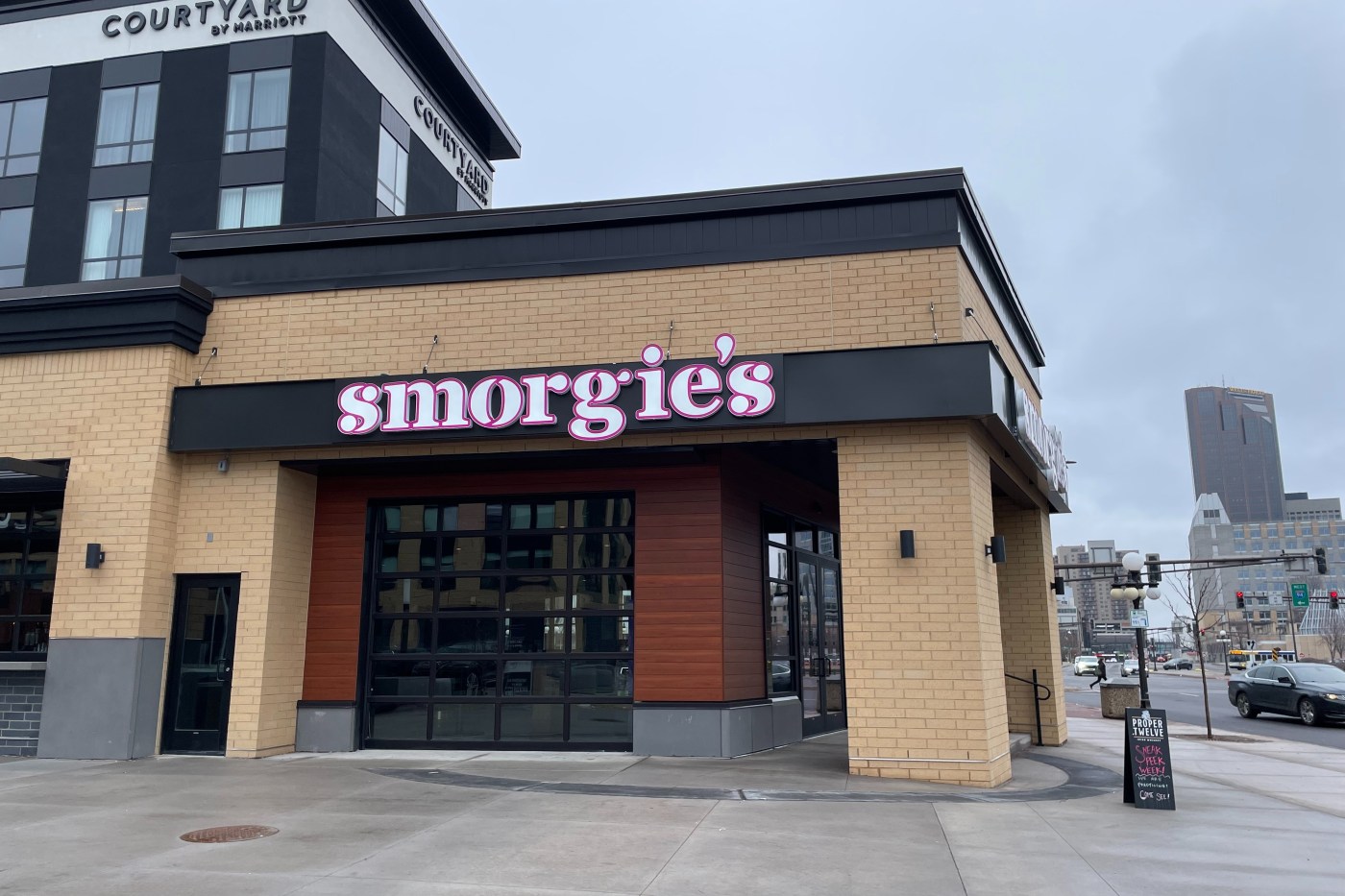
The exterior of Smorgie’s, in the Courtyard by Marriot across from the Xcel Energy Center in downtown St. Paul. (Jess Fleming / Pioneer Press)

No, Smorgie’s is an ideal across-from-the-X restaurant. They’re here to fill you up with food and beverages that make you happy and don’t cost too much — till 1 a.m. every single day.

On a recent visit, for example, the total bill for drinks, an appetizer, a pair of entrees and dessert: $64.39. (Which, I think, is the cost of one cocktail over at the X.)

Part of how they achieve this, I suspect, is by reducing staff. Diners seat themselves, and ordering is automated via QR code. At about 6:45 p.m. during that weeknight visit, there appeared to be one employee working the floor: bartending, running orders, bussing tables. She looked a bit stressed. I would be, too.

So still tip well, please — lest you have a smorgasbord (part of speech: noun; language of origin: Swedish) of bad karma come your way.

Smorgie’s

Where: 127 W. 7th Street, across from the Xcel Energy Center.

Hours: Open 11 a.m. to 1 a.m. daily.

Contact: smorgiesbar.com

Prices: Appetizers/snacks range from $8–$10; mains (salads, sandwiches, comfort food dishes) run $8–$14, with most costing $10, $11 or $12 apiece. Desserts are $4; drinks range from $6 to $12.

Reservations: Not accepted; walk-ins only.

Good to know: You can submit your own favorite comfort food recipe to the restaurant — and if they like it, they’ll feature it on the menu for a month.

Small Bites are first glances — not intended as definitive reviews — of new or changed restaurants.

Column: New QBs coach Kerry Joseph says ‘it’s about trust’ with the Chicago Bears QB — whoever that ends up being

posted in: News | 0

MOBILE, Ala. — Kerry Joseph doesn’t have any thoughts yet on the Chicago Bears’ biggest offseason decision, the one that holds the key to the NFL draft.

The team’s new quarterbacks coach, hired Friday, doesn’t even know where his office is at Halas Hall. He has been on a whirlwind tour since the season ended, free to seek a new job after the Seattle Seahawks forced out coach Pete Carroll.

Joseph, the assistant quarterbacks coach for the Seahawks the last two seasons, spent one day in Lake Forest interviewing for the Bears job. In between, he was scrambling to get to Mobile, where he’s serving as quarterbacks coach of the American team in the Senior Bowl.

Somehow along the way, Joseph got hooked up with Bears gear and was wearing a team-issued navy hat, navy shorts and gray sweatshirt at practice Tuesday at Hancock Whitney Stadium on the South Alabama campus.

He doesn’t have preliminary thoughts on Justin Fields. Joseph was the assistant wide receivers coach in Seattle in 2021, when the Bears drafted Fields. He has yet to dig in on this year’s draft, in which the Bears hold the first and ninth picks and are in position to select a new quarterback.

“I was getting transitioned to coming out here,” the 50-year-old Joseph said.

It’s the first time he has been an NFL position coach — above the assistant position coach level. The connection is easy to make. He worked with new Bears offensive coordinator Shane Waldron, who came from the Seahawks. The Bears also interviewed Seahawks quarterbacks coach Greg Olson for the offensive coordinator job.

The last first-time quarterbacks coach the Bears hired was Shane Day in 2010 based on his experience working with then-offensive coordinator Mike Martz in San Francisco. Since Day, the Bears have rolled through Jeremy Bates, Matt Cavanaugh, Dowell Loggains, Dave Ragone, John DeFilippo and most recently Andrew Janocko.

It would be overly dramatic to say this is the most important offseason for a Bears quarterbacks coach. There has been urgency to get the position right for the longest time. It just so happens they own the No. 1 draft pick as they prepare to thoroughly examine a talented group of passers, including USC’s Caleb Williams, North Carolina’s Drake Maye (who was a spectator at practice Tuesday), LSU’s Jayden Daniels and Michigan’s J.J. McCarthy.

Joseph, who was responsible for red-zone preparation with the Seahawks, had a hand in helping revive Geno Smith’s career in Seattle as Smith threw for 4,282 yards and 30 touchdowns in 2022. Joseph’s knowledge of Waldron’s system will be critical whether the Bears draft a quarterback or not.

“When you think about Shane and what we were able to do with the (Seahawks) offense, I think quarterback play is about having confidence,” Joseph said. “Quarterback play is just about being competitive. It’s about being smart, being dependable, having a good IQ of the game, being passionate.

“When you think about traits, when you talk about quarterback play and when you talk about Shane’s mentality, it’s just about being connected to the play caller, being connected to the offense. There are some things you’ve got to have and you’ve got to bring to it.”

Joseph was a quarterback at McNeese State and had a 42-11 record as a four-year starter, helping the Cowboys to two Southland Conference titles. He spent time with the Cincinnati Bengals in 1996 as an undrafted free agent before playing in NFL Europe. He tried to make the Washington Redskins as a slot back and then played safety for the Seahawks from 1998 to 2001, appearing in 56 games with 14 starts.

He returned to quarterback in the Canadian Football League in 2003, winning a Grey Cup with the Saskatchewan Roughriders in 2007, when he was named the league’s most outstanding player. After retiring following the 2014 season, he got into coaching at the college level with stops at his alma mater and Southeastern Louisiana before joining the Seahawks as an offensive assistant in 2020.

The diverse background — having played defense in the NFL — gives him a different perspective to teach offensive football.

“It helps me tremendously,” Joseph said, “because playing the safety position, playing that dime (position), playing down in the box helped me understand how defenses attack the offense, how guys fit. So now that I’ve gone back to quarterback, I see it from a defensive mentality.

“Being able to help guys to understand the game, not just from the offensive side but from the defensive side, kind of helped (with) where to put their eyes. That’s what it did for me as a player, and I try to teach it that way with a defensive mentality.”

Joseph will learn where his office is soon, and then he can hit the ground running as the Bears prepare for the draft and install a new offense — quite possibly with a new quarterback. As far as his philosophy on developing a young quarterback, he leaned into some basic tenets.

“I use three things: accountability, responsibility, communication,” Joseph said. “It’s about trust, believing and having confidence in each other. A quarterbacks coach and a quarterback, you’ve got to have those three things.

“Then, hey, it’s about the fundamentals. It’s about developing the fundamentals, developing the mentality to be a good leader. To be a winner. Just willing to compete. There are so many things that I have in my philosophy as a person that I take into the coaching world and into the quarterback room to help develop a group of guys.”

()