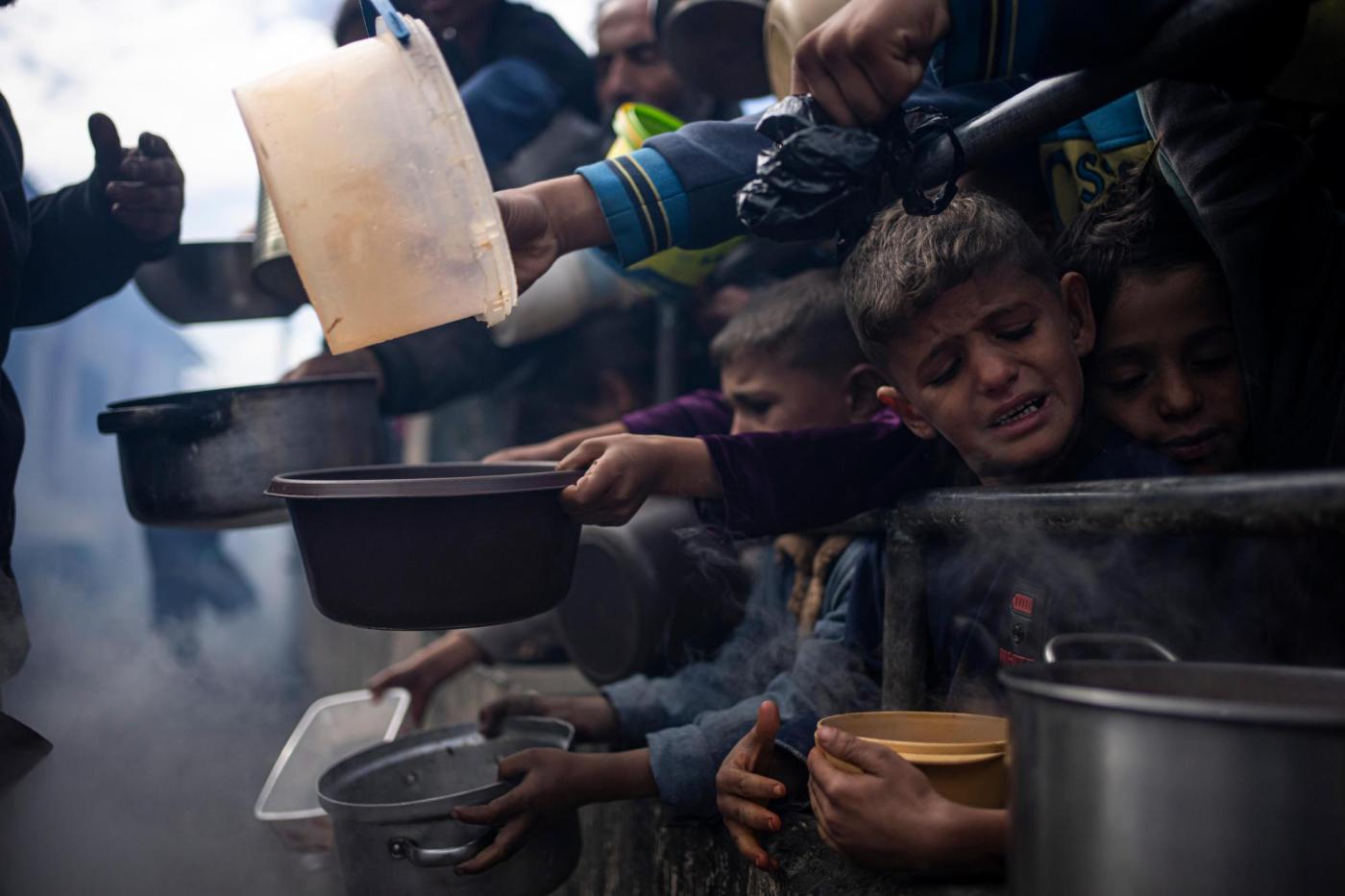
It’s not just Israeli bombs that have killed children in Gaza. Now some are dying of hunger too

posted in: News | 0

By MOHAMED JAHJOUH, JACK JEFFERY and LEE KEATH (Associated Press)

RAFAH, Gaza Strip (AP) — It’s not just Israeli bombs that have killed children in war-ravaged Gaza — now some are dying of hunger.

Officials have been warning for months that Israel’s siege and offensive were pushing the Palestinian territory into famine.

Hunger is most acute in northern Gaza, which has been isolated by Israeli forces and has suffered long cutoffs of food supplies. At least 20 people have died from malnutrition and dehydration at the north’s Kamal Adwan and Shifa hospitals, according to the Health Ministry. Most of the dead are children — including ones as old as 15 — as well as a 72-year-old man.

Particularly vulnerable children are also beginning to succumb in the south, where access to aid is more regular.

At the Emirati Hospital in Rafah, 16 premature babies have died of malnutrition-related causes over the past five weeks, one of the senior doctors told The Associated Press.

“The child deaths we feared are here,” Adele Khodr, UNICEF’s Middle East chief, said in a statement earlier this week.

Israel’s bombardment and ground assaults have already wreaked a high toll among children, who along with women make up nearly three-quarters of the more than 30,800 Palestinians killed, according to the Gaza Health Ministry.

Malnutrition is generally slow to bring death, striking children and the elderly first. Other factors can play a role. Underfed mothers have difficulty breastfeeding children. Diarrheal diseases, rampant in Gaza due to lack of clean water and sanitation, leave many unable to retain any of the calories they ingest, said Anuradha Narayan, a UNICEF child nutrition expert. Malnutrition weakens immune systems, sometimes leading to death from other diseases.

Israel largely shut off entry of food, water, medicine and other supplies after launching its assault on Gaza following Hamas’ Oct. 7 attack on southern Israel, in which terrorists killed some 1,200 people and took around 250 hostage. It has allowed only a trickle of aid trucks through two crossings in the south. Hamas has been designated as a terrorist organization by the United States, Canada and the European Union.

Israel has blamed the burgeoning hunger in Gaza on U.N. agencies, saying they fail to distribute supplies piling up at Gaza crossings. UNRWA, the largest U.N. agency in Gaza, says Israel restricts some goods and imposes cumbersome inspections that slow entry.

Also, distribution within Gaza has been crippled, U.N. officials say convoys are regularly turned back by Israeli forces, the military often refuses safe passage amid fighting, and aid is snatched off trucks by hungry Palestinians on route to drop-off points.

With alarm growing, Israel bent to U.S. and international pressure, saying this week it will open crossings for aid directly into northern Gaza and allow sea shipments.

DESPERATION IN THE NORTH

Conditions in the north, largely under Israeli control for months, have become desperate. Entire districts of Gaza City and surrounding areas have been reduced to rubble by Israeli forces. Still, hundreds of thousands of Palestinians remain.

Meat, milk, vegetables and fruit are nearly impossible to find, according to several residents who spoke to the AP. The few items in shops are random and sold at hugely inflated prices — mainly nuts, snacks and spices. People have taken barrels of chocolate from bakeries and are selling tiny smears of it.

Most people eat a weed that crops up in empty lots, known as “khubaiza.” Fatima Shaheen, a 70-year-old who lives with her two sons and their children in northern Gaza, said boiled khubaiza is her main meal, and her family has also ground up food meant for rabbits to use as flour.

“We are dying for a piece of bread,” Shaheen said.

Related Articles


Trudy Rubin: Gaza needs humanitarian aid now — with or without a cease-fire


Biden will announce a plan for a temporary port on Gaza’s coast to increase flow of humanitarian aid


Thomas Friedman: Inside America’s shadow war with Iran


Bret Stephens: The new rape denialism


Few Americans want US more involved in current wars in Ukraine and Gaza, AP-NORC poll finds

Qamar Ahmed said his 18-month-old daughter, Mira, eats mostly boiled weeds. “There is no food that suits her age,” said Ahmed, a researcher with Euro-Med Human Rights Monitor and an economic journalist. His 70-year-old father gives his own food to Ahmed’s young son, Oleyan. “We try to make him eat and he refuses,” Ahmed said of his father.

Mahmoud Shalaby, who lives in the Jabaliya refugee camp, said he saw a man in the market give a bag of potato chips to his two sons and tell them to make it last for breakfast and lunch. “Everyone know I has lost weight,” said Shalaby, the senior program manager for the aid group Medical Aid for Palestinians in northern Gaza.

Dr. Husam Abu Safiya, the acting head of Kamal Adwan Hospital, told the AP his staff currently treats 300 to 400 children a day, and that 75% of them are suffering from malnutrition.

Recent airdrops of aid by the U.S. and other countries provide far lower amounts of aid than truck deliveries, which have become rare and sometimes dangerous. UNRWA says Israeli authorities haven’t allowed it to deliver supplies to the north since Jan. 23. The World Food Organization, which had paused deliveries because of safety concerns, said the military forced its first convoy to the north in two weeks to turn back Tuesday.

When the Israeli military organized a food delivery to Gaza City last week, troops guarding the convoy opened fire — on a perceived threat, the military says — as thousands of hungry Palestinians mobbed the trucks. Some 120 people were killed in the shooting, as well as by being trampled in the chaos.

WORSENING SOUTH

Yazan al-Kafarna, 10, died Monday after almost a week of unsuccessful treatment in Gaza’s southernmost city of Rafah. Photos of the boy showed him extremely emaciated, with twig-like limbs and deep-sunk eyes in a face shriveled to his skull.

Al-Kafarna was born with cerebral palsy, a neurological condition that affects motor skills and can make swallowing and eating difficult. His parents said they struggled to find food he could eat, including soft fruits and eggs, since fleeing their home in the north.

He died due to extreme muscle wastage caused primarily by lack of food, according to Dr. Jabr al-Shair, head of the children’s emergency department at Abu Youssef Najjar Hospital.

On a recent day, around 80 malnourished children crowded the hospital’s wards. Aya al-Fayoume, a 19-year-old mother displaced to Rafah, had brought her 3-month-old daughter, Nisreen, who has lost vast amounts of weight over the winter months, sick with persistent diarrhea and vomiting. On her diet of mainly canned goods, al-Fayoume said she doesn’t produce enough breast milk for Nisreen.

“Everything I need is expensive or unavailable,” she said.

Fresh food supplies in Rafah have dwindled, while its population has swelled to more than 1 million with displaced residents. The main thing available are canned goods, often found in aid packages.

At Emirati Hospital, Dr. Ahmed al-Shair, deputy head of the nursery unit, said the recent deaths of premature babies was rooted in malnutrition among mothers. Malnourishment and extreme stress are both factors causing premature, underweight births, and doctors say anecdotally cases have risen during the war, though the U.N. does not have statistics.

Al-Shair said premature babies are treated for several days to improve their weight. But then they are released home, which is often a tent with not enough heat, with mothers too malnourished to breastfeed and milk difficult to obtain. Parents sometimes give newborns plain water instead, which is often unclean, causing diarrhea.

Within days, the babies “are brought back to us in a terrible state. Some were brought already dead,” al-Shair said. He said 14 babies at the hospital died in February and two more so far in March.

Currently, the hospital’s wards have 44 babies under 10 days old with weights as low as 2 kilograms (4 pounds), some on life support. Every incubator has at least three premature babies in it, raising the risk of infection. Al-Shair said he fears some will meet the same fate when returned home.

“We treat them now but God knows what the future will be,” he said.

Associated Press writers Sam Magdy and Sarah El Deeb in Cairo contributed to this report.

Follow AP’s war coverage at https://apnews.com/hub/israel-hamas-war

Trump attorneys post bond to support $83.3 million award to writer in defamation case

posted in: News | 0

By LARRY NEUMEISTER (Associated Press)

NEW YORK (AP) — Former President Donald Trump has secured a bond sufficient to support an $83.3 million jury award granted to writer E. Jean Carroll during a January defamation trial stemming from rape claims she made against Trump, his lawyer said Friday as she notified the federal judge who oversaw the trial that an appeal was underway.

Attorney Alina Habba filed papers with the New York judge to show that Trump had secured a $91.6 million bond from the Federal Insurance Co. She simultaneously filed a notice of appeal to show Trump, the 2024 Republican presidential front-runner, is appealing the verdict to the 2nd U.S. Circuit Court of Appeals.

The filings came a day after Judge Lewis A. Kaplan refused to delay a Monday deadline for posting a bond to ensure that the 80-year-old Carroll can collect the $83.3 million if it remains intact following appeals.

The posting of the bond was a necessary step to delay payment of the award until the 2nd Circuit can rule.

Trump is facing financial pressure to set aside money to cover both the judgment in the Carroll case and an even bigger one in a lawsuit in which he was found liable for lying about his wealth in financial statements given to banks.

A New York judge recently refused to halt collection of a $454 million civil fraud penalty while Trump appeals. He now has until March 25 to either pay up or buy a bond covering the full amount. In the meantime, interest on the judgment continues to mount, adding roughly $112,000 each day.

Trump’s lawyers have asked for that judgment to be stayed on appeal, warning he might need to sell some properties to cover the penalty.

Related Articles

National News |


Xcel Energy said its gear appears to have sparked Texas’ historic Smokehouse Creek fire

National News |


What is the State of the Union? A look at some of the history surrounding the annual event

National News |


Why are clocks set forward in the spring? Thank wars, confusion and a hunger for sunlight

National News |


MN Rep. Dean Phillips ends Democratic primary challenge, endorses President Biden

National News |


McConnell endorses Trump for president. He once blamed Trump for ‘disgraceful’ Jan. 6, 2021, attack

On Thursday, Kaplan wrote that any financial harm to Trump results from his slow response to the late-January verdict in the defamation case over statements he made about Carroll while he was president in 2019 after she claimed in a memoir that he raped her in spring 1996 in a midtown Manhattan luxury department store dressing room.

Trump vehemently denied the claims, saying that he didn’t know her and that the encounter at a Bergdorf Goodman store across the street from Trump Tower never took place.

A jury last May awarded Carroll $5 million after concluding that Trump sexually abused Carroll in the 1996 encounter, though it rejected Carroll’s rape claims, as rape was defined by New York state law. A portion of the award also stemmed from the jury’s finding that Trump defamed Carroll with statements he made in October 2022.

The January trial pertained solely to statements Trump made in 2019 while he was president. Kaplan instructed the jury that it must accept the findings of the jury last May and was only deciding how much, if anything, Trump owed Carroll for his 2019 statements.

Trump did not attend the May trial, but he testified briefly and regularly sat with defense lawyers at the January trial, though his behavior, including disparaging comments that a lawyer for Carroll said were loud enough for jurors to hear, prompted Kaplan to threaten to banish him from the courtroom.

Related Articles

National News |


Nicholas Kristof: The school issues we’re battling over aren’t the ones that matter

National News |


Paul Krugman: The rich spend differently from you and me

National News |


Judge denies Trump relief from $83.3 million defamation judgment

National News |


Thomas Friedman: Inside America’s shadow war with Iran

National News |


Biden uses feisty State of the Union to contrast with Trump, sell voters on a second term

Roseville police call in backup as fights break out among groups of youth; 3 injured

posted in: News | 0

As large groups of young people gathered in Roseville Thursday night, fights broke out and three people sustained non-life threatening injuries, police said.

Roseville police called in five other agencies to assist during the incident, which included 100 to 200 people at a fast food restaurant, fights and a glass door broken.

It began at Roseville Area High School, which the school said was hosting a student-sponsored cultural event. It drew a large crowd of non-Roseville Area High School youth and young adults, Principal Jen Wilson wrote in a Friday message to district staff and families.

At the event’s conclusion, “the large crowd gathered in the parking lot and refused to leave school grounds,” Wilson wrote. “RAHS leadership in partnership with the RAHS school resource officer and Roseville Police Department ordered the crowd to leave school grounds. Upon leaving school property, it’s reported that some of the attendees moved to businesses near HarMar Mall and Rosedale Center — resulting in ongoing disturbances that required police intervention.”

When police were at the school, “a number of fights broke out” and officers dispersed the group, said Roseville Deputy Police Chief Joe Adams.

Then, police were called to Chick-fil-A on Snelling Avenue near County Road B West. A large number of people were fighting in the lobby, Adams said.

A person sustained an injury to their arm from a sharp edge, believed to be a knife, Adams said. Two other people arrived at a hospital, also with wounds from sharp objects. Officers found knives at the scene.

It “was extremely chaotic,” Adams said.

Around the same time, police received another call reporting shots fired in the area of Raising Cane’s outside Roseville Center, but officers didn’t find anyone there or evidence of a shooting, Adams said.

No one was arrested or cited, and the investigation continues.

Related Articles

Crime & Public Safety |


Bloomington teen pleads guilty in West St. Paul girl’s drug overdose

Crime & Public Safety |


Wisconsin man gets more prison time in slaying, dismemberment of St. Paul man

Crime & Public Safety |


Charges: Texas bandits swipe nearly 19K worth of graphing calculators from eight east-metro Target stores

Crime & Public Safety |


Three more charged with sending $2.2M in fentanyl pills to Twin Cities hidden in stuffed animals

Crime & Public Safety |


Burnsville man gets 15 years for drug trafficking

Why are clocks set forward in the spring? Thank wars, confusion and a hunger for sunlight

posted in: News | 0

By JAMIE STENGLE (Associated Press)

ALLAS (AP) — Once again, most Americans will set their clocks forward by one hour this weekend, losing perhaps a bit of sleep but gaining more glorious sunlight in the evenings as the days warm into summer.

Where did this all come from, though?

How we came to move the clock forward in the spring, and then push it back in the fall, is a tale that spans over more than a century — one that’s driven by two world wars, mass confusion at times and a human desire to bask in the sun for a long as possible.

There’s been plenty of debate over the practice, but about 70 countries — about 40% of those across the globe — currently use what Americans call daylight saving time.

While springing the clocks forward “kind of jolts our system,” the extra daylight gets people outdoors, exercising and having fun, says Anne Buckle, web editor at timeanddate.com, which features information on time, time zones and astronomy.

“The really, really awesome advantage is the bright evenings, right?” she says. “It is actually having hours of daylight after you come home from work to spend time with your family or activities. And that is wonderful.”

Here are some things to know so you’ll be conversant about the practice of humans changing time:

HOW DID THIS ALL GET STARTED?

In the 1890s, George Vernon Hudson, an astronomer and entomologist in New Zealand, proposed a time shift in the spring and fall to increase the daylight. And in the early 1900s, British home builder William Willett, troubled that people weren’t up enjoying the morning sunlight, made a similar push. But neither proposal gained enough traction to be implemented.

Germany began using daylight saving time during World War I with the thought that it would save energy. Other countries, including the United States, soon followed suit. During World War II, the U.S. once again instituted what was dubbed “war time” nationwide, this time year-round.

In the United States today, every state except Hawaii and Arizona observes daylight saving time. Around the world, Europe, much of Canada and part of Australia also implement it, while Russia and Asia don’t currently.

INCONSISTENCY AND MASS CONFUSION

After World War II, a patchwork of timekeeping emerged across the United States, with some areas keeping daylight saving time and others ditching it.

“You might have one town has daylight saving time, the neighboring town might have daylight saving time but start it and end it on different dates and the third neighboring town might not have it at all,” says David Prerau, author of the book “Seize the Daylight: The Curious and Contentious Story of Daylight Saving Time.”

At one point, if riders on a 35-mile (56-kilometer) bus ride from Steubenville, Ohio, to Moundsville, West Virginia, wanted their watches to be accurate, they’d need to change them seven times as they dipped in and out of daylight saving time, Prerau says.

So in 1966, the U.S. Congress passed the Uniform Time Act, which say states can either implement daylight saving time or not, but it has to be statewide. The act also mandates the day that daylight saving time starts and ends across the country.

Confusion over the time change isn’t just something from the past. In the nation of Lebanon last spring, chaos ensued when the government announced a last-minute decision to delay the start of daylight saving time by a month — until the end of the Muslim holy month of Ramadan. Some institutions made the change and others refused as citizens tried to piece together their schedules. Within days, the decision was reversed.

“It really turned into a huge mess where nobody knew what time it was,” Buckle says.

WHAT WOULD IT BE LIKE IF WE DIDN’T CHANGE THE CLOCKS?

Changing the clocks twice a year leads to a lot of grumbling, and pushes to either use standard time all year, or stick to daylight saving time all year often crop up.

During the 1970s energy crisis, the U.S. started doing daylight saving time all year long, and Americans didn’t like it. With the sun not rising in the winter in some areas till around 9 a.m. or even later, people were waking up in the dark, going to work in the dark and sending their children to school in the dark, Prerau says.

”It became very unpopular very quickly,” Prerau says.

And, he notes, using standard time all year would mean losing that extra hour of daylight for eight months in the evenings in the United States.

A NOD TO THE EARLY ADOPTERS

In 1908, the Canadian city of Thunder Bay — then the two cities of Fort William and Port Arthur — changed from the central time zone to the eastern time zone for the summer and fall after a citizen named John Hewitson argued that would afford an extra hour of daylight to enjoy the outdoors, says Michael deJong, curator/archivist at the Thunder Bay Museum.

The next year, though, Port Arthur stayed on eastern time, while Fort William changed back to central time in the fall, which, predictably, “led to all sorts of confusion,” deJong says.

Today, the city of Thunder Bay is on eastern time, and observes daylight saving time, giving the area, “just delightfully warm, long days to enjoy” in the summer, says Paul Pepe, tourism manager for Thunder Bay Community Economic Development Commission.

The city, located on Lake Superior, is far enough north that the sun sets at around 10 p.m. in the summer, Pepe says, and that helps make up for their cold dark winters. Residents, he says, tend to go on vacations in the winter and stay home in the summer: “I think for a lot of folks here, the long days, the warm summer temperatures, it’s a vacation in your backyard.”