
Farah Stockman: Is this the Silicon Valley of Latin America?

posted in: News | 0

SAN JOSE, Costa Rica — Americans used to think of China as a place to do business, and Latin America as a place to vacation. More recently, our neighbors to the south are seen as the source of desperate migrants. That mindset led us to the mess that we are in now. Today, the American economy is far too dependent on China for critical supplies, while imports from countries in our hemisphere, aside from Canada and Mexico, are lagging, experts say. Our influence in our own neighborhood is waning.

It doesn’t have to be this way. I saw evidence of that in Costa Rica, a stable democracy that is vying to become the Silicon Valley of Latin America — with active support from the United States.

Reducing U.S. dependence on China

Costa Rica is crucial to the gargantuan U.S. effort to reduce dependence on microchips from China, which plays an outsize role in packaging and testing the tiny gadgets that run everything from smartphones to fighter jets. More than 40% of the chips the U.S. Department of Defense uses for weapons systems and infrastructure rely on Chinese suppliers. More than 90% of advanced chips are produced in Taiwan, a self-governing island claimed by China.

Now, Costa Rica is positioning itself to become a major hub outside Asia for packaging and testing microchips. In the 1990s, Intel built a factory near San Jose to do just that. That opened the door to more factories and industries and, as a result, an increasingly tech-oriented workforce. Today, Costa Rica’s biggest category of exports is no longer coffee or bananas but medical devices.

On a recent Thursday afternoon, in a hotel ballroom outside the capital, San Jose, President Rodrigo Chaves touted tax incentives, regulatory reforms and a 99%-renewable-energy grid as he rolled out a national strategy to expand the industry. “Welcome to Costa Rica, a country where thou shall not face red tape,” he boomed.

His audience — which included U.S. Commerce Secretary Gina Raimondo; Gen. Laura Richardson, the four-star who leads the U.S. Southern Command; and top executives from Intel — enthusiastically applauded.

Allies closer to home

“We need allies closer to home,” Raimondo told me. She is in charge of doling out tens of billions in subsidies to bring the industry closer to home, an effort that is crucial to ensuring that Americans stay on the cutting edge of artificial intelligence and other critical technologies in the future.

This great reshuffling of the U.S. supply chain could be the key to building better relationships in Latin America at a time of rising isolationism in the United States, when both parties have grown skeptical of free trade and frustrated by record numbers of migrant arrivals.

While the CHIPS and Science Act is best known for its billion-dollar subsidies to build facilities on U.S. soil, it also provides modest funding for our allies. Costa Rica and Panama have received money to beef up their workforces and their infrastructure. The Dominican Republic looks poised to be next in line.

It’s no accident that “building resiliency” for supply chains is a main goal of the Americas Act, the new bipartisan bill that would revamp relations with friendly neighbors and put them on a path to join the United States-Mexico-Canada Agreement, the trade agreement that replaced NAFTA.

I was a vocal critic of NAFTA, a view I came to while writing about American factory workers who lost their jobs when their plant moved to Mexico. Exporting our industrial base hurt American workers and U.S. national security. But the USMCA, which passed overwhelmingly in Congress a few years ago, has gone a long way toward addressing workers’ concerns. It’s popular. Why not expand it? And if more trade with Latin America will build up an industrial base that would have otherwise gone to Asia, it could make our region stronger, not weaker.

Nations that trade the most with their nearest neighbors get the biggest benefits from trade while minimizing the dislocating job loss that can come with it, as Shannon O’Neil argues in the recent book “The Globalization Myth.” Europe and Asia are mastering that. America is not.

A counter to ‘Belt and Road’

When America turned to Asia for low-cost labor, that left a void in our own backyard, as Karina Fernandez-Stark and Penny Bamber noted in a recent article in The Wilson Quarterly. China is filling it, becoming the most important trade partner and investor in much of Latin America. Twenty-two countries in the Western Hemisphere have signed onto China’s Belt and Road initiative. Chinese companies are building a deep-water port in Peru, a bridge across the Panama Canal and a deep space ground station in Argentina.

We can’t blame our Latin American friends for turning to China to make investments that we won’t provide. While we’ve been off trying to run the world, we’ve been elbowed out of our own hemisphere.

Supply chain diplomacy can help. Until now, Costa Rica has hedged its bets, signing onto Belt and Road while lobbying for the chance to join the USMCA. But the chance to be a microchip hub seems to have tipped the balance. Chaves abruptly excluded Chinese vendor Huawei — alongside others — from building the country’s 5G network, angering China.

“Sometimes you need to make difficult decisions,” Chaves told his audience. “We’re not imagining the future; we are building it, with those with whom we share values.”

It’s smart, both geopolitically and economically, to nurture that sense of shared destiny. It won’t be a quick fix to the region’s many problems, but it can help turn the tide over time. Costa Rica, Panama and the Dominican Republic are relatively small countries with limited influence. But if their economies are booming, they can provide more opportunities to those fleeing crisis-ridden places like Haiti and Nicaragua. Fewer migrants will arrive at our doorstep.

Team up with friendly neighbors

Like any policy, supply-chain diplomacy has its risks. We could be building up our future competitors. I couldn’t help but notice that San Jose seems better poised for the digital age than rural Ohio. Some technical high schools already teach an AI curriculum, a senior Intel executive in Costa Rica told me. The industry attracts top talent and fierce loyalty. At Intel’s plant near San Jose, one factory manager told me that he “bleeds blue” — the color of the company logo.

But this factory wouldn’t be competitive in the United States. Even in Costa Rica, it has struggled to compete with the low labor costs of Asia. Intel closed the plant in 2014 and sent its work to Malaysia, leaving a skeleton crew doing research and development. The factory reopened in 2020, after the pandemic set off a chip shortage. Intel has been expanding ever since, gobbling up space that used to be a cafeteria. Demand for chips will only increase with the rise of AI.

How we navigate the challenges posed by AI — and a far more powerful China — will determine our future. We have a choice: face those challenges by ourselves, or with friendly neighbors.

Farah Stockman writes for the New York Times.

Related Articles

Opinion |


Bret Stephens: The appalling tactics of the ‘Free Palestine’ movement

Opinion |


Tyler Cowen: Indiana can’t make universities more conservative with a law

Opinion |


Zeynep Tufekci: You don’t need to freak out about Boeing planes (but Boeing does)

Opinion |


Karl W. Smith: Raising Social Security’s retirement age is the least bad option

Opinion |


Ludwig, Miller: We are seeing a lethal shift in America’s shooting crisis

Bret Stephens: The appalling tactics of the ‘Free Palestine’ movement

posted in: Society | 0

Last week, Susanne DeWitt, an 89-year-old Holocaust survivor who later became a molecular biologist, spoke before the Berkeley, California, City Council to request a Holocaust Remembrance Day proclamation. After taking note of a “horrendous surge in antisemitism,” she was then heckled and shouted down by protesters at the meeting when she mentioned the massacre and rapes in Israel of Oct. 7.

At the same meeting, a woman testified that her 7-year-old Jewish son heard “a group of kids at his school say, ‘Jews are stupid.’” She, too, was heckled: “Zionists are stupider,” a protester said. At the same meeting, others yelled, “cowards, go chase the money, you money suckers” and “you are traitors to this country, you are spies for Israel.”

Protest movements have an honorable place in American history. But not all of them. Not the neo-Nazis who marched in Chicago in 1978. Not the white supremacists who chanted “Jews will not replace us” at their Unite the Right rally in Charlottesville, Virginia, in 2017.

And not too much of what passes for a pro-Palestinian movement but is really pro-Hamas, with its calls to get rid of the Jewish state in its entirety (“from the river to the sea …”), its open celebration of the murder of its people (“resistance is justified …”) and its efforts to mock, minimize or deny the suffering of Israelis, which so quickly descend into the antisemitism on naked display in Berkeley.

How did this happen?

It wasn’t a response to the human suffering in the Gaza Strip in recent months. A coalition of Harvard student groups issued a statement on Oct. 7 holding “the Israeli regime entirely responsible for all unfolding violence.” Pro-Hamas demonstrations broke out worldwide on Oct. 8. A Black Lives Matter chapter posted a graphic on Instagram of the Hamas paragliders who murdered hundreds of young Israelis at the Nova music festival. A Cornell professor said he found the massacre “exhilarating,” and demonstrators rallied in his support.

Nor is it a matter of seeking a Palestinian state — another fact the demonstrators openly avow. Among the popular chants at many protests is “We don’t want no two states! We want all of ’48!” — all of what had been Mandatory Palestine before the creation of Israel. Israeli soldiers and settlers vacated Gaza almost 20 years ago. The towns and kibbutzim that Hamas invaded on Oct. 7 are only “occupied” if one believes that all of Israel, in any kind of border, is a form of occupation.

In other words, the central, animating sentiment behind much of the protest movement is neither humanitarian nor liberationist. It’s eliminationist. And it expresses itself routinely in the tactics adopted by so many of its leading activists and followers.

Tactics like the grotesque and routine removal or defacement of posters of Israelis kidnapped to Gaza. Or holding a loud and aggressive demonstration outside New York’s Memorial Sloan Kettering cancer hospital (“Make sure they hear you, they’re in the windows,” said one of the protest leaders), apparently because the hospital has collaborated with Israeli medical institutions. Or forcing a Jewish teacher at a public school in Queens to flee her classroom for safety as hundreds of teenagers rioted through the school, some waving Palestinian flags. Or shouting down Rep. Jamie Raskin at the University of Maryland for being “complicit in genocide” when he came to the campus to give a talk on democracy and “the threat to reason in the 21st century.” Or surrounding a theater at the University of California at Berkeley that was supposed to host a talk by an Israeli lawyer, smashing windows, breaking through locked doors, spitting on and grabbing at least one student by the neck and forcing Jewish students to flee through an underground exit.

This is only a partial list. But it reveals the bullying mentality at the heart of the pro-Hamas movement.

It isn’t enough for them to speak out; they must shut other voices down. It isn’t enough for them to make a strong or clear argument; they also aim to instill a palpable sense of fear in their opponents. American civil libertarians of the past once understood that inherent in the right to protest was the obligation to respect the right of people with differing views to protest as well. That understanding seems to be wholly absent from the people who think that, say, heckling Raskin into silence is also a form of democracy.

In this sense, critics of Israel who claim that American Jews must choose between Zionism and liberalism have it backward. The illiberals aren’t the people defending the right of an imperfect but embattled democracy to defend its territory and save its hostages. They are the people who, like former Iranian president Mahmoud Ahmadinejad, want Israel wiped off the map and aren’t ashamed to say so.

Not surprisingly, they also seem to share Ahmadinejad’s attitudes toward dealing with dissent.

It’s true that in nearly every political cause, including the most justified, there are ugly elements — the Meir Kahanes or the Louis Farrakhans of the world. But the mark of a morally serious movement lies in its determination to weed out its worst members and stamp out its worst ideas. What we’ve too often seen from the “Free Palestine” crowd is precisely the opposite.

Bret Stephens writes a column for the New York Times.

Related Articles

Opinion |


Tyler Cowen: Indiana can’t make universities more conservative with a law

Opinion |


Zeynep Tufekci: You don’t need to freak out about Boeing planes (but Boeing does)

Opinion |


Karl W. Smith: Raising Social Security’s retirement age is the least bad option

Opinion |


Ludwig, Miller: We are seeing a lethal shift in America’s shooting crisis
Opinion |


Allison Schrager: What are the odds of enjoying March Madness now?

Q&A: Books For Africa founder Tom Warth marks 60-million milestone

posted in: News | 0

Tom Warth once visited a school library in Jinja, Uganda, that had nearly everything a library needs — except books.

There was a librarian, a card catalog, tables, bookcases and students, but the shelves were nearly bare. What few books there were, he said, were “tattered and worn.”

Matilda Arhin, a Books For Africa board member, on Wednesday, April 3, 2024, held a copy of the 60 millionth book shipped by the nonprofit organization in Marietta, Ga. Arhin served as container captain for the shipment. (Courtesy of Books For Africa)

Warth took it upon himself to fill the library with books — and then did the same for hundreds of other libraries across the continent.

On Wednesday, the nonprofit organization that Warth founded, Books For Africa, shipped its 60 millionth book to Africa. A truckload of books left the Books For Africa warehouse in Marietta, Ga., bound for the harbor in Savannah, Ga., where they will be placed on a container ship bound for Ghana.

Books For Africa, based in St. Paul, is the largest shipper of donated text and library books to the African continent, having shipped books to all 55 countries in Africa since 1988.

Warth, a native of England, founded the organization after he sold his publishing company, Motorbooks International. “I wanted to invest the money where it would make a difference,” he said. “Education is essential to Africa’s development and to the future of its students.”

Warth, 88, of Marine on St. Croix, celebrated his 70th birthday by climbing Mount Kilimanjaro in Tanzania as a fundraiser for Books For Africa. He trained for the climb to the mountain’s peak, 19,340 feet above sea level, by climbing the Main Street Stairs in downtown Stillwater 110 times, the equivalent of ascending the mountain.

When he turned 80, he decided to walk across the island of Zanzibar for yet another fundraiser. He also has walked across Gambia in West Africa; from Lake Michigan to South Dakota; from Canada to Iowa; and from Menomonie, Wis., to St. Paul and from Taylors Falls to the Capitol in St. Paul – all to raise both visibility and funds for Books For Africa.

Related Articles

Books |


Author and activist Bao Phi to receive Kay Sexton literary award

Books |


Literary calendar for week of March 31

Books |


Readers and writers: Mysteries true and fictional, and a gourmet journey

Books |


The Hold Steady to release illustrated children’s book in October

Books |


Readers and writers: Enger’s latest novel considers a dark future and a sentient Superior — with hope

“Without Tom, none of this would have happened,” said Patrick Plonski, the organization’s executive director. “Sixty million books have been shipped — and every single one of the African countries on the continent served — and it’s all been run out of this base here in Minnesota. All of this would have been unthinkable 36 years ago. It just shows the value of vision, and the ‘art of the possible.’”

To put that number into perspective, there are approximately 150,000 books at George Latimer Central Library in downtown St. Paul.

Last year, Books For Africa shipped 4,029,000 books, valued at more than $32.6 million, to 32 African countries — the most books ever shipped in a single year. About 800,000 digital books also were shipped on 116 computers and 150 tablets. More than $2.6 million was raised to ship the books to partners across Africa, Plonski said.

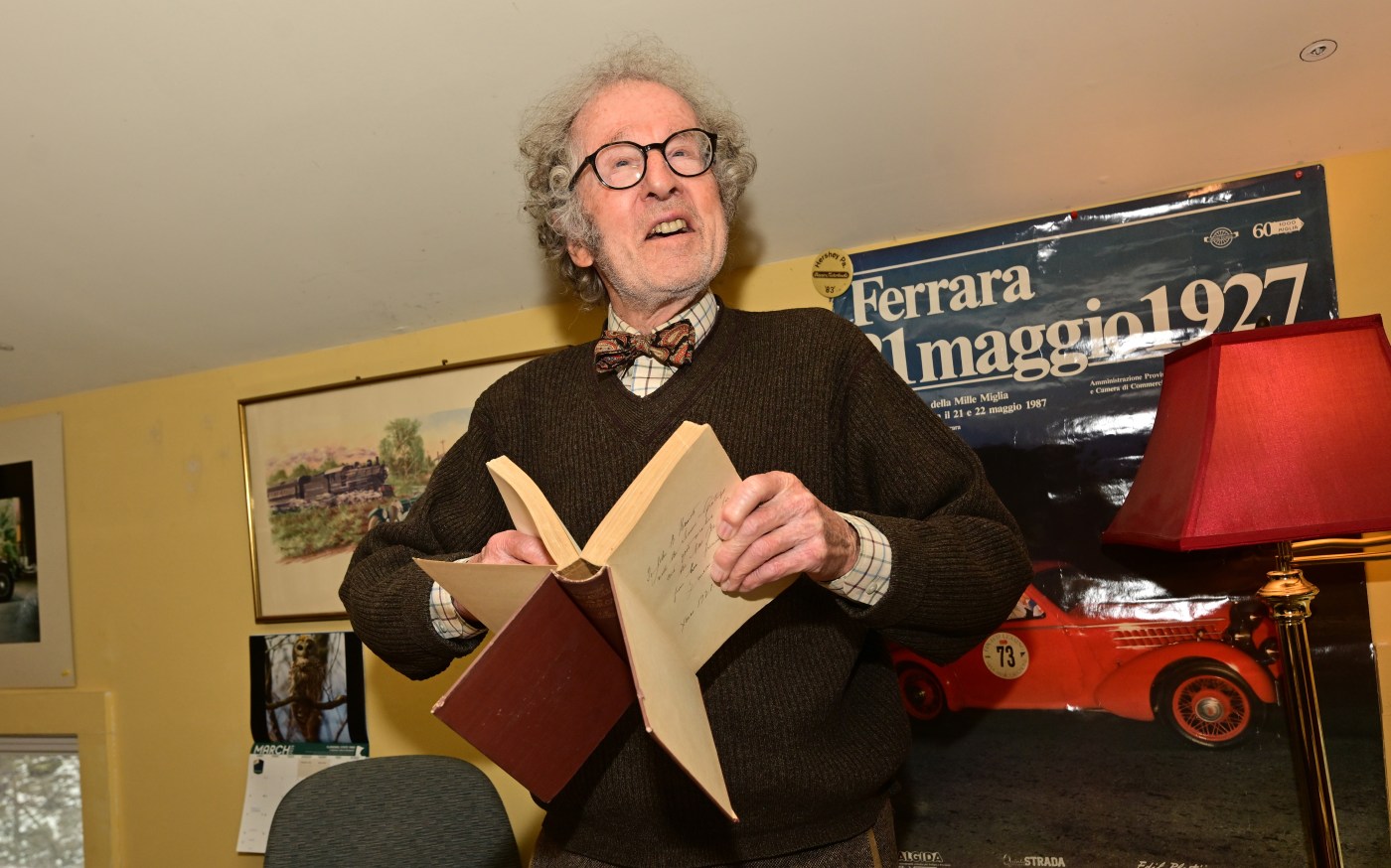
Warth, the owner of T. E. Warth Esq. Automotive Books, works out of an office above the Marine General Store in downtown Marine on St. Croix. He sells rare books to car enthusiasts.

Warth has two children and two grandchildren. He is married to Zantha LaFon Warth.

In an interview with the Pioneer Press over lunch at the Brookside Bar & Grill in Marine, Warth talked about Books For Africa’s recent milestone, a new children’s book called “The Book King: The Story of Tom Warth and Books For Africa,” and his love of hitchhiking. The transcript is edited for clarity and conciseness.

Tom Warth Q&A

Q: Congratulations on reaching 60 million. To what do you attribute Books For Africa’s success?

A: There are three reasons. Number one, books. Nobody likes to throw away a book, so we get given books. Number two, we started it in a philanthropic center of the country. Minnesota is known for philanthropy. I don’t think if we’d started in Baltimore or Washington, it would have worked. And third, we’ve had two great executive directors. You know, the first one, Bob Kowalczyk, didn’t mind packing the books and doing grunt work. And (Plonski) loves to network. You know, that’s the secret. I mean he has really made it fly.

Q: Talk about the importance of books, particularly printed books.

A: You know, we were talking about newspapers, and the tactile feel and the sniff of a newspaper and holding it out and how looking at it is so much nicer than looking at something online, and then I think of the children in Africa, we can’t abandon printed books. You know, half the population of Africa lives in rural areas. There are 400 million children. They live in huts with no printed material. Surely they need one printed book that they can touch and feel.

Q: Tell me about your childhood. Where did you go to school?

Tom Warth, a native of England, with his portrait of British prime minister Winston Churchill. (John Autey / Pioneer Press)

A: I grew up near Cambridge (England). I went to boarding school, and then I went to Cambridgeshire Technical College for a year. That’s like an American vo-tech. I learned basic things like typing, law, statistics, accounting, you know, a little about a lot, and that served me well the rest of my life. In fact, I got irritated at Motorbooks when they said in their advertisements for employees that they need to have a college degree. I said, “Well, I’m running the show, and I don’t have a college degree.”

Q: What brought you to the U.S.?

A: I lived in Eau Claire when I emigrated in 1960. I came to Eau Claire because that’s where my sponsor, an Eighth Air Force pilot who had befriended my dad (during World War II) lived. He came to visit my dad in 1959, and we met, and he said to me, “Tom, if you want to see America, I’ll sponsor you.” You know, no one was immigrating in those days. I just thought, “Well, I’d like to see America.” I came over and worked in a drugstore and on road construction. I stayed for about a year. Then I went back and got married, and then we decided to come to America, so we both came. America was the land of opportunity.

Q: Tell me about your interest in cars. How did that come about?

A: My dad (Ewart) liked fine cars. He had a Bentley, and he would reverse it into the parking space, so people would know what he had. My brother, John, and I were infected by that. John was two years younger. He ended up being a major dealer in cars. He would go to India and spend a year there trying to get into the good graces of the maharajas and so on, who had garages full of Rolls-Royces. Sadly, he died in 1986. He was 48.

Q: How did you get into car book publishing?

Tom Warth’s business sign at his office above the Marine General Store. (John Autey / Pioneer Press)

A: We lived in Minneapolis, and I worked for Prudential Insurance for five years, but my ambition was always to work for myself, not have a boss. I didn’t intend to have a big company or anything, but, with cars being my hobby, I started to think about getting material for (car) enthusiasts. I knew the car magazines, and so I put little ads in magazines like Road & Track, and gradually it got bigger and bigger. I was the first, and the hobby was small. Back then in the 60s, people didn’t have enough money to buy a lot of old cars. I threaded the needle in terms of timing. If I’d started it earlier, there wouldn’t have been enough business. If I’d started it later, other people would have been in it. We were publishing 100 books a year when I sold out in 1988.

Q: Have you always liked driving?

A: Yes. Oh, I love driving. I like seeing the scenery and stuff. We just drove to Savannah and stayed for 10 days in an Airbnb and that was 3,000 miles I put on. I’m still lucky enough to have my wits about me. I can still drive, you know? My eyesight is good, and my reaction times are good. I like walking better than driving, though. I walk three to four miles a day.

Q: How many cars do you have?

A: I have a 1960 gray Citroën 2-CV — or Deux Chevaux. I had a 1965 289-AC Cobra, which I had for many years and sold, and I’ve got a 2003 Jaguar. The everyday car is a Fiat 500.

Q: When did you move to Marine?

Tom Warth stands among books, boxes of books and assorted memorabilia at his office in Marine on St. Croix. (John Autey / Pioneer Press)

A: We were living in South Minneapolis, and a friend showed me a house on Judd Street that had English characteristics, and so we bought that in 1975. I’ve been here ever since. I’m in my third house here now. … We looked around within a 20-mile radius for the business. It was a banker in Osceola (Wis.) who convinced me that an industrial park in Osceola would be a good spot for Motorworks.

Author Rosemond Sarpong Owens in 2023 wrote a children’s book about Books For Africa Founder Tom Warth called “The Book King: The Story of Tom Warth and Books For Africa.” (Courtesy of Books For Africa)

Q: I understand a children’s book called “The Book King” has just been published about you.

A: People have said, “Tom, you’ve had such an interesting life. You should write your autobiography.” Well, now it’s been done. Rosemond Sarpong Owens wrote it, and she did a fabulous job. It’s a nice outline of my life.

Q: Let’s talk about your love of hitchhiking.

A: People say it’s dangerous, but I think it’s less dangerous now than it was in the ’50s and ’60s, because there’s supposed to be less crime. I think the problem is, there’s so much publicity about crime now that people are frightened. Is the driver going to attack the hitchhiker, or is the hitchhiker going to attack the driver? I just don’t think this happens.

In the 1950s, I hitchhiked around Europe. In 1961, I hitchhiked from Eau Claire to New Orleans for the Mardi Gras. Just south of Chicago, a lady picked me up, and she said, “What part of the South are you from?” I said, “I’m not from the South. I’m from England.” She’d mistaken the Union Jack on my backpack for a Confederate flag. I also hitchhiked from Eau Claire to Winnipeg to buy a car. In Cuba, when I was last there, they fine drivers who passed a hitchhiker and had an empty seat and didn’t pick them up.

I just think environmentally, we have to think about all these cars, four-seat cars with one person in them. I’ve picked up hitchhikers a lot, and I like it, you know, if you’re on a long drive.

Related Articles

Books |


Public Art St. Paul names Mohannad Ghawanmeh as its new president, executive director

Books |


‘Paddle for a cure’ pickleball tournament in Woodbury on Saturday

Books |


St. Paul life science incubator appoints new executive director

Books |


Coalition formed to help domestic abuse victims take pets with them

Books |


Unionized Science Museum workers await contract as cultural nonprofits face changing labor market

MN Legislature may pass gun bills on straw purchases, safe storage, reporting stolen weapons this session

posted in: News | 0

Minnesota lawmakers are weighing a variety of gun-control proposals this year, but only a handful have a good chance of passing.

Bills calling for a safe storage requirement, a requirement to report lost and stolen guns in a timely manner, and setting stronger penalties for straw purchases appear to have the most support this session. Gov. Tim Walz called for their passage in his State of the State address last month.

Increasing penalties for those who buy guns for others not eligible to purchase guns — known as straw purchasing — has support from both Democratic-Farmer-Labor and Republican lawmakers. But depending on whether that bill retains additional gun-control provisions, Democrats may have to move forward on their own. That also looks to be the case for a universal safe storage requirement and a reporting requirement for stolen firearms without GOP support.

DFLers have controlled the Senate, House and governor’s office since the beginning of 2023, and while they have passed a broad slate of legislation typically favored by liberals and progressives, their movement on gun control has not been as sweeping.

Gun measures

Last year, lawmakers passed two significant gun-control measures: a “red flag” bill creating extreme risk protection orders, and universal background checks. Both got through the Legislature after questions about whether they’d make it through the Senate, where it wasn’t clear if they’d find support from a handful of DFLers in rural and suburban districts.

They passed, but gun-control advocates at the Capitol, like Senate Judiciary and Public Safety Chairman Ron Latz, DFL-St. Louis Park, acknowledged those were their best shot at getting something through to the governor.

Other proposals that DFLers have backed, such as a ban on semiautomatic rifles sometimes known as assault weapons, have not seen serious legislative action this year. Walz last year pitched magazine capacity limits and banning people younger than 21 from buying semiautomatic rifles, though neither proposal gained steam.

An assault weapons ban bill sponsored by Rep. Leigh Finke, DFL-St. Paul, which lists more than a dozen weapons such as those patterned after the AR-15,  didn’t get a hearing by the first legislative deadline on March 22, more or less ruling out any further action before the session ends in May.

Straw purchases

DFLers and Republicans support stiffening penalties for straw purchasers — people who buy guns legally and give them to ineligible people such as those with felony convictions. But it may not really matter if it ends up getting approved as part of a broader public safety bill with other provisions Republicans won’t support.

Straw purchase penalties became the third top gun-control priority this session after the February shooting of Burnsville police officers Matthew Ruge and Paul Elmstrand, and firefighter/paramedic Adam Finseth. The shooter, Shannon Gooden, was prohibited from owning a gun after pleading guilty to assault with a dangerous weapon in 2008 but was still able to obtain one.

Ashley Anne Dyrdahl, Gooden’s girlfriend, was federally indicted in March for straw purchasing two AR-15-style firearms. Dyrdahl has pleaded not guilty.

“While straw purchases are already illegal under Minnesota law, our law contains loopholes that need to be closed in order to hold offenders accountable,” said Rep. Kaela Berg, DFL-Burnsville, as she presented a straw purchase bill to the House Public Safety Committee in March.

Berg’s bill would elevate the penalty for straw purchases from a gross misdemeanor to a felony in Minnesota. It also would ban binary triggers, which give firearms a rapid rate of fire by allowing them to fire both when the trigger is depressed and released. Republicans raised concerns about straw purchase penalties and another restriction being bound together.

Republicans, who advocated stronger straw purchase penalties last year, say they welcome the harsher penalties, though they questioned why their DFL colleagues did not include the stronger penalties in last year’s public safety bill. They have their own version of the straw purchase bill which does not include the binary trigger ban.

In general, GOP lawmakers have opposed new gun-control legislation, and have instead advocated for stronger enforcement of existing laws in order to keep guns out of the wrong hands.

Safe storage

A bill backers are calling the “safe storage” requirement bill would mandate firearms stored in the home to either be unloaded and locked or stored in a gun safe. Anyone found in violation could potentially face felony penalties if the firearm is used in a crime.

Proponents say requiring guns to be locked up will curb thefts and prevent children from gaining access to weapons.

Testifying in favor of the safe storage bill at a Senate Judiciary and Public Safety Committee hearing in March was Hilary Brasel, whose husband Michael was shot and killed last May in St. Paul’s St. Anthony Park neighborhood when he confronted a group looking for valuables in a family car.

The gun used in the killing of Michael Brasel, a youth hockey coach and father of two, was stolen from an unsecured closet. Two teenagers pleaded guilty in his death, with one sentenced to 25 years in prison for aiding and abetting second-degree intentional murder.

“I believe the proper storage of guns could have prevented Michael’s murder and can prevent this type of tragedy from destroying other lives in Minnesota in the future,” Hilary Brasel told the committee.

Also testifying in favor of the bill was Bloomington Police Chief Booker Hodges, who said he does not generally support gun-control legislation but supports safe storage requirements and stiffer penalties for straw purchases.

Gun rights supporters noted the state already has storage rules to protect children. Further, it applies a “one-size-fits-all” standard to people who have very different needs, said Rob Doar, senior vice president with the Minnesota Gun Owners Caucus.

“This treats a farmer who lives by himself in Roseau who keeps a firearm available to defend his livestock from predators the same as a day care operator in Edina,” he told the committee. “That one-size-fits-all solution doesn’t recognize the realities of how different people live their lives in this state.”

Reporting stolen guns

The third gun-control bill that’s a priority for DFLers this session would create a reporting requirement for lost and stolen firearms.

A person who owns or possesses a firearm would have to report the loss to a law enforcement agency within 48 hours of the time the person knew or reasonably should have known of the loss or theft.

The first violation would be a petty misdemeanor. Second offenses would be a misdemeanor and third violations would be a gross misdemeanor.

If a person does report a lost or stolen firearm, they would be immune to criminal prosecution “for an offense pursuant to state law related to the storage of firearms.”

The bill also requires law enforcement agencies to report lost or stolen firearms to Minnesota’s Commissioner of Public Safety within seven days.

Supporters say a reporting requirement will aid law enforcement efforts to track stolen weapons, which are often used in crimes.

Gun rights groups, including the Minnesota Gun Owners Caucus and the National Rifle Association, oppose the bill, with the NRA requesting the efficacy of a reporting requirement in preventing crimes.

Related Articles

Politics |


Letters: Speed up energy permitting in Minnesota

Politics |


Minnesota justices hear arguments in felon voting rights case

Politics |


Minnesota Supreme Court to hear felon voting rights case

Politics |


Minnesota Legislature will return from Easter break with plenty of bills still in the pipeline

Politics |


Letters: In Cobb case, was deadly force authorized?