By ERIKA KINETZ and SOLOMIIA HERA (Associated Press)
DOVHENKE, Ukraine (AP) — The smell in the car is sick and sweet, the overpowering scent of corpses that have lain too long in muck and ruin, the ones the dogs didn’t devour. Oleksii Yukov, a 38-year-old martial arts instructor who leads a team of volunteer body collectors in Ukraine, doesn’t notice.
He is on the phone with one of the mothers. She heard her son was injured in battle and left behind, but she’s not sure where.
“He was left to die and now they are telling me that ‘he died as a hero!?’” she says, choking out words between sobs.
“Don’t cry,” Yukov tells her. “Because if you get weak — no one will help him … Don’t cry in front of anyone! They are not worth it. Cry in front of the grave of your son only.”
“We will take everyone back,” he promised. “We just need some time.”
Yukov says the same thing to all the mothers. He tells them to talk about their dead children, so they will be remembered. There is one person in particular whose story Yukov does not want forgotten: Oleksandr Romanovych Hrysiuk — Sasha, to his mother, Olha.
In a cryptic voice message last year, Yukov urged Olha to tell Sasha’s story. “Not everyone has such a story,” he told her.
But he left out the most important part: What it had cost him to bring Sasha home.
COUNTING BODIES
The true toll of the war in Ukraine — and the odds faced by each side — can be measured in bodies.
More than half a million people have been killed or seriously injured in two years of war in Ukraine, according to Western intelligence estimates — a human toll not seen in Europe since World War II. The question of who prevails is being increasingly shaped by which side can tolerate higher losses.
By that measure, Moscow has the upper hand.
Analysts say it will be hard for Ukraine to outmatch Russian forces, which continue to grow despite hundreds of thousands of casualties, without significant resources from its international partners. But the U.S. Congress has not approved $60 billion in aid for Ukraine, even as soldiers at the front run low on ammunition.
“Putin is not running a democracy,” said Evelyn Farkas, a former senior Pentagon official for Russia and Ukraine who now heads the McCain Institute at Arizona State University. “Putin can afford to be more callous and disregard the body count.”
Ukrainian President Volodymyr Zelenskyy, on the other hand, is presiding over a more democratic system, “where the will of the people is actually the strongest component of their war machine.”
Russia had 3.7 times more men of fighting age than Ukraine in 2022, according to World Bank data. That means that though Russia has sustained nearly twice as many casualties as Ukraine, according to Western intelligence estimates, on a per capita basis Russia’s losses remain lower than Ukraine’s.
At current levels of recruitment, the Kremlin can sustain current attrition rates through 2025, according to an assessment by the Royal United Services Institute (RUSI), a think tank in London. Meanwhile, Ukraine this week took the politically difficult step of lowering the military conscription age from 27 to 25 in an effort to replenish its ranks.
“Manpower is another currency,” said Nick Reynolds, a research fellow at RUSI. “The Russians with their industrial base and larger manpower can expend manpower and materiel at less cost.”
Yukov understands that for people far away, war is geopolitics, death can be counted in numbers, and money matters more than men. But he knows better.
“War has one face,” he said. “Death and stupidity and horror.”
GOD TAKES THE BEST AWAY
The last time Olha Hrysiuk spoke with her son, Sasha asked about the spring crops, the vegetable garden, their horses and cows, were the chickens laying many eggs? The conversation went on, as if they had all the time in the world. It was May 15, 2022.
Sasha vanished the next day.
For three days, Olha knew only silence. She accepted it, because Sasha had told her he was going on a mission and might be out of touch.
On the fourth day, she called the head of her village, who called the nearest military office, who contacted his military unit, who said that Sasha was missing.
Few Americans want US more involved in current wars in Ukraine and Gaza, AP-NORC poll finds
Other voices: Surprise ‘retirement’ of rising Wisconsin star is a bad sign for the GOP
Sasha wasn’t a born fighter. An athlete, he studied physiotherapy before he was drafted and packed off on April 3, 2022. Olha gave him a silver cross on a chain to hang around his neck as he went into battle.
Where was her boy now, she wondered, the kid with the sweet smile and ears that stuck out, who loved to run and had so many friends she couldn’t keep count? Where was her son, who dreamed of building a home for the family he did not yet have?
“In Ukraine, we have a saying that God takes the best away,” Olha said. “I think this is the case.”
After pleading on social media for information, Olha’s daughter-in-law managed to speak directly with some soldiers from Sasha’s unit.
They said Sasha was dead. They were very sorry they couldn’t take his body with them, the shelling was too heavy, all they could do was hide him in a cellar in Dovhenke — a rural settlement in eastern Ukraine that fell to the Russians. They would write his name on the shells they fired because they loved him too. He was a hero, they said.
Sasha, 27 years old, had lasted exactly six weeks at war. It was time for him to come home. If Olha couldn’t have her son back, she’d take whatever pieces were left.
But how?
Olha started making calls, so many that she had to buy a notebook to keep track. She said she called the Ukrainian Red Cross, the International Committee of the Red Cross, Ukraine’s National Information Bureau, the Ukrainian military, the Coordination Headquarters for the Treatment of Prisoners of War, every hotline and volunteer group she could find. She emailed the Commissioner for Human Rights and wrote letters to the Ministry of Defense and even to President Zelenskyy himself.
She wrote down who answered, who didn’t, and, mostly, who told her to wait, wait, wait. For six months, Olha tried.
“I just could not live without trying,” she said. “How is it possible to not even see the bones of your child! I was even ready to go to Dovhenke myself!”
In the end, people told her that if Black Tulip couldn’t bring Sasha home, no one could.
‘WE HAVE TO BE BURIED’
Black Tulip is the name of the network of volunteer body collectors Yukov worked with back in 2014, when Russia seized Crimea and pushed into eastern Ukraine. Black Tulip has since disbanded but the name stuck. Yukov went on to found his own group, called Platsdarm, which can be translated as “bridgehead,” to continue Black Tulip’s mission.
It is Yukov’s job to bring everyone back. He has collected the fragments of a man scattered across the trees and restored the scraps to the soldier’s mother. He has pulled hot human remains from a smoldering helicopter. Once, a mother asked him to please retrieve her son’s arm, which she’d heard was left dangling in a particular tree; he did. He has rooted through feces to retrieve the finger bones and teeth of men whose corpses were eaten by pigs.
“Listen, if your child was killed, you would gnaw through this s— with your teeth to bury the body,” he said.
Yukov is racing against time, which eats up corpses, to bring all the souls home. But there are too many. He can’t fit them all in his car, no matter if he straps them to the roof, carries them in his hands. They overwhelm him.
“Sometimes I just want to scream. To yell. Because you realize what madness and pain it is,” he said. “I understand that I do not have enough life to finish this work of searching for the dead.”
Yukov’s story is the story of the bloodlands of Ukraine, a landscape transformed by generations of conflict. He grew up cold and hungry in Sloviansk, in eastern Ukraine, one of five children. They made it through one winter by foraging dried peas packed in his brother’s punching bag. He learned to share, down to his last piece of bread.
When Yukov was around six, a local cemetery got dug up to make way for a new children’s hospital. Bulldozers heaved piles of clothes and bones; children ran around playing with skulls stuck on the end of sticks.
He was shocked and ashamed as he stood before the unburied dead. “I looked at the bones and thought, “Crap …these are people!’” Yukov recalled. “What if my relatives are buried in this place?”
The forests of Yukov’s childhood were filled with the bones of German and Soviet soldiers from World War II, some so densely strewn they looked like snow.
He started searching for the dead when he was thirteen, but at first he made mistakes. The souls he offended — or failed to find — haunted him. He felt them poke his ribs as he slept and he woke up dizzy, his nose bleeding.
“Why do you keep coming?” he demanded of his phantoms. “What do you need?”
As a boy, he dreamt he was running in a forest, jumping over pits and trenches until he tumbled into a hole, falling deep into ruby-colored light. He smelled the bodies before he saw them, bones sliding beneath his feet as he sank.
“Someone grabs me by the scruff of the neck, whispering, ‘We have to be buried,’” he recalled.
He woke up wet with sweat. He knew what he had to do.
“Until they are buried according to their traditions and rituals, a soul will suffer. So it’s very important for me, even if it is an enemy, to return them home to be buried properly, for their souls to be calm,” Yukov said. “‘Collectors of souls’ is what the locals call us.”
A FATEFUL CLICK
In late summer 2022, Olha and her other son reached out to Yukov, seeking help. They sent along photos of Sasha and his tattoo, as well as satellite images of his approximate location.
Yukov got to Dovhenke in September, not long after the Russians left. More than 90 percent of buildings there had been destroyed or damaged, and it was hard to find the cellar where Sasha’s unit said they’d left him. Also, there were mines.
They spent days searching. On Sept. 19, Yukov took a step and heard a click. The force of the explosion knocked him to the ground.
“I was laying there and I felt like I had no legs,” Yukov said. “I was like, ‘It’s fine, I’ll get a prosthesis.’ … But I saw holes and blood spraying from my legs. I was like, ‘OK. Legs are in place.’ But suddenly, I can’t see with my eye. There’s no eye.”
His team came running for him, screaming. “STOP! DON’T RUN, STAND STILL!” Yukov hollered back, worried they’d get blown up too. “Bring tourniquets and a stretcher!”
They drove him to the hospital fast, in silence, their dog panting above the high whine of the straining engine. Yukov was limp in the backseat, legs cinched with tourniquets. He gingerly touched a bloodied white cloth to the spot where his right eye used to be.
Two weeks later, Yukov led everyone back to Dovhenke, his eye patched like a pirate, and stumbled around on crutches trying to find Sasha. But it was still too dangerous, and they had to wait another few weeks for the mines to be cleared. By then, Yukov had a new glass eye, which looks incredibly real until he raps on it with his knuckles.
When they finally got back to Dovhenke to search for Sasha, a small grey kitten with an injured nose kept jumping on Yukov’s shoulder, nuzzling him. The cat circled one spot in the wreckage. They started digging there.
“Souls come over and wander next to us,” Yukov explained. “A sign came to show us where he was lying … He wants to be back home. Mother is waiting.”
Sasha was pancaked beneath the rubble of a collapsed building. The place was scorched. There were fragments of 120mm mortars and signs of a massive blast.
By the time they’d pried through the last layers of concrete, it was dark. Denys Sosnenko, a 21-year-old who Yukov used to coach at kickboxing, went down in the pit to comb the dirt with his fingers, looking for bones.
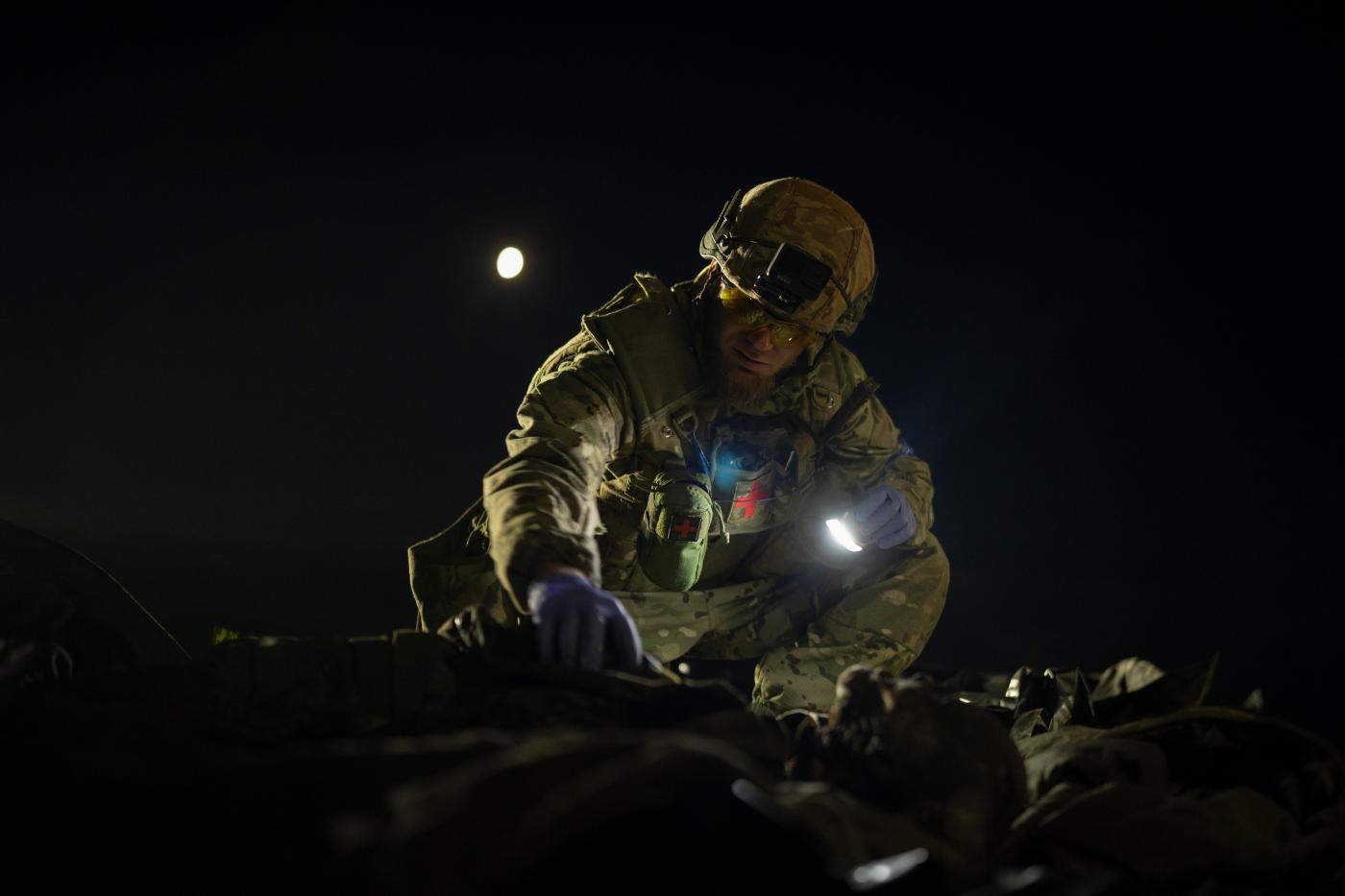
Yukov told Denys to try to keep the fragments of Sasha’s head together in what was left of his helmet. He handed part of Sasha’s skull, wet and yellowed, to Yukov, who placed it gently down in a large white bag. It was hard to keep track of all the pieces because it was pitch black and they were working by flashlight.
Denys pulled out a silver, soil-caked cross and set it aside, then a spoon and a watch.
Yukov went on, making a rough anatomical inventory of what was left of Sasha. An arm. The backbone. Pelvis. Femur. Elbow.
“Wait,” Yukov said. “Where is the other arm and shoulder blade?”
It was Nov. 25, 2022.
Two months later, Denys drove over a landmine while searching for bodies and died.
11 RUSSIANS AND ONE LEG
As in most wars, both sides have downplayed or obscured their losses, and the true toll may not be known for years. But from the sky, the multitudes of dead are already transforming the landscape. The graves look the same on both sides of the front: fields, once empty, now quilted with patchworks of fresh tombstones.
President Zelenskyy recently said that 31,000 Ukrainian soldiers have been killed in the war, less than half what Western intelligence has estimated. Russia’s losses are thought to be roughly double Ukraine’s.
Using satellite imagery and site visits, The Associated Press documented the rapid growth of soldiers’ graves at a few key sites in Russia and Ukraine where the war dead have accumulated at scale.
By March, more than 650 soldiers lay in what was open land outside Lviv two years ago, and there were more than 800 new soldiers’ graves in one Kyiv cemetery. Some 700 graves appeared in two plots for soldiers in a Kharkiv cemetery between Feb. 2022 through Sept. 2023, satellite images show. The AP also counted at least 1,345 new soldiers’ graves at a Dnipro cemetery in March, edged by six neat rows of empty pits in the earth waiting for more bodies.
Many more dead are scattered across both Ukraine and Russia, discreetly tucked among civilian graves.
Mediazona, an independent Russian media outlet, has identified the locations of dozens of Russian cemeteries that have swelled with war dead. Along with the BBC’s Russia service and a network of volunteers, they’ve confirmed the deaths of around 50,000 Russian soldiers killed since the full-scale invasion, a number they say probably captures just over half of the true death toll. Their count does not include Russian fighters from occupied territories in Ukraine.
The dead cannot be hidden from space. Satellite images show more than 750 graves at the Wagner cemetery in Bakinskaya, a town near the Black Sea, up from around 170 in Jan. 2023. About 15 kilometers (9 miles) away, an estimated 2,646 compartments for cremated remains have been built into new rows of dark grey walls at the Wagner Chapel, though it wasn’t possible to say how many were filled. The number of war dead buried at the Federal Military Memorial Cemetery north of Moscow, has tripled in the last year, to an estimated 846 graves.
These are the lucky ones, the ones who made it home.
Yukov says he’s collected over 1,000 bodies since the full-scale invasion began two years ago, more than half of them Russians.
“We are not fighting the dead,” he said. “I don’t separate the bodies of Russian soldiers and Ukrainian soldiers. They are all souls for me.”
One night in October, Yukov returned from a mission near Sloviansk with black body bags strapped to the roof of his car. They bounced perilously over potholes, as he sped to deliver the cargo to a morgue.
The count that day was 11 Russians and one leg, which was probably Ukrainian, judging by its boot. Their wounds would be documented. The things they carried — amulets that hadn’t worked, kids’ drawings, family photos, letters of love and despair — would be collected and cataloged. Their DNA would be tested, if necessary, and their identities logged in government databases.
The Ukrainians, Yukov hoped, would find their way home. The Russians would become currency to barter for Ukrainian bodies in periodic exchanges of war dead.
“When someone says, “I am tired of war,” yes, we are all tired,” Yukov said. “But we just need you to understand: Help us. Don’t stand aside. Because war has no borders. War will cross your doorstep too.”
He peered into a body bag. The corpses had baked in the sun and the meat of their faces was partly mummified. Yukov figured they’d been dead for around three months.
Suddenly angry, Yukov began speaking in agitated Russian.
“You carried this child in your womb,” he said, “Now your Russian boys are lying here, in Ukrainian soil. Why did you let them come here? You knew what this was all about, that they were going to kill and be killed.”
Yukov looked down at the bodies laid out on the night grass. “This is where it all ends,” he said.
He turned away and let out a little laugh, then stopped talking and shook his head in silence.
“So, I don’t know … It’s stupidity.”
HOLDING THE SKY TOGETHER
Olha hoped for a long time that missing meant alive. But when Yukov sent a photograph of the necklace they’d found in the cellar in Dovhenke, Olha recognized it instantly. It was the same silver Jesus she’d given Sasha when he left for war, only now it was an exhibit, number 3118, mud-flecked evidence of the dead.
Olha never got to see her son’s face again. By the time she got the body back, Sasha had no face anymore. This was hard for her because it allowed her to nurture a tiny, painful hope that there had been some mistake.
Yukov is a destroyer of hope for mothers. But they thank him anyway.
“I am glad we managed to do it,” Yukov messaged Olha, after he found Sasha. “We hug you and hope that we can meet you to get to know more about him. We are holding the sky together with you.”
“Your work is priceless,” she replied.
Olha buried what was left of Sasha on March 16, 2023 in her village cemetery, beneath a cross bandaged with flowers and ribbons.
“It’s very important for me to know his body is next to me,” Olha said. “We are all waiting for victory. For me, it’s the most important thing. If we do not win, what did my son die for — and so many other sons?”
Yukov never told Olha he’d lost an eye trying to find her son.
When she heard what had happened, she nodded faintly, her frown deepening to an expression of infinite sadness.
“I cannot express with words how grateful I am,” she said. She opened her hands and looked up, searching for sounds that could convey the enormity of loss. “I’m so shocked … As long as I live, I will remember the sacrifice he made for me and my family.”
Olha visits Sasha’s grave every day, to sit with him, talk with him and pray that he — and perhaps she herself — finds peace.
“Whatever people say, I know Sasha wanted to come home,” Olha said. “Sometimes I watch TV, the internet, TikTok, whatever, and I think: That’s it, we lost. I feel like giving up … But when I watch videos of Oleksii (Yukov), I want to keep helping. If there are people like Oleksii, nothing is lost yet in Ukraine.”
AP journalists Michael Biesecker in Washington and Volodymyr Yurchuk and Vasilisa Stepanenko in Ukraine contributed to this report.