St. Paul and Xcel Energy Center roll out Frozen Four red carpet again

posted in: News | 0

When the team bus pulls up outside the Frozen Four’s host arena – whether it is Tampa or Boston or Buffalo or wherever — and the players traipse down a red carpet, thronged by screaming fans, Kelly McGrath always feels a little sense of parenthood.

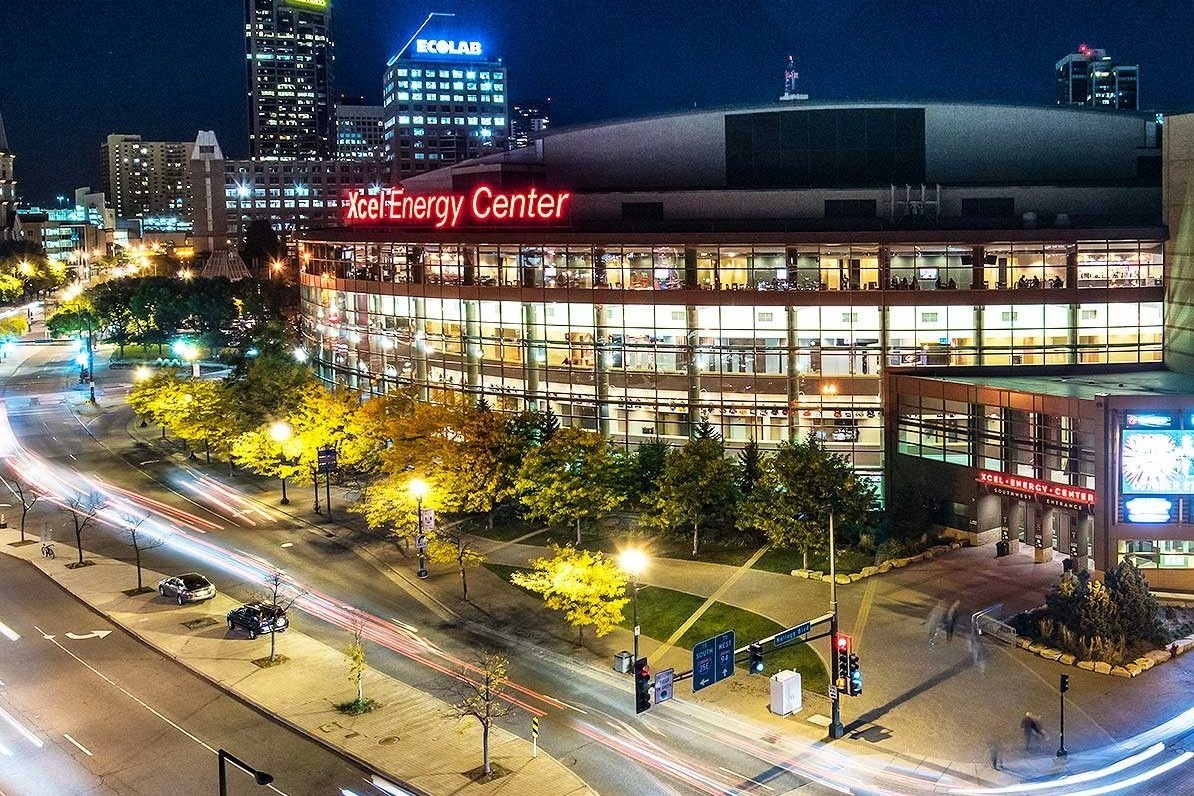
“That came out of this building in 2011. It was our idea, and now they do it everywhere, it’s just a normal part of the Frozen Four,” said McGrath, Xcel Energy Center’s general manager and executive director. “We like to remind them that it was a St. Paul idea, and the guys just feel like rock stars coming in.”

On Thursday, Friday and Saturday, the ‘X’ will host college hockey’s biggest show for the fourth time, and McGrath is working alongside the University of Minnesota and Visit St. Paul to ensure that the red carpet is rolled out. That is not just for the four teams coming to the arena, but for throngs of fans from Colorado, Massachusetts, Michigan and all across the hockey-loving world.

Before the opening faceoffs on Thursday, when Denver faces Boston University and then Michigan plays Boston College, myriad preparations will take place inside the building, while coaches and players spend hours watching video to determine their best strategies once the puck is dropped.

At the X, after hosting more than 40 NHL games each year, along with welcoming more than 100,000 prep hockey fans to downtown St. Paul each February and March for the girls and boys state tournaments, there are no worries about what will happen on the ice sheet.

“We do hockey,” McGrath said. “That’s our strength and our bread and butter, so when an event like the Frozen Four chooses Minnesota and Xcel Energy Center, I don’t worry about the hockey. Three games, we know how to do that pretty well.”

The next job is to make sure St. Paul and the arena are clean, safe and welcoming for those making the trip to the Twin Cities, whether it is for their first trip or their 100th to the X. Organizers from Minnesota have traveled to recent tournaments — hockey and other college sports — in other cities to see what they do in New York or Florida or elsewhere and if there are ideas to be borrowed to make for a better experience.

“We’re going to have equipment trucks ready for the teams at the airport so they don’t have to play that Tetris game under the bus to fit everything,” said Tom McGinnis, an assistant athletic director at the U of M and a former chair of the NCAA Men’s Ice Hockey Committee. “In 2018 we were the first place to have student-athlete lounges at the hotels. You spend five days here either in the locker room or in the hotel room, so we’re trying to expand the student-athlete lounge at the hotel, so they have a different places where they can go play video games or do other things and have a different place to hang out rather than just watching Netflix in their rooms.”

So fans don’t just sit in their hotel rooms, they will again offer Frozen Fest, which is a gathering spot at the RiverCentre, adjacent to the arena, with games, food, drinks and giveaways. RiverCentre will also host the Friday evening awards, culminating with the awarding of the 2024 Hobey Baker award.

This will be the seventh time the Frozen Four has come to St. Paul, and just the second time that there will not be a team from Minnesota among the quartet that advanced out of the regional round. The since-demolished St. Paul Civic Center hosted the tournament in 1989, 1991 and 1994. The three previous tournaments at the X have concluded with an in-state team — Minnesota in 2002, Minnesota Duluth in 2011 and 2018 — cutting up the nets after the title game. Organizers admit it will be unique this time around, without a team from this state, or even this time zone, participating.

McGrath said the crowd will be different as a result, with many locals coming to watch college hockey’s top teams regardless of where they’re from, and many fans from other parts of the country coming here, in a kind of photo negative of two years ago, when Minnesota and Minnesota State Mankato faced off in the Frozen Four opening round in Boston. She added that the demand for tickets is still significant, with many available on the secondary market.

“It’s still a destination event for college hockey fans, so the NCAA put their tickets on sale and previous buyers got the first crack,” McGrath said. “The tickets were mostly sold by about the first of the year. There’s always the ticket exchange where people can buy and sell, but for all intents and purposes, we’ve moved the tickets.”

The 2025 tournament will be held in St. Louis and the 2026 Frozen Four will head to Las Vegas for the first time. Beyond that the schedule is not set, but there is a likelihood that based on past success, we will be back in St. Paul again before too long.

“We’ll continue to bid on hosting this event,” McGinnis said. “It’s got a great history and tradition of being here in St. Paul and in Minnesota, and we’ll want to continue to do everything we can to keep bringing it back here.”
More than 145,000 in east metro have unsafe levels of PFAs, or ‘forever chemicals,’ in water

posted in: Society | 0

Drinking water for a significant number of people in the east Twin Cities metro does not comply with new federal guidelines on levels of so-called “forever chemicals,” human-made substances that have been linked to some cancers and other diseases.

Minnesota health officials on Wednesday said more than 300,000 people across Minnesota have unsafe levels of per- and polyfluoroalkyl substances, also known as PFAS, in their water systems under new standards from the Environmental Protection Administration.

A total of 22 systems have unsafe levels of contamination, and 10 of them are in the Twin Cities Metro area, according to the Minnesota Department of Health. Most are in the eastern part of the metro, where 3M manufactured the substances for use in products ranging from nonstick cookware to firefighting foam.

East metro city water systems affected include Hastings, Lake Elmo, Newport, Stillwater, South St. Paul and Woodbury. The Hastings Veterans Home and Cimmaron Park, a mobile home park in Lake Elmo, also have unsafe levels of PFAS, under the new EPA standards. Around 145,000 people are served by those water systems, according to state health department data.

Other Twin Cities water systems affected include Brooklyn Center and Mobile Manor, a mobile home park in Shakopee. Those account for a little over 90,000 people.

Outside the Twin Cities area, unsafe contamination can be found in Minnesota communities including Alexandria, Cloquet, Princeton, Sauk Rapids, and Waite Park.

New federal rules

As the EPA announced the adoption of new rules on PFAS on Wednesday, the Biden Administration said it’s providing about $1 billion nationally to help with the effort to mitigate them, a move the White House said could protect around 100 million people from the chemicals. About $15 million of the funding is going to Minnesota.

In a joint statement Wednesday, the state health department and the Minnesota Pollution Control Agency welcomed the new rules and noted Minnesota has already been working to identify and clean contaminated water sources.

“While communities have up to five years to come into compliance, we will continue to partner with drinking water systems around the state to provide guidance on how they can ensure safe drinking water for their residents,” the statement from the agencies said.

Still, even with a head start on the problem, MPCA Commissioner Katrina Kessler said Minnesota will need more funding to fix the issue.

PFAS are a group of thousands of chemicals used for their nonstick and water-resistant properties, whose use was pioneered by Maplewood-based 3M. They are used in a wide variety of products and are known as “forever chemicals” because they don’t break down in the environment and can accumulate in the tissues of living things.

Over recent decades, peer-reviewed studies have shown that exposure to PFAS could be linked to a heightened risk of certain cancers, decreased fertility, high blood pressure in pregnant women, low birth weights and hormonal interference.

New EPA rules on the substances mean any water source that has more than 4 parts per trillion of two common varieties of the substance, PFOA and PFOS, is considered unsafe for drinking. There are limits on several other types as well.

Health officials say exposure doesn’t guarantee a person will develop disease, but the risk is heightened by any exposure level above EPA guidelines. The problem is the chemicals accumulate over time, researchers say.

Legislature ban

Minnesota was one of the earliest states to take action on the substances, and last year the Legislature passed a ban on the substance from products like carpets, cleaning products, cookware, cosmetics, dental floss, toys and even ski wax. Firefighting chemicals, such as foams used at airports, will had exemptions.

Lawmakers named the expanded ban after Amara Strande, a 20-year-old Minnesota woman who died in 2023 after a five-year battle with a rare and aggressive cancer she said was tied to PFAS.

Strande, a graduate of Tartan High School in the east metro suburb of Oakdale, grew up in an area heavily contaminated with the chemicals due to dumping by 3M.

At a Wednesday news conference announcing the new rules and their effect on Minnesota, Strande’s father Michael Strande said he hopes the rule change will be the beginning of a permanent fix.

“How will this affect the people on the east side? Hopefully, in the next several years, the kids at Tartan High School will stop saying: Don’t drink the 3M cancer water,’” he said.

Hastings contamination

The city of Hastings was informed Wednesday that five of its six municipal wells are now above the allowable drinking water standards for PFAS due to new limits.

The new maximum contaminant levels for PFAS, also known as “forever chemicals,” is 4 parts per trillion, putting many east metro wells over the threshold.

The level of contaminants present in city wells has not changed, the city said in a news release.

“This is not an emergency. You do not need an alternative source of water, nor do you need to boil water before use,” the release stated.

Hastings has been working with state agencies since late 2022 to identify where the chemicals are coming from and how to mitigate them.

An Environmental Site Assessment was conducted, as part of phase one, and identified potential source locations for PFAS. Phase two of the ESA is now being conducted by the Minnesota Pollution Control Agency to narrow down the source locations.

The MPCA also is working with 3M to understand the connection with groundwater at the Mississippi River, which could allow Hastings to access the 3M East Metro Settlement Funding, according to the city news release.

A feasibility study was also done to address PFAS and Nitrate contaminations and it  recommended the construction of three water treatment plants, the first of which is currently in design, according to city officials.

The expected cost for the three treatment plants is $68.9 million. The city is still working to secure funding for the three treatment plants, which are each expected to take a year to construct.

Related Articles

Environment |


Why is the EPA regulating PFAS and what are these ‘forever chemicals’?

Environment |


Biden administration sets first-ever limits on ‘forever chemicals’ in drinking water

Environment |


New DNA analysis underscores peril facing Minnesota’s state bee

Environment |


Minnesota House OKs election bill allowing lawsuits over discrimination

Environment |


US Postal Service seeking to hike cost of first-class stamp to 73 cents

Steven Hill: Financial literacy is good for Americans, and for the country

posted in: News | 0

As this year’s presidential election gathers steam, there’s going to be a lot of emphasis on getting young people to vote. Since 2020, about 16 million young people have come of voting age, so you can bet that the presidential candidates will make their pitches to motivate these young Americans. And organizations like Rock the Vote will try to engage young voters as well.

But, as Americans, we are more than voters. We are also economic agents who must work and manage our economic lives. That can be a challenge for many young people to learn, and unfortunately few political leaders encourage young Americans to learn about economics or become financially literate.

Yet so many political decisions have an economic component. Economically informed citizens are better equipped to make good decisions, both in their personal lives and when voting or participating in civic life. When citizens understand the consequences of their financial choices, they can make more informed decisions at the ballot box.

I have sometimes wished that when I was younger I had been taught greater financial literacy. In particular, I would have benefited from lessons like, “If you purchase a house as soon as possible, you won’t waste years of your money paying rent, but instead you will save up equity for later use.”

And “If you put your money in the stock market and leave it there for five to 10 years, you’re almost guaranteed to make money, given the historical record.” Or how about: “For every year you wait before you take your Social Security, you will increase your monthly benefit by about 8 percent, which amounts to 70 percent more if you wait until you’re 70 compared to if you start taking Social Security early at 62.”

The first two I did not learn until much later in life; when it comes to the third one, I’m always amazed at the number of friends and associates who are approaching retirement years and don’t know that waiting to start your Social Security payments is (often) a good thing to do, if you can afford it.

What I have learned is that being financially literate at any age gives an individual the resources they need for greater security. And the sooner you know, the better it will go. Conversely, without financial literacy you can get yourself into a heck of a lot of trouble, including debt, bad credit, or even housing foreclosure and bankruptcy.

In 2022, 270,000 homeowners, or about 8 percent of mortgage-financed home buyers, were underwater on their mortgages, meaning they owed more on their property than it’s worth. In 2009, during the nationwide economic collapse sparked by a home mortgage crisis, nearly a quarter of the nation’s homes were underwater.

The film “The Big Short” showed how banks were handing out loans like candy, including memorable cases of mortgage lenders providing “NINJA loans” (“no income, no job, no assets”) to applicants, including an exotic dancer who owned five houses and a condo with adjustable rate mortgage loans on each.

When should you take on a huge financial commitment like buying a house? What are the pros and cons of investing in other commodities, whether the stock market, gold or the latest financial fad, bitcoin? The media trumpets stories about fortunes being made and a person can feel like they are missing the gold rush. And then later the media downplays the tragedies of those who made the wrong investments and lost everything.

Consequently, many young people never learn the basic financial skills needed to prosper in life, and in some ways it is understandable. Compared to making a bitcoin fortune or becoming a TikTok influencer, learning about economic and financial basics when you are 17, 18, 20 years old seems boring.

Fortunately more people are realizing the importance of education around financial literacy, especially for young people. Increasingly it’s recognized that economic education can equip young adults with essential knowledge about how the economy functions, including concepts like supply and demand, inflation, wages and fiscal policy.

Currently 35 states require high school students to take a course in personal finance to graduate, and 28 states require students to take a course in economics. The only states that have no requirement include Colorado, Delaware, Illinois, Maine, Massachusetts, Oklahoma, South Dakota, Vermont and Washington

Arizona enacted legislation to establish a State Seal of Personal Finance Proficiency to recognize public school graduates who have attained a high level of proficiency in personal finance.

Organizations like the Council for Economic Education have been advocating for public policy that instills in high school students the fourth “R” — a real world understanding of economics and personal finance. Its FinEd50 initiative advances policy changes at the state level and reports a 12-state increase since 2022 in states passing personal finance requirements. That translates into an additional 10 million high school students who will be able to learn financial literacy.

Full participation in our representative democracy requires a measure of understanding of our economic lives. I wished I had learned that many years ago. Fortunately more young people are now gaining knowledge of that very practical information. The United States is better off when more of its residents have high levels of financial literacy.

Steven Hill was policy director for the Center for Humane Technology, co-founder of FairVote and political reform director at New America. He wrote this column for The Fulcrum.

Related Articles

Opinion Columnists |


Other voices: The U.S. still owes a debt to its Afghan allies

Opinion Columnists |


Lawrence K. Zelvin: Fraudsters have artificial intelligence too

Opinion Columnists |


Stefanos Geroulanos: Why would anyone want a paleo diet? We’re desperate for half-truths about human origins

Opinion Columnists |


David French: Israel is making the same mistake America made in Iraq

Opinion Columnists |


Palma Joy Strand: Unlocking the power of difference, on purpose

Loons have holes on left side of defense. Who will fill them versus Houston?

posted in: News | 0

A concern resides on the left side of Minnesota United’s defense going into Saturday’s match against Houston Dynamo.

Left center back Micky Tapias didn’t train on Tuesday and appears likely to be sidelined for his third straight game with a hamstring injury. Meanwhile, fullback Zarek Valentin (thigh) has been out and Joseph Rosales will be suspended one game after picking up two yellow cards in the 1-1 draw with Real Salt Lake on Saturday.

“On one hand, you could look at it as a bit of a problem in the sense that … We are slightly stretched in that particular position, that side of the pitch,” head coach Eric Ramsay said Tuesday. “But also it’s an opportunity for someone, and I think, that’s always the way I look at it.”

Devin Padelford has been filling in for Tapias at center back, but Padelford is more of a full back and Rosales’ backup. It might make the most sense for Padelford to bump out to fullback, but then who steps on at center back?

Victor Eriksson is the most-likely candidate, but the new Swedish addition allowed a goal in his cover-your-eyes, eight-minute MLS debut in the 2-0 loss to Philadelphia on March 30. Hugo Bacharach and Morris Duggan are rookies without MLS experiences, and midfielder Kervin Arriaga has played center back, but he’s rehabbing a knee injury.

“We’ll work on it as the week goes on,” Ramsay said of the mix of players for those two spots. “And you’ll see come Saturday.”

As for potential returns for Tapias and Valentin, Ramsay said: “I think it will be probably a game too soon. But that’s not definitely the case.”

For Padelford, Ramsay used positional examples from his time as an assistant coach at Manchester United.

“We’ve very often playing with Licha (Lisandro) Martinez, who’s not your typical center-half profile and Luke Shaw often played left sided center back,” Ramsay said. “We sort of use those two guys as nice reference points for Dev because, I think, that you don’t need to stereotype the way in which a center half needs to look. And I think (Padelford) has played the role to his set of capabilities really, really well.”

Seeing red

Ramsay and Rosales chatted one-on-one after Tuesday’s training session and scrimmage in Blaine.

“He feels really disappointed in the (red card) situation and (in) himself, to an extent,” Ramsay said. “I think it was a really soft, second yellow card. Obviously, if you look at it objectively, then he sort of put himself in a position where you can allow the referee to do that. And it’s a shame because he played really well.”

MNUFC leaders “had a brief discussion” about trying to appeal Rosales’ second yellow card, “but it’s not something that we’re going to attempt to do,” Ramsay said.

Tani time

Loons backup forward Tani Oluwaseyi has played only 140 minutes this season, but he has four goal contributions (two goals and two assists) in six games. He notched the equalizing goal in the draw in St. Paul last weekend.

“He’s done brilliantly,” Ramsay said. “I spoke to him (Tuesday) and made it clear that’s obviously not going unnoticed; his general energy, enthusiasm, the way he comes on, the way he changes games. No. 1, the way he presses before we get to the goal contributions.

“Obviously he’s an important player for us at the moment,” Ramsay said. “And we just need to make sure that we have a nice balance between how we use him and how we use Teemu (Pukki), who can both, on their day, be a real threat at this level.”

Briefly

Winger Sang Bin Jeong appeared to be taken down by a RSL defender in the 18-yard box on Saturday, but no penalty was awarded to the Loons. “I thought it was a good shout for us, to be honest, but I’m not wanting to dwell on instances like that,” Ramsay said. … Arriaga and Hassani Dotson (hamstring) did “scaled back” work in training on Tuesday. “They got through what we planned for them to get through, so that’s really good,” Ramsay said. … Jordan Adebayo-Smith appeared to injure himself during warmups Tuesday. … Members of MNUFC and MNUFC2 had a closed scrimmage on Tuesday. “It’s something we want to do more of moving forward, making sure that it does feel like we are genuinely on a thread from top to bottom,” Ramsay said. “And the second-team players feel connected to the first team and the first-team players feel like they’ve got a role in bringing the young players through.”

Related Articles

Minnesota United FC |


Minnesota United finds late equalizer in a 1-1 draw with Real Salt Lake

Minnesota United FC |


Charley Walters: Time is now for Vikings to get a franchise quarterback

Minnesota United FC |


Minnesota United vs. Real Salt Lake: Keys to the match, projected starting XI and a prediction

Minnesota United FC |


Loons’ unbeaten start ended in 2-0 loss to Philadelphia

Minnesota United FC |


Minnesota United at Philadelphia Union: Keys to the match, projected starting XI and a prediction