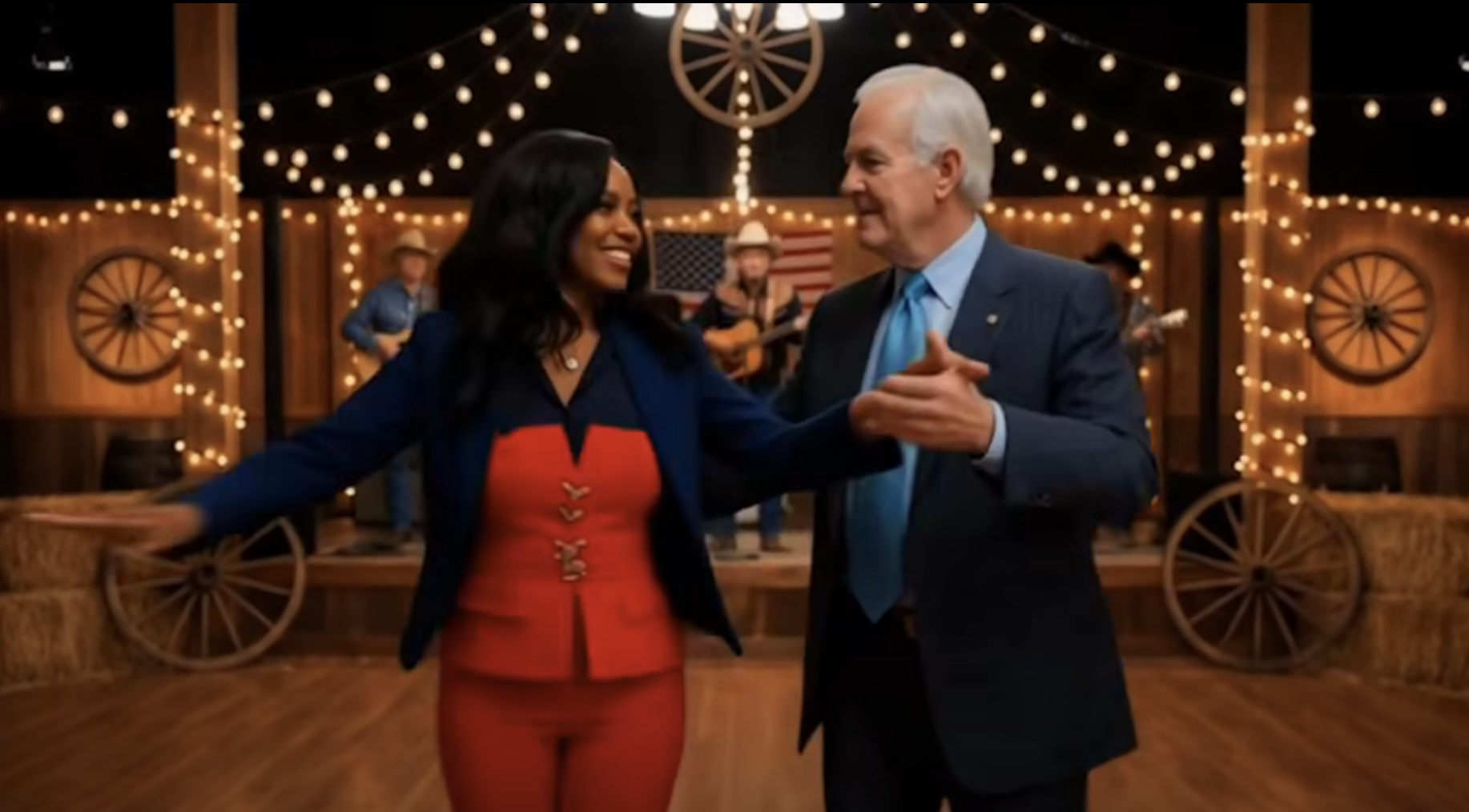
Texans have seen it all this year: Senator John Cornyn twirling Congresswoman Jasmine Crockett on the dance floor; Attorney General Ken Paxton driving his mistresses down to the “Love Shack”; and Texas state Representative James Talarico in a dress singing a tune about transgender people—all made possible by the powers of generative artificial intelligence.
Political ads have long been notorious for stretching the truth with underhanded editing techniques, false claims, and computer generated imagery, but the ability to instantly generate an uncanny mimicry of candidates has taken this year’s attacks to new heights of absurdity and debasement.
In that way, AI is transforming the political landscape and contorting conventional ideas about truth, free speech, and fair elections. Experts say the law is failing to keep pace as candidates and consulting firms use the rapidly evolving technology to caricature the opposition in new and controversial ways. Nowhere is this more true than in Texas, where a historic $500 million (and counting) in advertisements has flooded TV, radio, and digital platforms for the U.S. Senate race alone.
“We’re seeing questionable ads that are using various AI technologies all around the country, but the ads in Texas take it to a different level,” said Amy Kristin Sanders, a professor of media law at Penn State University. “This kind of synthetic content creation really messes with people’s traditional sense of what they can trust.”
(Youtube screenshot; Cornyn campaign)
AI tools are being used for everything from simple campaign flyers and infographics to fully synthetic videos and deepfakes of candidates. A recent study commissioned by the American Association of Political Consultants (AAPC) found that a majority of consultants are using AI to streamline the research process and perform mundane tasks. Republican consultant and admaker Vinny Minchillo said some agencies are taking it further and deploying AI in the creative process.
“It’s in very small ways that you don’t notice. I have used it as a transition between two shots, or to create an image that’s moving that used to be a still image,” Minchillo said. “But I think when you’re using AI to create something out of whole cloth, you just have to be smart.”
Some of the biggest Republican consulting agencies in the country, like Fifty Plus One (FP1) Strategies are doubling down on the use of AI. Synthetic ads are fast and inexpensive to produce, and they’ve even won the Reed Awards and the Pollie Awards—also known as the Oscars of political advertising.
In one ad during the primary season, the Cornyn camp portrayed Congressman Wesley Hunt with a deepfake where he parades around a puny pomeranian. The amusing video and tagline, “That dog don’t hunt,” were intended to emasculate the congressman. FP1 Strategies said the video was produced in one day by creative director Trent Wisecup, and it won four Reed awards.
“The best AI is deployed in the ruthless pursuit of excellence, and that requires old-fashioned elbow grease,” Wisecup said, describing his creative process on LinkedIn. “Think AI fluffs your ego? My agent teaches me about humility every day.”
(Youtube screenshot; Cornyn campaign)
As silly or preposterous as some of these ads may seem, it’s fully synthetic videos that give legal scholars like Sanders a sense of trepidation. That’s because the law tends to lag behind technological advances. Social media has become the Wild West of expressive content, and deepfakes blur the lines between free speech versus disinformation and defamation. Paxton’s “King James” attack ad is a perfect example. The uncanny deepfake version of Talarico is backdropped by a pride poster as he scribbles all over the Bible in crayon. It works in references to old quotes the Democrat actually said but presents them in a completely made-up context.
“We’re walking a really fine line between types of speech that we’ve historically protected, like parody and satire, and these new forms of synthetic content that have a much higher probability of fooling someone,” Sanders said.
Another survey commissioned by the AAPC found that most voters are deeply uncomfortable with the use of AI in political campaigns, whether it’s to craft a text message or a full blown deepfake. About half of survey respondents said it is unacceptable to use AI to write fundraising emails or texts, while 73 percent said it’s unacceptable to artificially generate an image or video for a campaign ad. Creating a deepfake of an opponent saying something they never said was considered the most egregious use of the technology, with 95 percent disapproval.
“Clients have asked us not to use AI because they feel like it is taking the edge off our message,” said Minchillo, who has worked with various consulting firms and campaigns around the country. “The usage of AI becomes the message rather than the story we’re trying to tell.”
Congress has yet to pass any federal regulations of deepfake campaign ads, so states are handling the dilemma at the local level. In 2019, Texas passed a law that criminalizes the publication of deepfake videos within 30 days of an election with the intent to injure a political candidate or to influence an election. Last year, the Legislature also considered a measure to require disclosures on AI political ads, like in some other states, but the bill never passed the Texas Senate. The House bill, which was carried by the deposed former House Speaker Dade Phelan, drew heavy backlash from the right-wing activist corps in Texas who saw the legislation as an attempt by the political establishment to police political speech.
A recent controversy in the Texas lieutenant governor race is raising questions about the narrow application of current state law.
In September, Lieutenant Governor Dan Patrick posted two deepfakes on social media of his opponent, Democratic state Representative Vikki Goodwin. In one scene, she wears a Longhorns jersey that reads “Taxes” instead of “Texas.” In another scene, the artificial Goodwin says she supported a capital gains tax, death tax, and state income tax. The ads also included deepfakes of Talarico and Democratic gubernatorial candidate Gina Hinojosa.
Goodwin responded by filing a police report in mid-September, citing the state law against deepfakes in political ads. “This is a video that looks like me. Words are coming out of my mouth, so I just felt it was important to put a stop to it,” Goodwin told the Observer. In a sworn affidavit accompanying the police report, Goodwin said she believed the deepfake was made with intent to “fraudulently influence the outcome of an election.”
Patrick quickly deleted the ads after Goodwin filed the report, which she says has made it difficult to pursue the case any further. A spokesman for Patrick told the New York Times that the deepfakes were an “obvious parody” that were published well before 30 days from Election Day.
Sanders said the 30-day window seems like a somewhat arbitrary boundary that doesn’t account for the real harm deepfakes can cause. “There are large groups of people that do engage in early voting,” Sanders said. “Many voters may make up their mind long before that.”
Ultimately, Goodwin said she would prefer if deepfake attack ads weren’t allowed in political campaigns at all because they’re a harmful distraction from the issues that really matter. That ties in neatly with her opposition to data centers and her plan to end tax subsidies for the corporations who build them. She hopes her case against Patrick can set some sort of precedent against future misuses of AI technology.
A sweeping ban on synthetic content in campaigns might appeal to many Americans, but Sanders said it’s probably impossible to achieve.
“Anytime the government regulates based on the content of the speech, the government has to show that there is a compelling government interest,” Sanders said. “And then of course, they have to show that the law is narrowly tailored to achieve that objective.”
In this case, the government has a compelling interest to preserve the sanctity of free and fair elections, but an outright ban would not be considered narrowly tailored. Sanders said that might discriminate against synthetic AI content without accounting for all the other kinds of political ads that use deceptive techniques, like clipping your opponent out of context. A federal judge in Montana recently blocked officials from enforcing the state law against deepfake campaign ads because it raised First Amendment concerns.
Sanders said candidates could still seek redress through existing civil laws. A candidate could sue for defamation, arguing that the deepfake constituted false speech, which injured their reputation. Under the First Amendment, however, political speech is considered sacred for the functioning of our democracy. There is a high bar for public officials to prove defamation because the courts must preserve the right to scrutinize those in power. Add satire into the mix, and these deepfakes become even more challenging to litigate.
“In some contexts, the law protects speech that isn’t necessarily accurate,” Sanders said. “Some of the most important critiques of our political and social issues of the day are done through the vehicle of parody and satire.”
Sanders said mandated disclosures of AI-generated content in campaign ads might be the only salient regulation that doesn’t significantly intrude on First Amendment principles. AI is here to stay, and voters will need to exercise greater scrutiny of the information they’re getting about candidates, especially as synthetic content becomes normalized in the years to come.
“You’re not going to put that genie back in the bottle,” Minchillo said.
The post Inside the New AI Slop Era of Texas Politics appeared first on The Texas Observer.
Leave a Reply