Opinion: What the Workout of the Signature Bank Loans Can Teach About Preserving Affordable Housing

posted in: News | 0

“Will the Signature buildings be viewed as a one-off, or the tip of an iceberg of a more endemic problem?”

Adi Talwar

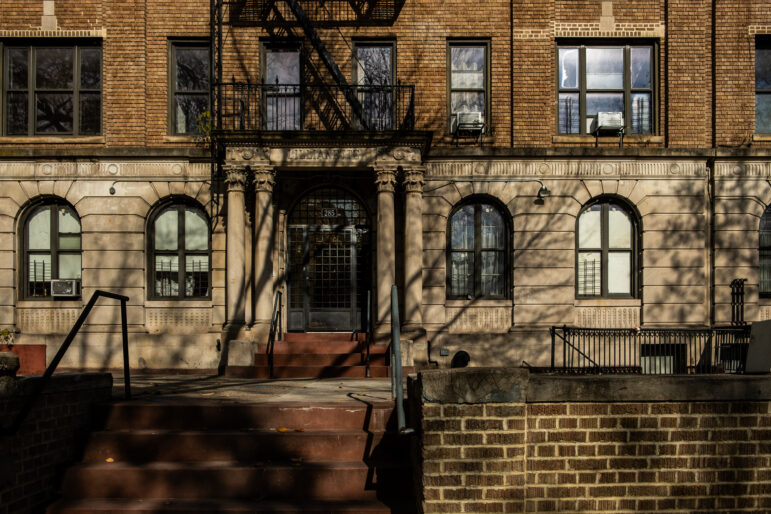
A Brooklyn building with a loan previously held by Signature Bank before its collapse.

CityViews are readers’ opinions, not those of City Limits. Add your voice today!

The privately owned rent regulated housing stock is arguably the largest source of affordable housing in the city. Its preservation should be a central feature of the city’s housing policy. Yet, it often falls prey to adverse legislation that does not balance the need to physically and financially maintain this housing, while keeping it affordable.

The Housing Stability and Tenant Protection Act of 2019 sought to strengthen tenant protections by eliminating the ability to decontrol rent stabilized apartments and tightening allowable rent increases relating to vacancies and apartment and building renovations. These changes had dramatic effects on both ends of the rent stabilized market.

At the high end of the market, the 2019 law undermined the financial assumptions of some lenders and owners, who expected decontrolled rents to be raised to market to support their investments. This contributed to the fall of Signature Bank and to recent problems of New York Community Bank: both had large portfolios of loans secured by rent stabilized apartments. It also resulted in high profile properties being sold at large losses. 

What hasn’t received as much attention is how the rent restrictions created an ever-tightening tourniquet on the cash flows of the most vulnerable segment of this housing—the vast majority of apartments, many built before 1974, located in low and moderate-income communities. Long established programs that could provide a safety net for this housing have diminished and became more difficult to use. 

Here are some basic metrics of this housing, as reported by the 2021 Housing Vacancy Survey,  that should be considered to keep this stock both healthy and affordable: 

There are almost 1 million privately owned, predominantly for-profit, rent stabilized units in New York City

760,000 of these apartments were built before 1974 

The median household income of the pre-1974 apartments is about $47,000 per year 

Over 1.5 million people living in households earning 80 percent or less of the area median income reside in all rent stabilized housing

The pre-1974 buildings, many of them small (less than 50 units), are heavily concentrated in low-income neighborhoods and most reliant on revenue from rent stabilized units. These buildings need continual access to capital to repair and replace their aging systems. Post 2019, the only viable way to support new investment is to seek rent increases through the major capital improvement (MCI) provisions in the rent stabilization regulations. The irony is that the buildings most likely in need of improvements have tenants least able to afford such increases. 

These same low-income buildings are disproportionately affected by the inflation of operating costs, like insurance, and by higher interest rates as mortgage loans come due—currently increasing from 3-4 percent to 7-8 percent. The cumulative effects will leave less money for maintenance and an inability to borrow funds for capital improvements, resulting in worsening living conditions for residents. These conditions are leading to the slow but accelerating deterioration of rent stabilized apartment buildings in low and moderate-income areas. 

How might this be averted?

The Federal Deposit Insurance Corporation’s (FDIC) takeover of Signature Bank, with its statutory requirement to preserve affordable housing, can provide a window to the cost and approach to preserve this critical housing. To fulfill that requirement, the FDIC has entered into a joint venture with a partnership of Related Fund Management, the Community Preservation Corporation (CPC), and Neighborhood Restore, collectively named Community Stabilization Partners (CSP), to work out 868 mortgage loans totaling $5.6 billion secured by 35,000 apartments (an average of 40 units a building). The Community Preservation Corporation, with its 50-year history of preserving affordable housing, reportedly will handle the management and servicing of the assets.  

CPC’s history of preserving affordable housing centered on balancing three objectives: restoring a building’s physical soundness, restructuring its economics to achieve long-term financial stability, and maintaining affordability for its residents. Whether the resources available to the workout team will enable it to meet these same objectives, should be closely watched as a barometer for fixing other troubled rent regulated apartment buildings.

CPC has historically approached preservation in the following way. First, CPC would work with the owner to define a scope of work that could restore a building’s physical integrity. The scope would focus upon the building’s mechanical systems, its exterior envelope, and other health and safety measures. Difficult judgements had to be made between work to be done immediately, and work done over time and paid by the building’s cash flow. 

Second, regulated rents could be increased through MCIs to pay for renovations (eligible seniors are exempted), but for older lower income buildings, renovations—even moderate in scope—would require increases likely to be unaffordable to many tenants. To keep rents affordable, two city programs had been used, plus, if available, federal rent subsidies. The first city subsidy was an as-of-right program, known as J-51, that could reduce real estate taxes for up to 20 years to off-set the costs for eligible renovation work. Second, for more extensive renovations, the city could provide long-term, secondary loans with interest rates as low as 1 percent.

Using these subsidies, often in combination, a calculation was made as to how much subsidy was needed, combined with market rate debt, and/or owner investment to complete the renovation and refinance the existing debt while generating sufficient cash to pay for the building’s ongoing operations, together with a reasonable profit to the owner. Long-term financial viability assumed that the rent regulatory system would reasonably pass along inflationary operating costs.

For almost all such transactions, CPC accessed a new mortgage to replace the existing debt, often at a discount, through a program it had developed in 1983 with the city’s public employee pension funds. The pension funds would provide a long-term fixed rate mortgage (30 years) for the property, insured by the city or state mortgage insurance program. The final product—a fixed up building, with long term reduction of real estate taxes and long-term fixed rate financing—held out the promise of sound and stable affordable housing for another generation of residents. Presumably, the FDIC can restructure its existing Signature loan assets to achieve similar results as part of the workouts. 

Perhaps most importantly, CPC worked with the city, state and pension funds to organize these programs in a package that was easily accessible to owners of small, low-income buildings. CPC became the one-stop shop for these owners, who could never navigate the maze of multiple city and state programs on their own. The efficiency of this system produced tens of thousands of preserved apartments at low-cost, as the transactions were not burdened with long and costly processing regimens.

Not all workouts are possible. Uncooperative and/or “bad” owners pose a dilemma. Replacing them may be a difficult path to follow. If a buy-out of an existing owner is not feasible, a forced sale through foreclosure portends to be a lengthy legal route, exacerbating existing conditions in buildings. Accepting less than ideal results with less-than-ideal owners is a judgment that the workout team will undoubtedly face.  

A challenge for the Signature workout team is that many of the tools used by CPC have frayed, while at the same time buildings are subject to more mandated public costs, most prominently those related to energy conservation. The as-of-right J-51 program expired, and was reintroduced with provisions that limits its usefulness. Public subsidies, the below-interest loans, are both under-funded and come with complicated processing requirements, not easily accessible at any scale. The Low-Income Housing Tax Credit (LIHTC), an exponentially more complex program, is for practical purposes not suited for the upgrade of small low-income buildings. 

How these difficulties may be bridged bears watching. Will a combination of cash from the FDIC-CSP joint venture leveraged with public subsidies be sufficient to meet long term standards of physical integrity, financial stability and affordability? 

How might this impact city and state policy? The 35,000 units of the CSP workout is but a drop in the bucket regarding the preservation of this affordable stock. Will the Signature buildings be viewed as a one-off, or the tip of an iceberg of a more endemic problem? Might this result in a rethinking of legislative actions to amend the 2019 law, and increase funding priorities for preservation? Or will the need to preserve other rent regulated properties in distress be kicked down the road? 

Herein lies a grand opportunity! The city, working with lenders with large portfolios of rental properties, might use the same public tools that would be available to the FDIC team to preemptively preserve their troubled properties in designated low and moderate-income neighborhoods. In turn, the banks could restructure their existing mortgages, as outlined above, to meet a bottom line of long-term physical and financial soundness and affordability. Properly restructured with mortgage insurance, the mortgage might be sellable to a third party like Fannie Mae or Freddie Mac.

This can be a win-win all around—for tenants, owners, lenders and the city. 

Michael Lappin is the former CEO of the Community Preservation Corporation (1980-2011). During his tenure, CPC financed and/or developed the preservation and building of over 92,000 affordable apartments in New York City.


What to know about Elon Musk’s ‘free speech’ feud with a Brazilian judge

posted in: News | 0

By GABRIELA SÁ PESSOA and BARBARA ORTUTAY (Associated Press)

SAO PAULO (AP) — Headline-grabbbing billionaire Elon Musk is clashing with a Supreme Court justice in Brazil over free speech, far-right accounts and misinformation on X, the social media platform Musk bought when it was Twitter.

Since his takeover, Musk has upended many of Twitter’s policies, gutted its staff and transformed what people see on the site. As its owner and perhaps most influential user, he’s also used it to try to sway political discourse around the world. His latest entanglement is inside the nation of 203 million people that has the largest population and economy in South America.

The South Africa-born CEO of Tesla and SpaceX bought Twitter in 2022 and declares himself a “free speech absolutist.” To his critics, it’s absolutism with a political slant. He reinstated previously banned accounts such as the conspiracy theorist Alex Jones and former U.S. President Donald Trump, as well as accounts belonging to neo-Nazis and white supremacists. Advertisers who halted spending on X in response to antisemitic and other hateful material were engaging in “blackmail,” Musk has alleged.

Free speech is a constitutional right in the United States but not in many other countries, including Brazil, where Supreme Court Justice Alexandre de Moraes this month ordered an investigation into Musk over the dissemination of defamatory fake news and another probe over possible obstruction, incitement and criminal organization.

WHAT ACCOUNTS HAS BRAZIL BLOCKED?

In Brazil, judges can order any site to remove content. Some decisions are sealed from the public.

Neither Brazilian courts nor X have disclosed the list of accounts that have been ordered to stop publishing, but prominent supporters of former President Jair Bolsonaro and far-right activists no longer appear on the platform.

Some belong to a network known as “digital militias.” They were targeted by a five-year investigation overseen by de Moraes, initially for allegedly spreading defamatory fake news and threats against Supreme Court justices, and then after Bolsonaro’s 2022 loss for inciting demonstrations across the country that were pushing to overturn President Luiz Inácio Lula da Silva’s election.

WHO IS JUSTICE DE MORAES?

De Moraes is unmistakeable, with his bald head, athletic build and sweeping black robe. In his escalating attacks on the judge, Musk called him “Brazil’s Darth Vader.”

Whether investigating former President Jair Bolsonaro, banishing his far-right allies from social media, or ordering the arrest of supporters who stormed government buildings on Jan. 8, 2023, Moraes has aggressively pursued those he views as undermining Brazil’s young democracy.

Days after a mob stormed Brazil’s capital, de Moraes ordered Facebook, Twitter, Telegram, TikTok and Instagram to block the accounts of individuals accused of inciting or supporting attacks on Brazilian democratic order.

HOW DID FREE SPEECH BECOME A CAUSE FOR BRAZIL’S FAR RIGHT?

Brazil’s political right has long characterized de Moraes as muzzling free speech and engaging in political persecution. Lawmakers from Bolsonaro’s circle have been imprisoned and his supporters’ homes raided.

Bolsonaro himself became a target of the digital militias investigation in 2021. That was partly because he was casting unfounded doubt on Brazil’s electronic voting system. That year, he also told a massive rally that he would no longer comply with de Moraes’ decisions, pushing Brazil to the brink of institutional crisis.

WHAT’S MUSK’S ROLE?

Far-right X users have been trying to involve Musk in Brazilian politics for years, said Bruna Santos, lawyer and campaign manager at nonprofit Digital Action.

“They often tag him, asking him to take a stand on Moraes,” she said.

On Saturday, he did, republishing a post from X’s Global Government Affairs, tagging de Moraes and writing: “Why are you doing this @alexandre?”

Musk posted Saturday that reinstating the accounts — most of which apparently are blocked only in Brazil — will “probably” lead the social media platform to dry up revenue in Brazil and force the company to shutter its local office.

In his decision to investigate Musk, de Moraes accused him of waging a public “disinformation campaign” about the top court’s actions.

IS MUSK A ‘FREE SPEECH ABSOLUTIST’?

While Musk has railed against what he perceives as the censorship of certain viewpoints by Twitter’s previous administration, he’s also tried to silence critics he doesn’t agree with, including journalists and nonprofits reporting on his companies.

Musk had accused the journalists in late 2022 of sharing private information about his whereabouts that he described as “basically assassination coordinates.” He provided no evidence for that claim, though earlier Musk decided to permanently ban an account that automatically tracked the flights of his private jet using publicly available data.

Last month, a federal judge dismissed a lawsuit by X against the non-profit Center for Countering Digital Hate, which has documented the increase in hate speech on the site since it was acquired by the Tesla owner.

X had argued the center’s researchers violated the site’s terms of service by improperly compiling public tweets, and that its subsequent reports on the rise of hate speech cost X millions of dollars when advertisers fled.

But U.S. District Court Judge Charles Breyer dismissed the suit, writing in his order that it was “unabashedly and vociferously about one thing,” punishing the nonprofit for its speech.

HOW BIG IS X IN BRAZIL?

Brazil is a key market for X and other platforms. About 40 million Brazilians, or about 18% of the population, access X at least once per month, according to the market research group eMarketer.

Twitter closed offices and laid off employees in Brazil in 2022 after Musk bought the company. It is not clear how many employees X has in Brazil.

X’s legal representatives in Brazil, law firm Pinheiro Neto, declined to comment. X did not respond to a message for comment.

WHAT HAPPENS NEXT?

That depends on Musk and X’s actions. If they reinstate the accounts in Brazil, the company will face fines — at least. While fines have generally not phased Musk, experts say they could increase and X could even face suspension.

“The fines could escalate, eventually leading to the platform’s suspension. But this is always the last measure, as it harms other users in Brazil,” said Filipe Medon, a data privacy lawyer and professor at the Getulio Vargas Foundation.

Regarding Musk — a foreign citizen with a company based in the U.S. — any measures from Brazilian authorities would demand legal cooperation with U.S. authorities.

___

Ortutay reported from San Francisco, California.

Time for tea in London? Top hotels show how it’s made to perfection

posted in: News | 0

George Hobica | Tribune News Service

Afternoon tea in London — whether at a posh hotel such as the Ritz or the Savoy or in a department store like Harrods or Fortnum & Mason — is a special occasion treat for visitors and locals alike. It’s not an inexpensive affair, as you’ll be sitting in elegant surroundings, perhaps dressed up a bit. The freshly baked scones with clotted cream and strawberry jam, the traditional dainty crustless sandwiches, the cakes and pastries are so popular at some venues that you’ll need to book well in advance.

But what about the tea itself?

Claire Ptak, a Californian now living in London where she writes cookbooks and owns a celebrity-endorsed cake shop, has this to say about afternoon tea at one of London’s luxury hotels: “I will always associate England with tea. The Ritz is a magical experience, having all these little things brought to you. The tea itself is not the most ‘flavour-forward.’”

Amen to that. Most people who brew tea, whether at home or as part of their job, don’t know how to extract full flavor from tea leaves. Indeed, tea has been neglected compared to other popular beverages. We have craft beer, craft coffee and craft cocktails — but where’s the craft tea?

Perhaps it’s due to bad tea advice, which can be found wherever you look.

Here’s an example from Yorkshire Tea, a popular supermarket brand in the U.K.: “Treat your water kindly. Run the tap a little so the water’s nicely aerated, and only boil it once to keep the oxygen level up. Add tea and water. Pop a tea bag into your mug, pour over the hot water and stir briefly. Wait patiently.”

Or this top entry from Reddit, the social news forum: “Teabag in cup. Pour hot water over. Leave for 2 minutes. Remove tea bag.”

Or this from Siri, Apple’s voice-activated digital assistant, quoting the Food Network: “Pour one tablespoon of tea leaves into a teapot for two six-ounce servings. Pour boiling water over the tea leaves and allow to brew 3-5 minutes.”

Much of this is simply wrong if you want a great cup of tea. Read on to see why.

How to make tea perfect

The good news: Several London hotels that serve afternoon tea recognized that their tea did not match the quality of the scones and fancy sandwiches and decided to do something about it.

Let’s start with the basics. Traditionally, when you order black tea in London, several items will come to your table: a teapot with tea leaves already brewing, sugar and milk, a tea strainer sitting in its holder, and a second pot of hot water for a second or third infusion. You have no idea how long the tea has been in contact with the water by the time it reaches you (it matters). You pour a cup through the strainer and the rest of the water sits in the pot getting stronger and more bitter by the minute. Meanwhile the water in the second pot has gone cold, so it’s useless.

Recently, I went back to London and ordered a pot of tea at my hotel, the new 199-room BoTree in the Marlyebone neighborhood.

The only thing that arrived at my table was a perfectly brewed pot of tea, with the brewing already stopped in the pantry. No tea leaves in sight, no straining.

I went back to the pantry and saw a barista making pots of tea, timing each brew precisely to two minutes. He made the tea in one pot and transferred the brew into a second one, the one that arrived at table.

That’s how you make a decent cup of tea.

But it’s not the whole story.

To find out more, I visited several London hotels I had heard were improving their tea service. I spoke to staff and to their tea purveyors.

One hotel with good tea, the boutique Milestone in Kensington, referred me to their tea guy, Dananjaya Silva, who is 36 and the third-generation proprietor of Ceylon- and London-based PMD Tea. I pumped him with questions about what makes a good cup of tea.

“Tea is king,” he told me when we met, “but water is god. A cup of our tea served in Edinburgh will not taste the same in London, all else being equal. That’s because London water is very hard while Edinburgh’s is softer. The softer the water, the better the tea.”

First tip: Use soft water or filter it

If your tap water has a lot of chlorine or minerals such as calcium, or just isn’t that great, use a neutral-tasting bottled water or filter it.

Many London hotels that care about tea, I learned from my tastings, brew it with good spring water. At London’s Conrad St. James, which sources tea from London’s Lalani and Company, they use Aqua Panna from Italy; at the Rubens across from Buckingham Palace Gardens, its Belu water from Wales.

Before I go on, let me make it clear that we are talking about making only black tea here, not green, blue or herbal. Different rules apply for those.

Second tip: Do not boil the water

Claridge’s and several other top London hotels, I soon discovered, get their tea from London’s Rare Tea Company, so I reached out to founder and tea expert Henrietta Lovell. Contrary to the “BS” advice online, she told me, “Whatever water you choose, do not boil tea water. Heat it to just boiling, around 95 C (203 F).” That’s because boiling removes oxygen and oxygen is part of what makes water taste good. As Lovell explained, “Ever wonder what those bubbles are when you boil water? It’s oxygen escaping.”

Most of the hotels and tea experts I queried agreed the ideal brew temperature for black tea is about 202-203 F, or 94-95 C, although at the BoTree they heat it closer to the boiling point, and several recommended preheating the pot with water at the same temperature to prevent a cold pot from cooling the water.

Third tip: Time the brewing to the minute. No “waiting patiently” nonsense

Lovell advises that most of the best flavor from black tea is extracted in the first 90 seconds, and one should never let the leaves steep for more than 3 minutes. “After that you get bitter tannins, although if you’re adding milk it’s OK to brew up a bit longer.” Set a timer because it’s easy to get distracted while you wait.

But do time it please. The tea connoisseurs I interviewed agreed that overbrewing is a sin. PMD’s Silva: “Steeping time must be monitored by the minute and the tea leaves must be removed after they’ve done their job!”

Afternoon tea at the London Ritz might include freshly baked scones with clotted cream and strawberry jam, traditional dainty crustless sandwiches, cakes and pastries, and of course the storied beverage itself. (Julie Mayfeng/Dreamstime/TNS)

Just before the COVID shutdowns, the famous Savoy Hotel sent staff to “tea school,” a four-hour training program offered by its tea merchant, Jing Tea, and committed to delivering tea with all brewing finished in the pantry rather than at the table. Manager Thomas Wickens told me when I sat down with him in the hotel’s Thames Foyer that overbrewing tea “is not acceptable. It’s like serving a burnt steak. It’s insulting to the palate.”

Today, however, the Savoy has gone back to the traditional way of serving tea. I imagine that it’s more labor-intensive to have staff time the brewing rather than leaving it to guests to monitor. Mr. Wickens is no longer with the Savoy.

Fourth tip: Carefully measure the tea leaves and the water

I also learned that the ideal ratio of black tea to volume of water is about 2 to 3 grams of tea, basically a level teaspoon, to about 2/3 cup (5 to 6 ounces or 150-160 ml) of water—or what the average tea cup holds (a coincidence that the teaspoon and the tea cup are ideal measures? I think not). Because the leaf size can vary between types of tea, true believers use a scale to weigh the leaves. At the Rubens, they bring out a small scale with calibration weights and weigh the tea in front of you.

Fifth tip: The type of teapot and cup matters

Cast iron? Silver-plate? Bone china? At the Conrad, where servers are encouraged to do a taste test before delivering the finished product, only glass tea pots (from Bodum) are now used. “Silver might look posh, but the metal might react with the tea’s flavor,” Manager Luigi Volpe told me. “Plus glass shows the tea’s color.”

PMD’s Silva advises against using a teapot with a built-in mesh strainer. Tea wants to be free, he insists, so he recommends putting the leaves directly in the pot and stirring both immediately when adding water and then just before pouring. Some experts even think the cup you drink from matters. According to Mariage Frères, a Paris-based tea merchant with an outpost in London’s Covent Garden, in the 8th sentury the celebrated Chinese poet Lu Yu wrote that to enjoy really delicious tea a porcelain cup should be used, preferably beside a lily pond in the company of desirable women or gentlemen.

Tastes (and access to ponds and desirable company) do vary, but just as a fine wine may not live up to its full potential when drunk from a mug, the same can be said of fine teas.

Sixth tip: Let’s not forget the tea leaves

Start with good-quality loose leaf tea, not “industrial” tea bags, from a reputable source such as those already mentioned, all of which do international mail order. Store it in a cool, dry place in a sealed container. At the Savoy, leaves are kept in the fridge.

“Tea is one of the mainstays of civilisation and the best manner of making it is the subject of violent disputes,” wrote George Orwell in his essay “A Nice Cup of Tea.” The author of “1984” and “Animal Farm” exaggerates, but clearly there is a right way and lots of wrong ways to make good tea. I took what I learned in London and put it into practice when I returned to New York. Finally, a good cup of tea at home. I’d been missing so much.

Afternoon tea at London’s Savoy Hotel begins at £80 ($100) per person. The tea is as good as the scones and crustless sandwiches. (The Savoy Hotel/TNS)

__________

How to make black tea

1. Heat water to about 203 degrees F (95 C), preferably a soft pH neutral water like Evian. You can also filter tap water. Never boil the water. Use a kitchen thermometer, a temperature-adjustable electric tea kettle or just boil to where the water starts to simmer.

2. Add one teaspoon of tea (about 2-3 grams) for every 2/3 cup (150 ml) of water into a preheated pot.

3. Set a timer. Don’t be afraid to experiment with the brewing time; anywhere from 90 seconds to 3 minutes will do.

4. Strain don’t contain. Do not use a tea ball or other mesh device to hold the leaves. Give them a stir. Strain the tea into cups or another vessel to stop the brewing. But definitely stop the brewing process at 3 minutes unless you prefer tannins or are using milk and sugar, which can counteract any bitterness.

________

Just want a perfect cuppa?

When you’re paying up to $100 for an afternoon tea experience at a posh London hotel, it’s a crime to be served bitter tea. However, if all you’re after is a perfectly brewed pot of tea without all the fixings, I recommend:

Mariage Frères

38 King Street, Covent Garden, London

The only U.K. location of Paris’ most renowned tea merchant. In business since 1854. Almost 1,000 varieties of tea for sale, and they’ll make you a pot from any of them, with varying prices. It’s truly a tea-lovers heaven.

The BoTree Hotel

30 Marylebone Lane, London. thebotree.com

No fancy afternoon tea but for £6 ($8) you get a perfectly brewed pot.

_______

©2024 Tribune Content Agency, LLC.

Outdoor gear industry facing challenges after “insane” post-pandemic growth

posted in: News | 0

Across 30 years in downtown Golden, Colo., Bent Gate Mountaineering has withstood three economic downturns including the Great Recession of 2008 and the pandemic recession of 2020.

The store, at 1313 Washington Ave., attracts customers ranging from serious mountaineers to tourists who buy T-shirts and rain ponchos for shows at Red Rocks Amphitheatre, but it’s facing increasing competition in the outdoor retail world.

A banner that hangs out front hints at the market pressures confronting it and other independent outdoor retail stores: “HUGE HUGE HUGE SALE” it says in big letters and vibrant colors.

That sign, a semi-permanent fixture, is an example of fallout from turbulence the outdoor industry experienced during the pandemic and its aftermath. Following boom years in 2021 and 2022, outdoor retail sales saw a 3% decline last year to $27.5 billion, and independent specialty shops got hit hardest. Half of them endured double-digit declines, according to the Outdoor Industry Association’s annual retail sales trends report, and on average they declined 9.7%.

A banner touting “huge” sales at Bent Gate Mountaineering in Golden is a sign of the times. General manager Ryan Mayer says the story must run “constant” sales to compete with direct-to-consumer online sales by manufacturers and wholesalers. Bent Gate has been a fixture at the heart of downtown Golden since 1994. (John Meyer/The Denver Post)

So, Bent Gate finds it necessary to run continuous sales to compete with direct-to-consumer marketing from outdoors manufacturers and vendors, other e-commerce outlets and used gear sellers.

“That sale banner does a good job telling the story,” said Bent Gate general manager Ryan Mayer. “We had to get a new one, since it was up all the time and our old one deteriorated. Not our favorite, but does the job for now.”

Industry experts say the distortions of the outdoor industry market started during the pandemic when people were desperate to get outside, including many who rarely gave it a thought before. The surge was felt at Bent Gate, as well as the Golden Bike Shop (which Bent Gate owns), and stores across the country.

“People would walk into the bike shop and say, ‘I’ll take whatever you’ve got,’ whether it was a $5,000 bike or a $15,000 bike,’” Mayer said. “Those (2020) numbers were gigantic and unrealistic.  A lot of retailers maybe bought (inventory) off those 2020 numbers for ’21 and ’22.”

A surplus of goods resulted in aggressive price competition, even as participation in outdoor recreation hit a record 168.1 million in 2022 according to OIA figures. Independent specialty retailers found themselves competing with manufacturers and wholesalers who resorted to direct-to-consumer sales with prices that were difficult or impossible for small retailers to match.

“It’s because of that over-buying, over-producing that we’re seeing these constant sales,” Mayer said. “It’s a game that we have to play. It’s more than, ‘OK, we’re going to have our Fourth of July sale, and a winter sale.’ It’s one of our day-to-day biggest challenges, dealing with markdown prices, not being able to sell at retail (prices), hurting our margins overall.”

More headwinds came with inflation. “You go to the grocery store and a half-gallon of milk is now $5.50, after it was $3 not so long ago,” said Jon Dorn, an executive with Boulder-based Outside Inc., a digital media company that focuses on sports, recreation, fitness and nutrition. Dorn sees last year’s decline as a “correction,” though, one of several he has seen over 30 years in the industry.

Related Articles

Business |


Real World Economics: Flu in the coop – should the Fed worry?

Business |


Other voices: No, voters aren’t imagining it. Inflation has been a bear

Business |


Another month of robust US job growth points to continued economic strength

Business |


Plans for Superior natural gas plant stalled by city council

Business |


Young voters are more concerned with the economy. That’s bad for Biden

“I saw this in 2014 and 2009-10,” Dorn said. “I saw this in 2001, in 1997. You have these periodic booms and busts. I think this is a small one.”

Equipment sales in 2023 declined 6.2%. Apparel dipped 3%, footwear 2%. In January, REI announced it was laying off 357 employees, its third workforce reduction in a year. In a letter to employees, chief executive Eric Artz said outdoor specialty retail revenues declined in all four quarters of 2023, adding that the co-op expects another decline in 2024. Still, REI plans to open 10 new stores in 2024, including one in Loveland.

“Overall, there is still clearly a strong desire on the part of our members and customers to spend time outside,” REI Co-Op chief financial officer Kelley Hall said in an email to The Post. “We saw solid results and year-over-year growth for the first three quarters of 2023.

However, that trend materially shifted in the fourth quarter. We believe this is due to two strong external factors. The first was a historically warm and dry winter, resulting in significantly weaker performance in our cold weather categories compared to our plans. The second was a broad shift in consumer spending towards off-price (sales and discounts), largely due to inventory-driven price cuts across many outdoor brands and retailers.”

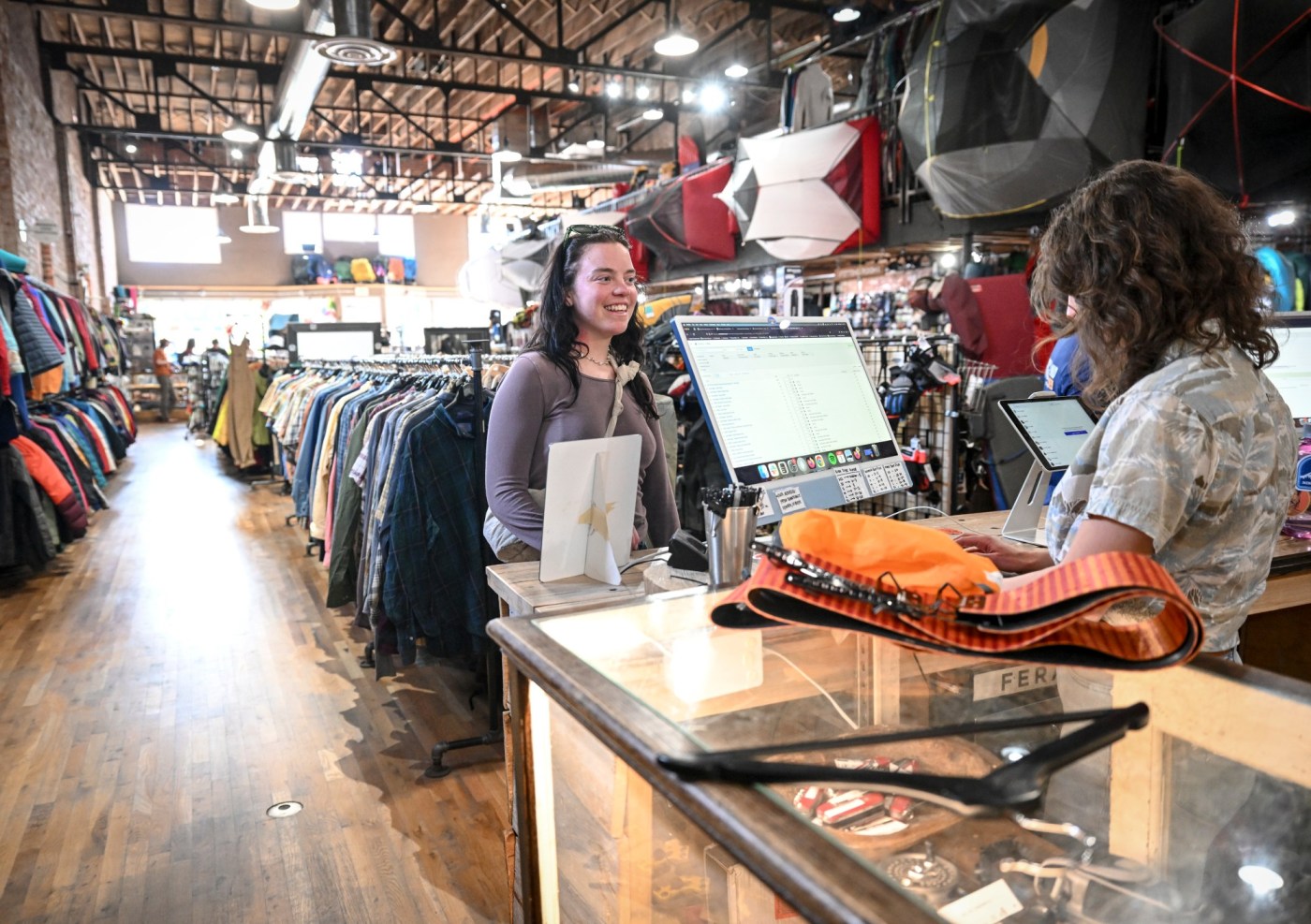
Feral mountain gear owner Jimmy Funkhouser, whose Denver shop, at 3936 Tennyson St., specializes in buying and selling used gear, says the decline in 2023 should be seen as a market correction after two years of “insane” growth.

“Any business in the outdoor industry that thinks 2021 and 2022 was a result of something we were doing as an industry, they’re kidding themselves,” Funkhouser said. “There was a lot of artificial growth in the economy in 2021 and 2022 as a result of stimulus money. I don’t think there’s any real reason to be alarmed about a small pullback in 2023 after two years of just massive growth.”

With its reputation as a place to save money on used gear, Feral is thriving. In fact, Funkhouser will soon open a second store in Grand Rapids, Mich.

“Fortunately we continued to see really strong growth in 2023,” Funkhouser said. “We’ve continued to see growth overall in our business, but our used side of the business does continue to outpace the overall business.”

Wilderness Exchange, located less than a block from the behemoth REI Flagship store at Confluence Park, has seen a surge in its consignment business. They also sell overstock merchandise and closeouts acquired from manufacturers and “samples” which they get from sales reps when those reps change over from one season’s product lines to the next.

Taylor Spaeth takes inventory of newly acquired used gear at Feral mountain gear. (AAron Ontiveroz/The Denver Post)

“There’s a subversive element to what we sell,” said Wilderness Exchange owner Don Bushey. “We subvert the traditional manufacturer-vendor-wholesale-retailer relationship. We do consignments and samples. We aggregate samples from around the country. We’re a known go-to for that. We buy entire sample sets at a discount and sell to the customer. Those two parts of our business are actually crushing it right now.”

It’s a model that has worked for 30 years, but Bushey says challenges remain because of competition from vendors who have “bombarded” his customers with promotional emails.

“Our competitive niche has always been curating a very select assortment of hard goods closeouts,” Bushey said. “We buy last year’s style, and color. That market has weakened, because of how highly promotional pricing has been, and how much is on sale. Suddenly this year’s jacket at 30% off is a lot better value proposition than last year’s jacket at 30% off. You can charge $6 for a dozen eggs, but you’re still charging $8 for a carabiner that you sold 20 years ago for $8. We haven’t benefited from inflation. I’ve actually seen pricing deflation in a lot of outdoor products because there is over-surplus, over-production. Demand is down so supply is up.”

Bushey and other industry experts say they are confident the outdoor retail market will recover before long. The OIA report says “improving economic conditions including increasing wages, growing GDP and low unemployment should lead to modest growth” over the next two years. At Outside Inc., Dorn says they see the industry as being “healthy, growing, and growing in the right ways, notwithstanding what we see as a temporary dip in sales as a result of inflation and a COVID hangover.”

And, Bushey says, there will always be a hunger for outdoor recreation.

“It’s not like people suddenly are going to say, ‘The outdoors were a trend,’ or, ‘It’s not relevant to us.’ It’s actually more relevant than it’s ever been,” Bushey said. “People getting out into wild places, that’s your humanity. That’s a part of you, that’s what we do. We hope to bring people to a place where they interact with the natural world, and learn from it, and be challenged by it. That’s not going away. You’re never going to get in that flow state while skiing, or ‘the zone’ when you’re climbing, and not want that feeling again. That feeling is what we live for.”

Heather Hummel prepares to drop off a bag of used outdoor goods while shopping with Parrish Atkinson and Levi the dog at Feral mountain gear in Denver this week.(AAron Ontiveroz/The Denver Post)