A Ramsey County District Court judge has allowed a legal case to move forward involving the contested sale of controlling interests in Bremer Bank, one of the Midwest’s largest farm lenders, while signaling that key questions have already been settled in favor of the philanthropic trustees who engineered the stock sale.
The judicial order, which calls for mediation in advance of an evidentiary hearing, neither approves nor denies the long-contested stock sale. Instead, it reaffirms that the case will not “relitigate” allegations of trustee misconduct.
In October 2019 the three trustees of the Otto Bremer Trust — one of the state’s oldest philanthropies — sold more than 725,000 “Class B” shares in Bremer Bank, the charity’s largest asset, to 19 East Coast hedge funds, positioning the bank board for takeover and the bank itself for a possible sale.
Bank officials and bank employees responded by filing suit against the three trustees, and individual hedge funds then filed legal action of their own against the bank when the stock sale was frozen.
The result was at least six separate lawsuits and the legal involvement of the Minnesota Attorney General’s office, which regulates charities and accused the trustees of self-dealing.
In April 2022, Judge Robert Awsumb removed Brian Lipschultz as a trustee of Otto Bremer Trust, noting his conduct — including berating the charity’s grantees and running a side business using the philanthropy’s resources — constituted a serious breach of trust.
Awsumb, however, did not give merit to the claim that the three trustees engineered the stock sale to increase their own investment advisory fees. Nor did he take issue with the trustees’ compensation, which he said was within a cap created by the philanthropy’s founding documents. He left the question of the actual stock sale unresolved for consideration at a later date. The Minnesota Attorney General’s office did not appeal Awsumb’s ruling.
Judge Mark Ireland this week ordered the bank board and trustees to schedule mediation in advance of an evidentiary hearing in the case, which he said will not focus on whether the trustees “breached their fiduciary (duties) or abused their discretion” in the October 2019 stock sale.
Calling those issues settled, Ireland said “the court expressly concluded that the trustees’ compensation was reasonable,” though “neither the attorney general’s petition nor the trial order are conclusive and binding on all issues.”
As a result, the trustees’ legal motion for a quick judicial decision, or summary judgment, to immediately approve the October 2019 stock sale “is not appropriate at this time,” Ireland wrote.
After the Timberwolves’ loss to Denver on Wednesday, which likely cost them the No. 1 seed in the NBA Western Conference playoffs, players discussed ways in which perhaps Karl-Anthony Towns could make a difference in future matchups with the Nuggets.
Because, as Denver coach Mike Malone said postgame, “I have a feeling that we’re probably going to see that team again in the playoffs.”
“I think he helps a lot. They really hurt us on the glass, and it’s a team effort,” Wolves center Rudy Gobert told reporters. “Even if I’m doing my best boxing out, sometimes the cutting in the back or they’re getting some of those boards that really hurt us today. And also on the free-throw line too. I think having KAT, who is a really good rebounder and has a lot of size, would’ve really helped.”
He also takes some pressure off Anthony Edwards’ shoulders as far as being a No. 1 scoring option.
“A lot of credit to Anthony, because the pressure and the attention on him went up, and for the most part I thought he did a really good job of getting off the ball, using his gravity to create offense for his teammates. And now we have another person that draws that type of attention,” Timberwolves coach Chris Finch told reporters. “KAT gives us another big body out there, for sure — some shooting. We always miss KAT. I don’t think that’s ever in doubt.”
And they’re about to get him back. Everything suggests Towns will return to action this weekend at Target Center — either Friday against Atlanta or, at the latest, Sunday in the regular-season finale against Phoenix.
Towns’ return instantly makes Minnesota’s roster more talented. The big man returns to a team that has played well in his absence. The Wolves are 12-6 in the 18 games since Towns went down with his torn meniscus. Over their last 18 games, the Wolves sports the NBA’s eighth-best offense, fourth-best defense and fourth-best net rating
The offense is what has surged over the past month, which is a bit of a surprise when you lose your second-best scorer. But Minnesota has found a true offensive rhythm in Towns’ absence, one founded upon ample ball and player movement. That has sparked more aggression and production from the likes of Jaden McDaniels, Mike Conley, Nickeil Alexander-Walker, Kyle Anderson and Naz Reid as the Wolves have formed a well-rounded offensive attack.
“I think him being out has allowed everyone to step up and play and have roles and get going for the postseason. I think the postseason definitely shows — and my career is a testament to that — that you never know what you might need. And just being able to be available and be providing, guys stepping up big, it’s good to get their game reps now,” Alexander-Walker said. “Guys like J-Mac have been huge since Karl has been out — Monte, myself, Naz and what he’s doing in his role. So I think adding Karl will be a huge help for us, make us more of a threat to make a deeper run.”
The key now for Minnesota is to maintain its rhythmic, equal-opportunity offense while incorporating Towns back into the lineup. The Wolves’ offense was static for much of the season, never quite delivering the results to match up with the talent.
That issue has been resolved over the past month. Can that continue with Towns — who, for all of his abilities, has been known to hold the ball for too long on occasion — back on the court?
“Obviously he’s extremely talented. We need him to be a very good version of himself, but also I think there are certainly some things that we’ve figured out in the last couple of weeks that we’re going to need him to kinda lean into as well,” Finch said. “It might be slightly different than the rhythm in which we were playing before he left. So there is a few things there, but we’ve already talked about some of that stuff. He’s actually seen it before we even talked about it. He was the first to kinda bring it up, some of the things that he’s noticed, which has been great. So yeah, that’s one more reason we’re excited and hopeful to have him out there soon. We can get to work on that.”
That’s why Towns returning prior to the playoffs is so valuable for the Wolves. He can knock off rust and Minnesota can work out kinks before it is truly showtime. And, with the No. 1 seed likely out of reach, that can all be done under slightly less pressure.
Because as Finch noted, there will be hiccups along the way. Reintegration is rarely seamless. But given the current date on the calendar, things need to take shape quickly. Even if Minnesota’s ceiling is higher with Towns, the Wolves can’t afford even one step backward before leaping in the right direction.
“KAT’s gotta really kinda lean into just making that easy, quick play. We’ve seen how teammates … everyone is benefiting from it and they’re stepping up. And hopefully, Ant can benefit from the gravity of KAT, and vice versa,” Finch said. “And that we didn’t always have during the regular season. So hopefully now we see it and we believe in it a little bit more.”
“Offensively, yeah, just bringing his unique talent that we miss. That’s gonna be great for us,” Gobert said. “But also spacing for his teammates. Keep the offense flowing like it’s been flowing. And you add his talent to that offense, it can be pretty special.”
San Francisco-based Afar magazine has just released its list of the 31 best new hotels around the world. It’s a rundown certain to inspire wanderlust, even if you weren’t planning to visit, say, Winston Churchill’s London digs or the highlands of Iceland anytime soon.
But if you were, Afar’s editors suggest Iceland’s Highland Base Kerlingarfjöll. The sleek Nordic retreat about three hours from Reykjavík is run by the same team behind the Retreat at Blue Lagoon. And the new Raffles London at the OWO nestles 120 guest rooms and suites inside the historic Edwardian building that once served as Winston Churchill’s Old War Office — that’s the OWO reference.
California gets a nod for The Inn at Mattei’s Tavern in Los Olivos, a 19th-century stagecoach stop and tavern that is now a luxurious 67-room Auberge Resort in the heart of Santa Barbara wine country.
And if you’re planning a Hawaii getaway, Afar’s list includes the post-tsunami reimagining of Kona Village, now a Rosewood Resort on the Kohala Coast of the Big Island of Hawai‘i with individual thatched-roof hales, a cultural center, swimming pools and four restaurants and bars spread across 81 acres of dramatic, volcanic landscape.
Kona Village, a Rosewood Resort, opened on the Kohala Coast of the Big Island of Hawai‘i last year. (Courtesy Kona Village, a Rosewood Resort)
Here’s a peek at the North American hotels and resorts on the list. Find all 31, along with details and photos at www.afar.com and on newstands April 23.
Best New North American Hotels
The Inn at Mattei’s Tavern, Los Olivos
Kona Village, a Rosewood Resort, Island of Hawai‘i
Where can you taste the world’s best bourbon, make the acquaintance of the world’s most famous Thoroughbred, tour the home of the “Paul Revere of the South,” shop for high-end antiques in a converted schoolhouse, and spend the night in a castle — all in the same small county?
If you said Woodford County, Kentucky, go to the head of the class.
Located in the state’s scenic Bluegrass Region, Woodford County offers enough to keep a visitor occupied for an entire vacation.
Start with the Thoroughbreds. Drive along US 60, and you will quickly discover that you are in an upscale neighborhood where the sprawling farms belong to folks such as the Sheikh of Dubai (Gainsborough at Darley) and Barbara Jackson, widow of California wine magnate Jess Jackson (Stonestreet).
Most visitors make a beeline for Coolmore at Ashford Stud where Triple Crown and Breeder’s Cup winner American Pharoah stands at stud.
The superstar stallion, along with his stablemate, fellow Triple Crown winner Justified, will happily pose for pictures with adoring fans. These guys preen, prance and mug for the cameras in a manner the Kardashians might envy.
If you want a Thoroughbred farm with history, opt for Airdrie Stud, which occupies part of fabled Woodburn Farm, considered by many to be the birthplace of the American Thoroughbred breeding industry.
Prior to the Civil War, it was Belle Mead Plantation outside of Nashville, Tennessee, that was considered de rigueur for quality blooded horses. During the war, however, these valuable Thoroughbreds were routinely confiscated by both Union and Confederate forces.
Belle Meade’s owner sent his best stallions and mares to Woodburn for safekeeping, thus sowing the seeds of the Kentucky Thoroughbred industry.
Many of Woodford County’s farms are available for touring through visithorsecountry.com.
The front porch of Holly Hill Inn in Midway, Kentucky. (Talitha Schroeder/TNS)
Chef Ouita Michel at her flagship restaurant, Holly Hill Inn in Midway. (Talitha Schroeder/TNS)
Confit Chicken Leg: Creamy grits, roasted wild mushrooms, chili oil, herbs at The Stave Restaurant. (Rebecca Burnworth/TNS)
Vallozzi’s Restaurant Versailles, Kentucky, offers diners robust Italian fare. (Catlyn Treadway/The Styled Social Co./TNS)
Stone warehouses at Woodford Reserve Distillery, the oldest bourbon distillery in Kentucky. (Woodford Reserve/TNS)
Triple Crown and Breeders Cup winner American Pharoah stands at stud at Coolmore at Ashford Stud in Woodford County. (Cooltucky Creative/TNS)
A showroom at Irish Acres Antiques. (Anna McCauley/TNS)
By now, you’re ready for some Kentucky elixir, right? Take a drive through some of America’s most scenic countryside (Old Frankfort Pike in the county has been designated a National Scenic Byway) to arrive at Woodford Reserve Distillery.
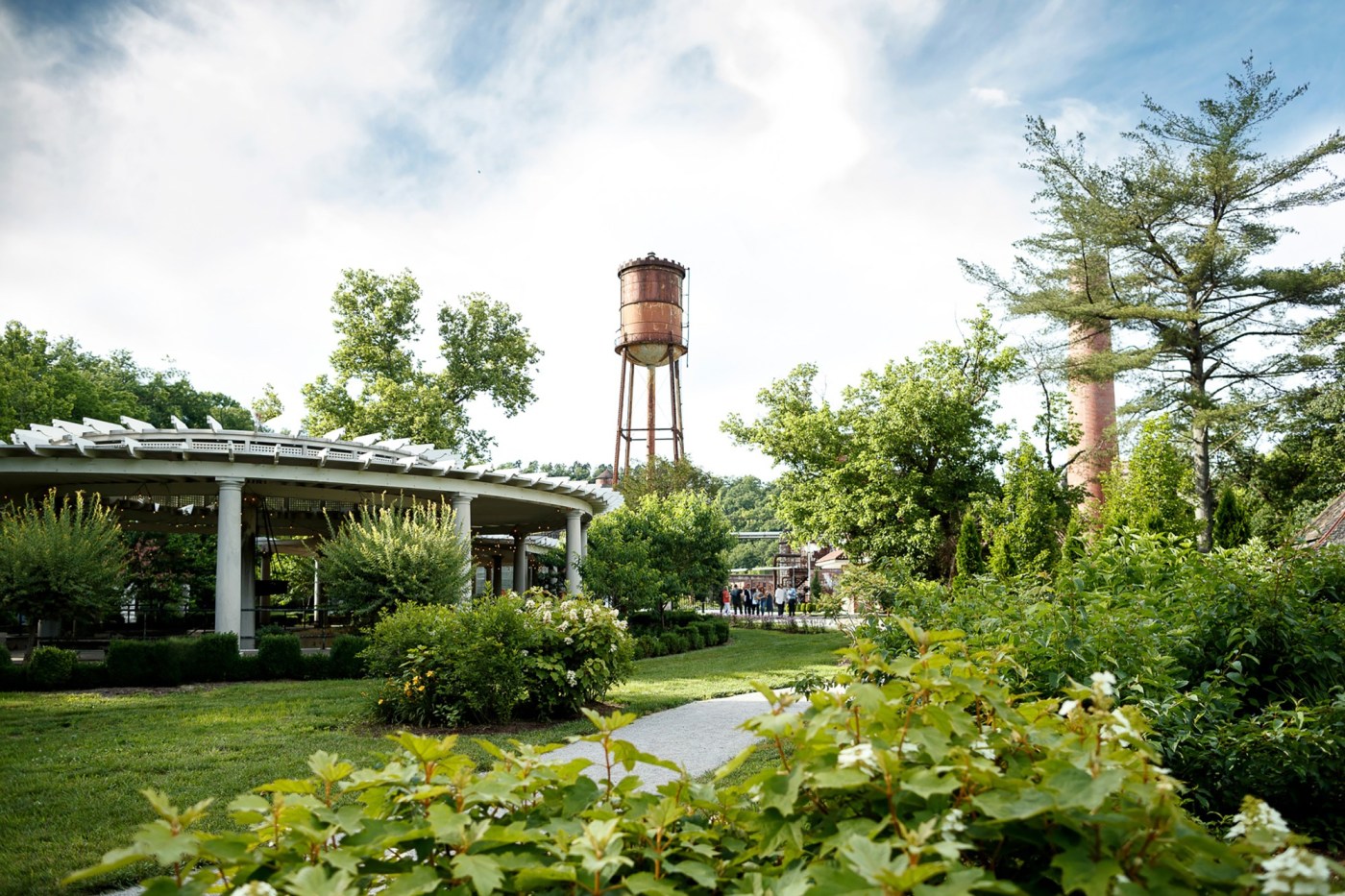
Situated on picturesque Glenn’s Creek, Woodford Reserve is the oldest distillery in the state, with a tradition dating back to early 1800’s distiller Elijah Pepper. On a tour, get a close-up look at the triple distillation process – from the copper pot still to the only surviving stone aging warehouses in America. Afterward, enjoy a tasting of the official Kentucky Derby bourbon.
If you’re still in a bourbon frame of mind, head four miles down McCracken Pike where Glenn’s Creek narrows to a trickle, and you will see a turreted castle rising above the trees. Don’t worry – you’re not hallucinating.
Welcome to Castle & Key Distillery where the legendary E.H. Taylor Jr. began making bourbon in1887. During his tenure, Taylor spared no expense in making what was then the Old Taylor Distillery a showplace.
Following Prohibition, the distillery fell into ruin for a half century – increasingly looking less like a Sir Walter Scott castle and more like a William Faulkner decaying Southern Gothic mansion.
That changed in 2018 when a multimillion-dollar renovation brought Castle & Key back to its original elegance. The castle, peristyle and springhouse with its chandelier and elegant columns were restored. The original sunken gardens were recreated and are at their best in summer when the hydrangeas are in bloom.
Finally, in 2022, the distillery’s Small Batch Kentucky Straight Bourbon became the first bourbon produced here in nearly five decades.
Want to soak up the bourbon with some regional cuisine? The Stave, where the food is described as “sleekly sophisticated without being pretentious,” sits between the two distilleries.
In the summer, you can dine on a wooden deck among trees backing up to the creek and listen to live music.
Summer’s most popular destinations, according to Google
The rest of the year, grab one of the hotly contested inside tables and indulge your taste buds with all manner of home-style cooking – from bacon jam grilled cheese and hot honey fried chicken to blackened catfish and grits and confit chicken leg served with creamy grits, roasted wild mushrooms, chili oil and herbs.
For a completely different culinary experience, book a table at Vallozzi’s Restaurant in the county seat of Versailles (please note that in Woodford County, it’s pronounced vur-sales and not vur-sigh).
Located in the town’s spiffed-up former police station, Vallozzi’s is complete with brick walls, artwork and cool light fixtures, along with a bar featuring an impressive array of bourbons.
The Italian menu is robust. As an antipasto, try the Arancini (fried risotto, mozzarella and marinara); then move on to the chopped salad bursting with flavor (pepperoncini, red onion, garbanzo beans, tomato and cucumber tossed in a well-seasoned Italian dressing), and as an entrée, the chicken parmesan or lobster risotto.
No talk of dining in Woodford County can be complete without mentioning multi-James Beard-nominated chef Ouita Michel. Michel has amassed a restaurant empire in the Bluegrass Region, but her flagship is Holly Hill Inn, located in the charming railroad community of Midway.
Originally an early 19th century tavern, the inn has southern charm equaled only by Michel’s inventive cuisine. She makes a cheddar crab puff to die for, and if you follow that with a boneless ribeye with Henry Bain sauce and horseradish cream and a cheeseboard composed of all local cheeses for dessert, you will have a meal not soon forgotten.
Appetite sated, it’s time for more exploring. Browse the boutiques and galleries of Midway before heading to the hamlet of Nonesuch (yes, really) and Irish Acres Antiques.
Imagine a place where staid New England drawing room meets 1930s over-the-top Hollywood glamor. You’ll find it at this rehabbed former elementary schoolhouse turned upscale antiques emporium where you can pick up a beautifully crafted Christmas ornament for $20 or walk out with a 200-year-old mahogany cupboard for $38,500.
In what was the school cafeteria, The Glitz is a restaurant that resembles a Tinseltown movie set, with its color scheme of black, silver, mauve and pink and its décor of smoky mirrors, gauzy drapery and hundreds of twinkling lights.
If you’re a history buff, tour the Jack Jouett House, an unassuming Federal-style home built in 1797 for its namesake. Jack Jouett isn’t exactly a household name outside of the commonwealth of Kentucky, but here he is known as the Paul Revere of the South, in 1781 having ridden 40 miles to Monticello and Charlottesville to warn Virginia Gov. Thomas Jefferson and the General Assembly that the British were coming.
After a full day of touring and eating, anyone would be thrilled to head to a well-appointed luxury hotel for the night. Especially if that hotel is The Kentucky Castle, Woodford County’s version of Downton Abbey.
Originally built by a Kentuckian with deep pockets as a home for his bride, the Castle now offers a truly regal experience on a property spread across 110 acres of rolling Bluegrass countryside.
Accommodations are in the castle’s main building (where opulent features such as gilded mirrors, chandeliers, decorative molding, ceiling frescoes and a sweeping staircase are jaw-dropping); the turrets, or cabins on the outskirts of the estate, offer a glamping experience.
Dine in the restaurant and then cap off the evening with a bourbon cocktail in the bar. Or unwind in the tranquility of the Castle’s gorgeous spa where you can opt for a Warm Himalayan Salt Stone Massage or one of their signature body scrubs, combining mint and lavender from the hotel gardens with … what else? … bourbon. If that doesn’t relax you, nothing will.
You’ve seen the horses, drank the bourbon, toured the unique places, sampled the food, and feel you’ve checked all the boxes.
Wrong. You haven’t even started drinking wine (Woodford County has four wineries), picking fruit at Eckerd’s Orchard or learning the lore of the rail at the Bluegrass Scenic Railroad and Museum.
Don’t worry. That just means another visit to “the most charming county you’ve never heard of.”