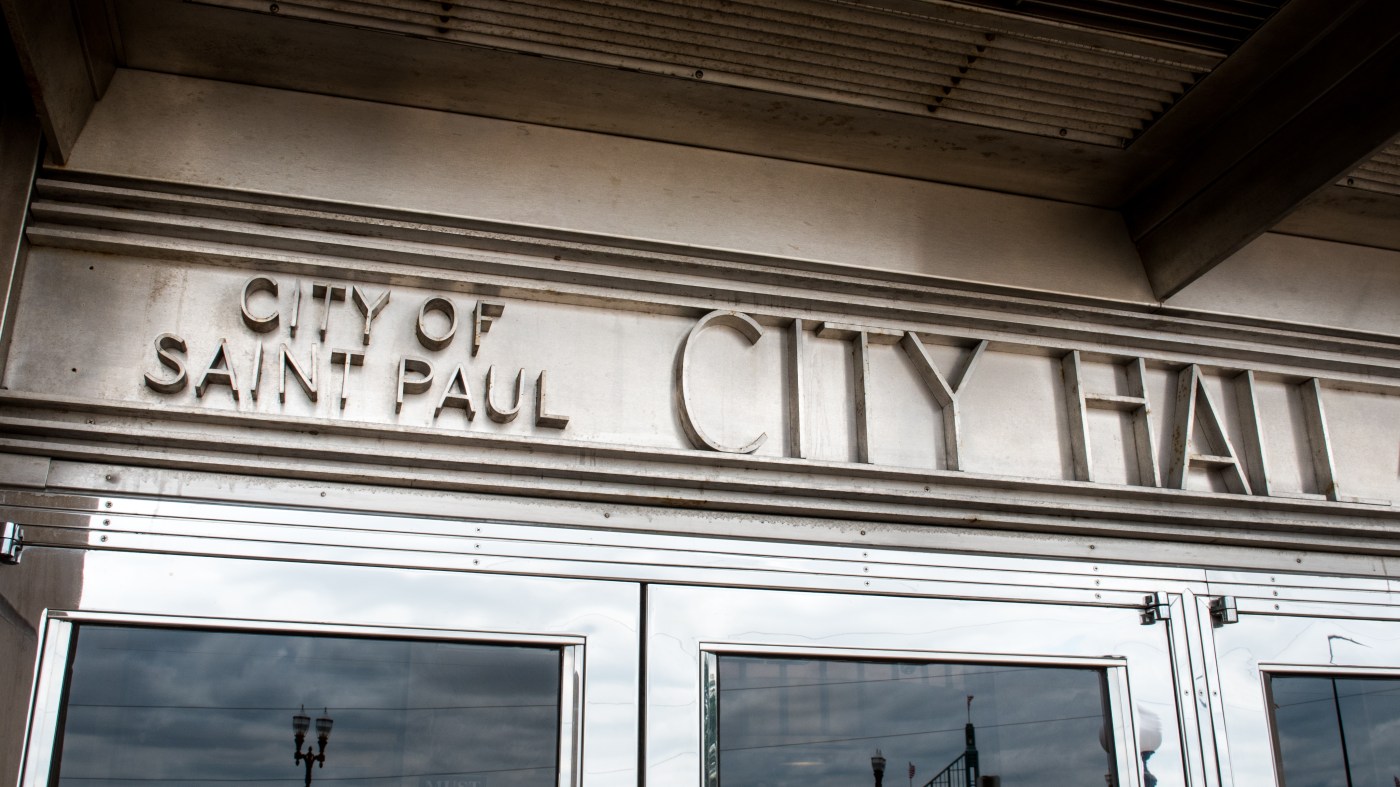
St. Paul City Council weighs rezoning 1984 Marshall Ave. for 7 townhomes

posted in: News | 0

To accommodate his plans for seven townhomes at 1984 Marshall Ave., developer Stephen Moriarty recently asked the city to rezone the corner parcel for a higher intensity of residential, multi-family development.

“There’s not a lot of townhomes available in St. Paul,” said Moriarty on Wednesday, noting the future rentals could someday be converted to homeownership for sale as starter homes. The site, which would utilize surface parking only, is already ringed by an apartment building adjacent to the west, multi-family housing to the northeast and a church to the south.

His request was opposed by the city’s Planning Commission and the Union Park District Council, which noted that West Marshall Avenue already was rezoned in 2018 following months of careful study to determine block to block density.

The request also gave some members of the St. Paul City Council pause on Wednesday, leading to a decision to consider it at a later date.

Moriarty told the council his townhomes would only be two stories. While the corner lot in question currently hosts a single-family home from 1910, the underlying zoning is “RM1,” which already allows up to three stories of residential, multi-family construction.

Moriarty’s request for RM2 zoning would allow up to five stories of construction, which council members noted was several more stories than actually needed for the townhome project to move forward.

“I am very supportive of multi-family housing along Marshall,” said Council President Mitra Jalali, a key architect of the 2018 rezoning study. “(But) I was frankly under the impression they could have just built these townhomes.”

Related Articles

Local News |


St. Thomas neighbors appeal site plan approved for new D1 hockey, basketball arena

Local News |


St. Paul City Council Member Anika Bowie filed for office using wrong address, owes $1,200 in parking, traffic tickets

Local News |


St. Paul City Council green-lights hotel at Allianz Field

Local News |


St. Paul EV charging rules loosened prior to April 17 vote

Local News |


Former St. Paul City Council, Ramsey County Board member Ruby Hunt marks 100th birthday

St. Paul City Council requires new parking lots to be EV-ready

posted in: News | 0

The St. Paul City Council on Wednesday approved new requirements that future surface parking lots spanning at least 15 stalls be developed with electrical conduit or raceway connections readying them for electric vehicle charging stations.

The new rules do not require the actual installation of the chargers themselves, in recognition that the technology will evolve with time. Instead, 80% of the stalls in residential lots must be conduit-ready, though an amendment introduced by Council President Mitra Jalali last week reduces the requirement in commercial lots to 20% of all stalls, with the expectation that most drivers will not be charging their cars in business lots overnight.

Council Member Rebecca Noecker said she was “especially glad to be able to balance both our needs for preparing our climate resilient future and also the needs of some of our smaller businesses.”

The new requirements were approved 5-0. Council members Anika Bowie and Nelsie Yang were absent.

Minneapolis, Bloomington and St. Louis Park currently all require the installation of actual chargers, though the number varies.

Related Articles

Local News |


St. Thomas neighbors appeal site plan approved for new D1 hockey, basketball arena

Local News |


St. Paul City Council Member Anika Bowie filed for office using wrong address, owes $1,200 in parking, traffic tickets

Local News |


St. Paul City Council green-lights hotel at Allianz Field

Local News |


St. Paul EV charging rules loosened prior to April 17 vote

Local News |


Former St. Paul City Council, Ramsey County Board member Ruby Hunt marks 100th birthday

‘We Need to Do Better’: Language Barriers Create Steeper Hurdles for African Migrants in Shelter 

posted in: News | 0

During the last two years, over 189,200 migrants have come to New York City and about 64,400 are currently under the city’s care; of those, roughly 17 percent are from African countries, according to City Hall.

Gerardo Romo / NYC Council Media Unit

Asylum seekers rallied outside City Hall before a joint hearing of the Immigration and Hospitals Committee on April 16, 2024.

New York City Councilwoman Alexa Avilés opened Tuesday’s hearing on the experiences of Black migrants by calling for more funding and language access services for new arrivals from African countries, hundreds of whom gathered at City Hall for the discussion and a rally outside beforehand.

Avilés, chair of the City Council’s Committee on Immigration, said that while the city has been offering social and healthcare services to migrants in Spanish and English, it has failed to meet the needs of migrants who speak other languages.

“Those needing information translated and interpreted in languages predominantly spoken in West African countries, including Wolof, Arabic, Bambara, Fulani and French, among others, have reported difficulty in communicating with migrant shelter staff and obtaining information from city agencies,” she said.

While the vast majority of asylum seekers and immigrants who’ve entered the shelter system initially came from Latin America, more adult migrants and families are now coming from the African continent.

During the last two years, over 189,200 migrants have come to New York City and about 64,400 are currently under the city’s care; of those, roughly 17 percent are from African countries, according to City Hall.

During Tuesday’s joint hearing of the Immigration and Hospitals Committee—which was not attended by officials from Health + Hospitals or New York City Emergency Management, two key agencies handling the city’s migrant response—advocates complained about the language barriers and lack of access to interpreters in shelters.

They also cited the difficulty of certifying new immigrants for workforce programs such as Occupational Safety and Health Administration (OSHA) training in languages such as Arabic, French, Pulaar, and Wolof.

Avilés asked the commissioner of the Mayor’s Office of Immigrant Affairs (MOIA) about this lack of opportunities for non-English and non-Spanish speakers.

“As you know OSHA is a federal program,” said MOIA’s Commissioner Manuel Castro in response, acknowledging that it is difficult to find trainers who speak other languages. “This is also an issue that partly belongs to the federal government. They need to do better at providing training in these languages.”

According to Adama Bah, founder of Afrikana, a community center serving asylum seekers, the city does not have translators for some of the languages it needs, and the language phone line it uses to access an interpreter by phone does not work after hours, so she has been translating herself.

“There’s many people in this audience right now that I have to call after hours to translate for migrants, and they’re constantly calling and telling the staff members to speak to Adama.”

And written documents do not work for those who cannot read, advocates explained.

“There is a significant amount of people who are illiterate,” Bah explained. “We have been sending voice clips to the migrants explaining to them what their rights are and to understand what’s going on. So it’s not just written, we need vocals.”

An oral history teacher at LaGuardia Community College who has been volunteering with new arrivals from Africa read the testimony of two such migrants. 

“Life in the shelter is not a life,” she read, narrating the experience of a young Senegalese man. “I wouldn’t advise anyone to live in such condition. If you go out to look for work and you miss a meal, then you have to go find food. But if you can’t find any work, how are you supposed to buy food.”

The other shared testimony came from a migrant from Mauritania who’d had difficulties getting information from shelter workers. “You meet staff at the shelters who would rather clean their fingernails than answer a question,” the woman said. “Sometimes you ask a question and strangely you get many different answers.”

During the hearing, Council Speaker Adrienne Adams’ asked the administration officials present what their takeaways were from the large audience and their testimony.

“That we need to do better, and we agree we absolutely need to do better every day,” Molly Schaeffer, interim director of the Office of Asylum Seeker Operations, acknowledged. “Specifically with language access. I think that was the biggest thing we heard.” 

Schaeffer explained that around 81 percent of migrants from African nations are single adults or part of adult families, which makes them more likely to have shorter stays than families with children coming from Latin America. Under Mayor Eric Adams’ deadline policy for new immigrant arrivals, families with kids are subject to 60-day shelter limits, while adults without children get just 30 days.

Asylum seekers from African countries have accounted for 16 percent of applications at the city’s asylum application help center, Schaeffer added.

She explained that the primary preferred languages of migrants under city’s care—though not necessarily reflective of the most newly arrived—is Spanish, at 76 percent, followed by those whose primary language is French (9 percent), English (3 percent), Russian (2 percent), Arabic (2 percent), and Fulani and Chinese (1 percent each).

The wait time for a new shelter placement is 24 hours, Schaeffer said, though she did not provide details about the current length of the waiting list, and City Hall did not respond to questions about it by publication.

The Senegalese young man whose testimony was shared by the LaGuardia Community College professor also touched on the impact of the city’s shelter deadline policy, which a number of lawmakers have pressed City Hall to abolish.

“They’ll kick you out in the middle of the night in the cold,” he said, according to the shared statement. “They just don’t respect us.”

To reach the reporter behind this story, contact Daniel@citylimits.org. To reach the editor, contact Jeanmarie@citylimits.org

Want to republish this story? Find City Limits’ reprint policy here.
South St. Paul mayor appointed to Dakota County workforce development board

posted in: News | 0

South St. Paul Mayor Jimmy Francis was appointed to the Dakota-Scott Workforce Development Board by the Dakota County Board of Commissioners last week.

South St. Paul Mayor Jimmy Francis was appointed April 9, 2024 to the Dakota-Scott Workforce Development Board, which oversees employment and training programs for the two counties. (Courtesy of Dakota County)

Francis will represent the private sector on the development board, which oversees employment and training programs in Dakota and Scott counties.

“In my day job, I deal a lot with employers that have workforce concerns and issues as well as wins,” Francis said Wednesday. “I am excited to bring that to the table and bring workforce concerns to the employers.”

Francis, who grew up in South St. Paul, works as an employee benefits broker with Assured Partners of Minnesota. In his role, he works with employers and employees to deliver cost-effective employee group benefit plans.

A common theme Francis has seen recently is employer-paid benefit options, which he said can not only attract new employees, “but it also retains employees, which is critical right now,” he said.

With experience in both the private and public sectors, including Neighbors Inc., Guild Inc., Rotary Club, Kaposia Days Festival and the Winter Carnival, Francis brings a range of business knowledge to the workforce board, according to a county news release.

“I’m honored that people think I have some skills to bring to the board,” Francis said.

The workforce development board is a state leader in developing innovative programs administered through CareerForce locations in Burnsville, Shakopee and West St. Paul.

Related Articles

Business |


Unlicensed St. Paul driver sentenced to 5 months plus probation for killing Burnsville priest riding bike

Business |


A new Rosemount recycling plant will be the first in Minnesota to handle aluminum cans

Business |


What ever happened to Twin Cities’ ‘Fishing Hat’ bank robber and his victims? Filmmaker takes deep look

Business |


Nacho mania: Seven of our favorite plates of chips, cheese and more in the east metro

Business |


More than 145,000 in east metro have unsafe levels of PFAS, or ‘forever chemicals,’ in water