Fact check: Biden is right about $35 insulin cap but exaggerates prior costs for Medicare enrollees

posted in: Politics | 0

Samantha Putterman | (TNS) KFF Health News

Insulin for Medicare beneficiaries “was costing 400 bucks a month on average. It now costs $35 a month.”

President Joe Biden, in a March 22 speech

____

The cost of insulin in the United States has risen considerably in recent years, with some estimates finding that Americans have paid around 10 times as much for the drug as people in other developed countries.

But recent changes by the federal government and drug manufacturers have started to drive insulin prices down, something President Joe Biden often mentions at campaign events.

Biden told the crowd at a March 19 campaign reception in Reno, Nevada, that he’s fought for years to allow Medicare to negotiate with drug companies.

“How many of you know someone who needs insulin?” Biden asked. “OK, well, guess what? It was costing 400 bucks a month on average. It now costs $35 a month.”

We’ve heard Biden make this point several times on the campaign trail — in other instances, he has said beneficiaries were paying “as much as” $400 a month — so we wanted to look into it.

The Inflation Reduction Act, which Biden signed in 2022, caps out-of-pocket insulin costs at $35 a month for Medicare enrollees. The cap took effect in 2023. In response, three drug manufacturers said they planned to reduce the price of insulin to $35 through price caps or savings programs.

The legislation also helped patients by clarifying how much they would have to pay for insulin and other drugs.

But Biden overstated the average monthly cost that Medicare beneficiaries were paying before the law.

One government estimate for out-of-pocket insulin costs found that people with diabetes enrolled in Medicare or private insurance paid an average of $452 a year — not a month, as Biden said. That’s according to a December 2022 report by the Department of Health and Human Services using 2019 data. Uninsured users, however, paid more than twice as much on average for the drug, or about $996 annually.

About Half of US Insulin Users Are on Medicare

More than 37 million Americans have diabetes, and more than 7 million of them need insulin to control their blood sugar levels and prevent dangerous complications. Of the Americans who take the drug, about 52% are on Medicare.

It’s unlikely that many Medicare enrollees were paying the $400 out-of-pocket monthly average Biden referred to, though it could be on target for some people, especially if they’re uninsured, drug pricing experts told us.

“It would be more accurate to say that it could cost people on Medicare over $400 for a month of insulin, but the average cost would have been quite a bit lower than $400 on Medicare,” said Stacie Dusetzina, a health policy professor at Vanderbilt University School of Medicine.

Medicare Part D, also called the Medicare prescription drug benefit, helps beneficiaries pay for self-administered prescriptions. The benefit has several phases, including a deductible, an initial coverage phase, a coverage gap phase, and catastrophic coverage. What Medicare beneficiaries pay for their prescriptions often depends on which phase they’re in.

“It is confusing, because the amount that a person was supposed to pay jumps around a lot in the Part D benefit,” Dusetzina said. For example, she said, Medicare beneficiaries would be more likely to pay $400 a month for insulin during months when they hadn’t yet met their deductible.

Mariana Socal, an associate scientist at Johns Hopkins Bloomberg School of Public Health, said it’s also difficult to estimate insulin’s precise cost under Medicare because individual prices hinge on other factors, such as how many other prescription medications patients take.

“Because the Medicare program has multiple instances where the patient is required to pay a coinsurance (percentage of the drug’s cost) to get their drug, it is very likely that patients were paying much more than $35 per month, on average, before the cap established by the Inflation Reduction Act went into effect,” Socal wrote in an email.

There are different ways to administer insulin, including through a pump, inhaler, or pen injector filled with the medicine.

In a 2023 report, HHS researchers estimated that about 37% of insulin fills for Medicare enrollees cost patients more than $35, and 24% of fills exceeded $70. Nationally, the average out-of-pocket cost for insulin was $58 per fill, typically for a 30-day supply, the report found. Patients with private insurance or Medicare paid about $63 per fill, on average.

For people with employer-sponsored insurance, the average monthly out-of-pocket spending on insulin in 2019 was $82, according to a report published in October 2021 by the Health Care Cost Institute, a nonprofit that studies health care prices. The study found that the majority of patients were spending an average of $35 a month, or lower, on the drug. But among the “8.7% of individuals in the highest spending category,” the median monthly out-of-pocket spending on insulin was about $315, the study said.

Our Ruling

Biden said Medicare beneficiaries used to pay an average of $400 per month for insulin and are now paying $35 per month.

The Inflation Reduction Act capped the monthly price of insulin at $35 for Medicare enrollees, starting in 2023. The change built in price predictability and helped insulin users save hundreds of dollars a year.

However, most Medicare enrollees were not paying a monthly average of $400 before these changes, according to experts and government data. Costs vary, so it is possible some people paid that much in a given month, depending on their coverage phase and dosage.

Research has shown that patients with private insurance or Medicare often paid more than $35 a month for their insulin, sometimes much more, but not as high as the $400 average Biden cited.

We rate Biden’s statement Half True.

____

PolitiFact copy chief Matthew Crowley contributed to this report.

(KFF Health News is a national newsroom that produces in-depth journalism about health issues and is one of the core operating programs of KFF — the independent source for health policy research, polling and journalism.)

©2024 KFF Health News. Distributed by Tribune Content Agency, LLC.

A vehicle backfiring startled a circus elephant into a Montana street. She still performed Monday

posted in: News | 0

By AMY BETH HANSON (The Associated Press)

The sound of a vehicle backfiring spooked a circus elephant while she was getting a pre-show bath in Butte, Montana, leading the pachyderm to break through a fence and take a brief walk, stopping noontime traffic on the city’s busiest street before being loaded back into a trailer.

Viola, an Asian elephant with the Jordan World Circus, still participated in two performances Tuesday after her time on the lam in the southwestern Montana city of about 35,000 people that in the late 1800s was the world’s largest copper-producing area.

Viola was getting a bath behind the Butte Civic Center just after noon on Tuesday when she was startled, Civic Center manager Bill Melvin said.

She went through a “kind of rickety” fence and went onto Harrison Avenue, a four-lane street, stopping traffic and causing folks to pull out their cellphones to take photos and video. Viola walked about half a block in the road before turning into the parking lot of a convenience store and casino, Melvin said.

Town Pump surveillance cameras caught images from several angles of the elephant walking down the street in front of the building and plodding through the parking lot with a trainer beside her. She then moved to a residential lawn where she started eating some grass.

People with the circus drove a trailer over with another elephant inside, Melvin said. They “put the ramp down and she walked right back in and that was it.”

“The other elephant was very happy to see her,” Melvin said.

About 10 minutes passed from when she was startled to when she was back in the trailer, he said.

“She come back and she performed last night and everything was good,” Melvin said. “I mean the show went on, as they say.”

Viola and the Jordan World Circus have performances on Wednesday in the state capital Helena.

___

AP reporter Sarah Brumfield contributed from Silver Spring, Maryland.

Marc-Andre Fleury signs one-year extension with Wild

posted in: News | 0

Marc-Andre Fleury has made his decision, and the Wild were happy to help.

The veteran goaltender, who this season moved into second place on the NHL’s career wins list, will not retire at season’s end and will play at least one more year in Minnesota on a $2.5 million contract extension.

“He’s played so well for us this season (that) it’s too soon for him to retire,” Wild general manager Bill Guerin said. “That’s my personal view.”

Fleury is scheduled to start the Wild’s season finale against Seattle on Thursday at Xcel Energy Center. He has played in 39 games, going 17-14-5 with a 2.98 goals-against average and .895 save percentage in a tandem with fellow goalie Filip Gustavsson.

Guerin said he is comfortable with using the same tandem next season and, if necessary, keeping prospect Jesper Wallstedt in Iowa for another year. Wallstedt started two games on the team’s just-completed five-game road trip, going 2-0 with a 1.01 GAA and .962 save percentage against Chicago and San Jose.

“There’s no rush,” Guerin said. “The worst thing you can do is force somebody in. I’m not saying we’re going to try to force Wally in more or keep him down in Iowa for another full year.”

Fleury will turn 40 in November. He is playing this season on a two-year, $7 million contract extension.

If the Wild feel comfortable with Wallstedt, 21, they could try to trade Gustavsson this summer for a scoring forward, something the team desperately needed this season, the team’s second in 12 years without a postseason berth. It snapped a 17-season playoff streak for Fleury.

Related Articles

Minnesota Wild |


John Shipley: Wild find positive narrative during season’s longest road trip

Minnesota Wild |


Wild get big effort in 3-1 victory at Los Angeles

Minnesota Wild |


Wild’s plan to boost Jesper Wallstedt’s confidence was a success

Minnesota Wild |


Rookies help Wild to rout Sharks in San Jose

Minnesota Wild |


Denver wins 10th NCAA title at the X

Tim Walz says copper wire theft bills are ‘top priority,’ urges legislators to move them forward

posted in: Politics | 0

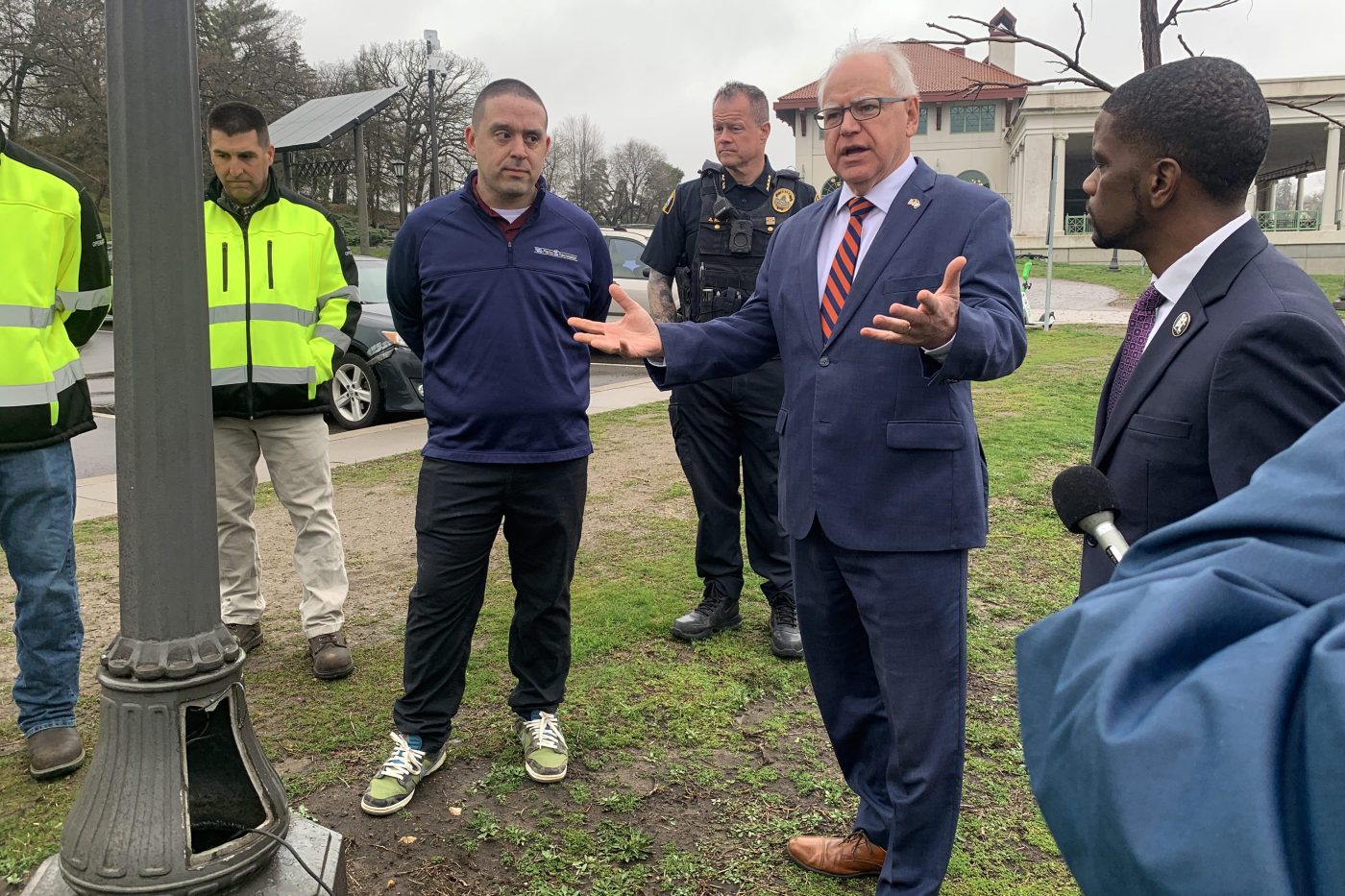
Gov. Tim Walz went to St. Paul’s Como Lake Wednesday to get a close-up view of the damage that copper wire thieves have caused to 100 light poles, darkening the path around the popular destination.

“Our teams come and replace them and replace them and replace them,” St. Paul Mayor Melvin Carter told him about fixing the wire. “We’ve seen these stripped out literally the next day.”

“From the very same one?,” Walz asked.

“From the very same one,” Carter answered.

Walz and Carter visited Como Regional Park to highlight what they say is a need for legislation to curb copper wire theft.

The legislation would require anyone selling copper metal to have a state-issued license. Construction contractors, people who work in residential trades, and other licensed workers would continue to be allowed to sell copper and wouldn’t need a separate license. The bills would still allow residents and businesses to recycle copper materials with scrap metal companies for free.

St. Paul spent $1.2 million last year on repairs and replacement due to wire theft from street lights and traffic signals, and the problem has been growing. The cost was about $250,000 in 2019, according to the city.

Copper wire theft “may seem like a fairly innocent thing,” Walz said as he addressed the media Wednesday. “If you think about it, it is not only incredibly costly and time consuming for the city, it’s also incredibly dangerous. We light our cities so that we make sure that these beautiful places are safe.”

The danger was evident on Christmas Eve when a driver fatally struck Steven Wirtz, a 64-year-old retired Marine, as he walked his dog across a St. Paul street in his North End neighborhood that was pitch black due to copper wire theft.

Concerns from scrap metal industry

Sen. Sandy Pappas and Rep. Athena Hollins, both DFL-St. Paul, are sponsoring the bills. With about a month left in the legislative session, Walz said Wednesday, “This is a top priority” and he encouraged legislators to move the bills forward.

Jeremy Estenson, representing the Institute of Scrap Recycling Industries, said at a Senate committee hearing last week that the problem with theft used to be catalytic converters, it’s now copper wire and “it will be aluminum. … It will be something else.”

There’s a need “to do something more comprehensive and meaningful as opposed to this whack a mole strategy where we might try to tackle or license whatever commodity happens to be the most popular to steal at that time, probably driven by market prices,” Estenson said.

The industry’s main concern, Estenson added, is “this will only license people who do things legally to start with. … Criminals generally don’t go get their paperwork in order before a night out on the town with their Sawzall and their tools stealing copper.”

Furthermore, scrap metal recyclers believe a side effect of requiring a $250 license for sellers will be “a cooling effect on recycling because there are people who just do a little bit of recycling” and might throw it in the garbage instead of seeking out a license that costs more than what they’d earn from recycling, Estenson.

Estenson said they’d like to continue talking about the price of the license or allowing a small amount of wire to be recycled without a license.

Why officials say licenses are needed

The problem extends beyond St. Paul — 38 mayors signed onto a letter supporting the legislation.

State law already requires scrap metal dealers to collect information from a seller’s driver’s license or identification and the license plate of the vehicle they arrived in.

Requiring a license to sell copper wire would help police because they can’t trace where copper brought to scrap yards is coming from, said St. Paul Police Chief Axel Henry. Though St. Paul labels its wires with “City of St. Paul,” people strip it off, so there’s not another easy way to identify it as stolen.

Someone selling stolen wire could just tell a scrap metal recycler, “It’s mine.’ … And (police) can’t prove where it came from,” Henry said.

People have been charged in cases when they’re caught in the act of stealing wire, and police and St. Paul officials encourage anyone who sees suspicious activity around light poles to call 911.

Related Articles

Crime & Public Safety |


Jacob Wetterling Resource Center director honored with national award

Crime & Public Safety |


Court says private vehicle is ‘public place’ under Minnesota gun law

Crime & Public Safety |


25 years after Nathan Edberg’s truck was found abandoned in Vadnais Heights, search for answers continues

Crime & Public Safety |


Hennepin County Attorney Mary Moriarty campaigned on change. Some say she’s gone too far.

Crime & Public Safety |


What ever happened to Twin Cities’ ‘Fishing Hat’ bank robber and his victims? Filmmaker takes deep look