By KATE PAYNE and DAVID FISCHER, Associated Press
TALLAHASSEE, Fla. (AP) — When a 20-year-old opened fire at Florida State University, terrified students barricaded doors and fled across campus, abandoning chemistry notes and even shoes, in a shooting that investigators said killed two men and wounded at least six others.
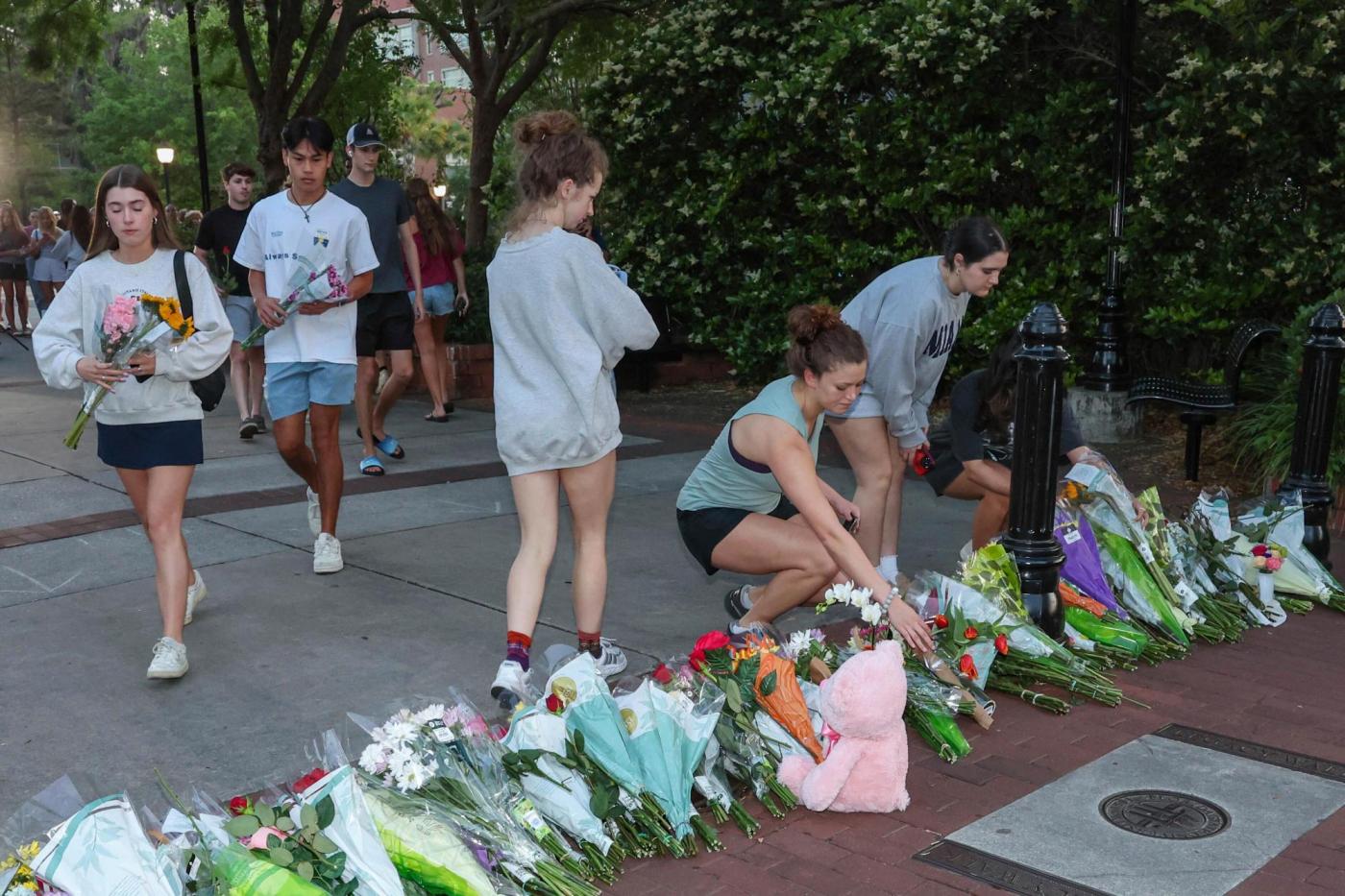
By Friday morning, memorials of candles and flowers dotted the campus and students and professors began returning to retrieve their belongings as they tried to start healing from the previous day’s shooting, which sent shockwaves of fear across the campus. A pair of vigils were planned for the afternoon.
“I heard some gunshots and then, you know, just blacked out after,” said Carolina Sena, a 21-year-old accounting student who was inside the student union when the shooting started. “Everyone was crying and just panicking. We were trying to barricade ourselves in a little corner in the basement, trying to protect ourselves as much as we could.”
The shooter, identified by police as Phoenix Ikner, is believed to be a Florida State student and the son of a sheriff’s deputy who opened fire with his mother’s former service weapon, investigators said. Authorities have not yet revealed a motive for the shooting, which began around lunchtime Thursday just outside the student union.
Officers quickly arrived and shot and wounded the gunman after he refused to comply with commands, said Tallahassee Police Chief Lawrence Revell.
The two men who were killed were not students, said Florida State University Police Chief Jason Trumbower, who did not release additional information about the victims.
The shooter obtained a weapon that belongs to his mother, who has been with the sheriff’s office for over 18 years and has been a model employee, said Leon County Sheriff Walt McNeil. Police said they believed Ikner shot the victims using his mother’s former service handgun, which she had kept for personal use after the force upgraded its weapons.
Five people who were wounded were struck by gunfire, while a sixth was hurt while trying to run away, Revell said. Two were expected to be discharged from Tallahassee Memorial HealthCare on Friday, three have been upgraded to good condition and one remained in fair, a hospital spokesperson for Tallahassee Memorial HealthCare said Friday morning.
The shooter was a long-standing member of the sheriff’s office’s youth advisory council, the sheriff said.
“He has been steeped in the Leon County Sheriff’s Office family, engaged in a number of training programs that we have,” McNeil said. “So it’s not a surprise to us that he had access to weapons.”
As of Thursday night, Ikner was in the hospital with “serious but non-life-threatening injuries,” according to Revell. The hospital declined to provide an update on the shooter’s condition, saying it cannot comment on the identity of patients.
Witness says the suspect’s shotgun jammed
Ambulances, fire trucks and patrol vehicles raced toward the campus just west of Florida’s capital as the university issued an active shooter alert.
Aidan Stickney, a 21-year-old studying business management, was running late to class when he said he saw a man get out of a car with a shotgun and aim at another man in a white polo shirt.
The gun jammed, Stickney said, and the shooter rushed back to his car and emerged with a handgun, opening fire on a woman. Stickney ran, warning others as he called 911.
“I got lucky today. I really did. I really, really did,” he said.
Trumbower said investigators have no evidence that anyone was shot with the shotgun.
Shots sent students scattering
Holden Mendez, a 20-year-old student studying political science and international affairs, said he had just left the student union when he heard a series of shots. He ran into a nearby campus building, where his previous emergency response training kicked in.
“There was a lot of fear. There was a lot of panic. There was a lot of misinformation that was being spread around. I was doing my best to kind of combat that,” he said. “I told people, ‘Take a deep breath. This building is secure. Everything is going to be ok.’”
Andres Perez, 20, was in a classroom near the student union when the alarm sounded for a lockdown. He said his classmates began moving desks in front of the door and police officers came to escort them out.
“I always hang out in the student union,” Perez said. “So the second I found out that the threat was there, my heart sank and I was scared.”
Shooting shocks campus and the nation
President Donald Trump called the shooting “a horrible thing” while also suggesting that he would not be advocating for any new gun legislation. “The gun doesn’t do the shooting, the people do,” he said from the Oval Office.
University President Richard McCullough said he was heartbroken by the violence. “Our hearts go out to our students and the victims of this terrible tragedy,” he said.
Another shooting a decade ago at Florida State
Florida State has about 44,000 students. In 2014, the main library was the site of a shooting that wounded three people. Officers shot and killed the gunman, 31-year-old Myron May.
The university canceled classes for the rest of the week and canceled home athletic events through Sunday.
Fischer reported from Fort Lauderdale. Associated Press reporters Stephany Matat in West Palm Beach, Curt Anderson in St. Petersburg, Michael Schneider in Orlando, Mike Balsamo in New York, Eric Tucker and Christopher Megerian in Washington, John Seewer in Toledo, Ohio, and Hallie Golden in Seattle contributed to this report.