When they found Adrian Martinez in his room at Schofield Barracks, his things had already been packed in boxes. His trip to Houston—paid for with government funds—was booked: United Airlines Flight 252, scheduled to depart Honolulu two days later on October 18, 2024, and arrive the following morning at George Bush Intercontinental Airport. His parents and brother planned to be outside Terminal C to welcome him home.
He was only 22, with heavy eyelids, an angular face, and curly black hair. He stood 5 feet, 11 inches tall, but in photos, his slender body swam inside his dark blue uniform. Long sleeves covered tattoos, including the words “All my heroes are dead” on his left forearm.
Military police found him in the closet, “still hanging by his neck,” a report shows. He was wearing gray pants and a blood-stained white T-shirt.
By the time investigators arrived, emergency medical responders had already taken the body down and pronounced Martinez deceased. The building had no security cameras. Army investigators took photos and measurements, conducted interviews, and reviewed medical records, according to his family.
The Army’s investigation, completed seven months later and approved by a two-star general, concluded that Martinez had taken his own life. He was, the investigation found, “not mentally sound,” and his death occurred in the line of duty. Records show that the medical examiner in Honolulu reviewed information supplied by the military and performed an external examination, not an autopsy, before ruling Martinez’s death a suicide.
Other circumstantial evidence in Martinez’s military case file points toward suicide, but his relatives in Texas don’t believe he took his own life. They question why Martinez would have hanged himself from a rod so near the ground that he could have easily stood up to save his life. They fear he could have been the victim of foul play—and they hired their own expert to perform an autopsy.
He was a beloved brother and son, and they believe he was eager to go home. He had that plane ticket, a planned move, and ideas of helping his father with his apartment-repair business. He’d also talked about looking for work as a chef and had promised his mother they would bake a Russian cake together.
“He had many plans,” his mother, Verónica Zaldo, said. “And he had un chorro de ganas to cook.”
For two years, his grieving family has gathered information, and they immediately noticed that the military’s death investigation report omitted what they consider the most significant factor: Martinez was a whistleblower.
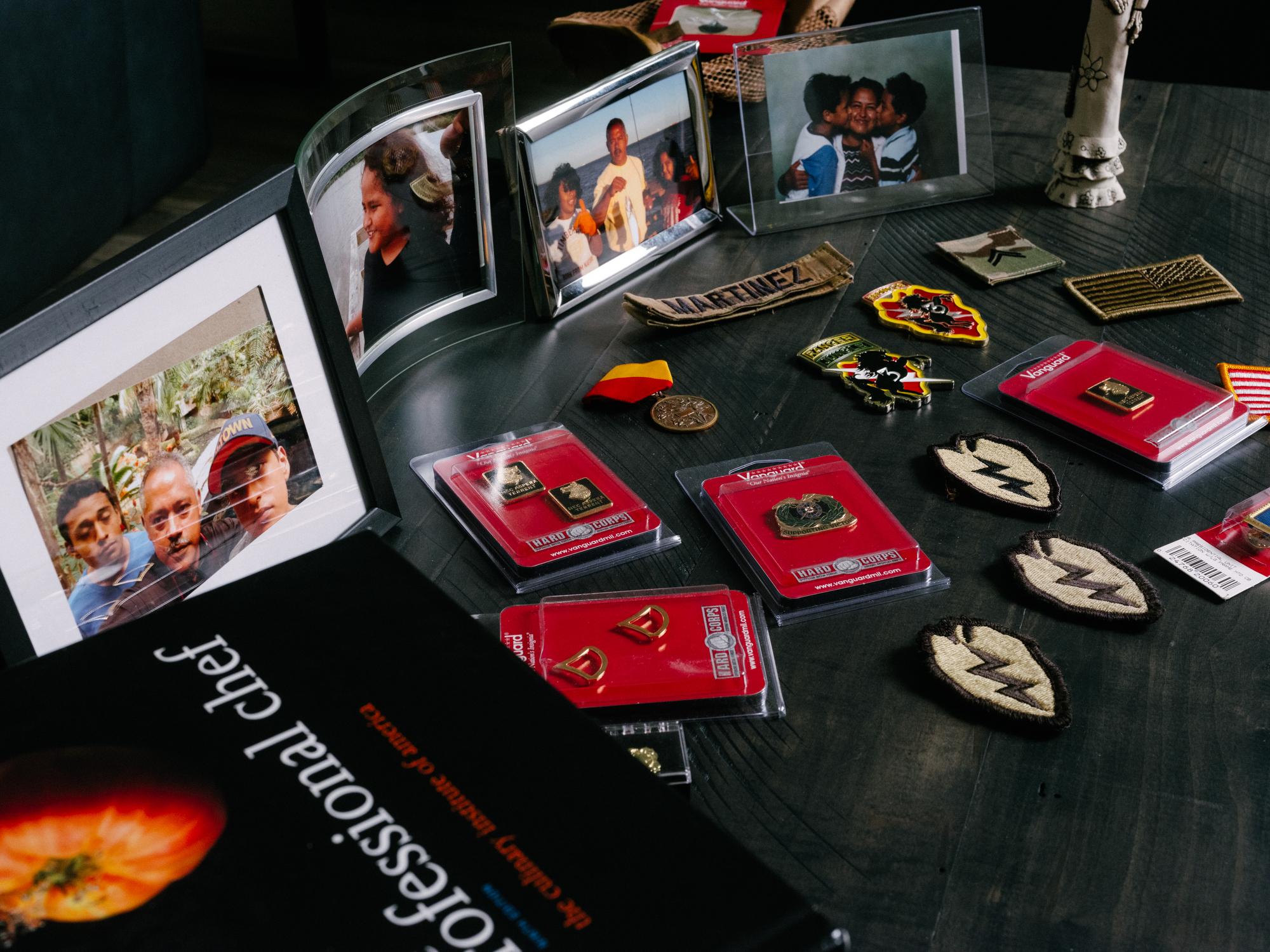
Medals, patches, and ribbons alongside family photos and cookbooks belonging to Martinez
He’d reported being sexually assaulted by another soldier in the Philippines in 2022, his relatives said, and that investigation was completed the year prior to his death. His complaint was found credible, an investigator told the family, and the accused officer left the Army.
Yet, according to their report, death investigators hadn’t considered the possibility that Martinez could have been targeted for retribution—though in his wallet when he died, he had a note documenting an odd warning he’d received from a superior officer after going to a hospital for mental healthcare.
The tragic sequence of events between Martinez’s reported assault and his unnatural death is documented in military records, along with text messages and other information painstakingly gathered by his family and shared with the Texas Observer. Those records provide a detailed account of how Martinez, previously lauded for his service, felt abandoned—and at times attacked—by the Army after coming forward about his assault. They don’t disprove the government’s conclusions about his cause of death, but they do raise serious questions about how Martinez was treated as he pursued military justice and, if he did take his own life, how and why he arrived at that precipice.
Martinez grew up in the Clear Lake area of Houston, between the eponymous lake and the massive NASA complex with his parents, Rafael Martínez and Zaldo, natives of Mexico, and his older brother, who shares his father’s first name and goes by Rafa.
At 8, Martinez once got bored of playing with a friend his age because the other kid “didn’t know anything about politics,” he told his mother. “That’s when I realized he wasn’t like other kids,” Zaldo told the Observer in Spanish.
During his teens, he read more than 100 books, his father said. Then, through a culinary arts program at Clear Springs High School, Martinez studied under a chef who’d run a Michelin-starred restaurant. “I realized he had enough talent to become a great chef,” Rafael recalled.
Then, at 17, Martinez suddenly decided to join the U.S. Army.
His father objected. He was concerned partly because of what he’d read about Vanessa Guillén, another Mexican American and native Texan who’d joined the Army, then been sexually harassed at Fort Hood and killed in April 2020. The military’s failure to immediately investigate sparked a national scandal, cited by advocates as evidence of systemic failures that left young, lower-ranking soldiers vulnerable inside the Army, especially women, LGBTQ+ members, and those from working-class or immigrant families.
No one talked about it openly, but everyone worried about how Martinez might be treated as a bisexual teenager. By the time he enlisted in mid-2020, the military’s “Don’t Ask, Don’t Tell” policy—the rule that long forced service members to hide their sexuality—had been gone for nearly a decade. On paper, nothing prevented Martinez from being himself.
But the policy’s 2011 repeal didn’t eliminate prejudice. An analysis of Department of Defense Health Related Behaviors Survey data in 2015 found that LGBTQ+ service members reported higher levels of moderate or severe depression and self-harm than their peers. Five years later, similar patterns persisted. A 2020 study published in Military Medicine found that LGBTQ+ soldiers reported higher rates of anxiety, post‑traumatic stress symptoms, and suicidality.
Veronica Zaldo, mother of Adrian Martinez, in her Houston-area home in June
Martinez argued that what happened to Guillén was an isolated incident and that the Army would provide valuable experience. He wanted to go into politics, and serving his country would help. He added that if his parents didn’t sign the consent form, he’d enlist at 18.
Rafael signed. Zaldo signed. Rafael asked only that Martinez continue to cook, hoping that advice might keep him safe. “Look, if you’re going to go, at least go to the kitchen, because if something happens, there’s a better chance that they’ll keep you there and won’t send you to the front,” Rafael told his son.
On the day his parents bid him farewell for boot camp, Martinez “was in tears,” Rafael said. “That’s when he started to feel that, well, his life was going to be different.”
For 10 weeks that summer, Martinez slept in the woods, threw grenades, and marched for miles carrying up to 35 pounds of equipment at Fort Jackson, South Carolina. He completed Basic Combat Training on August 27.
Three months later, he finished the Culinary Specialist Course at Fort Lee, Virginia. The kid who’d learned to cook for four in a small apartment could now feed 800 soldiers in the field. He finished with a grade of 95.8 out of 100, one of the best in his class. The Army described him as having an “outstanding display of professionalism and … [a] high degree of technical skills.”
He received a diploma with a gold seal that read “honor graduate.”
Near the end of 2020, Martinez, then 18, arrived at Schofield Barracks, a base on Oahu Island that’s surrounded by mountains and about 23 miles from Honolulu. It’s the Army’s largest base in Hawaii. He’d been assigned to the Hotel Forward Support Company, the support unit for the 2nd Battalion, 27th Infantry Regiment, 3rd Brigade Combat Team, known as the “Wolfhounds.”
Martinez spent two years as an enlisted cook, competing in culinary tournaments yet still dreaming of the special forces. Whenever he could, he sent home photos, mostly selfies of him cooking. In early snapshots, he looked happy—like his dreams had come true, his mother said.
In April 2022, he received an achievement medal for “exceptional” performance: “His actions are in keeping with the finest traditions of military service and reflect great credit upon himself,” it read.
Then, something occurred during a training trip to the Philippines that year that Martinez described to his relatives only in broad terms: A noncommissioned officer in his unit had sexually assaulted him. He offered no details and identified his attacker only by the nickname “El Chino.”
Rafa remembers that when his brother returned, “He was like a different person.”
Martinez had lost his silly sense of humor. “He became very distant,” his mother said. In a phone call, Martinez declared he was not going to reenlist, without explanation. The official separation date for his four-year contract was November 8, 2024.
“ADRIAN SHOULD HAVE HAD ACCESS TO A PROCESS THAT WAS INDEPENDENT, TRAUMA-INFORMED, AND TRANSPARENT.”
Military records suggest that after the 2022 trip, Martinez began suffering from undiagnosed post-traumatic stress disorder. He was drinking heavily and once mentioned the idea of swimming out to sea to end his life. On May 12, 2022, military police found him under the influence of alcohol, with a rope tied into a noose in his room. He had called a crisis hotline himself.
Martinez’s response was not atypical. Veterans with a history of military sexual trauma face a substantially higher risk of suicide. The risk is around 1.7 times higher for men and more than two times higher for women, according to a 2016 study of Veterans Health Administration records. The U.S. Department of Veterans Affairs’s 2022 suicide-prevention report found that veterans with such histories also suffered higher rates of depression, PTSD, and substance abuse.
That May, Martinez was admitted to Tripler Army Medical Center, the largest military hospital in the Pacific, and diagnosed with alcohol use disorder. He reached out to his family days later.
In that call, he told his father he’d decided to blow the whistle.
Despite everything, he kept pushing himself. Martinez completed substance abuse treatment in November. In December, he finished the Army’s Air Assault Course, which teaches soldiers how to load, move with, and rappel from helicopters, some of the Army’s toughest training.
His family believed he trusted the military’s investigative system to deliver justice.
In February 2023, Martinez filed a sexual harassment complaint against the noncommissioned officer. By then, reforms known as the I Am Vanessa Guillén Act had been in effect for more than a year.
Guillén had been the victim of sexual harassment before being murdered, a tragedy that became the symbol of what happens when the military fails to protect a soldier from abuse. The law that bore her name was meant to reform and improve the process Martinez was about to go through.
Guy Womack, a veteran, former military judge, and defense attorney in Houston who’s spent four decades working on military justice cases, said the new law “took the investigation from the hands of the military commander and created the office of the chief special prosecutor.”
Under the reformed system, a neutral officer outside the complainant’s chain of command would investigate Martinez’s complaint, and a senior, independent judge advocate—not the unit commander—would decide whether to pursue prosecution.
During that process, Womack said, a whistleblower and an alleged abuser are typically moved to different sections, different schedules, and sometimes different bases entirely: “They’re trying to keep them separate so that nothing more can happen, and also so that no witness could be intimidated.”
The law granted specific protections to Martinez as a complainant, protections that didn’t exist before Guillén’s case. He should have had access to victim support services and legal resources independent of his chain of command. And under the law, any adverse action against him that appeared connected to his report was supposed to trigger scrutiny.
“Adrian should have had access to a process that was independent, trauma-informed, and transparent,” said Josh Connolly, senior vice president at Protect Our Defenders and former chief of staff to U.S. Representative Jackie Speier, who helped spearhead the Guillén Act.
“TO WHOEVER READS OR HEARS THIS, I PRAY MY MEMORY DOESN’T FAIL…”
Instead, what happened to Martinez appears to fit a disturbing pattern, Connolly told the Observer. Too often, “a service member reports sexual assault, remains under the authority of the same institution that failed to protect them, and later faces adverse administrative or disciplinary action that can derail their career.”
Months after his death, Martinez’s parents were told that investigators substantiated their son’s complaint but never told them what his alleged attacker admitted to doing. A notice they finally received through the Houston office of U.S. Representative Sylvia Garcia said only that “appropriate action” had been taken. The letter, dated January 10, 2025, confirmed that both the command and the Army Criminal Investigation Division (CID) had investigated Martinez’s complaint and closed the process in May 2023. The officer whom Martinez accused had, at some point, “separated from the Army.”
Based on the information his parents eventually received, Connolly said, “there are serious questions about whether” Martinez received the protections he deserved during that process.
Martinez began to drink heavily in 2023 and later sought substance abuse treatment, according to the Army’s death investigation. Further, Martinez found himself the subject of a complaint months after the investigation into his report closed.
In January 2024—just a month after he received an Army Achievement Medal for exceptional service—Martinez was accused of sending a text message to a fellow soldier “asking for inappropriate pictures” and of “wrongfully, without consent, grabb[ing] a soldier’s buttocks.” According to his family, he acknowledged sending the text but denied any non-consensual contact.
On February 14, 2024, the Army issued a military protective order barring contact between Martinez and his accuser. On March 5, his brigade commander classified the harassment as “minor,” records show. His relatives, who eventually received those documents, were left to wonder whether Martinez had crossed a line with another soldier, perhaps under the influence of alcohol, or whether he’d been targeted for retribution because of his prior whistleblowing activity.
Martinez began working as an operations assistant in the battalion’s S3 section, under the command of Sergeant First Class Jacob T. Girard. The reassignment followed the protective order—the Army apparently followed protocol and gave him another assignment to separate him from his accuser.
Girard, his direct supervisor for nine months in 2024, defended Martinez in a September 5 letter. “In January of 2024, SPC Martinez was accused of sexual misconduct,” Girard wrote. “He has not shown any evidence of this type of behavior while serving directly for me.” He also praised Martinez’s “attention to detail and exceptional work ethic.”
On April 19, 2024, Martinez was hospitalized again, this time for mental distress and alcohol withdrawal. Tripler Army Medical Center admitted him for three days of treatment. Upon release, he was confronted by a superior officer whose behavior he found threatening, according to notes Martinez recorded on a piece of paper that he carried in his wallet until his death.
Martinez’s handwritten summary, based on a blurry photo of the original and a redacted Spanish translation provided to his family, says the higher-ranking officer claimed Martinez was faking his symptoms. The officer asked how it was possible that the hospital had discharged him if he was so sick. The officer also asked what exactly Martinez had told the doctors, which Martinez interpreted as a violation of medical privacy laws.
Martinez presented medical documentation to prove he wasn’t lying, including records of his diagnoses of alcohol withdrawal and his appointments with a counselor and the Army’s Substance Use Disorder Clinical Care program.
“Yes I did wrong in drinking this heavily, but I self-reported—I wanted help. Why did [name redacted] hammer in my problems!?” Martinez wrote, according to a photo of his summary.
Then the officer asked Martinez if he wanted to stay in the Army. If not, he said, he could get him out quickly.
“He obviously wanted me to state I wanted out the Army. [I don’t know] his intentions but I feel they were not pure,” Martinez wrote.
Martinez continued that he believed the officer misused his position to extract this information in a hostile manner, causing him great emotional distress. “To whoever reads or hears this,” he wrote, “I pray my memory doesn’t fail—there are witnesses to this, and I may bring it to a higher level of the chain of command so that no one else suffers this indignity.”
In interviews, two military justice experts described such confrontations as common, though questionable, tactics. Although the Guillén Act requires independent scrutiny of any adverse action linked to a complaint, nothing in the family’s documents suggests this episode was reported or investigated prior to Martinez’s death.
Instead, Martinez folded his note and placed it in his wallet, where it was found six months later on his body.
Rafael at his son’s grave in June
Medical instructions issued in April 2024 stated that Martinez should not be deployed, transferred, given temporary duty, or separated from the Army, and he should remain near a facility with behavioral health services. On July 19, a behavioral health provider confirmed that his alcohol and mental health issues were continuing.
Around that same time, the Army initiated proceedings to force him out before his term of duty ended in November.
On August 21, his company commander, Captain Cole Jacobs, handed Martinez an involuntary separation form, effective immediately. The Army was separating Martinez under an Army regulation for commission of a serious offense, related to the complaint filed against him in January 2024.
On September 18, 2024, he was informed by letter that a superior would recommend his discharge be general, under honorable conditions. But his family has no evidence such a discharge was granted.
On that same date, Martinez signed a separate form called an Election of Rights, a document through which soldiers facing separation choose which legal protections to exercise or waive. The form included a right to consult an attorney. Martinez could have requested a military or civilian attorney paid for by the government. He could have requested a hearing and presented statements in his defense. Instead, he waived everything.
It also read: “Have you filed an unrestricted report of sexual assault within 24 months of the initiation of separation action?” Martinez checked “No.” Perhaps he misunderstood the question. Or perhaps he knew that under Army regulations, an “unrestricted report of sexual assault” is different from the sexual harassment complaint he’d filed 19 months earlier.
Given his mental health, the Army’s acceptance of his decision to waive his rights appears improper, Connolly said.
“Before a soldier waives legal rights in a separation proceeding, the Army should ensure the soldier understands the consequences of that waiver and has a meaningful opportunity to consult counsel,” Connolly said. “That is especially important when the soldier has a documented mental health diagnosis, has expressed suicidal ideation, and has previously reported sexual assault.”
Martinez’s refusal of an attorney and his omission of his prior complaint, Connolly said, “raise serious concerns about whether the process was reliable, informed, or fair.”
The battalion’s physician assistant, Captain Kyle Mogensen, conducted Martinez’s official separation physical on September 9. He checked a box “normal” for a psychiatric evaluation field and another that said “is medically qualified.”
A separate mental health evaluation conducted the same day found “no evidence of mental defect, emotional illness, or psychiatric disorder of sufficient severity to warrant disposition through military medical channels,” per the Army’s investigation.
But on September 10, Martinez told the brigade psychologist that he “had a desire to fall asleep and not wake up.” On September 11, Martinez again expressed a desire to commit suicide to another soldier, who reported it. His last visit to behavioral health was September 12.
The Army’s Suicide Prevention Program requires commanders to identify soldiers at elevated risk and intervene. In principle, Womack said, the expectation is straightforward. “We expect all the services to immediately address any kind of depression, suicidal tendencies, any kind of behavior that could be self-destructive,” he said. “We expect the command to identify that and act on it immediately and try to get aid.”
But in the critical weeks prior to his departure, Martinez does not appear either to have been monitored or hospitalized.
On September 27, Martinez sold his car. Then he went on what the military calls “terminal leave” from September 29 to October 18.
On October 1, the Army issued new separation orders, accelerating his planned departure date by two weeks, to October 18, the date of his Houston flight. Those orders included a new instruction: The unit commander was supposed to assign a noncommissioned officer of grade E-5 or above to “escort Martinez while out‑processing.”
The Army’s Line of Duty investigation, completed seven months after his death, documented a command failure during those weeks: “No accountability or check-in procedure was in place for SPC Martinez while he was on terminal leave.”
On October 2, the rest of his unit deployed to the Joint Pacific Multinational Readiness Center on a different island; Martinez was assigned to stay behind. But the officer in charge of that rear detachment did not know Martinez and later told investigators he received no information and no instructions about him.
On October 6, a fellow soldier spoke with Martinez outside the shop on base. Martinez said he was upset about his separation but eager to return to Texas.
The night of Sunday, October 13, in Hawaii—early Monday, October 14, in Houston because of the five-hour time difference—Martinez made five phone calls between 10:23 and 10:41 p.m. to Texas.
Neither his family nor public or military records explain why. Martinez seems to have been under the apparently mistaken belief that he was in some kind of trouble in Houston.
The first call went to the Houston Police Department (HPD). The second to the Harris County Sheriff’s Office. The third, again to HPD, lasted four minutes. In a recording the family later obtained, Martinez asks about a supposed criminal case or warrant—though no criminal case in the Harris County district clerk’s database names him.
The operator directed him to HPD’s Clear Lake Division. He made two more calls, one that lasted seven minutes.
Close to 11 p.m. Hawaii time—4 a.m. in Houston—Martinez texted Rafa, who was still up watching a boxing match. “[Not gonna lie] man, I’m anxious [as fuck] about getting out, haven’t even done my resume yet. Can’t seem to focus,” Martinez wrote.
Rafa told him that was normal, and after leaving the base in Hawaii, his anxiety would disappear.
“Yeah, I figured as much,” Martinez replied.
“Anxiety is a virus, let’s do things right this time around,” Rafa wrote.
“True, you’re right,” said Martinez.
Shortly after that, Martinez stopped responding. Rafa noticed first. “At first the phone would ring, then go to voicemail. By Tuesday it went straight to voicemail,” Rafa recalled. Martinez, he thought, would never have cut him off like that. “He knew how much it would hurt us.”
Martinez’s brother and father started tracking him, like bloodhounds following their instincts, from 3,000 miles away. The Red Cross gave them the number for the military police at Schofield. Rafa finally reached military police on October 16.
Later that same night, close to midnight, two military officers knocked loudly at the door of the Houston apartment where Rafa and his father live. Rafael was awake; he’d barely slept in two days.
The officers told them to sit down. “They told us they found my brother in his room,” Rafa said. “And that they had tried to resuscitate him, that they tried to give him medical attention, but it was too late.”
Rafael found their tone rude and told them to leave. Rafa told his mother the next day. She seemed numb.
Months later, in a phone conversation with the Army Criminal Investigation Division, the family learned more details—and they pieced together more information gradually as documents arrived. Military police had arrived for a welfare check and found Martinez’s room locked, and they had to obtain a master key to get access. They entered at 10 a.m. and found him still hanging in his closet. Emergency Medical Services attempted resuscitation and pronounced him dead at 10:38.
One officer who searched the room reported finding empty alcohol containers and a note on the dresser that appeared to have been written by Martinez, which contained personal reflections about God, death, and greeting St. Peter in heaven.
The chief medical examiner of Honolulu County, Dr. Masahiko Kobayashi, reviewed marks on Martinez’s neck and a belt found with his body, as well as information from the military, to reach a conclusion. Cause of death: asphyxia by hanging. Manner: suicide.
The U.S. military has its own medical examiner system, specifically designed to handle violent, unnatural, or suspicious deaths under federal jurisdiction. A Department of Defense instruction states that a forensic investigation of such a death is incomplete without an autopsy. It is unclear why one wasn’t conducted in Martinez’s case.
The Army didn’t respond to the Observer’s requests for comment.
The family, which obtained a death benefit from the Army, used part of it to pay for the burial and part to hire an independent medical expert, Dr. Albert I. Chen, a forensic pathologist in Kingwood, who performed the first autopsy and also concluded that the most likely cause of death was hanging, with no obvious signs of foul play. But he found the manner of death to be undetermined.
On January 16, the family met again with Army representatives. According to Zaldo, when she raised the issue of the sexual assault her son had reported, a colonel said he knew nothing about it.
The Army denied Martinez military funeral honors. On November 1, Brigadier General Adam D. Smith, the Army’s adjutant general, signed a letter informing the family and citing a section of U.S. code that prohibits such honors when they “would bring discredit upon the United States Army.” He did not specify what justified that conclusion.
What the family does know is that Martinez had a documented history of mental illness and suicidality that had been tracked for weeks and was seemingly ignored in the days before his death.
The last time Martinez spoke with his mother, he was crying. He told her he felt alone, that no one wanted him there. Zaldo told him that other people’s opinions don’t define a person. She told him his family was waiting.
“You’re coming home,” she said.
“Yeah, Mama. Almost.”
The family has never seen photos of the death scene.
But they know investigators found the note that Martinez folded into his wallet. It was addressed simply “to whoever reads or hears this.” Near the end, Martinez described one of the last things he’d told the officer who confronted him outside the hospital after his breakdown.
Martinez tried to explain to the unnamed officer who confronted him that he’d told the doctors: “I did not have, nor do I have, suicidal or homicidal thoughts.”
An ofrenda made by Martinez’s parents
The post A Texas Soldier’s Death Casts Doubt on Federal Whistleblower Protections appeared first on The Texas Observer.
Leave a Reply