A change in popes — through death or resignation — is a complicated process, with centuries-old rituals involving the transition in leadership for both the spiritual head of the global Catholic Church and the Vatican’s head of state.
These are the need-to-know terms — some of them in Latin — to help make sense of news in the coming days:
Who is the Vatican camerlengo?
This is the “chamberlain” — the cardinal in charge of formally verifying the pope’s death — and then sealing his room and study. Between then and the election of the new pope, the camerlengo administers the “goods and temporal rights” of the Holy See. The current one is the Irish-born American Cardinal Kevin Farrell.
U.S. Cardinal Kevin Joseph Farrell presides over a vigil service over the death of George Floyd, a Black man who died after being restrained by Minneapolis police officers, in Rome’s Santa Maria in Trastevere Church, June 5, 2020. (AP Photo/Andrew Medichini)
Who is in the College of Cardinals?
There are 252 cardinals worldwide, and as a body, they are in charge of the Holy See’s affairs in-between popes, albeit with limits. Of them, 135 are “cardinal electors,” who gather in the Vatican to choose the new pope. For centuries, they have chosen one of their own. The vast majority of the electors — 108 — were made cardinals by Pope Francis, according to Vatican statistics.
What is the conclave?
This is the closed-door meeting of the cardinal electors to choose the new pope in the Sistine Chapel. Its name, literally “with a key,” was used in the 13th century to describe the process of locking up the cardinals until the election is completed. It must begin no more than 20 days after the death or resignation of a pope. The electors are sequestered from all outsiders for the duration; the last three popes were chosen within days.
Who is the dean of the College of Cardinals?
The current dean is Italian Cardinal Giovanni Battista Re. He is the head of the College of Cardinals who informs the rest of the cardinals and the ambassadors to the Holy See of the pope’s death once he learns of it from the camerlengo. He convenes the conclave and presides as the electors take their oaths. Once a new pope is chosen, the dean asks him if he accepts and what name he wants to be called.
Cardinal Tarcisio Isao Kikuchi, Archbishop of Tokyo, left, is congratulated by fellow cardinals after being elevated by Pope Francis during a solemn Mass in St. Peter’s Basilica at the Vatican, Dec. 7, 2024. (AP Photo/Gregorio Borgia)
What is the Domus Santa Marta?
This Vatican guesthouse, built in 1996, specifically houses cardinals during a conclave and is used at other times as a hotel for visiting priests and Vatican officials. Pope Francis never moved out after he was elected pope, choosing to live in suite 201, rather than the papal apartments in the Apostolic Palace.
What does ‘extra omnes’ mean?
A Latin phrase for “all out,” it’s spoken by the master for papal liturgical celebrations, currently Italian Archbishop Diego Ravelli, to ask all those present except the cardinal electors to leave the Sistine Chapel to begin the voting process during the conclave.
Why is the pope’s ring called the fisherman’s ring?
Each pope gets this ring at the Mass marking the beginning of his pontificate. It bears this name because Jesus told St. Peter, the first pope, that he would be “a fisher of men.” Until the 1990s, it was destroyed upon a pope’s death. Now, it’s “annulled,” or marked in such a way that it can’t be used as a seal.
What are the General Congregations?
This is the name given to the gathering of all members of the College of Cardinals after the pope’s death and before the start of the conclave to discuss major church affairs. All cardinals who aren’t infirm take part in this meeting in the Vatican’s Apostolic Palace. They also discuss preparations for the conclave, under oath and in secret.
What does it mean when they say, ‘Habemus Papam’?
This Latin phrase translates to “We have a pope.” These are the words used by the “protodeacon” of the College of Cardinals to announce from the loggia of St. Peter’s Basilica that a new pope has been elected. He then says the new pope’s birth name and the name he has chosen to use as pope, also in Latin. The current protodeacon is French Cardinal Dominique Mamberti.
Who are the infirmarii?
These are the three cardinals, chosen by a random drawing from the electors, who are charged with gathering the ballots of any electors who are ill during the conclave.
What does Pope Francis’ motto ‘miserando atque eligendo’ mean?
This is Latin for “having had mercy and choosing him” — a phrase that Francis chose as his motto when he was elevated to bishop and kept as his papal seal. It was drawn from the homilies of St. Bede the Venerable, an 8th century monk. It comes from the Gospel narrative of St. Matthew, a tax collector whom Jesus called to follow him.
Who are the revisers?
These are the three cardinals, chosen by random drawing from the electors, who are charged with reviewing the ballots during the conclave.
What is a rogito?
This is the document, or “deed,” listing key details of the pope’s life and papacy that is placed in his coffin. It’s written in Latin by the master for papal liturgical celebrations. A copy is kept in the Vatican archives.
Who are the scrutineers?
These are the three cardinals, chosen by random drawing from the electors, who are charged with reviewing each ballot and announcing it to the assembled conclave after each round of voting. They then tally the votes — to win the election, two-thirds of the votes are necessary — and they also burn the ballots.
What does the saying ‘sede vacante’ mean?
This is Latin for “vacant seat,” the period between the pope’s death or resignation and the election of a new one.
What to know about the death of Pope Francis
Watch: Mass for Pope Francis at the Cathedral of St. Paul
Pope Francis emerges from convalescence on Easter, delights crowd with popemobile tour
Andreas Kluth: The US has Greenland (and foreign policy) exactly upside down
Thomas Friedman: Trapped in a woke right-wing ideology
What is St. Mary Major?
This is the basilica in Rome where Pope Francis said he wants to be buried. Francis is breaking with the tradition of his predecessors who are buried inside the Vatican, saying he wanted to be near his favorite icon of the Virgin Mary, the Salus Populi Romani, a Byzantine-style painting of the Madonna draped in a blue robe, holding the infant Jesus who in turn is holding a jeweled golden book. The icon is located in the church first built in the 5th century and devoted to the Virgin Mary. In his will, Francis said he wanted a simple underground tomb with only “Franciscus” written on it.
What does the text ‘Universi Dominici Gregis’ contain?
This Latin phrase means “the Lord’s whole flock.” It’s the Vatican constitution that regulates the processes from a pope’s death until a new one is elected. St. John Paul II issued it in 1996 during his papacy, and Pope Benedict XVI twice amended it, most significantly by removing John Paul’s provision that after about 12 days of balloting a simple majority could elect a new pope rather than a two-thirds majority. If the conclave lasts that long, the top two vote-getters go to a runoff, with a two-thirds majority required to win. Neither of the top two candidates casts a ballot in the runoff.
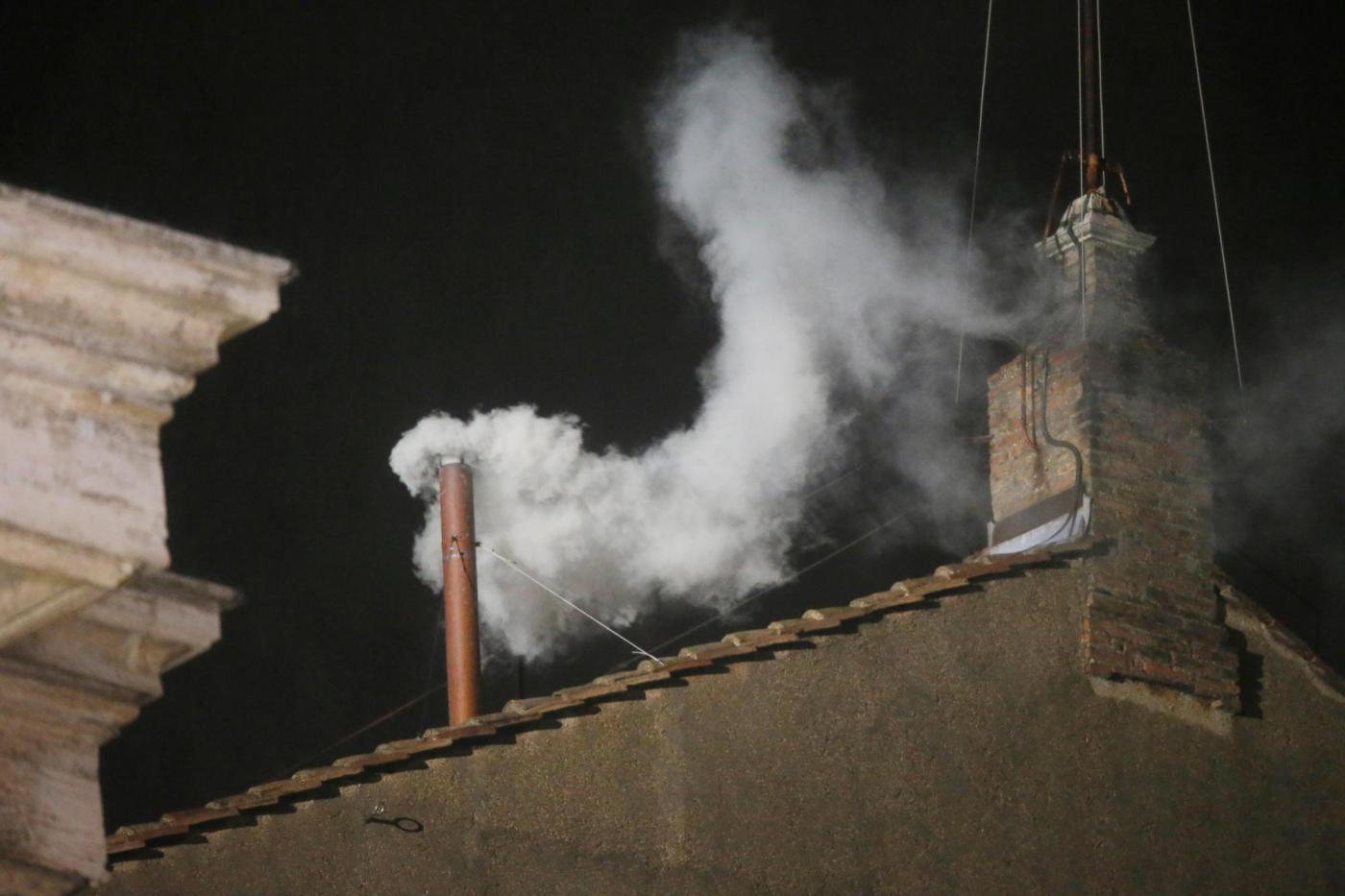
What does white or black smoke mean during a papal transition?
After each round of voting in the Sistine Chapel, the ballots are burned in a special furnace to indicate the outcome to the outside world. If no pope is chosen, the ballots are mixed with cartridges containing potassium perchlorate, anthracene (a component of coal tar), and sulfur to produce black smoke. But if there is a winner, the burning ballots are mixed with potassium chlorate, lactose and chloroform resin to produce the white smoke. Bells also are rung to further signal there is a new pope.
Associated Press religion coverage receives support through the AP’s collaboration with The Conversation US, with funding from Lilly Endowment Inc. The AP is solely responsible for this content.