By ZEKE MILLER, JON GAMBRELL and AAMER MADHANI, Associated Press
RIYADH, Saudi Arabia (AP) — President Donald Trump told Gulf leaders on Wednesday he urgently wants “to make a deal” with Iran to wind down its nuclear program but Tehran must end its support of proxy groups throughout the region as part of any potential agreement.
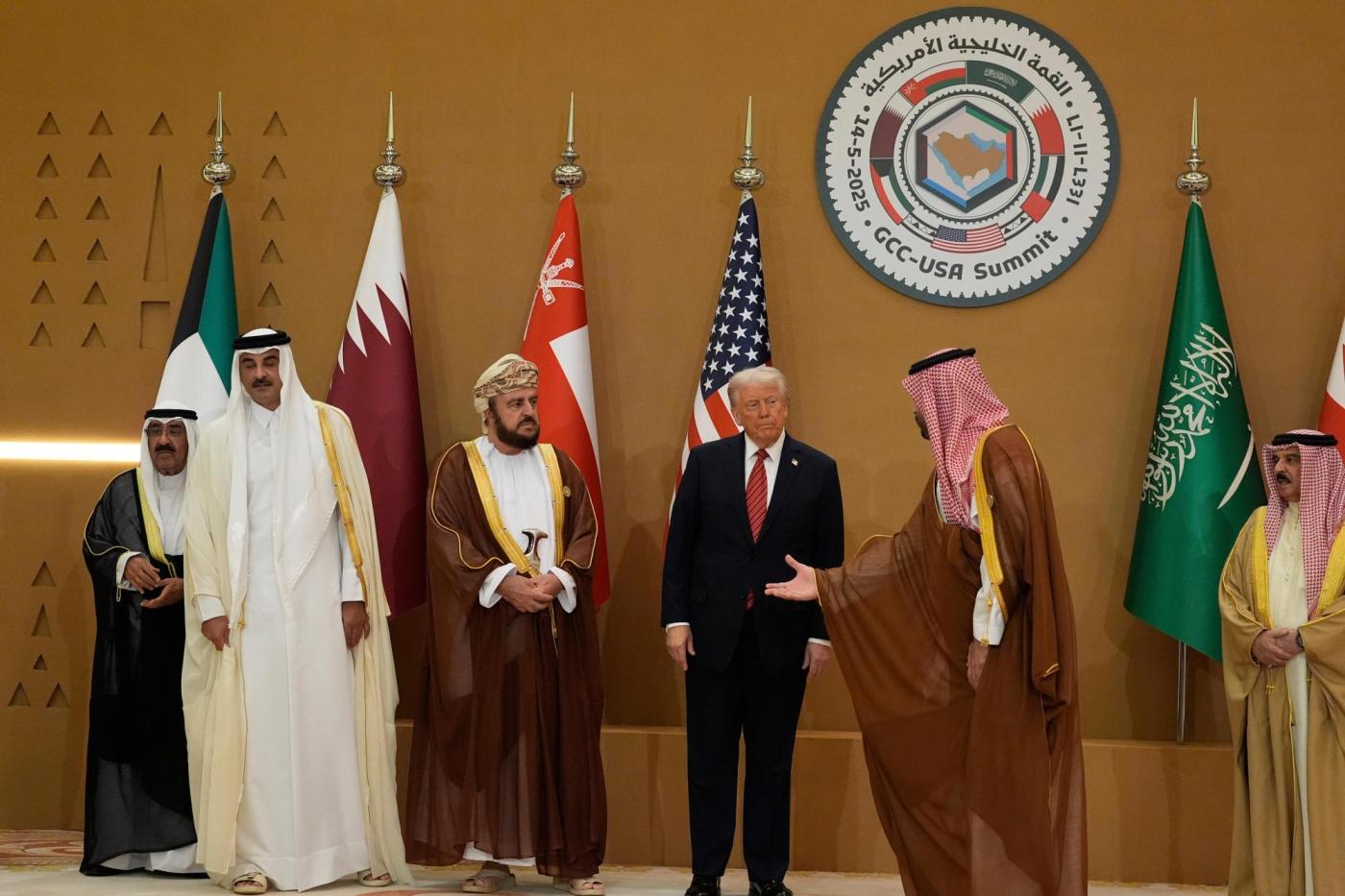
Iran “must stop sponsoring terror, halt its bloody proxy wars and permanently and verifiably cease pursuit of nuclear weapons,” Trump said in remarks at a meeting of leaders from the Gulf Cooperation Council hosted by Crown Prince Mohammed bin Salman in the Saudi capital. “They cannot have a nuclear weapon.”
Related Articles
Trump meets with Syria’s insurgent-turned-leader in Saudi Arabia
Other voices: DOGE’s damage makes way for serious government reform
Timothy Shriver: If you want to solve problems, lose the contempt
Hegseth’s plan to cut senior military jobs could hit more than 120 high-ranking officers
Trump’s new pardon attorney says he will scrutinize pardons that Biden issued at the end of his term
The U.S. and Iran have engaged in four rounds of talks since early last month focused on Iran’s nuclear program. Trump has repeatedly said that he believes brokering a deal is possible but that the window is closing.
The Republican president’s strongly worded push on Iran to cease support of Hamas in Gaza, Hezbollah in Lebanon and the Houthis in Yemen come as its proxy network has faced significant setbacks in the 19 months since Hamas launched its Oct. 7, 2023, terrorist attack on Israel.
Hamas has been designated as a terrorist organization by the United States, Canada and the European Union.
In Iran, Foreign Minister Abbas Araghchi called Trump’s remarks “deceitful” but did not directly address the U.S. leader’s call on Iran to cease support of proxy groups.
Later, Trump, in an exchange with reporters aboard Air Force One, urged Iran “to make the right decision” about its nuclear program “because something’s going to happen one way or the other.”
“So we’ll either do it friendly or we’ll do it very unfriendly,” Trump warned. “And that won’t be pleasant.”
Trump said that he believed the moment was ripe “for a future free from the grip of Hezbollah terrorists.” Hezbollah is severely weakened after its war last year with Israel in which much of its top leadership was killed, and after losing a key ally with the fall of former Syrian President Bashar Assad, a conduit for Iran to send arms.
Lifting sanctions on Syria
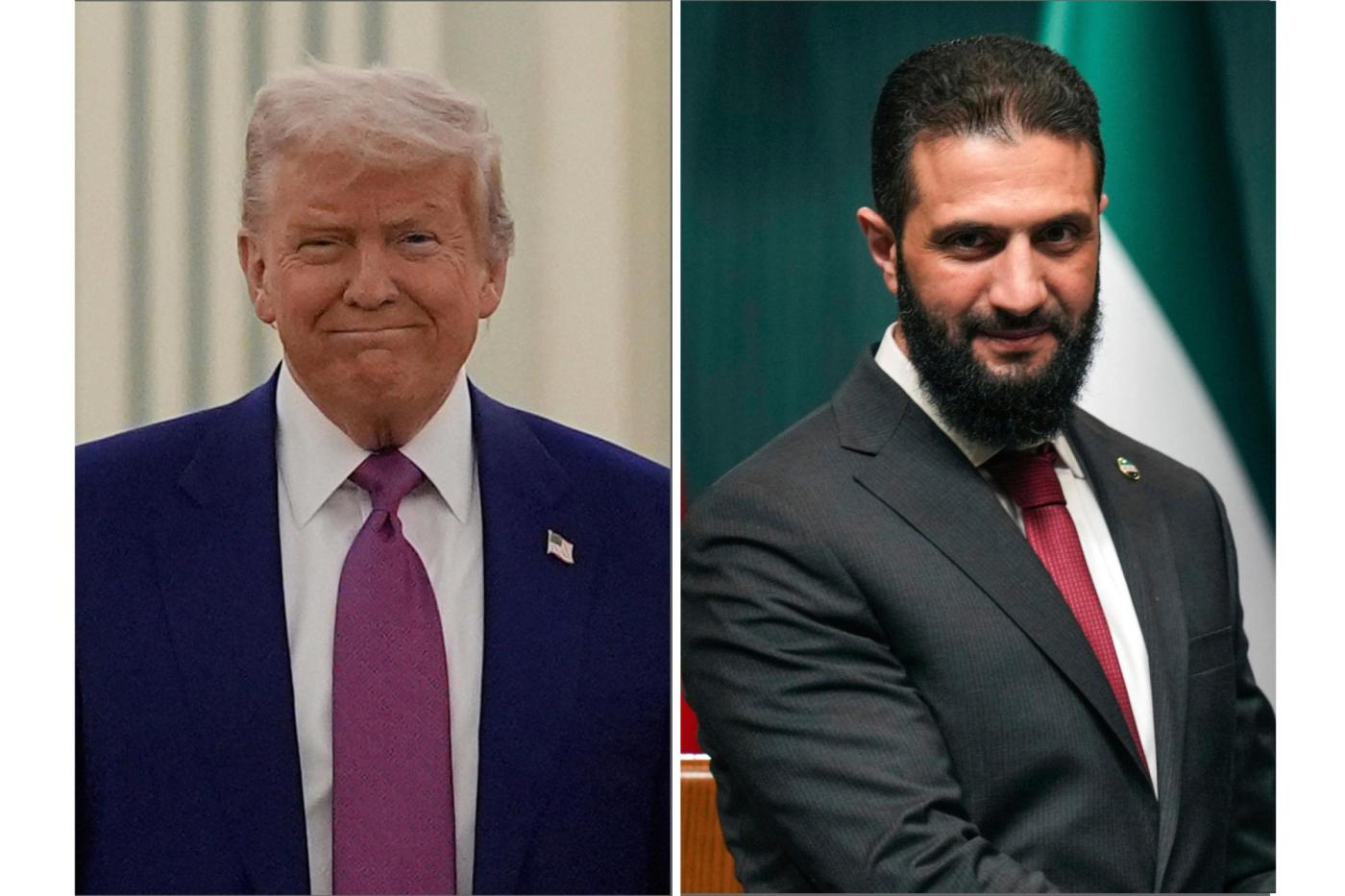
Trump’s comments on Iran came after he met Wednesday with Syrian President Ahmad al-Sharaa, a face-to-face engagement with the onetime insurgent leader who spent years imprisoned by U.S. forces after being captured in Iraq.
Trump agreed to meet al-Sharaa at the end of his stay in Saudi Arabia. He was headed next to Qatar, where he will be honored with a state visit. His Mideast tour also will take him to the United Arab Emirates.
In this photo released by the Saudi Royal Palace, President Donald Trump, centre, looks to Saudi’s Crown Prince Mohammed bin Salman, right, shake hands with Syria’s interim President Ahmad al-Sharaa, in Riyadh, Saudi Arabia, Wednesday, May 14, 2025. (Bandar Aljaloud/Saudi Royal Palace via AP)
Al-Sharaa was named president of Syria in January, a month after a stunning offensive by insurgent groups led by al-Sharaa’s Hayat Tahrir al-Sham, or HTS, stormed Damascus and ended the 54-year rule of the Assad family.
Trump said he decided to meet with al-Sharaa after being encouraged to do so by Prince Mohammed and Turkish President Recep Tayyip Erdogan. He also pledged to lift yearslong sanctions on Syria.
“The sanctions were really crippling and very powerful,” Trump said. “It’s not going to be easy anyway, so it gives them a good, strong chance” to rebuild the country, he added.
Prince Mohammed joined Trump and al-Sharaa for the meeting, which lasted 33 minutes. Erdogan also took part in the talks via video conference.
The prince said Trump’s decision to engage with al-Sharaa and lift the sanctions will “alleviate the suffering of the Syrian people” and spur a “new chapter” for the nation.
Formerly known by the nom de guerre Abu Mohammed al-Golani, al-Sharaa joined the ranks of al-Qaida insurgents battling U.S. forces in Iraq after the U.S.-led invasion. He still faces a warrant for his arrest on terrorism charges in Iraq. The U.S. once offered $10 million for information about his whereabouts because of his links to al-Qaida.
Al-Sharaa returned to his home country of Syria after the conflict began in 2011 and led al-Qaida’s branch called the Nusra Front. He changed the name of his group to Hayat Tahrir al-Sham and cut links with al-Qaida.
The sanctions go back to the rule of Assad, who was ousted in December, and were intended to inflict major pain on his economy.
Both the Biden and Trump administrations left the sanctions in place after Assad’s fall as they sought to take the measure of al-Sharaa.
State visit to Qatar
After meeting with members of the GCC — which includes Bahrain, Kuwait, Oman, Qatar, Saudi Arabia and the United Arab Emirates — Trump headed to Qatar, the second stop in his Mideast tour.
Qatar, like the other Gulf Arab states, is an autocratic nation where political parties are banned and speech is tightly controlled. It is overseen by its ruling emir, Sheikh Tamim bin Hamad Al Thani. Sheikh Tamim took power in June 2013 when his father stepped down.
President Donald Trump speaks during the Gulf Cooperation Council (GCC) Summit in Riyadh, Saudi Arabia, Wednesday, May 14, 2025. (AP Photo/Alex Brandon)
Qatar has also played a central role in pay-to-play-style scandals around the globe.
In Israel, authorities are investigating allegations that Qatar hired close advisers to Israeli Prime Minister Benjamin Netanyahu to launch PR campaigns to improve the Gulf nation’s image among Israelis.
Two European Union lawmakers were accused of taking money from Doha in a scandal dubbed “Qatar-gate.” U.S. prosecutors in 2020 accused Qatar of bribing FIFA executive committee members to secure the tournament in the country in 2022.
In 2024, RTX Corp., the defense contractor formerly known as Raytheon, agreed to pay more than $950 million to resolve allegations that it defrauded the U.S. government and paid bribes to secure business with Qatar. Doha always has denied wrongdoing.
Qatar follows an ultraconservative form of Sunni Islam known as Wahhabism born out of Saudi Arabia. However, Qatar struck a different tack in the Arab Spring by backing Islamists, including Egypt’s Muslim Brotherhood and former Egyptian President Mohammed Morsi, as well as those who rose up against Assad.
Its support of Islamists, in part, led to a yearslong boycott of the country by Bahrain, Egypt, Saudi Arabia and the United Arab Emirates. That boycott only ended as then-President Joe Biden prepared to enter the White House in 2021.
Qatar also has served as a key mediator, particularly with the militant group Hamas as the international community pursues a ceasefire for the Israel-Hamas war in the Gaza Strip. Qatar also served as host of the negotiations between the United States and the Taliban that led to America’s 2021 withdrawal from Afghanistan.
Qatar is home to Al-Udeid Air Base, a sprawling facility that hosts the forward headquarters of the U.S. military’s Central Command.
The oil-and-gas rich country is also in the center of a controversy over its offer to provide Trump with the gift of a luxury Boeing 747-8 that the U.S. could use as Air Force One while new versions of the plane are under construction by Boeing.
The Qatari government has said a final decision hasn’t been made. But Trump has defended the idea even as critics argue it would amount to a president accepting an astonishingly valuable gift from a foreign government.
Trump has indicated he would refurbish the aircraft and it would later be donated to his post-White House presidential library. He says he would not use the plane once he leaves office.
AP writers Suzan Fraser in Ankara, Turkey, Tia Goldenberg in Tel Aviv and Nasser Karimi in Tehran, Iran contributed.