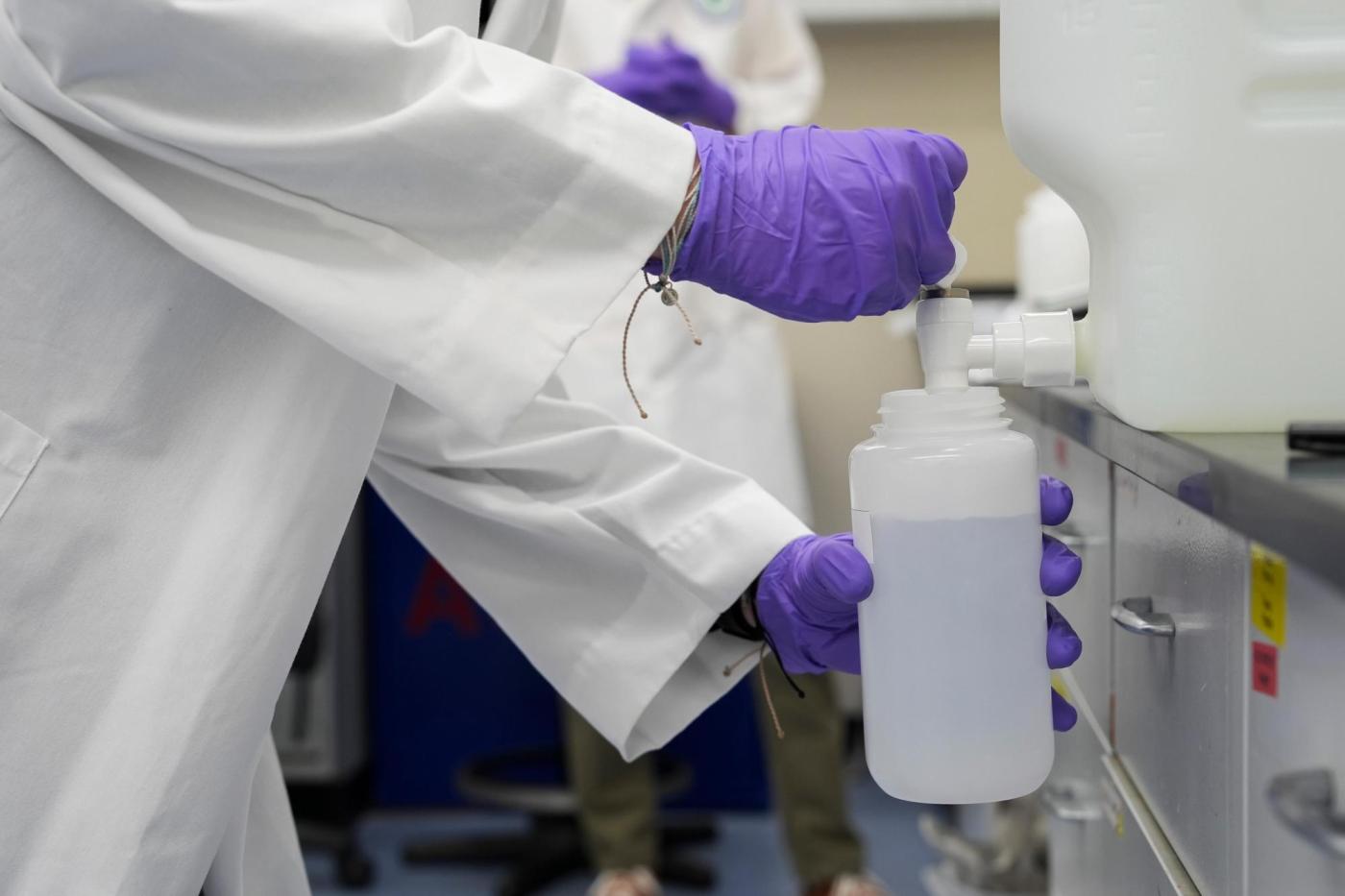
These researchers are trying to diagnose CTE during life. They’re recruiting former football players

posted in: All news | 0

Researchers are hoping they can tackle the mystery of how to diagnose CTE in the living.

The Boston University CTE Center and other research centers have received a $15 million NIH grant to diagnose CTE during life, as the scientists recruit hundreds of former football players for the new study.

Former NFL quarterback Matt Hasselbeck is among the first to sign up for “The DIAGNOSE CTE Research Project-II.”

“As a former NFL player, I know I am at risk for CTE, but right now I am blessed to be feeling healthy,” said Hasselbeck, a three-time Pro Bowler during his 18-season career.

“As a former quarterback, I’m choosing to volunteer for DIAGNOSE CTE II to honor my teammates, especially those who blocked for me and took hits to the head, so I didn’t have to,” he added. “I encourage former college and pro football players age-50 and over to join me in signing up for the study to help researchers learn how to diagnose and treat CTE.”

Related Articles


First at-home test kit for cervical cancer approved by the FDA, company says


FDA will allow three new color additives made from minerals, algae and flower petals


Despite historic indictment, doctors will keep mailing abortion pills across state lines


When they don’t recognize you anymore


Cancer before age 50 is increasing. A new study looks at which types

Right now, CTE only can be diagnosed definitively after death following an autopsy.

Researchers in the study will look at new disease biomarkers to help doctors diagnose the progressive brain disease chronic traumatic encephalopathy in living patients.

Scientists are also trying to learn how to differentiate CTE from similar diseases like Alzheimer’s.

“This study will create unprecedented data sets needed to accurately diagnose CTE during life,” said Michael Alosco, associate professor of neurology at the Boston University Chobanian & Avedisian School of Medicine.

“It will fill two missing links in the literature preventing us from developing definitive diagnostic criteria for CTE during life,” Alosco added. “First, we need longitudinal studies that include brain donation. Second, we need to better compare people at risk for CTE to other disease groups.”

Although this study will only study male football players, researchers said the findings will benefit all groups at risk for CTE — including male and female contact sports athletes and military veterans.

The study will examine new potential biomarkers using blood and brain imaging to help doctors accurately diagnose CTE in living patients.

Participants will enroll in one of the five NIA-funded Alzheimer’s disease research centers to complete neurological, cognitive and neuropsychiatric exams, multimodal brain imaging, tau PET imaging, and blood draws.

The information will be analyzed to characterize the specific signs, symptoms, and biomarkers of people at risk for CTE. Travel support for participants is provided.

Chris Nowinski and the Concussion Legacy Foundation will lead recruitment efforts. Robert Turner, an associate professor from Duke University, will help with recruitment focusing on understudied groups.

The DIAGNOSE CTE Research Project-II will recruit 350 men, age 50 and older, including 225 former college and professional football players, 75 control participants and 50 people with Alzheimer’s disease.

Former football players, as well as men who have no history of contact and collision sports, who are interested in participating are encouraged to sign up for the Concussion Legacy Foundation Research Registry at CLFResearch.org.

What your net worth statement is telling you

posted in: All news | 0

By Amy Arnott of Morningstar

A summary of all your assets and liabilities is a crucial first step toward getting a better handle on your finances. Before you start putting together a net worth spreadsheet, gather as much information as you can to get the best sense of what it can tell you.

Overall net worth (assets minus liabilities)

The ultimate insight from a net worth statement is exactly what it says: the net worth number, which is simply assets minus liabilities. The number in isolation doesn’t tell you too much, but it is a useful benchmark to track over time. A negative net worth figure would obviously indicate room for improvement.

Related Articles


Google will pay Texas $1.4B to settle claims the company collected users’ data without permission


15 states, including Minnesota, sue over Trump’s move to fast-track oil and gas projects via his ‘energy emergency’ order


More warning signs emerge for US travel industry as summer nears


Federal Reserve official sees signs of slowing economy but not ready to cut rates


The new rules of airline loyalty programs

Debt ratio

To calculate your debt ratio, you’ll need to add up all required monthly debt payments, including mortgage payments, student loans, auto loans, and credit card debt. Then take the total and divide it by your monthly gross (pretax) income. Lower is better for this number, and any number greater than 43% will likely create problems in obtaining or refinancing a mortgage.

Emergency fund

Most financial advisors recommend keeping at least three to six months’ worth of monthly living expenses in cash or other low-risk, highly liquid assets to cover a sudden job loss or other unforeseen events, such as car repairs, appliance replacement, or other home repairs. Some investors may want to keep closer to 12 months’ worth of expenses in cash if variable pay makes up a significant portion of their total compensation.

Division of assets between partners

This question normally comes up in the context of divorce, but it can be worth considering for couples who plan to remain married, as well. Depending on your state’s estate-tax limits — and potential future changes to federal estate-tax laws— it can be beneficial for couples to try to balance out the assets owned by each individual. It’s also important for each member of a couple to have their own retirement assets.

Allocation of assets among taxable, tax-deferred, and real estate holdings

There’s no particular reason why the allocations need to be exactly one third each, but the principle of equitable distribution helps avoid assets that are out of balance in any particular area. In particular, it’s wise to avoid an overly large concentration in residential real estate because it’s not particularly liquid. Investors should generally direct most of their savings toward tax-deferred retirement accounts, but once those have accumulated a healthy balance, it can make sense to steer some savings toward taxable accounts.

Single-company risk

If any one stock accounts for a large share of your net worth, that might be cause for concern. That’s particularly true in the case of employer stock because it means that your human capital — your ability to generate income and earn a living — and financial capital both depend on the fortunes of one company.

Liquidity and valuation issues

For most assets, valuation is straightforward. But things get a bit trickier for collectibles that aren’t liquid, such as antiques and baseball cards. For any physical assets, make sure all of these assets are both securely stored and itemized on their homeowners’ insurance policy.

Number of accounts

Life is complicated enough without having a bunch of financial accounts scattered across different institutions. It’s easy to accumulate multiple accounts if you changed jobs and never moved assets from a previous employer’s plan or set up different IRAs at different times. But the hassle of keeping track of account numbers, passwords, and updated account balances may not be worth it. That’s particularly true for investors approaching age 72 when required minimum distributions kick in.

Investors don’t have to take RMDs from each account but will need to base their withdrawals on the account totals in every covered account. Having a limited number of accounts to deal with also makes things easier for family members if you die or become incapacitated.

This article was provided to The Associated Press by Morningstar. For more personal finance content, go to  https://www.morningstar.com/personal-finance

Amy Arnott is a portfolio strategist at Morningstar.

Northwoods comes to life with sounds of spring during evening by campfire

posted in: All news | 0

KOOCHICHING COUNTY, Minn. — When it comes to spending time outdoors, it’s pretty tough to beat sitting by a campfire on a nice spring evening when the natural world is coming back to life after a long winter.

Such was the case late last month, when I met up with a friend at “The Shack,” the headquarters of his family’s deer camp in Koochiching County not far from the Big Fork River, for the weekend.

There was nothing on the agenda, other than “bombing around” the woods a bit to see what we could see (and hear what we could hear) and hanging out at the firepit surrounded by spruce and poplar trees.

It was glorious.

Earlier that Friday, before heading east to the Northwoods, I had attended the Glenn Allen Paur Lecture on the University of North Dakota campus in Grand Forks, which featured Marilyn Vetter, president and CEO of Pheasants Forever/Quail Forever and a 1988 UND grad, as keynote speaker. I sat next to Dave Lambeth, often referred to as “the dean of Grand Forks birders,” who asked me if I’d fired up my Merlin bird-identification app yet this spring.

As I told Lambeth, I hadn’t used the app to that point but hoped to use it as soon as later that evening.

Good plan, he said, as the weekend was shaping up as a good one for spring bird activity.

That evening as we sat by the campfire, a five-star sunset had dipped below the wall of trees, and darkness was descending when the show started. Somewhere back in the trees, a tiny saw-whet owl was calling. Some say the call is like the high-pitched sound of a saw being sharpened — or “whetted,” as they might have said in the old days — a repetitive “to-to-to” kind of sound.

One calling owl became two, then a third and then — somewhere in the distance on the other side of the road — a fourth.

The saw-whets definitely were chatty and putting on a show. A better serenade to a spring evening by the campfire would have been hard to imagine.

It was completely dark, save for the stars shining above us, when a different-sounding owl joined the show.

I fired up the Merlin app, which revealed the new bird was a barred owl, a common Minnesota owl with a hooting call the state Department of Natural Resources describes as “who cooks for you, who cooks for you-all.”

Related Articles


Gov. Walz encourages legislators, and anglers, to get the lead out


As temps climb in May, some local splash pads will open early (but not in St. Paul)


Keystone Woods and the controversy over dogs, birds and land use


Dakota County: Need a bike? Rick’s annual bike sale takes place May 10


Walleyes take center stage as Minnesota Fishing Opener approaches

We couldn’t decide whether the barred owl was moving around or whether there was more than one because the sound would come from different places in the forest, but no more than one at a time. We’d hear an owl calling in one place, only to hear a call in a different part of the woods a few minutes later.

The saw-whets, perhaps intimidated by the larger owl, had gone quiet.

At one point, it sounded like a real ruckus was going on as the barred owl’s call changed from hooting to more of an eerie wail, or screeching sound. Like owls fighting, perhaps, or fending off a predator.

We could only imagine what was going on somewhere back there in the trees. In the dark.

It was kind of creepy, but in a good way.

On a March evening 10 years earlier, we’d been sitting at the same firepit surrounded by the same dark woods when we heard a creepy sound we never were able to identify.

In a column I wrote about the encounter, I described it as “kind of a ‘yeep!’ noise, a single call that overtook the chorus of coyotes that were howling on the other side of the road.

“It wasn’t a ‘whoop’ or a ‘yelp,’ and it definitely wasn’t a screech,” I wrote. “Just a single ‘yeep!’”

What the …?

Whether it was a bird, an animal or some kind of creature that goes “bump” in the night, we’ll never know, but I sure wish the Merlin app had been a thing back in those days. At the very least, I wish I’d have recorded the call to play it back for someone more knowledgeable than me.

On that Saturday night, after spending the afternoon bombing around the woods and hearing several ruffed grouse drumming, we took a hike to a swampy area on the other side of the road just before dark.

Chorus frogs — which make a sound like plucking the teeth of a comb — and leopard frogs (at least I think they were leopard frogs) were in full voice in a small wetland. We could hear them but couldn’t see them, other than occasional ripples on the surface of the water.

At times, the sound — “joyous” is the only word I can use to describe it — was almost deafening.

From owls one night to frogs the next, with drumming ruffed grouse in-between, the weekend served up a Northwoods symphony at its finest.

Related Articles


15 states, including Minnesota, sue over Trump’s move to fast-track oil and gas projects via his ‘energy emergency’ order


Gov. Walz encourages legislators, and anglers, to get the lead out


New Arctic Cat leadership restores more than 300 jobs in Thief River Falls, St. Cloud


Trump nominates Daniel Rosen as next U.S. Attorney for Minnesota


Local Catholic leaders praise ‘quietly competent’ new Chicago-born Pope Leo XIV

Today in History: May 10, golden spike completes transcontinental railway

posted in: All news | 0

Today is Saturday, May 10, the 130th day of 2025. There are 235 days left in the year.

Today in history:

On May 10, 1869, a golden spike was driven in a ceremony in Promontory, Utah, marking the completion of the first transcontinental railroad in the United States.

Also on this date:

In 1775, Ethan Allen and his Green Mountain Boys, along with Col. Benedict Arnold, captured the British-held fortress at Ticonderoga, New York.

Related Articles


Today in History: May 9, FDA approves first birth control pill


How Putin uses the USSR’s victory in World War II to rally support for him and the war in Ukraine


Today in History: May 8, ‘Son of Sam’ killer pleads guilty


Today in History: May 7, RMS Lusitania torpedoed, sunk by German submarine


80 years after World War II, Germany is still painstakingly searching for its fallen soldiers

In 1865, Confederate President Jefferson Davis was captured by Union forces near Irwinville, Georgia.

In 1924, J. Edgar Hoover was named acting director of the Bureau of Investigation (later known as the Federal Bureau of Investigation, or FBI) by President Calvin Coolidge; Hoover would serve as FBI director until 1972.

In 1933, book burnings were held in 34 cities across Germany, targeting authors whose ideologies were in conflict with Nazism.

In 1940, during World War II, German forces began invading the Netherlands, Luxembourg, Belgium and France. On the same day, British Prime Minister Neville Chamberlain resigned, and Winston Churchill formed a new government.

In 1994, Nelson Mandela was inaugurated, becoming the first Black president of South Africa.

In 1994, the state of Illinois executed serial killer John Wayne Gacy, 52, for the murders of 33 young men and boys.

In 2014, Michael Sam was selected by the St. Louis Rams in the seventh round of the NFL draft, becoming the first openly gay player drafted by a National Football League team.

In 2023, Rep. George Santos, the New York Republican infamous for fabricating his life story, was indicted on charges that he duped donors, stole from his campaign and lied to Congress. (Santos pled guilty in August 2024, and was sentenced to 87 months in prison in April 2025.)

Today’s Birthdays:

Basketball Hall of Fame coach Jim Calhoun is 83.
Musician-songwriter Donovan is 79.
Sen. Fashion designer Miuccia Prada is 76.
Olympic skiing medalists Phil and Steve Mahre are 68.
Sen. Cindy Hyde-Smith, R-Miss., is 66.
Singer-activist Bono (U2) is 65.
Sen. John Curtis, R-Utah, is 65.
Playwright Suzan-Lori Parks is 62.
Model Linda Evangelista is 60.
Rapper Young MC is 58.
Racing driver Helio Castroneves is 50.
Actor Kenan Thompson is 47.
Olympic swimming gold medalist Missy Franklin is 30.