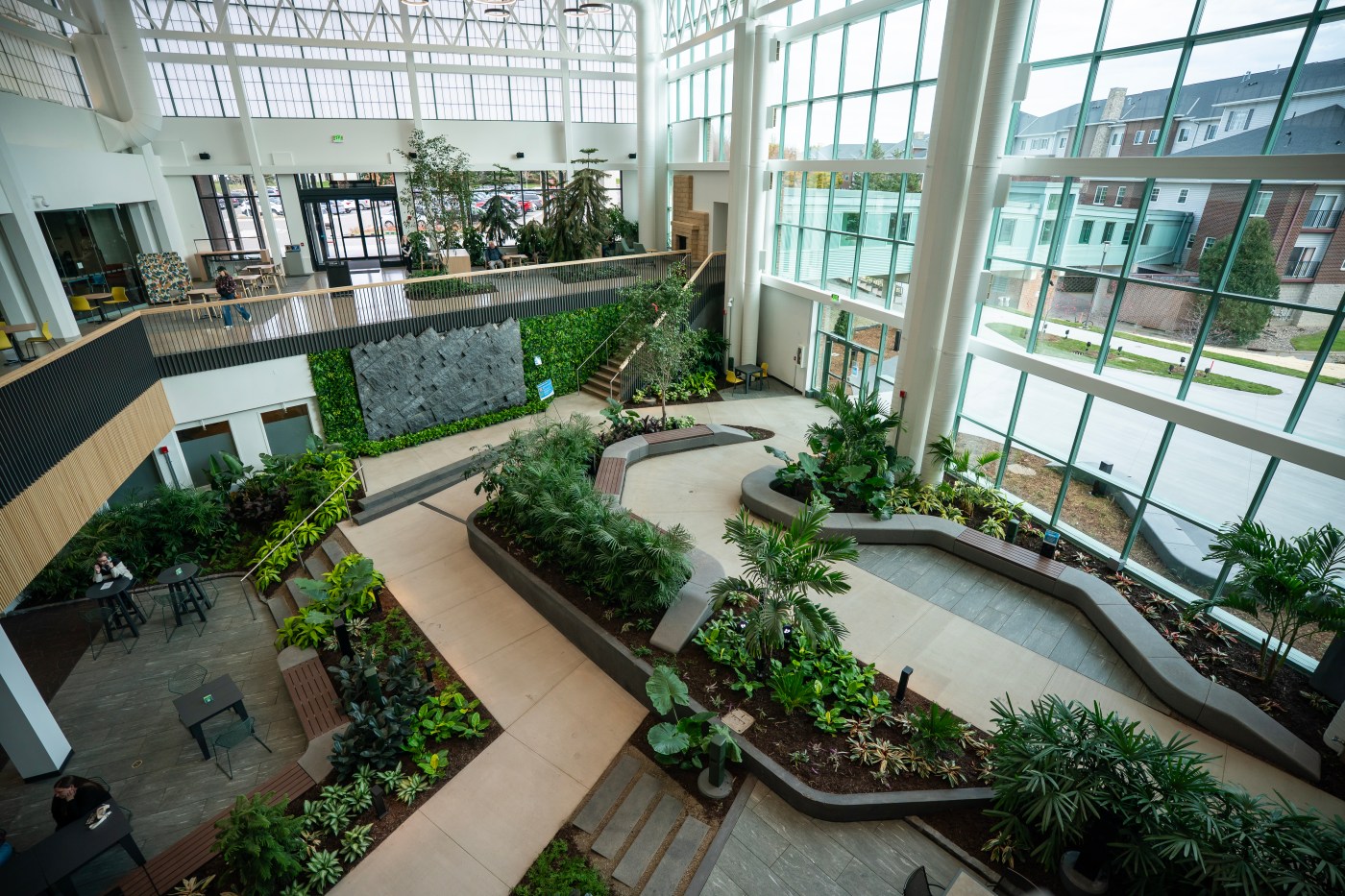
Revalon Wesson spent a lot of time in the R.H. Stafford Library in Woodbury as a kid. They remember getting lost in the books, the sound of the waterfall that stood in the middle of Central Park and the lush greenery surrounding it.
As an adult, Wesson has used the space to study and connect with friends. Now that the park has undergone a $42 million renovation, adding close to 24,000 square feet to the building since its opening in 2002, Wesson said there’s a bit of nostalgia missing from the space, but the update was much needed.
“There’s much more seating,” Wesson said. “I do like the more modern look to it. It just looks a lot cleaner and more accessible.”
Woodbury Central Park’s grand reopening was held Sunday, and all were welcome to attend and check out what the updated space has to offer. Some visitors were Woodbury residents like Wesson, who’d frequented the space prior to the renovation. Others came from neighboring cities like Cottage Grove, with young kids excited to explore the updated playground, and others traveled from throughout the Twin Cities to see the space for the first time.
“It’s welcoming and I like the integration of the green space, and these community spaces allow in the wintertime for you to be indoors but still feel like you have access to live greenery,” Kenos Leong said. “It’s really important and amazing, and we don’t really have a lot of that in Minneapolis.
Updated after 23 years
The indoor park, which connects the R.H. Stafford Library, YMCA and Stonecrest Senior Living, is a three-story building. On the side of the east entrance, visitors will notice a welcome desk in partnership with Destination Woodbury, the city’s new visitors bureau.
Visitors are encouraged to stop by the desk for guides, to ask questions or get connected to community resources, according to Woodbury Parks and Recreation Director Michelle Okada.
The east entrance also leads directly to the amphitheater, which is used by public speakers, as well as for wedding events, concerts and performances. The theater seats 175 people total and has been renovated with cushioned benches and is now fully enclosed, Okada said.
A new large event space is also located on the first floor. It can host up to 300 people, according to Okada, depending on the configuration of the space. It can also be split into three rooms, Woodland Rooms A, B and C. The space will be used for large event gatherings, community meetings and wedding events, Okada said.
The R.H. Stafford library sits between the east and west entrances. Both entrances now have varied seating arrangements, from soft-seated booths to high and low top tables, along with benches and cushioned chairs. The additional seating is one of Okada’s favorite improvements, she said.
“The architects were really thoughtful in including welcoming elements,” Okada said.
New and updated seating options are an addition to the entire building. On the lower level of the space, amidst the indoor garden, which features tropical plants and a new water wall, visitors can sit on benches surrounded by plants, with charging stations nearby for those working on devices. Tables for larger groups are also scattered throughout the walkable green space.
A visitor looks at the new water feature, not running, inside Woodbury Central Park. (Claudia Staut / Pioneer Press)
“This place is wonderful to go in the winter, because you’re surrounded by green, but it’s a good way to escape the snow,” said Sara Hudis, of St. Paul, who was especially excited about the nearby power outlets, said.
Spaces for all ages
The lower level is also home to the South Washington County Schools district offices and meeting rooms, as well as two designated meeting and event spaces, Savanna Rooms A & B.
Those spaces, however, were not what the kiddos were interested in on Sunday. Instead, the little ones flocked to the updated two-story Lookout Ridge indoor playground.
A view from the ground level of the new indoor playground at Woodbury Central Park. (Claudia Staut / Pioneer Press)
“We came to the library a bunch, and then we came to the old Lookout Ridge a handful of times (before the renovation),” said Allison Ryks, of Cottage Grove. “But this is beautiful.”
Ryks’ two kids, Hattie, 9, and Wesley, 7, said they had a lot of fun going down the slide of the playground and climbing all the way to the top.
Locally designed art is also an intentional feature of the building, according to Okada. At Lookout Ridge, a large mural of the St. Croix River Valley follows the playground from top to bottom, starting on land and traveling up to the sky. On the first floor, a public wall art gallery displays photos taken by community members and wraps around to a birch tree tile mosaic.
“I think the cohesion of the mural and playground is a unique element,” Okada said.
The building, which connects to Stonecrest Senior Living, has long hosted events for seniors in various spaces, Okada said. Now with the renovation, two rooms on the second floor, Prairie Rooms A & B will be used most frequently by the senior community.
While the entire building was created with community input, Okada said, seniors in the community were very involved in the design process for the two meeting spaces. The rooms will host hobby activities like bridge, knitting and book club, as well as learning opportunities like history classes and fitness. There is also a small kitchen in the space for social gatherings.
“We will be having a fantastic time,” Woodbury Bridge Club manager Earl Conner said. “We were in the dungeons of the basement before. Now we’re in an open space upstairs with the light.”
Sustainability and accessibility
Another integral element of the updated building was incorporating sustainable technology and natural architecture, including metal and wood columns and paneling, according to Okada. The building uses geothermal technology for heating and cooling, bird-safe glass, a solar rooftop and energy-efficient lighting throughout the space.
All new lighting illuminates the upper atrium at the remodeled Central Park in Woodbury. (John Autey / Pioneer Press)
“We are really looking forward to the cost benefit,” Okada said.
Along with sustainable features, the building is also ADA compliant, something Woodbury resident Linda Hood said she was very happy to see.
“I’m very impressed,” Hood said of the renovated space.
Hood, a disability advocate who won Miss Wheelchair Minnesota in 2022, has helped create awareness around the need for adult changing stations across the state and country, as well as create legislation surrounding the matter.
She is the reason why the indoor park, which has 28 single-stall bathrooms, features two with adult changing tables, according to Woodbury Mayor Anne Burt.
Hood, who has lived in Woodbury since 2002, said the bathrooms are her favorite part of the renovation. She loves visiting the library, but before the changing stations were updated to fit her needs, she said she’d have to go home in order to simply use the bathroom. Now she can stay for as long as she’d like, she said.
Metro Transit officer Beverly Rodriguez honored posthumously
Special elections to decide whether DFL, GOP control MN Senate
Best Burgers 2025: 14 neighborhood spots for a crave-worthy burger
Best Burgers 2025: 11 ‘destination’ burgers worth the drive
Washington County: November elections include 9 candidates for South Washington County school board
Other elements of the space have also been updated to be ADA-compliant, like the floor, which once had a gravel texture that has been smoothed out.
“The floor was hard because anytime the floors aren’t smooth, it’s hard on the wheels and makes for a bumpy ride,” Hood said.
Other added features include a wellness room for prayer, or anyone in need of a quiet space, a dedicated lactation room for nursing parents, a working space available for community organizations to rent, which is currently being used by TrueLens Community Media and more.
For more information, pricing and hours, visit woodburymn.gov/centralpark.