For decades, March 31 was marked with civil rights marches, school commemorations, and community celebrations honoring Cesar Chavez and the labor leader’s championing of better working conditions for farmworkers. In California and Texas, his birthday was a state holiday.
But when The New York Times published its investigation earlier this year on how Chavez groomed and sexually abused two girls and raped civil rights icon Dolores Huerta, the news ripped through the very spaces that had long organized to keep Chavez’s memory alive. Since then, a public reckoning has taken shape with communities revisiting Chavez’s legacy and grappling with how to disentangle him from the history of the broader farmworker movement and the ongoing fight for Latino equality in the United States.
That reckoning includes a proposal by U.S. Senator John Cornyn to abolish the César E. Chávez National Monument in California, which became the first national monument associated with contemporary Latino history when it was established in 2012. The monument comprises the United Farm Workers union’s former headquarters and compound, known as La Paz—in the Tehachapi Mountains northeast of Los Angeles—where Chavez’s abuse took place.
Sehila Mota Casper, executive director of Latinos in Heritage Conservation, is among the signatories of a joint letter opposing the proposal, citing concerns it would undermine federal recognition of the broader legacy of the farmworker movement. The Texas Observer spoke with Mota Casper in late April about what it means to approach this moment through a community-centered lens and how historic preservation can involve reexamining what was once considered settled history.
TO: In the aftermath of the revelations about Cesar Chavez’s abuse, we’ve seen institutions and communities act quickly. Cities moved to rename streets. Murals disappeared overnight in some places. Is there harm that can come from this sort of action if it’s done too quickly, even if the intent is accountability?
The harm can be whenever we react too quickly, and that’s really what I saw throughout the U.S. … instead of allowing the community to come together, give community time to process, and come up with a community solution.
We saw a lot of individuals from a top-down level beginning to make decisions for community rather than engaging them in this. The reason why I say that is because the farmworker movement was about hundreds and thousands of individuals. Whenever you narrow it down and when there are individuals that are still assigning one movement to one man, then that’s where that can be detrimental.
With the proposal by John Cornyn to abolish the Cesar Chavez Monument in California, is the risk that you would lose not only the monument and its designation but also how the farmworker movement is recognized at the federal level?
That’s right.
We had just had a directive from our state governor trying to remove the Cesar Chavez Day, and then Cornyn came out with this bill to not only remove and cancel the Cesar Chavez Monument but to eliminate all of the federal land [associated with the monument].
What we saw was like a knee-jerk reaction responding to this … when in fact this history doesn’t belong to anyone other than farmworkers, their descendants, and Latinos.
What does accountability on this front look like when it is defined by community and not elected officials?
This decision really requires that we think about history not in a reactionary way but that we’re very intentional in the way we’re approaching a story, a narrative, especially in real time as it’s unfolding. Myself, as a historian, I know that narratives change over time. It is very common that these narratives change over time. It’s also very common that news and information comes up. Because of that, we have to be able to then reinterpret this history, reinterpret this story, or in this case reinterpret the monument.
I think accountability means that those that are in leadership positions or positions of power step aside and recognize this is much greater than their positions. This is about people. This is about their parents, their children. It’s about Latino history, Asian Pacific Islander history, farmworker and labor history, and because of that we know that the decision needs to go up from community. And that would be justice because then each community would be able to say, “We don’t want to celebrate the Cesar Chavez Day. Instead, let’s have the national or state Farmworker Day.”
We see murals that are compilations of storytelling in a small community and Cesar Chavez could be one small face in this overall story of the Latinos within that community, but that doesn’t mean that we just need to whitewash the entire mural. Whenever you have a decision like that, you’re literally wiping out all of this history, all these decades of individual contributions and movement and erasing it just because we’re then assigning it to one person.
There’s a lot of pain here. There’s the harm done to Dolores Huerta and the other women who came forward. There are people who had pictures of Cesar Chavez up in their home or folks whose activism was informed or inspired by the work of Chavez, Huerta, and the farmworker movement. How do you make space for that pain in that process?
When we think about the narrative around these histories, especially around the Chavez national monument park, that decision should come from the individuals that were directly harmed. That decision should come from women, from individuals that used to live at La Paz.
We have to have the correct individuals at the table that are helping lead these conversations. It should be taken out of politics and supported by individuals that are trauma-informed, that are trained in these practices and that are also historians and preservationists like myself, where we’ve worked with difficult histories. … Maybe it’s a situation where we find another location. Maybe it’s a situation where we keep that location because that’s what community wants, but we remove this from being a hero-focused story.
There’s long been an underrepresentation of Latinos in the accountings of our history. Latinos have also been kept at the margins of who has the authority and the power to shape how we remember. Add on to that, the ongoing debates about history can even be taught in this country. What has to change structurally to avoid repeating these patterns?
I grew up in a time here in Texas where we did not have the farmworker movement in our history books.
Having these foundational things like an educational exposure to these types of histories along with having these truthful conversations within the public narrative of saying, “Are we going to be truthful in our storytelling or are we going to continue glossing over this?”—those are the types of things that educate us as a community, educate us as people, and allow us then to evolve.
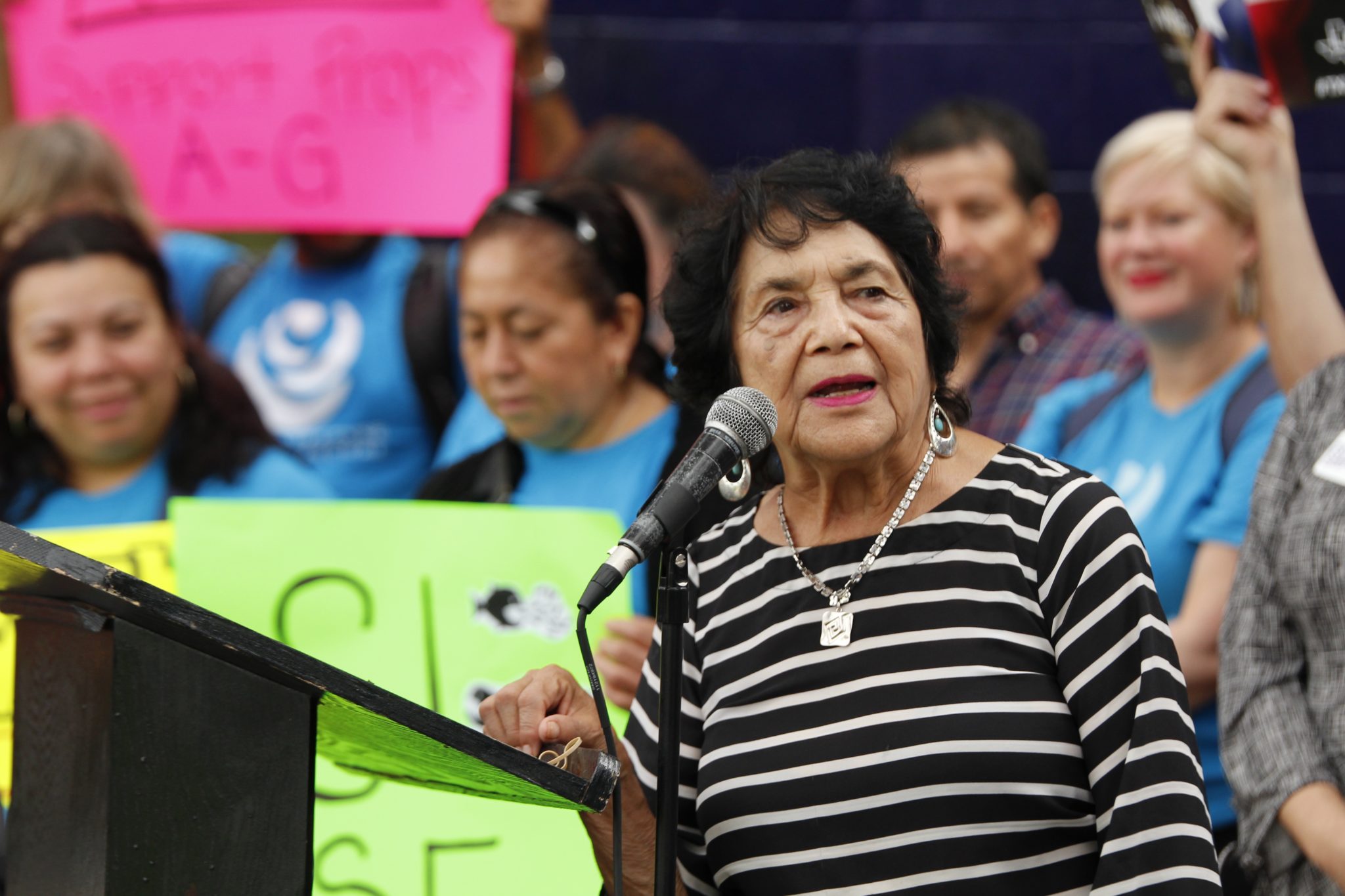
Dolores Huerta in Austin on October 9, 2018 (Gus Bova)
We run a lot of potential risk of repeating patterns. If we had not brought this up, we would not be talking so much about the safety of women in the farmlands or within a male-dominated field. We wouldn’t be talking so much and reacting so quickly about sexual assaults on children if this didn’t surface. Immediately, we saw Latinos begin to break that pattern.
In this case, in real time, we recognized what was occurring and in doing so and speaking out and having a really strong voice, we were ensuring that we’re not going to repeat these patterns, that we’re talking about it, and that we’re forcing ourselves to create solutions around it.
What have you felt is missing from the conversation about how to handle Chavez’s legacy and the legacy of the broader farmworker movement?
I believe that the biggest thing that’s missing is community voice. I’m really happy that this is getting so much national dialogue. It deserves that. But we also need to be speaking with farmworkers—United Farm Workers and the farmers that are working out in the fields, individuals that are second- and third-generation farmworkers.
Within historic preservation and within the realms of academia and history, I’m seeing a primary focus on Chavez rather than beginning to really think about what an equitable solution model could look like—one where women of color are put forward in this narrative and one where farmworkers and the other civil rights [activists are put forward].
I’m beginning to think about how can we, in a sensitive manner, be able to move forward and lead by example on how future generations can actually confront such situations and be able to retell a narrative that needs to be retold.
This interview has been edited for length and clarity.
The post Reckoning with History: What Should Become of the Cesar Chavez National Monument? appeared first on The Texas Observer.
Leave a Reply