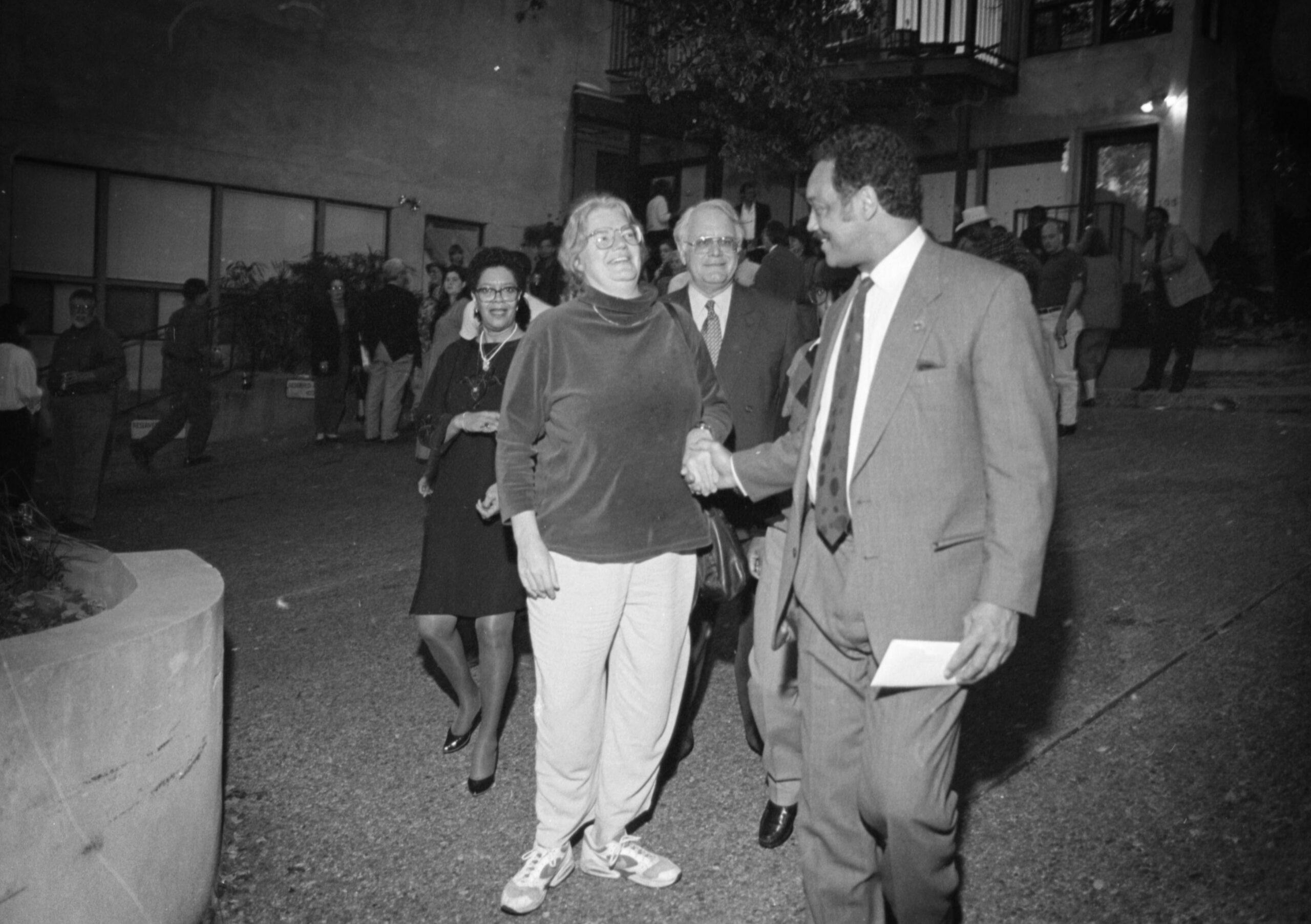
On February 19, two days after the death of the reverend and civil rights icon Jesse Jackson, the Observer’s longtime contributing photographer Alan Pogue emailed me a shot of Jackson shaking hands with Molly Ivins, our onetime co-editor and unofficial patron saint.
In the moments following the photo, Pogue said, Ivins injected some of her typical humor, acting as though Jackson’s squeeze had “squashed her knuckles,” which is captured in a separate, blurrier image. “Playing it for a laugh,” Pogue wrote. “That Molly, always the card.”
(From left to right) Hazel Overby, Molly Ivins, George Bristol, and Jesse Jackson in January 1995 (Alan Pogue)
I liked the picture, but, to run it here, I needed to suss out more of the context. Pogue’s contact sheet for the shoot in question provided a handwritten date—January 27, 1995—and the name of Austin artist Mercedes Peña. By sheer luck, I had worked with Peña some 20 years later (before I became a journalist) at Casa Marianella, a shelter for immigrants in Austin.
I called Peña, who remembered the photo’s setting without hesitation. Jackson and Ivins had shaken hands in the parking lot outside what was then Peña’s condo on West Sixth Street near the capital city’s downtown. Her partner, the developer and philanthropist Ed Wendler, had assembled a gathering of liberal luminaries with a personal goal of getting Jackson involved in a project to support a school in a Haitian slum, she said. (Pogue’s contact sheet does record the word “Haiti.”)
Others who attended told me their memories of the occasion had understandably faded, but they did help me confirm the woman on the left as Hazel Overby, a longtime Austin Democratic Party and civil rights activist—also a leader of the Texas wing of Jackson’s Rainbow Coalition—who passed away in 2006 (two years after Wendler and a year before Ivins). In addition, the white man in the middle is George Bristol, then a Democratic political consultant, fundraiser, and advocate for public parks, who now lives in Fort Worth. (At press time, I have not identified the younger man partly visible over Jackson’s shoulder.)
No one could precisely recall why the civil rights leader was in town—though surely it wasn’t just for this gathering.
According to the Observer and Austin American-Statesman archives, Jackson was in Austin on that date to speak at the funeral of John C. White, a former Texas agriculture commissioner and Democratic national chairman who advised the reverend during the latter’s 1988 presidential bid. At a Capitol service, Jackson delivered “a thunderous 30-minute eulogy,” the Statesman reported, before speaking again over White’s casket, down the road at the Texas State Cemetery.
Curious, I decided to check the Observer’s archive for coverage of the progressive, outsider reverend’s 1980s runs for the White House. Seven years before Pogue took the photo printed here, the Observer (not yet being a nonprofit) endorsed Jackson, praising his “progressive and humane political and economic agenda,” including his proposal to force private pension funds to invest in public works and his support for “the creation of a Palestinian homeland.”
In the same issue, we printed a speech then recently given by Ivins. “Jackson is an interesting political problem for the Democratic party. The leadership of the Democratic party is terrified of him,” she said.
“My own reading is that it’s folly for the Democratic party to try to distance itself from Jesse Jackson. … He can bring into the political process voters no one else can.”
Jackson fell short, of course, in his bid to secure the Dems’ presidential nomination, but he did place a strong second in the Texas primary.
The post Jesse Jackson Comes to Town appeared first on The Texas Observer.
Leave a Reply