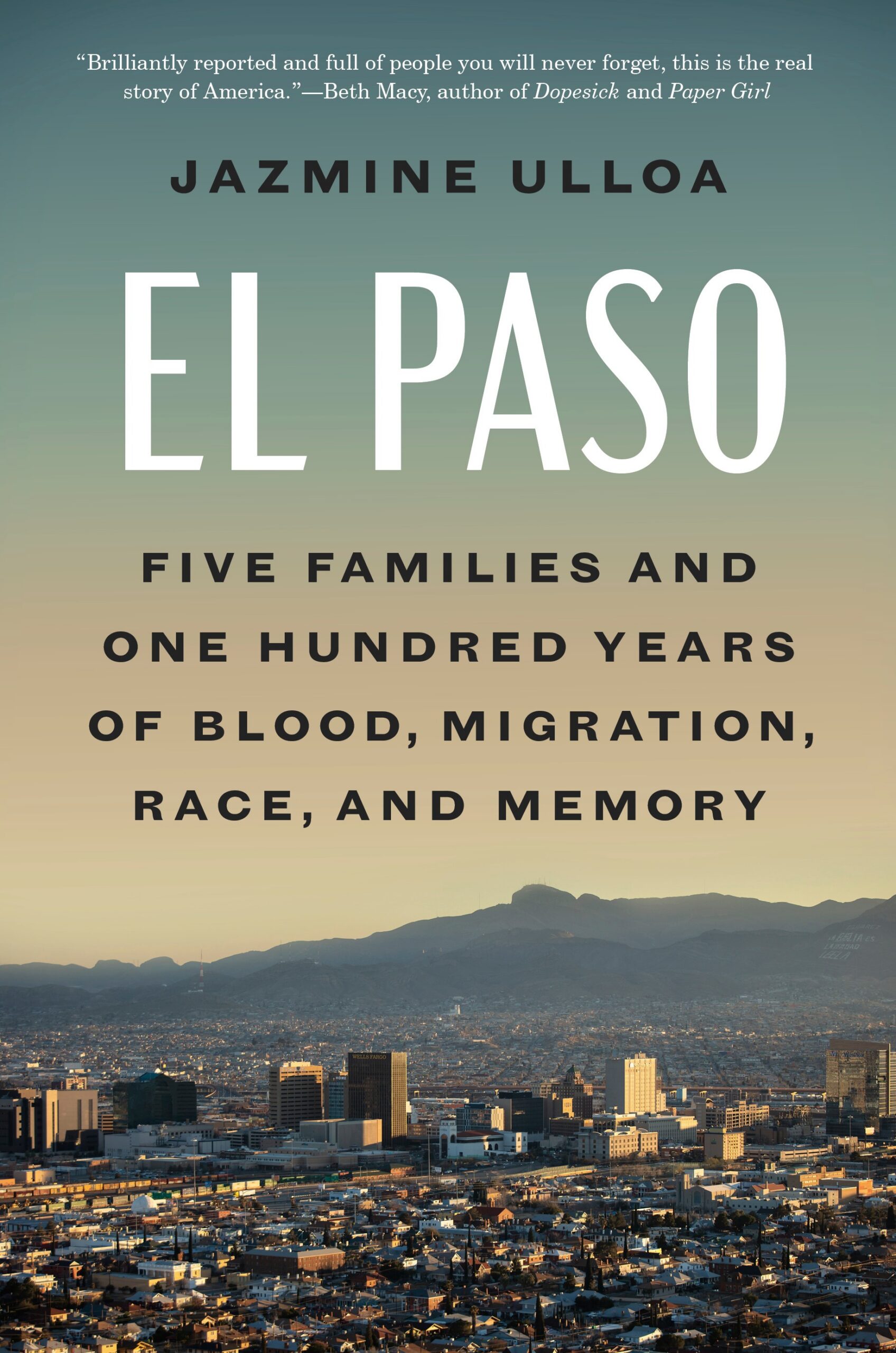
Editor’s Note: This excerpt is adapted from El Paso: Five Families and One Hundred Years of Blood, Migration, Race, and Memory by Jazmine Ulloa, out March 2026 from Dutton, an imprint of Penguin Publishing Group. © 2026 by Jazmine Ulloa.
On August 3, 2019, I was nearly 2,000 miles away in Washington, D.C., where I worked as a national political reporter in the bureau of The Boston Globe. It was a Saturday, and I was in a movie theater when my phone lit up with calls and messages. Friends and family in El Paso were checking in on each other and letting me know they were safe: There had been a mass shooting at a Walmart near the most popular shopping mall in town. Photos and videos from the scene showed bloody victims wheeled out in shopping carts, customers murmuring prayers through the gun blasts.
The nation had scarcely processed what had unfolded when another mass shooting wracked Dayton, Ohio, thirteen hours later. We jumped into covering the twin tragedies from afar, another deadly day in a politically divided nation replete with guns. But I could not help but feel we were missing the story in the place where I was from. Unlike the killings in Ohio, where authorities had found no political or racial motive, federal enforcement officials were calling the El Paso rampage an act of homegrown terrorism and one of the deadliest attacks on Latinos in the United States. The massacre, as one federal prosecutor would later say, had “spared no one—not the old, not the young, not men, not women, not white, not black, and certainly not brown.” Yet a police detective who filed a report from the scene on that day said the shooter had stated his target as simply “Mexicans.”
El Paso: Five Families and One Hundred Years of Blood, Migration, Race, and Memory (Publisher)
So on Monday morning, with our breaking news deadlines met, I got on a plane to El Paso. When I landed that afternoon, word was still spreading of lost loved ones and close calls. Nearly every passenger around me was scrolling through news stories or murmuring, in shock and in grief, about what they had heard or thought they knew. One of my closest childhood friends, Andrea, had texted a group of us to let us know her father was safe, though I did not know yet just how close he had been to the gunfire.
I grabbed my bags and made my way through the terminal, a sense of comfort swelling inside of me at the sight of the old carpet with Southwestern motifs and the mountains beyond the glass windows. It was a familiar routine, the coming and the going. I had been doing it since I had left for college at seventeen. Outside, the desert heat warmed my cold, bare arms. My eyes adjusted to the glare of the brightness. I spotted my uncle Fernando waiting for me in his car by the curb, and I hopped in. We drove west through winding highways as we chatted in Spanish about my life in D.C. and where each of us had been when we learned of the shooting. El Paso Strong signs already decked billboards and businesses. There was a sadness in the air. The city felt apagada—dim and in mourning.
We stopped at the adobe bungalow where Fernando and my aunt Bertha, public‑school principals, lived on a hilly street named after a dead president. I said a quick goodbye and moved my luggage into a worn black SUV that they loaned me for reporting. As I pulled out of their driveway, I debated whether to head straight to the crime scene or make one more quick stop to see the rest of my family. We’re Mexican American, tight‑knit and proud and complicated, and I was sure to answer for it later if I did not. But before I knew it, I found myself taking a detour through the scenic road that curves around the edge of the Franklin Mountains. High above the city, I stopped at the main overlook and sat on one of the stone walls.
Police say the shooter left his home north of Dallas on a warm summer night. He was 21. I picture him as he appeared in his mug shot: pale and disheveled, with dark, matted hair and dull brown eyes. The court records I have read say he could not sleep, that his mind was racing with violent thoughts when he climbed into his car and started driving. On his way out, he passed manicured lawns and shady oak groves, running paths, tennis courts, and affluent homes with tall, pitched roofs and walls of stone veneer—quiet blocks, each one nearly identical to the next, carrying the faraway sounds of grackles and the faint scent of freshly mowed Bermuda grass.
He traveled for at least ten hours. Ten hours to reconsider. To stop. To turn around. But he did not. Suburban roads gave way to open Texas highways, to farms and ranchland where other men had waged other wars. The place he had left behind was one of the many across the United States that had become so diverse in recent years that it reflected what demographers describe as the changing face of America. The place where he arrived the next morning had always been that kind of place, the borderland between Mexico and the United States, where life and culture can be fluid and identities often bend, meld, and collapse into one another.
The temperatures in El Paso that Saturday had been hot and quickly getting hotter. Prosecutors say he drove around aimlessly for a while. Delusions in his broken brain. Hate in his heart. It was in those wayward moments when he posted an angry screed to a website known to attract white supremacists and extremists. It ran some 2,300 words and issued a warning against the “Hispanic invasion of Texas.” Its ideas embodied a racist doctrine known as the “Great Replacement,” which has long circulated in the far‑right corners of the internet and holds that Western elites, sometimes led by Jews, want to diminish the power of white Americans by encouraging the immigration of Black and brown people. He and his way of life were under attack, the shooter wrote, by foreigners and immigrants, by people who did not look or act or sound like him, and who he believed were supplanting white people. “If we can get rid of enough people,” he said, meaning Mexicans and Hispanics, “then our way of life can be more sustainable.”
Seventeen minutes later, court records say, he arrived at a Walmart lot in a commercial center, encompassing big‑box stores, a cinema, and a shopping mall frequented by residents on both sides of the border. He had in his trunk a loaded semiautomatic rifle in the mold of an AK‑47 and 1,000 rounds of hollow‑point bullets that he had bought online. He pulled out the weapon, slung it up against his shoulder, and opened fire. The grounds descended into chaos. Workers and customers, some hurt and bleeding and carrying others, ran for the exits or fell to the ground. Hundreds of people scrambled to their cars, ducked under tables, or fled into movie theaters and storage rooms. First responders and SWAT teams and helicopters rushed to the scene, encircling the area and blocking off roads. People who were there that day have told me what they remember. Billowing smoke. Blood on the pavement. Surveillance footage captured the man moving through the Walmart’s clear sliding doors and stalking the aisles, a cold and unfeeling figure dressed in a black T‑shirt, khaki cargo pants, safety goggles, and protective earmuffs that drowned out the screams.
Police said that they caught up to him at a nearby traffic light after he fled, and that, with his hands raised in the air, he exited his car and declared himself the shooter.
He was arrested near a park, a stone’s throw away from where I went to high school. With those hours of terror in August, El Paso became one more battleground over the nation’s identity—[a] place, much like the rest of the United States, caught between two visions of itself, one rooted in division, another in connection.
From my perch on top of the mountain, I thought about how, when I was in high school, my friends and I would come up to this same spot in the evenings. The stone steps and ledges would be packed with people: Teenagers kissing. Children and their parents straddling the tower viewers. Young women wandering about in sparkly quinceañera dresses, their royal courts, families, and photographers in tow. My mind then was often on the future and where I would go next. On that afternoon, however, the overlook was nearly empty. There was a warm breeze blowing, and I wanted to take in the city one last time the way I remembered it, before the violence.
I knew the next few days would be like entering the darkest depths of a pit. I knew this because some of my earliest years as a young reporter had been on the night cops’ beat. With heavy police scanners strapped to my belt, I had become well acquainted with the circling highways of San Antonio by homicide. The codes and chatter from the radios led me from scene to scene. I learned to arrive quickly, to gather my bearings, and to withdraw somewhere deep inside of myself in the face of fierce, raw emotions—to become someone on the outside looking in—as I knocked on doors or tracked down officers and firefighters, witnesses and survivors, people who were living through what could well be one of the worst days of their lives. It was a grisly assignment and a lowly one. Veteran journalists who had been around when newsrooms had larger staffs and people read the morning print paper often told me that if I could do this job, I’d be able to do any in the business.
I had expected covering American politics to be different. But as Donald J. Trump rose to power in 2016, he demonized Mexicans and immigrants as gang members, murderers, and terrorists. He promised to build a wall along the nation’s southern border and to have Mexico pay for it. He called for restrictions on trade and warned of threats from abroad. Once in the White House, he embarked on an isolationist “America First” agenda and a harsh immigration crackdown. The moves energized many everyday Americans—largely white and Christian—who felt their values under attack by foreigners and had for years watched manufacturers shutter plants and ship jobs overseas. They also emboldened the Patriot militias, border vigilantes, and white power activists who had operated in the shadows of our national political system for decades. All through Trump’s first term, we reported on the anti-Trump protests and counterprotests flaring up across the nation. Clashes between neo-Nazis and anti–white supremacists erupted on college campuses and on the grounds of the California state capitol.
In Trump’s telling, immigration was at the root of all of the nation’s problems. By the summer of 2019, with another presidential election cycle beginning to heat up, the border—and El Paso specifically—had become a powerful backdrop: a symbol of the fear of the other and the outsider, of the invaders and the invaded, of the potential loss of white cultural status and power in a quickly changing nation. In the weeks and months before the shooting, the images circulating online and on television from my hometown had been jarring. Migrants penned up and waiting to plead asylum at an international bridge. Brown children marching out of nearby tent camps. Families separated at the border.
We were only starting to understand it then. We were not covering everyday political contests and disputes. We were at the front lines of a grave and fundamental fight over who we were—over who should belong in the United States and who should not, over whether we believed in, would live up to, and could uphold a multiracial, multiethnic democracy or craved a strong-man’s control and promises of a return to a white Christian nation—in a world where companies and industries were getting too big, moving too fast, breaking too many things, and leaving too many people behind. Those tensions had drawn a white supremacist to the border, and now they had also brought me home.
After lingering for a few moments more, I decided to go see my grandmother Alicia and another one of my aunts, also Alicia, in the Lower Valley. I drove all the way south to the Border Highway, which runs along the Rio Grande. When I was young, the road had been flanked by chain-link fences, but pushes to increase immigration enforcement under both Republican and Democratic administrations over the decades had brought more border patrol vans, federal officers, and rusty, corrugated metal bars that reached high into the air. I went east, all the way to a quiet neighborhood near the border wall, where mesquite trees and wide, open yards are set against irrigation canals. The Alicias live there five houses apart on the same stretch of a curving street. My aunt and I embraced and spoke in low voices, like the passengers on the plane.
El Paso has long been a big city with a small-town feel, and the degrees of separation from the shooting were closing in again. My aunt told me that a friend of hers had worked as a house cleaner for one of the fathers shot and killed. We spoke about how shaken people were, but I could not stay long. I dropped off my things and headed back up into the heart of the city, where a makeshift memorial had sprung up on a tall hill overlooking the parking lot of the store that the shooter had stormed.
The post In El Paso, a Homecoming Marred by Violence appeared first on The Texas Observer.