Bloodhounds in North Dakota are blazing a trail in the Midwest

posted in: All news | 0

By JACK DURA

FARGO, N.D. (AP) — The North Dakota Highway Patrol’s newest recruit has floppy ears, four legs and an amazing knack for finding people.

Related Articles


Berkshire Hathaway resumes buybacks and CEO supports Kraft’s decision to pause its split


FBI investigating ‘suspicious’ cyber activity on system holding sensitive surveillance information


Videos from officers show terrifying moments during Texas mass shooting that left 3 dead


Millions of Americans under threat of tornadoes as spring storm season kicks in early in the US


Capitol rioter who was pardoned by Trump gets a life sentence for molesting 2 children in Florida

Beau, a 12-week-old puppy, is joining a band of bloodhounds who are in demand for difficult cases across the upper Midwest.

They trail missing children, people with dementia and criminal suspects. The agency uses drones and aircraft to aid searches, but bloodhounds remain an age-old, low-tech solution.

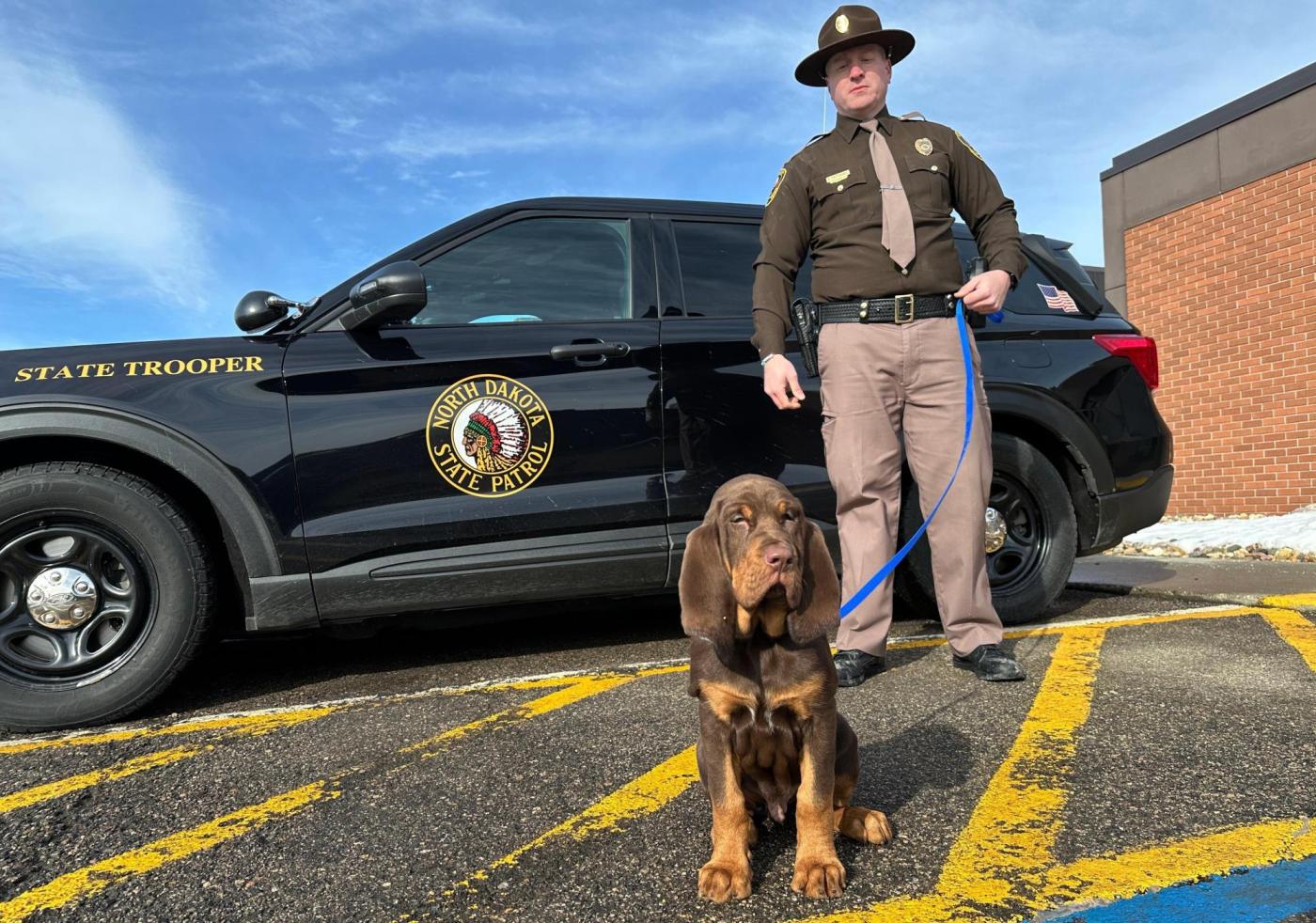
“These dogs are just specifically bred to search for people,” said Trooper Steven Mayer, who handles Bleu, one of the dogs.

The nose knows

Bloodhounds are used from Maine to Florida to Texas to Arizona to California, said Danny Jones, executive director of the U.S. Police Canine Association. Drones and helicopters can work ahead of a dog, but the bloodhound is hard to beat.

“To actually get a direction and start moving in a direction, you’re going to need a dog on the ground to start that trail, and that’s the difference between the technology and actually having a dog such as a bloodhound on the ground,” Jones said.

Bloodhounds have about 300 million scent receptors in their nose, vastly more than humans and more than other dogs, Mayer said.

Their big, floppy ears and folds of skin help gather odor for the dog to trail people, sometimes after a week or more, he said. The dogs have scented from a wall someone touched, the dirt a person stumbled in and vomit on a car door.

North Dakota Highway Patrol Trooper Steven Mayer and Bleu, a bloodhound, stand for a photo, Feb. 11, 2026, near the state Capitol in Bismarck, N.D. (AP Photo/Jack Dura)

Busy schedules

Highway Patrol began using bloodhounds about 14 years ago, moving away from dual-purpose dogs to singular-purpose drug dogs and trailing dogs. The state force receives about 70 calls a year for their services, including one to Montana last year to help find a man suspected in the killing of four people at an Anaconda bar.

Two pairs of handlers and dogs drove 10 hours to help. They got fairly close to the suspect, who was in the location where the dogs were indicating on, Mayer said. Other requests have come from South Dakota and Utah.

A North Dakota Highway Patrol bloodhound named Beau sits for a photo Friday, Feb. 27, 2026, outside the Highway Patrol office in Fargo, N.D. (AP Photo/Jack Dura)

Beau was born in Texas but has since moved to North Dakota’s largest city of Fargo. His early training is mostly potty and kennel training and basic commands, as well as socializing him to different places, people and environments, said Trooper Dustin Pattengale, Beau’s handler. He won’t be ready for a full or certified trail until he is about 9 months old.

“The basic training is just introducing him to scent articles and then ramping up the training to where he goes further and further and encompasses different trails, different types of environment,” Pattengale said.

Bloodhounds are high-drive, loving and caring but can be stubborn, slobbery and naughty, and they’re not a dog for an apartment, Mayer said.

His partner, Bleu, is a big, friendly dog with one eye, having lost the other following an injury playing with another bloodhound. His trailing abilities are not hindered, Mayer said.

North Dakota Highway Patrol Trooper Steven Mayer watches as Bleu, a bloodhound, sniffs the air, Feb. 11, 2026, near the state Capitol in Bismarck, N.D. (AP Photo/Jack Dura)

Beau is a growing puppy, his long ears wet from dragging on the ground as he explored a blanket of snow, sniffing constantly. He likes his beef liver treats.

“He is a very energetic young pup. He’s pretty relaxed for the most part, most days, but he is eager. He likes to work. He likes to sniff,” Pattengale said.

New tool in Omaha

In addition to searches, North Dakota has helped agencies in other ways. Last year, Mayer went to Omaha, Nebraska, for a week to help the city police department train its first bloodhound, Willow.

Omaha used to call in the closest bloodhounds, from the Chicago area, for searches, Omaha Police Sgt. Scott Warner said. The value was clear and Willow arrived early last year.

He hopes Willow becomes an asset for the region. Omaha plans to have multiple dogs and handlers someday, he said.

Willow has trailed missing people, including an elderly man on Christmas Eve, through falling darkness, steep hills, mud and water.

Finding mentors for training is crucial, Warner said. Much of the bloodhound community is word-of-mouth, he said.

“I had no idea that North Dakota had a bloodhound program. There’s not a directory that I can look at that tells me where dogs are,” Warner said.

Handlers drop everything to go

Mayer and his wife have traveled the world to help train dogs, making trips to Hungary, Italy, South Africa and Wales, with plans later this year to go to Slovenia and Austria. They charge nothing.

Beau, a bloodhound puppy, licks the face of his handler, North Dakota Highway Patrol Trooper Dustin Pattengale, on Friday, Feb. 27, 2026, outside the Highway Patrol office in Fargo, N.D. (AP Photo/Jack Dura)

Handlers are a special breed of people, Mayer said.

“They drop everything at the drop of a hat and they’ll leave their family, their friends, they’ll leave Easter dinner to go find a stranger that they’ve never met before,” he said.

North Dakota’s dogs are something of a social media sensation for the Highway Patrol. Beau’s name was picked in a Facebook vote. Recent videos depict him chewing a toy bear and another bloodhound, Lorace, gallivanting in new boots.

“Everybody loves a dog, I mean, especially these little babies, these floppy-eared ones,” said Mayer, who hopes the dogs’ visibility yields earlier calls for their assistance.

“The more word we can get out about the program and the faster we get calls on it, the easier we can get out and be available to help people,” he said.

Study suggests Trump’s unproven autism claims influenced care

posted in: All news | 0

By LAURA UNGAR

Last year, President Donald Trump told pregnant women not to take Tylenol as he promoted unproven ties between the fever reducer and autism and touted an old generic drug as a treatment for the developmental condition.

Related Articles


Mexico and US will start talks March 16 on reviewing their free trade agreement


Trump turns to an Oklahoma senator with a fighter’s reputation as his next choice to lead DHS


Man pleads guilty to bringing explosives to a DC church marking the start of a Supreme Court term


US Postal Service expects to run out of cash in a year without help from Congress, postmaster says


Cornyn goes on offense against Paxton as Republicans await Trump’s endorsement

For nearly three months after that, new research found, Tylenol orders for pregnant women showing up in emergency rooms dropped and prescriptions of the generic drug for children rose. This happened despite sharp criticism of the president’s message from doctor groups saying that the drug, leucovorin, shouldn’t be broadly used for autism and Tylenol is safe during pregnancy.

“It just shows that in our country right now, health care has been politicized in a way that political messages are driving and impacting care — and not always for good,” said Dr. Susan Sirota, a pediatrician in Highland Park, Illinois, who wasn’t involved with the research.

Doctors, who published their work Thursday in The Lancet, looked at changes in drug ordering or prescribing compared with projected trends, or what might have happened if things had continued on the same path as before the White House briefing.

They found that orders for Tylenol – also known by the generic names acetaminophen and paracetamol – were 10% lower than predicted for pregnant emergency department patients aged 15 to 44. And outpatient prescriptions of leucovorin for children aged 5 to 17 were 71% higher than expected during the same study period, late September to early December.

Researchers observed no similar shifts in comparable medications, suggesting the changes were directly tied to the briefing.

The research had limitations. For example, it didn’t capture all Tylenol use by pregnant women because most people buy the painkiller over the counter outside of a hospital setting.

Still, it reflected how an unconventional news conference by a political leader could change not just patient behavior but prescribing as well, said co-author Dr. Michael Barnett.

In past administrations, “there are lots of layers of approval and expert consensus” before officials make big announcements about medical topics, said Barnett, who is with Brown University School of Public Health.

Pregnant women generally take Tylenol for pain or fever. Untreated fevers in pregnancy, particularly in the first trimester, increase the risk for miscarriages, preterm birth and other problems, according to the Society for Maternal-Fetal Medicine. Some studies have raised the possibility that taking Tylenol in pregnancy might be associated with a risk of autism, but many others haven’t found a connection.

Leucovorin is a derivative of folic acid used for, among other things, reducing the toxic side effects of certain chemotherapy drugs and treating a rare blood disorder. It has also been studied for a neurological condition known as cerebral folate deficiency and for a subset of autistic children, according to the American Academy of Pediatrics.

The pediatrics group doesn’t recommend routine use of the drug for autistic children. Early, small-scale studies have explored its use, “and some findings suggest potential benefit in carefully selected cases,” the group said.

But evidence remains limited, the pediatrician group said. And in late January, the European Journal of Pediatrics retracted a study evaluating leucovorin as an autism treatment.

Still, after the federal announcement about the drug, Sirota said some families in her practice asked about getting it for their autistic children. She educated them about the evidence, told them about the potential for side effects and didn’t prescribe it. Potential side effects include irritability, nausea and vomiting and skin issues like dermatitis.

Sirota said it has been hard to deal with the repercussions of government pronouncements like the ones on autism.

“It feels like a pattern with our government, right? They keep building on these houses of cards that just fall down,” she said. “This politicizing of medicine just in general, and moving away from science, has been so challenging.”

The Associated Press Health and Science Department receives support from the Howard Hughes Medical Institute’s Department of Science Education and the Robert Wood Johnson Foundation. The AP is solely responsible for all content.

Justice Department publishes missing Epstein files involving uncorroborated claim about Trump

posted in: All news | 0

By ALANNA DURKIN RICHER

WASHINGTON (AP) — The Justice Department on Thursday released additional Jeffrey Epstein files involving uncorroborated accusations made by a woman against President Donald Trump that the department said had been mistakenly withheld during an earlier review.

Related Articles


Mexico and US will start talks March 16 on reviewing their free trade agreement


Trump turns to an Oklahoma senator with a fighter’s reputation as his next choice to lead DHS


Man pleads guilty to bringing explosives to a DC church marking the start of a Supreme Court term


US Postal Service expects to run out of cash in a year without help from Congress, postmaster says


Cornyn goes on offense against Paxton as Republicans await Trump’s endorsement

The department said last week that it was working to determine if any records were improperly withheld after several news organizations reported that the massive tranche of records that had been made public didn’t include some files documenting a series of interviews conducted in 2019 with a woman who made an allegation against Trump.

The accuser was interviewed by the FBI four times as it sought to assess her account but a summary of only one of those interviews had been included in the publicly released files.

On Thursday, the department said those files had been “incorrectly coded as duplicative,” and therefore were inadvertently not published along with other investigative documents related to the disgraced financier, who killed himself while awaiting trial on sex trafficking charges in 2019.

“As we have consistently done, if any member of the public reported concerns with information in the library, the Department would review, make any corrections, and republish online,” the department said in a post on X.

Trump has consistently denied any wrongdoing in connection with Epstein. The department noted in January that some of the documents contain “untrue and sensationalist claims against President Trump that were submitted to the FBI right before the 2020 election.”

Attorney General Pam Bondi listens as she testifies before a House Judiciary Committee oversight hearing on Capitol Hill in Washington, Wednesday, Feb. 11, 2026, in Washington. (AP Photo/Tom Brenner)

The new disclosures come as Attorney General Pam Bondi faces continued turmoil over the department’s handling of the files released under a law passed by Congress after months of public and political pressure. Five Republicans on the House Oversight Committee joined Democrats in voting Wednesday to subpoena Bondi, demanding that she answer questions under oath in a sign of mounting frustration among members of the president’s own party.

The Trump administration has faced constant political headaches since the rollout of the files began in December, with critics accusing the department of hiding certain documents or over-redacting files, or in some cases, not redacting enough. In some cases, the department inadvertently released nude photos showing the faces of potential victims as well as names, email addresses and other identifying information that was either unredacted or not fully obscured.

Department officials have defended their handling of the files, saying they took pains to release the files as quickly as possible under the law while also protecting victims. Department officials have said errors were inevitable given the volume of the materials, the number of lawyers viewing the files and the speed at which the department had to release them. The department has said it’s entitled to withhold records that exposed potential abuse victims, were duplicates or protected by legal privileges, or related to an ongoing criminal investigation.

Some of the new records published Thursday pertained to a woman who contacted the FBI shortly after Epstein’s 2019 arrest and claimed that a man named “Jeff” living in Hilton Head, South Carolina, had raped her there in the 1980s when she was around 13 years old. The woman told the agents she didn’t know the man’s identity at the time, but decades later concluded he was Jeffrey Epstein when a friend texted her his photo from a news story.

In a follow-up interview a month later, the woman added a host of other claims, including that Epstein had schemed to have her mother sent to prison, beaten her, arranged sexual encounters with other men and once flew her to either New Jersey or New York, where she claimed to have bitten Donald Trump after he tried to sexually assault her.

Agents spoke with the woman two more times, at one point asking her to provide more detail on her supposed interactions with Trump, but reported that she declined to answer additional questions and broke off contact. There’s no indication that Epstein ever lived in South Carolina and it was unclear whether Trump and Epstein knew each other during the time period involved.

The woman’s report was one of a number of uncorroborated, sometimes fantastical, reports that federal agents received from members of the public alleging misconduct by Trump and other famous people in the months and years after Epstein’s arrest.

US and Venezuela agree to reestablish diplomatic relations in historical shift

posted in: All news | 0

CARACAS (AP) — The United States and Venezuela agreed to reestablish diplomatic relations in a major shift in a historically adversarial relationship, the State Department said on Thursday.

Related Articles


Mexico and US will start talks March 16 on reviewing their free trade agreement


Trump turns to an Oklahoma senator with a fighter’s reputation as his next choice to lead DHS


Man pleads guilty to bringing explosives to a DC church marking the start of a Supreme Court term


US Postal Service expects to run out of cash in a year without help from Congress, postmaster says


Cornyn goes on offense against Paxton as Republicans await Trump’s endorsement

The move comes after rounds of Trump administration officials have visited the South American nation following a U.S. military operation that deposed former President Nicolás Maduro in January. Since then, the Trump administration has been stepping up pressure on Maduro loyalists now in power to accept its vision for the oil rich nation.

Relations between the two countries were cut off following another geopolitical debacle in 2019, during the first Trump administration. The U.S. Embassy was closed in Caracas and diplomatic staff moved to neighboring Colombia.

The State Department said in a statement that talks between the countries were “focused on helping the Venezuelan people move forward through a phased process that creates the conditions for a peaceful transition to a democratically elected government.”

Since the unprecedented U.S. offensive in Venezuela, the Trump administration has pushed the government to open its oil sector to foreign companies. The government of acting President Delcy Rodríguez, formerly Maduro’s vice president, approved an amnesty law that would enable to release of politicians, activists, lawyers and many others, effectively acknowledging that the government has held hundreds of people in prison for political motivations.

A demonstrator holds a Venezuelan flag during a student-led march calling for the release of people whose relatives and human rights groups consider political prisoners on National Youth Day in Caracas, Venezuela, Thursday, Feb. 12, 2026.(AP Photo/Ariana Cubillos)

On Sunday, Venezuela’s top opposition leader and winner of the 2025 Nobel Peace Prize María Corina Machado said that she will return to Venezuela in the coming weeks and that elections will be held in Venezuela.

Such seismic shifts would have been unthinkable just months before in the South American nation. Venezuela’s main political current, known as Chavismo, has been able to dodge curve balls thrown at it for years, from U.S. sanctions to spiraling economic crisis.