The ironies that affix themselves to the life and literature of Larry McMurtry are best exemplified by the title of his autobiographical meditation on storytelling, Walter Benjamin at the Dairy Queen, wherein the eponymous German cultural critic, who warned of the dehumanizing dangers of mechanical reproduction, is imagined at the fast-food eatery beloved by Texans and responsible for the Dilly Bar.
Despite the blue jeans and cowboy boots McMurtry wore to accept his 2006 Oscar for best adapted screenplay for Brokeback Mountain, the Pulitzer Prize-winning writer of Lonesome Dove did not consider himself a cowboy, and he spent the bulk of his literary life letting readers know that.
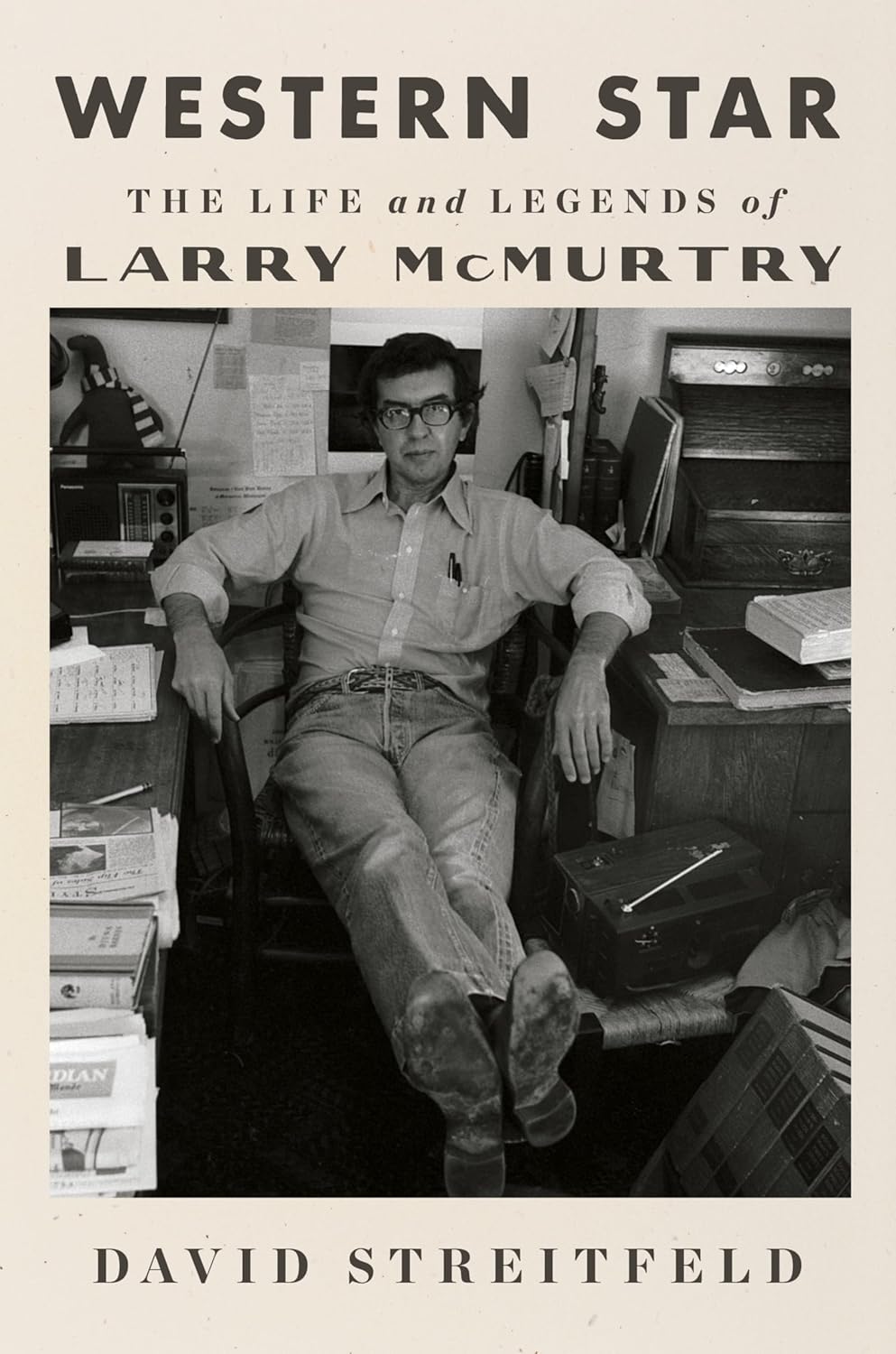
Now, David Streitfeld’s masterfully paced and carefully researched biography, Western Star: The Life and Legends of Larry McMurtry—out this March from Mariner—paints the picture of an artist at odds with the materials at hand, a writer whose every attempt at illustrating the reality of his region was met with misreading.
As a kid born into a cattle-ranching family in Archer City in 1936, not only did McMurtry care nothing for cows and only tolerate horses, but he was also a bookish child, terrified even of chickens, who would sneak off to read Don Quixote in solitude.
“When Larry thought about cowboys, he thought about his family,” writes Streitfeld, who goes on to note that McMurtry wrote his most celebrated work, Lonesome Dove, to understand his father, Jeff, a cowboy who came of age in a time that no longer needed cowboys.
Western Star: The Life and Legends of Larry McMurtry
If McMurtry’s magnum opus was an attempt at figuring out his father, it was an attempt also aimed at demystifying all that his father’s world represented.
Lonesome Dove, which was first conceived as a film script in 1972, was intended to give voice to the dispirited and displaced character of the cowboy and by extension the myth of the Old West.
“I thought I had written about a harsh time and some pretty harsh people, but, to the public at large, I had produced something closer to an idealization; instead of a poor-man’s Inferno, filled with violence, faithlessness and betrayal, I had actually delivered a kind of Gone with the Wind of the West,” McMurtry wrote in the introduction to the 2000 edition of the novel.
McMurtry cushions his failure to decenter the core of the Western myth, which he identifies as the belief that cowboys are brave and free, by deciding in the same introduction that the Western myth was “essentially unassailable.”
In a kind of happy defeat, he notes: “Readers don’t want to know and can’t be made to see how difficult and destructive life in the Old West really was. Lies about the West are more important to them than truths, which is why the popularity of the pulpers—Louis L’Amour particularly—has never dimmed.”
But it was not just the “pulpers” whom McMurtry took critical shots at.
“BY NECESSITY, I INVENT.”
In his 1981 Texas Observer article “Ever a Bridegroom: Reflections on the Failure of Texas Literature,” the author, who in 1986 would try to turn Archer City into a mecca for bibliophiles by bringing his legendary Booked Up store to his hometown, attacked iconic Texas writers such as Katherine Anne Porter, Bud Shrake, Bill Brammer, and John Howard Griffin as being woefully overrated.
As Streitfeld notes, McMurtry felt that “Texas novelists and Texas critics were stuck on the range,” despite the fact that “the people and the stories were in the cities.” The essay, modeled somewhat on a section of Norman Mailer’s Advertisements for Myself, “is a plea for taking Texas books seriously, even if the ultimate judgment on nearly all of them is negative,” Streitfeld says.
McMurtry was already known at the time for criticizing the work of famed folklorist J. Frank Dobie, who was for many the summit of Texas literary culture, in an essay provocatively called “Southwestern Literature?,” wherein he disregarded the bulk of Lone Star lit by concluding that “The material is here, and it has barely been touched.”
The juiciest parts of McMurtry’s willfully literary life—his trips to Boystown, the notorious red-light district in Nuevo Laredo; his collection of erotica; his penchant for emotional three-ways; his long friendship with Diane Keaton and short affair with Cybill Shepherd—all take a back seat in the new biography to the truest theme in McMurtry’s life: his unyielding faith in the truth of fiction.
In Western Star, all moments of comedy, terror, and romance are tied to aspects of the literary world.
Unrequited love takes the form of fruitless pining over his literary agent, Dorothea Oppenheimer. Adventure comes in the form of book-scouting road trips. And an absolute identity crisis arises in 1991 when McMurtry realizes, post-heart surgery, that he cannot concentrate enough to read or write.
This all works well enough, for while McMurtry’s artful articulation of small-town stagnation in The Last Picture Show as well as the sociopathic sensibilities of ranch life in Horseman, Pass By were easily usurped into cinema, where nuance was blunted, the complicated compromise McMurtry suffered in selling Texans what they wanted was always addressed in his fiction.
In his picaresque 1970 masterpiece Moving On, a character named Charlie Rawlins, who sells much-sought-after relics from a Texas now passed, confesses to dealing in fraud: “You know there’s six thousand antique stores in Texas alone, not to mention Arkansas and Louisiana? Where you gonna find that many kerosene lamps and wagon wheels? I tried to buy some rusty old branding irons from a man the other day and the son of a bitch wanted five dollars a piece. … I can make ’em for two and a half, already rusted.”
The in-joke regarding the manufacturing of myth is as postmodern as anything Pynchon might have penned in V. or the Crying of Lot 49.
An unimpeachable stylist, McMurtry ventured further into mythmaking himself when he tried his hand at nonfiction. According to Streitfeld, all the quotes in a 1964 Texas travel piece for Holiday magazine were invented, and it’s unclear if McMurtry even made the drive he describes.
“I have this compulsion to fictionalize,” McMurtry confessed in a 1976 Dallas Morning News article. “And I don’t make a good journalist, either. I just can’t stick to the facts. By necessity, I invent.”
Corralling a talent that was extraordinary to the point of coming off as casual, refusing to be reined in by the rude reality of its surroundings, is a feat. The character of Larry McMurtry as depicted in Western Star sets a stylish standard for serious Texas writers while offering an aspirational example of how all artists can aesthetically observe their surroundings without ever being bound by the strictures of their state.
The post The Aesthete from Archer appeared first on The Texas Observer.
Leave a Reply