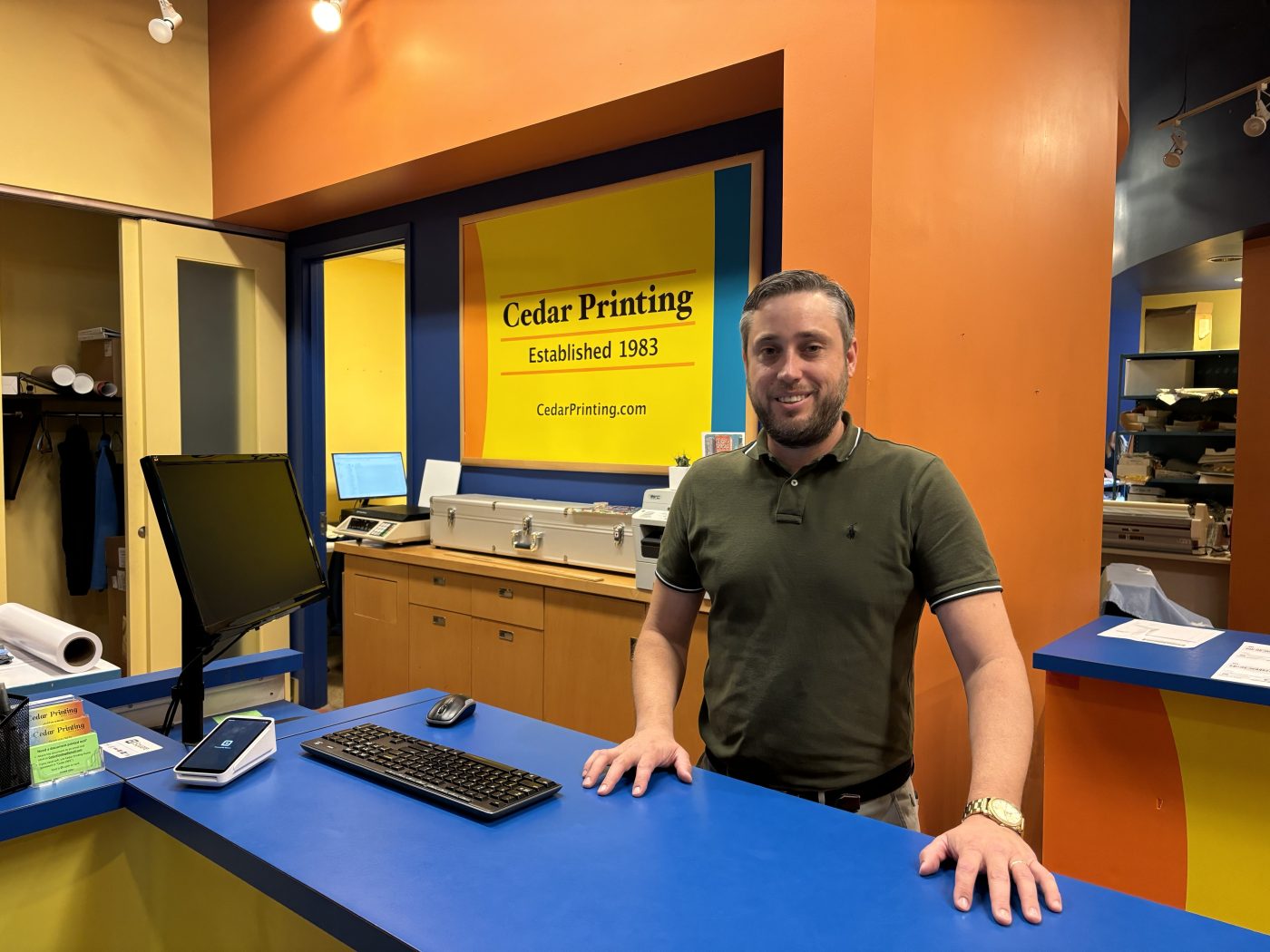
Especially in an increasingly digital age, printed materials often fall to the bottom of people’s to-do lists, said Tyler Hjeltness, the owner of Cedar Printing, a skyway print shop in Securian Financial’s 401 Building.
But then, suddenly, a major event or deadline or project presentation is a few days away, and you’ve forgotten to order your programs or marketing brochures or public signage.
“That’s part of our secret to success, is we cater to emergencies,” Hjeltness said. “Five to seven days is a typical lead time for a shop like ours, but we turn ‘em around tight, and we do it with a smile. It makes an impression on people when you can get the impossible done for them when at every other turn they’re told no.”
Hjeltness started working for Cedar Printing’s previous owner, Andy Flamm, in 2016 and bought the now-43-year-old business in 2019. Since then, Hjeltness has expanded the shop’s focus from primarily everyday business printing — think business cards, letterhead, invoices — to additionally incorporate more colorful marketing materials, wide-format banners and storefront graphics.
And interestingly, Hjeltness said he’s seeing a resurgence in how customers value printed objects, to the extent that the company is busier than ever. Currently, Hjeltness and his team are juggling about 60 active projects in various stages, from just-ordered to ready for pickup, and ranging in price from about $40 to several thousand.
“If you get a nice physical piece that somebody really obviously put some time and effort into, it seems to stand out,” he said. “There are things that digital media will never achieve. This is a cliche, but you can’t wrap a candy bar in a PDF.”
On an autumn Thursday afternoon, production manager Justin Kron completed final quality checks on an order of about 700 oversized postcards for a Minneapolis nonprofit. After they’re printed and cut to the right dimensions, he’ll apply a postage stamp to each one by hand.
“A lot of people want their stuff physically stamped because it shows someone cared enough to physically handle it,” Hjeltness said. “It wasn’t just a machine that just spit out a billion things and you’re just one in a billion.”
Meanwhile, print specialist Armand Clark kept an eye on a huge glossy banner for an upcoming event at the Minnesota Children’s Museum that was slowly emerging from a large-format printer. That morning, Minnesota Public Radio “Morning Edition” host Cathy Wurzer swung by to pick up an order. Recently, a renewable energy company based in Chicago hired Cedar Printing to produce and send a multi-state marketing push. Even the signage at the nearby Skyway Grill came out of Hjeltness’ shop.
“So we can be hyperlocal and also national,” Hjeltness said.
Running a print shop requires plenty of heavy, noisy machinery. The guillotine-style paper cutter in the corner weighs about as much as a sedan. An industrial paper folding machine is so loud when it’s running that Hjeltness keeps it in its own small room to reduce how disruptive it would be. So it’s not uncommon, he said, for print shops to be located in industrial parts of town or in out-of-the-way warehouses.
But for him, staying in the skyways is non-negotiable.
“I could technically run this out of a garage somewhere for cheaper rent, but no,” he said. “Being seen and being part of the community is what makes this enjoyable, honestly.”
More from Double-Decker Downtown
Read our deep dive into the past, present and future lives of the St. Paul skyways, and explore more profiles of skyway businesses:
After 43 years, Paul Hartquist’s personal service keeps skyway jewelry store shining
At Skyway Grill, owner Scott Johnson feeds everyone
Blue Hummingbird Woman brings native culture and wellness to the skyways
At skyway barbershop, Mr. B aims to empower through haircuts
Through clothing, skyway tailor Patricia Caldwell aims to beautify the world
Cycling Museum of Minnesota brings over a century of two-wheeled history to the skyway
Your guide to every lunch spot in the St. Paul skyways
Related Articles
I-94 to close next weekend both directions in downtown St. Paul for bridge work
Household cats encouraged to compete for royal titles at Saintly City Cat Club show
U.S. Bank Center mortgage acquired by St. Paul Downtown Development Corporation
MN Supreme Court reopens Keith Ellison’s wage theft case against Madison Equities
Crackdown on social service providers leaves some without housing assistance