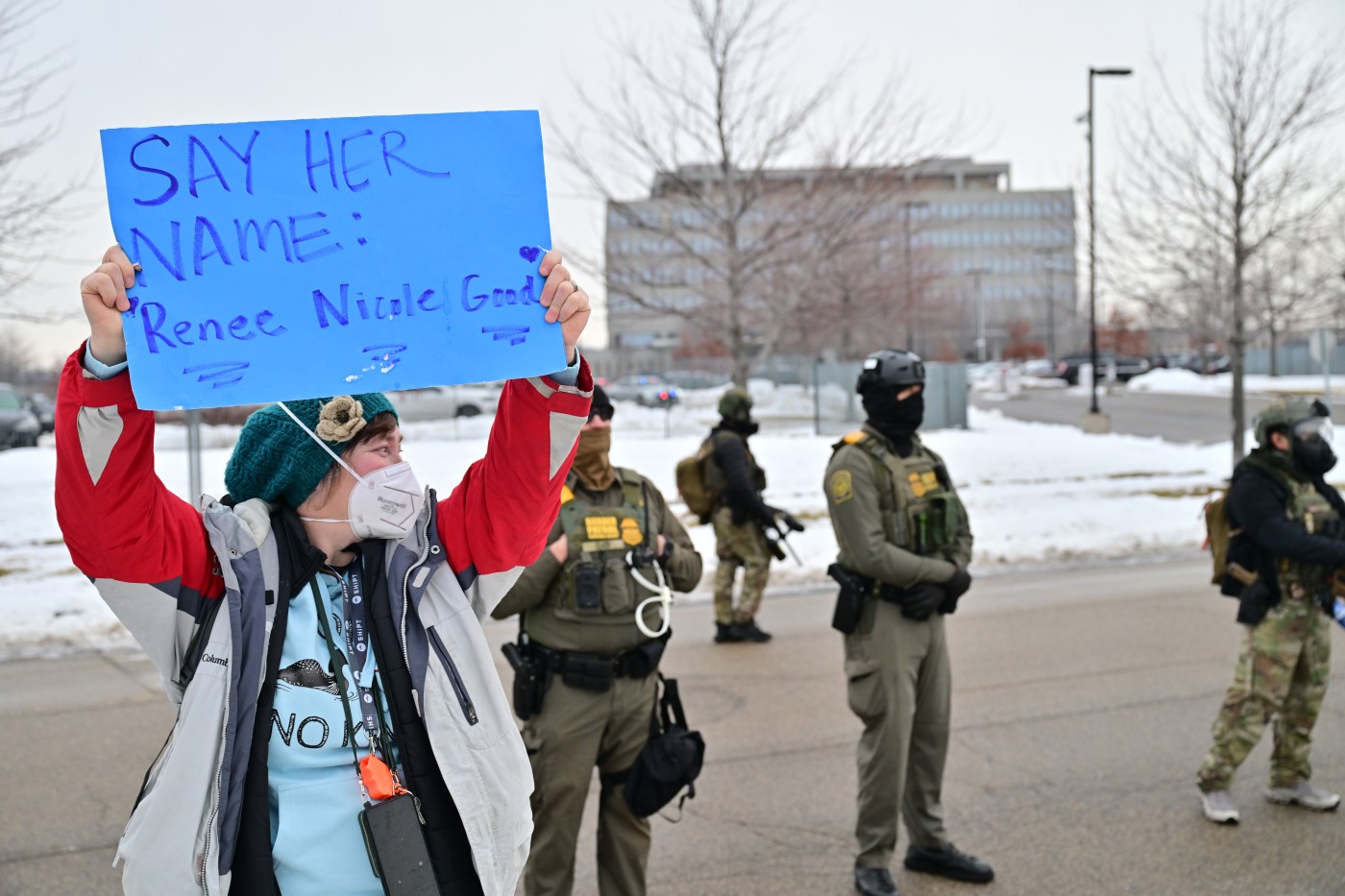
Federal officers are leaving Louisiana immigration crackdown for Minneapolis, documents show

posted in: All news | 0

By JACK BROOK, Associated Press/Report for America

NEW ORLEANS (AP) — Federal immigration officers are pulling out of a Louisiana crackdown and heading to Minneapolis in an abrupt pivot from an operation that drew protests around New Orleans and aimed to make thousands of arrests, according to documents obtained by The Associated Press.

Related Articles


Minnesota shooting videos challenge administration narrative, policing experts question tactics


Wall Street ticks toward a record following mixed data on the job market


US intercepts fifth sanctioned tanker as it exerts control over Venezuelan oil distribution


Luigi Mangione in court as he fights to block death penalty, murder charge and key evidence


Sluggish hiring closes out a frustrating year for job seekers though unemployment slips to 4.4%

The shift appeared to signal a wind-down of the Louisiana deployment that was dubbed “Catahoula Crunch” and began in December with the arrival of more than 200 officers. The operation had been expected to last into February and swiftly raised fears in immigrant communities.

The Trump administration has been surging thousands of federal officers to Minnesota under a sweeping new crackdown tied in part to allegations of fraud involving Somali residents. More than 2,000 officers are taking part in what the Department of Homeland Security has called the biggest immigration enforcement operation ever.

The officers in Minneapolis have been met with demonstrations and anger after an ICE officer fatally shot a woman on Wednesday.

Documents obtained by the AP indicated that federal officers stationed in Louisiana were continuing to depart for Minneapolis late this week.

“For the safety of our law enforcement, we do not disclose operational details while they are underway,” DHS said Friday in response to questions about whether the Louisiana deployment was ending in order to send officers to Minnesota.

In December, DHS deployed more than 200 federal officers to New Orleans to carry out a monthslong sweep in and around the city under Border Patrol Cmdr. Gregory Bovino, who was also the face of aggressive operations in Chicago, Los Angeles and Charlotte, North Carolina. Bovino has been seen in Minneapolis this past week.

“Catahoula Crunch” began with a target of 5,000 arrests, the AP first reported. The operation had resulted in about 370 arrests as of Dec. 18, according to DHS.

The operation heavily targeted the Hispanic enclave of Kenner just outside New Orleans, leading immigrant-run businesses to close down to protect customers and out of a fear of harassment.

Documents previously reviewed by AP showed the majority of people arrested in the Louisiana crackdown’s first days lacked criminal records and that authorities tracked online criticism and protests against the deployment.

Republican Louisiana Gov. Jeff Landry welcomed the crackdown. But New Orleans’ Democratic leaders called the 5,000-arrest target unrealistic and criticized videos that showed agents arresting or trying to detain residents, including a clip of a U.S. citizen being chased down the street by masked men near her house.

New Orleans’ Democratic leaders have been more welcoming of a National Guard deployment that President Donald Trump authorized after Landry asked for help fighting crime. The troops arrived just before the New Year’s Day anniversary of a truck attack on Bourbon Street that killed 14 people.

Associated Press writer Rebecca Santana contributed to this report from Minneapolis.

Brook is a corps member for The Associated Press/Report for America Statehouse News Initiative. Report for America is a nonprofit national service program that places journalists in local newsrooms to report on undercovered issues.

Swiss prosecutors request male bar manager to be placed in pre-trial detention over fatal fire

posted in: All news | 0

MARTIGNY, Switzerland (AP) — Switzerland held a national day of mourning on Friday for the 40 people who died in an Alpine bar fire during a New Year’s Eve celebration, as prosecutors requested one of the managers to be placed in pre-trial detention.

Valais region’s chief prosecutor Beatrice Pilloud said in a statement the detention of the man was needed to avoid a “risk of flight.” The man’s wife and co-manager will remain free under judicial supervision, the statement said.

A Swiss business register lists French couple Jacques and Jessica Moretti as the owners of Le Constellation bar, in the Alpine resort of Crans-Montana, where a fire broke out less than two hours after midnight on Jan. 1. As well as the fatalities, 116 people were injured, many of them seriously.

Local media reported that Moretti was being held in custody pending the court’s decision after the couple were questioned by prosecutors in Sion on Friday morning.

Swiss authorities have opened a criminal investigation into the owners, who are suspected of involuntary homicide, involuntary bodily harm and involuntarily causing a fire.

A memorial service and a minute’s silence marked Friday’s national homage, while church bells across Switzerland rang out for five minutes, beginning at 2 p.m.. Across the country, people gathered to light candles, put down flowers for the victims and followed the national ceremony that was livestreamed on public television.

Speaking at the memorial ceremony in Martigny, Swiss President Guy Parmelin said that “the memory of that terrible night illuminates the faces of the 156 victims, their happy days, their carefree spirit.”

He added: “Our country is appalled by this tragedy. It bows before the memory of those who are no longer with us. It stands by the bedside of those who are about to embark on a long road to recovery.”

Investigators have said they believe sparkling candles atop Champagne bottles ignited the fire when they came too close to the ceiling. Authorities are looking into whether soundproofing material on the ceiling conformed with regulations and whether the candles were permitted for use in the bar. Fire safety inspections hadn’t been carried out since 2019.

The severity of burns made it difficult to identify some victims, requiring families to supply authorities with DNA samples. Police have said many of the victims were in their teens to mid-20s.

An autopsy has been ordered for five of the six Italian victims and has been delegated to the prosecutors’ offices in Milan, Bologna, and Genoa, where the bodies of the victims have been returned.

Related Articles


US will provide $45 million in aid to Thailand and Cambodia in a bid to ensure regional stability


US intercepts fifth sanctioned tanker as it exerts control over Venezuelan oil distribution


Israeli strikes kill at least 13 across Gaza, as Trump is expected to announce Board of Peace


Iran supreme leader signals upcoming crackdown on protesters ‘ruining their own streets’ for Trump


Today in History: January 9, Americans arrive in Lingayen Gulf during World War II

“What happened is not a disaster: It’s the result of too many people who didn’t do their job or who thought they were making easy money,” Italian Premier Giorgia Meloni said during a press conference on Friday. “Those responsible must be identified and prosecuted.”

Meloni said the State Attorney General’s Office has contacted the Swiss Attorney General to follow the investigation. She also confirmed that the Rome Prosecutor’s Office has started a separate probe.

“The families have my word that they will not be left alone while they seek justice,” she added.

The Paris prosecutor’s office Monday announced that it was opening a probe to assist the Swiss investigation and make it easier for families of French victims to communicate with Swiss investigators. Nine French citizens were killed, the youngest of them aged 14, and 23 others were injured.

Minnesota shooting videos challenge administration narrative, policing experts question tactics

posted in: All news | 0

By CLAIRE GALOFARO

The federal officer steps in front of the Honda SUV, parked nearly perpendicular across a one-way residential street in Minneapolis, with snow piled up on the curb.

Within seconds, he would shoot and kill the driver, Renee Good, a 37-year-old mother of three.

Federal officials said the officer acted in self-defense, that the driver of the Honda was engaging in “an act of domestic terrorism” when she pulled forward toward him and that he was lucky to escape alive.

Policing experts say some of the choices the officer made in that moment defy practices nearly every law enforcement agency have followed for decades.

‘A dangerous decision to make’

Videos filmed by bystanders from several angles show the Honda stopped on Portland Avenue just before the shooting. It’s straddling multiple lanes, but not entirely blocking traffic: the driver-side window is open, the driver waving their left arm as if to signal cars to go around. One large SUV drives around the front of the Honda and down the street. Multiple unmarked federal vehicles are idling on the road nearby.

Some bystanders heckle officers: “Go home to Texas,” one woman shouts from the sidewalk. “Why won’t you let your faces be seen?” shouts another. Some blow whistles to alert neighbors immigration agents are in the area, others honk.

A gray four-door Titan truck comes to a stop facing the driver’s side of the Honda. Two officers climb out and approach the Honda. Both officers wear what appear to be wool hats and black masks covering their noses and mouths.

A woman can be heard saying “go around.”

One officer says, “Get out of the car. Out of the car. Get out of the f—ing car.”

The Honda’s reverse lights come on, and it begins to roll slowly backward as one of the officers grabs the driver-side door handle and tries to pull it twice, then puts his arm into the open driver’s window.

A third officer, who had been out of the way on the passenger side of the car then walks around the Honda’s hood, stands just in front of the driver and appears to be holding his phone up like he’s filming.

“Why would he do that? Why would he put himself in a more dangerous position than he was already in?” asked Geoffrey P. Alpert, an expert on policing at the University of South Carolina, who called it “absurd” for an officer to use his body to try to block a 4,000-pound SUV.

Darrel W. Stephens, former chief of the Charlotte-Mecklenburg Police Department, also pointed to this moment as the baffling first step in a series of questionable actions that most police departments have discouraged for years. As a police chief, he prohibited officers from standing in front of cars in the early 1990s.

“I can’t explain why he would stand there and place himself in front of the car,” Stephens said. “That’s a dangerous decision to make.”

‘A 4,000 pound unguided missile’

Homeland Security Secretary Kristi Noem described the incident as an “act of domestic terrorism” carried out against ICE officers by a woman who “attempted to run them over and rammed them with her vehicle. An officer of ours acted quickly and defensively, shot, to protect himself and the people around him.”

President Donald Trump said in a post on Truth Social that the ICE officer shot the driver in self-defense. Trump said based on that video “it is hard to believe he is alive.” He said the driver “viciously ran over the ICE officer.”

But it’s unclear in the videos if the car makes contact with the officer.

The Honda starts to drive forward, its tires turning to the right as the officer stands in front.

“Why doesn’t he step out of the way? Why doesn’t he move?” asked Alpert.

Related Articles


What to know about restrictions on state use of money for child care and other social services


Vance calls killing of Minneapolis woman by an ICE officer ‘a tragedy of her own making’


After delays, the missing Jan. 6 plaque will be displayed at the Capitol


Federal immigration officers shoot and wound 2 people in Portland, Oregon, authorities say


FACT FOCUS: Minneapolis shooting prompts spread of misrepresented and fabricated images online

The officer unholsters his gun. Within a second he shoots into the windshield and then lurches backward away from the car as it turns away from him.

Homeland Security Secretary Kristi Noem has not publicly identified the officer who shot Good. But she spoke of an incident last June in which the same officer was dragged by a fleeing vehicle. Court records from that case identify the officer as Jonathan Ross.

Most police departments long ago prohibited officers from shooting at moving vehicles except for very limited circumstances where there’s no other option to save lives, experts say.

“And the reason is a good one,” said Sharon Fairley, a law professor and criminal justice expert at the University of Chicago. “If the officer is successful at shooting the driver, then you have a motor vehicle, a two-ton vehicle that’s not being directed, and it creates a huge public safety risk.”

The officer shoots a second time. By then, he’s at the side of the car, an arm’s length from the driver-side window. A third shot immediately follows.

None of the other officers draw their weapons.

The officer who fired the shots watches the car careen down the road and re-holsters his gun. The street is quiet for a moment.

Three seconds later, the Honda crashes into a parked car with such force its tires fly off the street, the pile of cars lurches forward several feet and snow billows.

“Thank goodness no one was in the car she hit on the side of the road,” Alpert said, “and fortunately there were no kids playing out there and no one else got hurt.”

Alpert described the car at that point as “a 4,000 pound unguided missile.” People don’t hit the brakes when they’ve been shot, Alpert said.

There were pedestrians on the street. One video shows a woman walking a poodle.

Drops of blood stain the snow

A pedestrian in a flannel shirt runs toward the crash.

The officer who fired the shots walks slowly in that direction. Most of the federal agents remain with the unmarked vehicles.

Drops of blood stain the snow.

None of the agents immediately go to the Honda to render aid; a minute after the crash the pedestrian in the flannel shirt is seen in the video leaning alone into the open driver’s side door. A medic runs toward the crash site.

Bystanders begin screaming.

“Criminals!” shouts a woman. “What did you do?”

A man billows “murderers!” over and over.

Officers order everyone to get back.

One bystander trains her camera on the officer who fired the shots as he walks away from the crash and toward his colleagues at the parked federal vehicles, telling them to call 911. He does not appear injured.

“You,” she screams, “shame, shame.”

He climbs into an SUV as the bystander shouts, “don’t let the murderer leave!”

The SUV drives away.

Fairley, the University of Chicago professor, said the investigation into what happened here will have to examine whether the officer acted reasonably, both in firing his gun and in the moments leading up to it. It can weigh questions like whether the agent put himself in danger by stepping in front of the car, and if along the way there were other choices the officers might have made to avoid a death.

“The question is going to come down to is was the officer reasonable in their belief that the driver presented an imminent threat of death or bodily harm to himself or to someone else,” she said. “That’s really the legal question that has to be answered.”

The car’s license plate, for example, was visible throughout the ordeal.

One alternative, Fairley said, was to have just let her leave, and go arrest her later.

When Elevators Break, These NYCHA Residents Are Stuck in Their Apartments

posted in: All news | 0

At NYCHA’s Surfside Gardens, slow repairs leave seniors and residents with disabilities waiting years as broken elevators, intercoms, playgrounds, and trash compactors disrupt daily life.

Right to left: Aleksandra, Svitlana Matyash, and Valeriy Feldman outside Surfside Gardens’ Building 1. Residents say frequent elevator outages in the senior-designated building leave them stuck upstairs. (Photo by Bella Week)

On a chilly afternoon in mid-December, four residents of Surfside Gardens’ Building 1, one of two senior-designated buildings in the Coney Island public housing complex, gathered in the last moments of sun outside the lobby, chatting in Russian. All live on upper floors of the 14-story building. When the elevators stop working, they say coming out here becomes impossible.

“When the elevator is broken, we need to stay home,” said Aleksandra, 79, who uses a walker and asked that her last name not be used for fear of causing trouble with the New York City Housing Authority (NYCHA), which runs the complex. 

“I live five floors up, she lives third floor, he lives seven or eight floors,” she said, nodding toward Valeriy Feldman, 85, who uses a wheelchair. Translating Feldman’s words from Russian, Aleksandra added: “Every time, it’s a problem for him.”

Surfside Gardens, home to a large population of seniors and residents with disabilities, has long struggled with infrastructure failures that residents say NYCHA has been slow to fix. 

Elevator breakdowns are the most disruptive, but they aren’t the only issue: in at least two buildings, the intercom system has been broken for years, and the trash compactor has been out of service, leaving garbage to pile up outside. A playground has been fenced off since June 2023 for repairs that have yet to begin, while another reopened in 2024, over a decade after Hurricane Sandy destroyed it. 

Although NYCHA has committed capital funding to address many of these problems, residents say the agency allows conditions to deteriorate to a critical point before beginning multi-year repair projects, leaving them with limited access, daily disruptions, and ongoing health and safety risks.

Shakema Ashby, 32, and her 4-year-old daughter, Artist, at Surfside Gardens, where the playground is expected to remain fenced off for five years. (Photo by Bella Week)

Decades of federal, state, and city underfunding have left the system with major repair needs across its developments. To address these shortfalls, NYCHA has pursued alternative funding models at some sites, including transferring some properties to private management through the federal Rental Assistance Demonstration program (known locally as PACT) and creating the Public Housing Preservation Trust. Now, potential federal budget cuts threaten to strip resources from a repair process already failing to meet residents’ needs.

“It’s been like this for years,” said Silvana Merced, 48. “But you want to raise our rent or throw us out if we’re a dollar short. It’s terrible.”

Elevator outages are frequent across the complex. NYCHA service interruption data reviewed by City Limits show that Surfside Gardens experienced 140 elevator service disruptions across its five buildings in 2025. Building 3, home to the most residents, had 47 outages, including one that lasted 11 days.

Service logs also show 10 instances of full “no service” conditions in 2025, meaning a building had no functioning elevators at all. On the evening of July 11, over 300 residents in Building 3 were left without a working elevator for 24 hours.

For Deidre King, 58, who lives in Building 3 and uses a wheelchair, outages can mean being abruptly and indefinitely stuck inside.

“I can’t come down the stairs,” said King. “So when the elevators break, I have to stay upstairs.”

Not all residents are affected the same way. Rosa Bernitt, 70, who lives in Building 2, said she can usually manage the stairs, but it’s hard.

“I can still use the stairs to go down,” she said. “Going up is a little difficult, but I can make it.” She worries about her neighbors with less mobility. “Other people, they cannot. They need the elevator.”

Stacey Thomas (left) and Deidre King (right) outside Surfside Gardens’ Building 3. The building experienced 47 elevator outages in 2025, sometimes leaving King, who uses a wheelchair, unable to leave her apartment. (Photo by Bella Week)

NYCHA’s failure to provide reliable elevator service has long been the subject of scrutiny. In 2018, the agency settled a lawsuit after the U.S. Department of Justice accused it of systematically violating federal health and safety regulations, including failing to provide adequate elevator services. A federal monitor was appointed in 2019 to oversee NYCHA’s efforts to improve living conditions and capital projects.

Planning for Surfside Gardens’ elevator replacement project began in March 2022. The following year, Mayor Eric Adams and Gov. Kathy Hochul announced $300 million to fund that project and elevator replacements at 19 other NYCHA developments. By that point, Surfside’s elevators, installed in 1990, were already well beyond the manufacturer’s recommended 20-year lifespan. 

The project to replace the complex’s 10 elevators has been in the procurement phase since January 2024. NYCHA Deputy Press Secretary Andrew Sklar said in a statement that the project has faced delays, in part due to the rejection of earlier non-responsive bids. Construction is now expected to begin in early 2027, with completion anticipated in May 2028—roughly six years from initial planning and 16 months behind schedule.

While NYCHA has made improvements under federal monitorship, the most recent monitors’ report, released in December, describes a modest backslide across several obligations last year.

Elevator outages in 2025 lasted an average of almost seven hours, which was 18 percent longer than the previous year. The agency met its requirement to replace 275 elevators by the end of 2025—a year behind schedule—though it remained out of compliance with nine of 18 outstanding elevator-related mandates.

Residents say a broken intercom at Surfside Gardens’ Building 3 has left the front door propped open for years, raising safety concerns and leading to stolen packages. (Photo by Bella Week)

The situation could soon worsen. The Trump administration has proposed cutting the U.S. Department of Housing and Urban Development’s budget by 44 percent. NYCHA receives about 70 percent of its funding through HUD, including half its capital budget. If approved, the cuts would further strain a capital process that already leaves residents waiting years for critical repairs. 

In a statement, NYCHA Press Secretary Michael Horgan said the agency is monitoring the situation. “As more information becomes available from the federal government, the Authority will continue to assess our options in addressing any impacts related to funding,” Horgan said. “NYCHA remains fully focused on our work to ensure residents’ health and safety and improve their quality of life.”

For Merced, who has lived at Surfside since she was a kid, the delays have been hard. “There’s nothing being done here,” she said. “It’s like we just got left behind.”

To reach the editor, contact Jeanmarie@citylimits.org

Want to republish this story? Find City Limits’ reprint policy here.

The post When Elevators Break, These NYCHA Residents Are Stuck in Their Apartments appeared first on City Limits.