Orioles’ Triple-A affiliate, Norfolk Tides, sold to Diamond Baseball Holdings but expected to stay put

posted in: News | 0

Ken Young wasn’t looking to sell, but he finally got an offer he couldn’t turn down.

As a result, the Norfolk Tides, the Orioles’ Triple-A affiliate, will change hands for the first time in 30 years.

Young, the team’s president and chief owner since 1993, has agreed to sell the club to Diamond Baseball Holdings, which owns more than 20 minor league baseball teams, the Tides and DBH announced Tuesday.

Young, a longtime food service executive, said the ownership change puts the team in no danger of leaving, adding that the club’s staff will stay put.

“They don’t want to go anyplace,” Young said, referring to DBH. “They know Norfolk’s a good market. The Tides will stay in Norfolk.”

Subject to obtaining the consent of the International League and satisfying other standard closing conditions, the transaction is expected to be completed promptly.

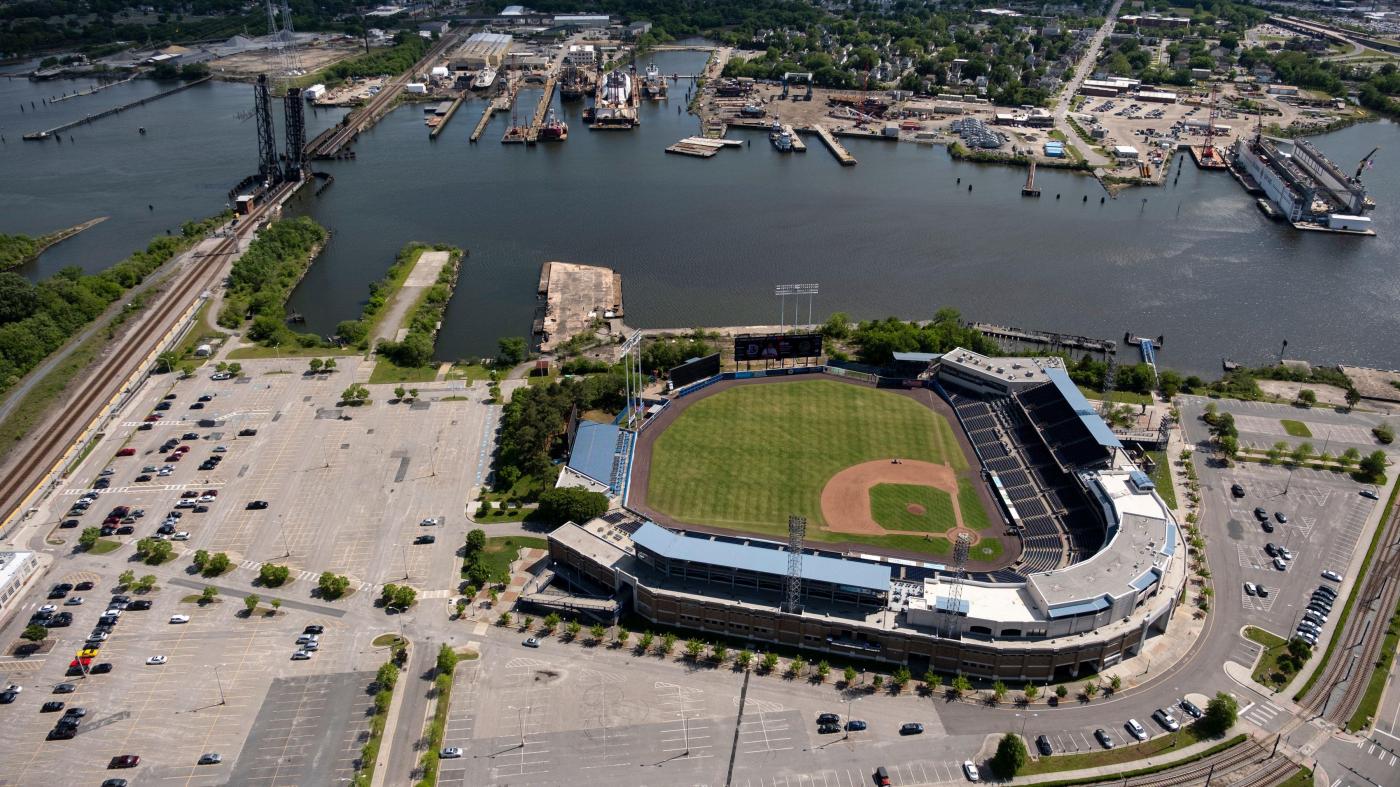
Norfolk is operating under a player development contract with the parent club that runs through 2030. The Tides recently signed a two-year extension to their Harbor Park lease with the city that runs through the 2024 season and is expected to be extended long-term in the coming months.

Young, who declined to disclose terms of the sale, will remain with the club as an advisor and continue to help negotiate the lease extension with the city.

DBH is under the umbrella of Silver Lake, a $101 billion private equity investment firm. Founded in 2021 by media conglomerate Endeavor, DBH owns teams from the low Class A level to Triple-A, including Gwinnett, Memphis, Scranton/Wilkes-Barre and St. Paul of the IL.

Tides general manager Joe Gregory said a representative from DBH was in town Tuesday to answer questions from the staff.

“It would’ve been easy to just have a Zoom call and put the staff on,” Gregory said. “But for them to actually fly somebody in here and sit down face to face and talk to everybody, I think, shows their effort and their genuine care that they have for the best interests of the existing staff.”

Young said DBH contacted him about purchasing the team about 18 months ago, when the company began buying several minor league clubs.

“I really wasn’t interested,” Young said. “And they kept coming back and finally got to a point [where] I thought, ‘I need to listen to these guys.’ So that was really how it came about.”

Young, 72, said his decision to sell was driven in part by an aging group of investors in the team, whom he said are “satisfied” with the results of the transaction.

Young also sold the Albuquerque Isotopes, the Triple-A affiliate of the Colorado Rockies, to DBH. The company now owns nearly a third of baseball’s Triple-A franchises, as well as a handful of Double-A teams.

“Looking at what happened with those transactions, team leadership and front office staff stayed in place,” Gregory said. “This seems like a good thing for the team and for Norfolk and the surrounding area.”

The Orioles, who have been affiliated with the Tides since 2007, are on board. In a statement, minor league operations director Kent Qualls thanked Young and the ownership group “for the outstanding partnership over our last 17 seasons in Norfolk,” adding that Baltimore looks forward to a continued affiliation with the city alongside DBH.

Pat Battle and Peter Freund, executive chairman and CEO, respectively, of DBH, expressed their desire for continuity.

“We are thrilled to add this iconic Triple-A franchise to the DBH family and immensely appreciative to be entrusted with continuing Ken’s notable legacy in Norfolk,” they said in a statement. “We are very enthusiastic about the Tides’ future, the incredible staff that is already in place and the continued partnership with the Orioles in the Norfolk community.”

A proposed casino beyond left field at Harbor Park has gone through a handful of false starts, and its future remains unknown. Young, who lives in Tampa, Florida, said the casino project “really has no bearing on this transaction.”

His memories of his time in the city are fond.

“I will say that I loved being in Norfolk and having the team there and the fans and everything else,” Young said. “Just great. A good relationship with the city — all of those things. But it was the right time to do this, and they gave us a good offer.”

Last month, the Tides won their first IL title since 1985. They followed that by winning the Triple-A National Championship Game in Las Vegas.

Norfolk’s roster this season included several of the Orioles’ most highly regarded prospects, including 19-year-old shortstop Jackson Holliday, the top-ranked prospect in all of baseball.

The team’s attendance was the highest it had been since 2008.

“It has been a fantastic year for the Tides, capping off Ken’s legendary ownership tenure,” Gregory said. “The entire staff here thanks Ken for all that he’s done for Norfolk and for minor league baseball.”

()
The Orioles’ season left its mark on baby names. Could another awesome year birth more Adleys, Gunnars, Cedrics and Félixes?

posted in: News | 0

To David Thompson, Orioles catcher Adley Rutschman is someone who hugs his teammates, the man “at the heart of actually leading this resurgence within the city, and within the fan base, and within the franchise.”

The blossoming baseball star is also something else: the namesake of David and his wife, Kaitlyn Thompson’s 3-month-old son, Trevor Adley.

“Last summer, I wasn’t pregnant, and Adley Rutschman was doing amazing things for the Orioles and just bringing such hope to the Orioles community, and so that’s what our story being pregnant was all about as well, having hope that he would eventually come,” said Kaitlyn, 28, a third-grade public school teacher.

The Pasadena couple said they refer to their son using his first and middle name, and that some friends just call him Adley. The Orioles played on the television when he was born at Anne Arundel Medical Center on July 3, though his moniker was settled on well before that (after his parents decided against Adley Gunnar).

“It’s kind of a shame that our son is only a couple months old, and he’s not older to see this season and actually understand it,” David, 31, said at the end of September. “It’s going to be a summer we literally will never forget.”

The Orioles’ spectacular 2023 season ended this week almost as quickly as it took off, but the players left their mark on a group sure to become lifelong fans: babies named after the team’s own baby Birds.

While big names in Baltimore baseball (think Cal Ripken Jr., or Brooks Robinson) haven’t always made a huge dent in the baby name charts following their successes, it’s a new generation’s turn to try to tilt the trends.

“It’s undeniable that, especially at the margin, popular celebrities or fictional characters — or even in some cases, athletes — influence names,” said Sean Mussenden, a professor and data editor at the University of Maryland’s Howard Center for Investigative Journalism.

Could young players with standout names — Adley, Gunnar, Grayson, Félix or Cedric — inspire a new crop of mini-mes?

“We love to tell ourselves stories of overcoming challenges and triumphing,” said Victoria Harms, a senior lecturer in the history department at the Johns Hopkins University, where she teaches a popular seminar titled “The Cold War as Sports History.”

Sports is an easy arena for evoking pride and hope, “especially when rookies carry a team … it’s just the perfect story that we love to watch,” Harms added. “They come in and then just inspire an entire city.”

People naming their children after famous athletes is nothing new. “Kobe” made it into the nation’s top 1,000 most popular boys names in 1997, the year after NBA shooting guard Kobe Bryant made his debut with the Los Angeles Lakers, and has remained a top-600 name ever since, according to data from the Social Security Administration. In 2020, the year Bryant died in a California helicopter crash, it was the 239th most popular name.

For girls, “Serena,” safely within the top 1,000 most popular names for decades, hit a recent peak in 2000, the year after now-retired tennis great Serena Williams won her first major singles title at the U.S. Open.

But athletic acclaim doesn’t necessarily translate to contemporaneous baby-name fame.

Names of current players haven’t yet overwhelmed Baltimore delivery rooms or OB/GYN offices, according to representatives from Mercy and Sinai hospitals. “Adley” didn’t show up in the top 100 most popular baby names in Maryland last year, nor did Cedric, Gunnar or Félix (and Grayson was ranked 50th, for boys).

“Cal” never made it into the top 1,000 baby boy names documented by the Social Security Administration during Cal Ripken Jr.’s 21-season career with the Orioles, while “Calvin,” Ripken’s given name, remained steadily popular long before, during and after his career.

The boys name “Brooks” didn’t see a meaningful spike in national popularity until a few years after third baseman Brooks Robinson, who also played for over two decades for the Orioles, retired in 1977, according to Social Security Administration data. It’s become increasingly popular in recent years, reaching a high of 76th most popular boys name in 2022.

“I would think often about the fact that he was named after Brooks Robinson,” Westminster resident Mike Holden said of his 7-year-old son, Brooks. “But now, with Brooks Robinson’s passing, I think it’s just even more significant for me. I love that we have a son named as a tribute to someone who was such a great human being.”

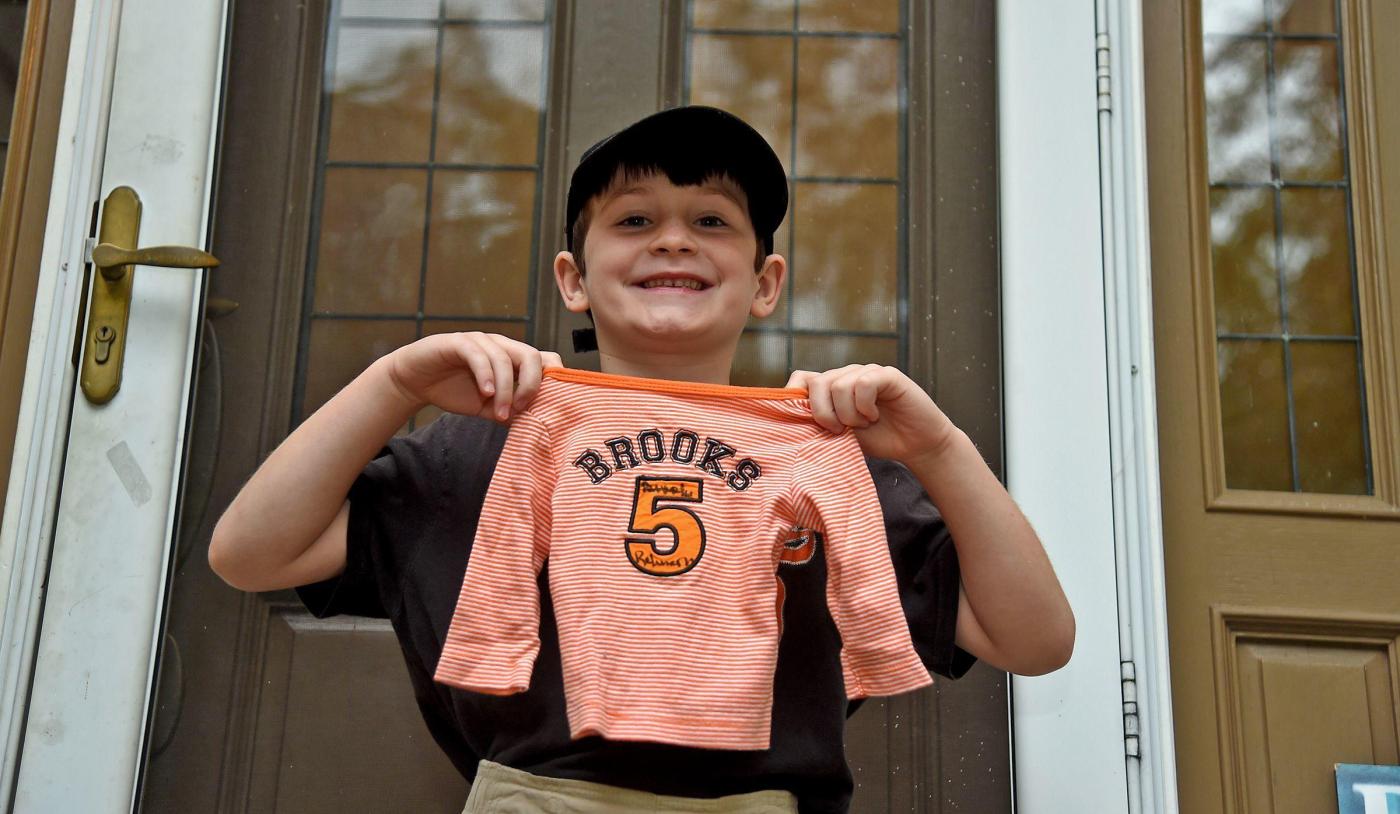
Brooks is Mike and Erin Holden’s fifth child (fitting, since Robinson wore No. 5). As a kid himself, Mike Holden, who grew up in Laurel, received a baseball in the mail for his birthday, sent and signed by Robinson.

When his son Brooks was only about a year old, Holden took him and his brother, Nolan, to meet Robinson at a sports memorabilia store. The Orioles legend signed the outfit Brooks wore home from the hospital when he was born — a shirt with No. 5 on the back and the name Brooks.

“He’s so genuine and had so many kind interactions with people over the years,” Mike, 48, said of Robinson, who died Sept. 26. “He really had a bond with Baltimore and the fans.”

But Orioles-inspired names from past eras aren’t confined to the city and nearby counties, or even the state.

Pittsburgh resident Calvin Yoder grew up with a life-size poster on his bedroom wall of his namesake, Cal Ripken Jr., and said his parents “thought of him as a really good role model … not a super flashy guy or anything like that, but he’s someone who is just dedicated to getting it done and doing it well.”

Soon after Yoder was born, his father, who grew up in Baltimore, and mother drove their young son to Cleveland for an Orioles game and held him up in an attempt to catch Ripken’s attention.

Now, Yoder has a 12-year-old nephew in Pennsylvania named Camden, after the ballpark and as a tribute to Yoder’s father’s love of the team.

But as Yoder contemplates names for his own future child with his fianceé, he said the strongest contender aside from repurposed family names is one borrowed from the Orioles roster: Adley.

Pennsylvania couple Sarah and David Shepke, who both attended Orioles games growing up, named their son Grayson Adley in mid-July after Rodriguez and Rutschman — committing to the middle name only after Sarah underwent a cesarean section.

“Right after I woke up from my surgery, my husband said that the Orioles were playing at that time and he said ‘Adley just hit a home run,’ and Grayson had been pitching that night,” said Sarah, 32.

Grayson Adley Shepke is destined to play for the Orioles one day, or at least that’s Sarah’s hope. Girls named after Adley could also wind up wearing catcher’s mitts, if Rutschman’s devoted fan base continues to grow.

“Being a unisex name, it just made sense” for Ellicott City couple Jordan and Courtney Kenney to name their daughter born in September after Rutschman, said Jordan, 36.

They contemplated similar girls’ names, like Adalyn and Ainsley, Courtney said, but Adley felt like the “perfect” choice.

“We love his character and how much he’s transformed the team,” Jordan said, adding that his own Adley — though still an infant — is already a “sweetheart” with sass.

Some Orioles fans are still trying to convince their partners to run with a baseball-inspired name for their soon-to-arrive babies, like Harford County resident Chris Peacher.

“It’s the name of the person who’s brought joy back to watching the Orioles,” Peacher, 32, said of Adley, a title he’s considering for his second son, expected in early January. His wife, Caitlin Peacher, has been pushing for “unique” names, like “Crew,” Chris said.

But the name Adley would hold personal sentimentality. Chris attended Rutschman’s MLB debut last year with his son Cole and his late father, Glenn Peacher, the only game the three went to together before Glenn died in November 2022, Chris said.

“If he stays around here for the long haul … I do think that [Adley Rutschman] could live up to that namesake [like Brooks Robinson has], where we see a lot of kids named after him,” Chris said, adding that he and Caitlin are considering the name Brooks as well.

Interning in 2014 with WBAL, where his father — affectionately known as “Detour” Dave Sandler — worked for a long time, Brooks Sandler became familiar with the Orioles clubhouse, he said. Later he got a job working in player development for the Orioles, and he likes to think his name, Brooks, might have helped him stand out.

Now 30 and working in the University of Pittsburgh’s athletic department, he grew into the name — and all that came with it.

“You don’t really have a choice,” he said, “you’re just an Orioles fan.”

()

‘The game is still the same’: Veterans, psychologists give young Orioles advice for baseball playoff debuts

posted in: News | 0

It was only about a month into his big league tenure when Orioles rookie Jordan Westburg got a memorable piece of advice from 10-year veteran Aaron Hicks.

Westburg had just rocketed a pitch down the third base line in the ninth inning, with the Orioles trailing the Los Angeles Dodgers 10-3 on July 18. For a moment, after his feet crossed the bag at first, he contemplated sprinting for second. But he thought better of it, and stayed put.

With the Orioles so far behind, the play would prove virtually meaningless. The O’s lost by that same score just a few batters later. But the play meant something to Hicks.

“After the game, Aaron Hicks came up to me and he was like, ‘Hey, man, our style of baseball is aggressive here. I think you should have gone for it,’” Westburg said.

For an Orioles team packed with young big leaguers, those tidbits of guidance will perhaps become even more important — particularly when they come from the few current Orioles with postseason experience, like Hicks.

With the team set for its first postseason appearance since 2016 on Saturday against the Texas Rangers at Camden Yards, only six Orioles have any playoff experience. Hicks, who was released by the New York Yankees and picked up by the Orioles in May, has the most playoff appearances, with 30 games under his belt and a combined .216 batting average and .325 on-base percentage.

Backup catcher James McCann and second baseman Adam Frazier, both of whom were signed this past offseason, are the only other Orioles position players to have seen playoff action, with a combined eight games.

“I’m very grateful for guys like him and McCann and Frazier to show us the ropes as position players who have been there, done that,” said Westburg, who made his major league debut June 26.

In sports psychology, there are two schools of thought when it comes to the best way to get ready for a big game, said Dr. Mark Aoyagi, a psychology consultant to MLB and NFL teams.

The first school? Treat a playoff game like any other. Avoid stressing yourself out by thinking of how important it is.

“The bases are still 90 feet, the mound is still 60 feet, 6 inches,” Aoyagi said. “It’s all the same, and so you just approach it the same.”

But Aoyagi finds himself more persuaded by the second school.

”The other approach says: Basically, there’s no way to prepare for the big game. And so rather than trying to have everything be the same, you just train for any eventuality,” Aoyagi said. “You could feel fine, but you could also feel chaotic. Or you could feel tired or you could be sick.

“The idea is to train in such a way that regardless of how you end up feeling, thinking, how your body is on that particular day, you’re still going to be able to perform to the best of your capabilities,” said Aoyagi, who is also a professor and co-director of sport and performance psychology at the University of Denver.

Stephany Coakley, a certified mental performance consultant who has worked with professional and Olympic-level athletes, recommends athletes prepare a kind of ritual to ground themselves in the present, rather than worrying about the outcome of a game.

“It’s imperative that they use whatever techniques that they have to come back to the present moment, whether it’s like tapping into their breath, taking a deep breath or doing their reset: taking their hat off or flipping their glove,” said Coakley, who also serves as senior associate athletic director for mental health performance and wellness at Temple University.

There is also another noteworthy remedy to stress in sports, said Dr. Brad Hatfield, a professor of kinesiology at the University of Maryland, who has focused his research on sports psychology.

Laughter.

Hatfield said he recalls speaking with a group of high school baseball coaches, and one of their most common questions was what to say to a young pitcher struggling on the mound.

“And I told them to keep it very simple — and even to tell a joke,” Hatfield said.

Across the Orioles clubhouse, everyone has their own strategy for staying cool. For outfielder Anthony Santander, it’s taking a moment to pray before games. For reliever Jacob Webb, another recent addition to the roster with a few games of playoff experience, it’s focusing on his breathing during stressful situations.

For 25-year-old rookie reliever DL Hall, it comes in the form of a mantra, of sorts.

”It’s all about — I always say — not running away from the storm. Everything is a storm — all the extra, outside noise,” Hall said. “Instead of trying to run from it, you just kind of embrace the storm. It’s going to come either way.”

With an average age of 27.9 years, according to ESPN, the Orioles’ current roster sits close to the middle of the MLB pack.

But only one team remaining in the playoffs is younger: the Philadelphia Phillies.

The Rangers are the second oldest, with an average age of 30. The Dodgers are first with an average age of 30.5.

Several of the Orioles’ best players are in their early 20s and set to make their postseason debuts.

That includes 22-year-old infielder Gunnar Henderson, a leading candidate for the American League Rookie of the Year, who is also the only player on the roster born in the 2000s.

It also includes 23-year-old pitcher Grayson Rodriguez, who cruised to a 1.80 ERA in his final six starts of the season, following a brief demotion to the minor leagues after beginning the year with an ERA above 7.00.

Some young Orioles, like Henderson and Rodriguez, bypassed college ball to sign with the team, but others gained postseason experience there, including 25-year-old star catcher Adley Rutschman.

In the 2018 College World Series — as a sophomore — Rutschman helped lead the Oregon State Beavers to the championship, setting a record for the most hits in the series with 17.

To win the championship that year, the Beavers defeated the University of Arkansas, where Orioles rookie Heston Kjerstad, now 24, played outfield. Kjerstad was named to the All-Tournament Team as a freshman.

But postseason games in the majors are different.

And veteran Kyle Gibson, one of three Orioles pitchers with a postseason resume, said the conversations about how to prepare for key moments have begun already.

Before the Orioles played the Tampa Bay Rays, their closest division rival, at Camden Yards in mid-September, Gibson reminded his teammates not to overemphasize the moment.

”We sat down, and I said: ‘Listen, everybody is going to come in here and make this to be the biggest series of the year,’” Gibson said. “The biggest series for us is going to be the first game in the playoffs that we play.”

Yet, when those games finally arrive, the message might change.

”As these young guys get closer to it, and get in the moment, I know the other veteran players are just going to be telling them: ‘Hey, yes there [are] more consequences for losses, but at the same time, the game is still the same. And if you make more of it, it really kind of gives you just the chance to put too much pressure on yourself.”

On the advantages of age in baseball, at least one mathematician has run the numbers.

In 2017, Kennesaw State University professor Joe DeMaio published a paper that tracked the average age of World Series-winning teams, compared with the major league average. The results don’t exactly bode well for the Orioles.

DeMaio studied the most recent 39 World Series-winning teams, separating them into two categories: batters and pitchers.

Twenty-eight of the 39 teams had an average batters’ age that was older than the rest of the majors. When it came to pitching, 30 of the teams were older than the league average.

And not only were World Series-winning teams older than the average — they were often significantly older, ranking in the top 25% of the league.

But DeMaio has a message for hopeful Orioles fans in Baltimore:

“For the Orioles fans out there: Don’t hate me. Don’t send me hate mail,” he joked. “That’s why we play the games.”

()

The Orioles were one of three 100-win MLB teams to lose in the playoffs. It’s too early to blame the format. | ANALYSIS

posted in: Adventure | 0

Since 1990, MLB’s winningest team has won the World Series just seven times.

The two teams tied for the most single-season wins in MLB history — the 1906 Chicago Cubs and 2001 Seattle Mariners — both had losing playoff records. The 2006 title-winning St. Louis Cardinals had a winning percentage of .516, just above average. And as recently as 2021, the Atlanta Braves — with the 12th-most regular season wins — won the World Series.

The postseason is home to the unpredictable, where healthy rosters and timely performances reign supreme. If anything is to blame for MLB’s best getting bounced this year — the Orioles (101-61), Braves (104-58) and Los Angeles Dodgers (100-62) combined to go 1-9 in the divisional round — it’s the randomness of the playoffs and those teams falling flat for a few days in October, not the five-day break each of them received.

“It’s a round bat and a round ball and a round Earth that we live in, and sometimes, the ball just doesn’t bounce your way,” Orioles executive vice president and general manager Mike Elias said Thursday.

If the best teams were guaranteed to advance, the postseason would have little mystique. And that unknown, both beloved and despised come autumn, reared its head again this year, leaving the league’s three 100-win teams in its wake.

In other words: That’s baseball.

The Braves and Dodgers lost to divisional foes whom they finished at least 14 games ahead of in the regular season. The Orioles were surprisingly swept for the first time since May 2022.

“Still irritated, still frustrated, still pissed,” manager Brandon Hyde said Thursday.

In the 2001 book “Curve Ball,” an analysis of chance in baseball, authors Jim Albert and Jay Bennett simulated 1,000 seasons, finding that the “best” team won the World Series 21% of the time.

“The cream won’t generally rise to the top,” the authors wrote.

Anything can happen in a best-of-five or best-of-seven series and postseason baseball is so revered for the improbability of it all. It’s what makes October heroes: No one could have expected Tito Landrum, who retired with 13 career home runs, to belt the Orioles to victory in the 1983 American League Championship Series.

The playoffs are so gripping because of it. If one team is expected to beat another 55% of the time, the worse club will still win a seven-game series four times out of 10, mathematician Leonard Mlodinow wrote in his 2009 book, “The Drunkard’s Walk: How Randomness Rules Our Lives.”

The sheer chance of it offers a reminder that just because the Orioles, Braves and Dodgers won 100 games does not mean they were shoo-ins for the next round. It’s a challenge for any team, no matter how good, to win a postseason series.

Over the past two years, since MLB adopted a new playoff system that gave four teams byes through the first round, only three of those eight clubs have advanced past the division series. Some have pointed to rust as the culprit: In a departure from routine, these teams had five days off, which could have a detrimental effect.

The argument holds water. A team successfully churning along all season in a rhythm suddenly changes its schedule. Such a variable could hurt a well-oiled group.

For a team accustomed to playing each day, five days off is a long time. “I don’t think it helps,” Hyde said. “Let’s put it that way.”

But the bye still provides an advantage as those top teams skip the wild-card round. Sure, only three of eight teams (38%) that received byes over the past two years have reached the championship series, but a lower percentage of wild-card teams (5 of 16, or 31%) have done the same, since they must win twice as many series.

Plus, just because the bye-receiving teams fell short this season doesn’t mean they will in future. It’s only been two years, MLB commissioner Rob Manfred told reporters Thursday in Philadelphia.

“That is absolutely too small a sample to draw any inferences,” David Berri, a sports and economics professor at Southern Utah University, wrote in an email to The Baltimore Sun.

Before the season ended, many saw the break as a bonus. Orioles outfielder Aaron Hicks noted one big advantage: A team can restart its rotation while other teams might enter a division series with tired arms.

Elias said Thursday he had monitored how other top seeds were faring but shied against using the bye “as an excuse.”

“I do not believe that was the difference between us winning or getting swept in the ALDS the way we did,” he said. “I don’t have a big opinion about it.”

Perhaps the intermission threw the Orioles off a bit. But it was their starting pitchers — players accustomed to several days off between outings — who turned in the poorest performances. Twice, an Orioles starter did not complete the second inning.

Before ALDS Game 2, outfielder Anthony Santander said he didn’t think the playoff format had caused the Orioles problems. Backup catcher James McCann pointed to the Tampa Bay Rays, who held the second-best AL record but were eliminated from the postseason before the divisional round, as evidence of a potential flaw in the system. But he didn’t cite the five-day layoff as an issue while speaking to reporters before Game 3.

“As far as, is there a reason we’re down 0-2? Is it because we had the days off? I don’t think so,” he said. “We easily could have had guys banged up and that [could have given] us time for them to get healthy. I think that’s just a way to change the narrative and that’s not what we’re going to do.”

It’s easy to point to a pattern and blame a new system. But it’s not yet apparent that the format is at fault.

Perhaps next year, the Orioles will win fewer regular-season games but advance farther in the playoffs. That’s baseball.

()