Donald Trump thanks you for your attention to these matters in his second term

posted in: All news | 0

By STEVEN SLOAN, Associated Press

WASHINGTON (AP) — A stunning military intervention in Venezuela. Telling the New York Giants which coach to hire. Threats against Iran, Denmark, Greenland and Colombia. Posing with someone else’s Nobel Peace Prize. Dangling the potential of deploying U.S. troops in Minneapolis. Flipping off a critic. Announcing an aggressive round of tariffs. Threatening political enemies.

Related Articles


Surrounded by billionaires in Davos, Trump plans to lay out how he’ll make housing more affordable


Trump slams UK deal to hand over Chagos Islands after he previously backed it


Top EU official questions Trump’s trustworthiness over Greenland tariff threat


Trump’s voice in a new Fannie Mae ad is generated by artificial intelligence, with his permission


Judge refuses to block new DHS policy limiting Congress members’ access to ICE facilities

For President Donald Trump, this blizzard was just the first half of January.

If a president’s most valuable currency is time, Trump operates as if he has an almost limitless supply, ever willing to share no matter the day, the hour or the circumstance.

He’s rewritten the role of the presidency in a divided country, commanding constant attention with little regard for consequences. For all his talk about strength, his approach leans more toward virality than virility with social media as his primary accelerant.

“The president exists loudly,” said Sen. John Kennedy, R-La. “The president will play with fire. I haven’t seen him yet play with live hand grenades, but I’ve seen him come damn close. That’s just the way he is, and it’s not going to change.”

At least Trump thanks you in the process.

During his second term, the Republican president has signed off of his social media post with the catchphrase “thank you for your attention to this matter” 242 times, according to data compiled by Roll Call Factba.se. For good measure, he often uses all capital letters and a few exclamation points.

Trump’s decades of seeking attention

He has spent decades seeking attention, first in the New York tabloids and later as a reality television star. Attention, positive or negative, is its own reward. In the attention economy, Trump is what Wall Street might call a market maker.

The gambits often have a tenuous relationship with truth and sometimes involve misogyny or racism. They can step on the administration’s other priorities and don’t always bend political realities in Trump’s favor (see affordability concerns and the Epstein files ).

But they’re hard to ignore.

“He’s saying hello to you in the morning, and he says good night to you at the end of the day,” Republican strategist Ron Bonjean said. “You’re never not going to hear from him.”

In his second term, he observed even fewer constraints on where to assert his presence, with a fondness for sports. During September alone, Trump attended three major sporting events around New York City. His visit to the U.S. Open final forced long security lines and delayed the start of the match. The crowd — dominated by New York’s elite — booed him, but that didn’t matter. He was still on the stadium’s big screen and all over social media.

That’s where some of the biggest changes during Trump’s second term have unfolded.

During his first administration, many Silicon Valley leaders were cold — or outright hostile — to Trump. He was banned from platforms including Twitter and Facebook after the Jan. 6, 2021, attack on the U.S. Capitol.

The leaders of those companies are now openly allied with Trump or at least friendly with him. Twitter is now named X and owned by Elon Musk, who led the Department of Government Efficiency during the first months of the second term and has returned to the president’s orbit after a brief falling-out. Musk and Meta CEO Mark Zuckerberg were among the technology executives who attended Trump’s inauguration last year.

AI quickly produces memes and videos

Trump, who’s not known to use a computer, this time has his own social media platform, where his team relies on fresh artificial intelligence technology to quickly produce memes and videos that keep the president at the forefront of the online conversation. Those posts often veer into crude territory, such as one in October that showed him wearing a crown, flying a plane, dumping excrement on his opponents.

“The social media we’re talking about in Trump’s second term is not the social media of Trump’s first term,” said Nolan Higdon, a lecturer at the University of California, Santa Cruz, where he focuses on critical media literacy.

For now, there are few brakes on Trump’s impulses.

House Speaker Mike Johnson brushed off the excrement post as “satire.” Vice President JD Vance, a devout Catholic, has defended Trump’s posts, including one depicting him as the pope. In an interview with Vanity Fair, White House chief of staff Susie Wiles described Trump, who doesn’t drink, as possessing an “alcoholic’s personality,” meaning he “operates (with) a view that there’s nothing he can’t do.”

Indeed, his approach has been remarkably successful in achieving the disruption he seeks to impose in the U.S. and abroad. He uses social media as a weapon, warning of aid that will be cut off to states that resist him. His posts regarding Greenland and Denmark sparked a genuine diplomatic crisis and raised questions about the long-term sustainability of NATO.

The two nagging exceptions revolve around Epstein and affordability.

After telling his supporters to “not waste Time and Energy on Jeffrey Epstein,” he eventually gave in to congressional pressure and signed a bill that earned overwhelming support on Capitol Hill calling for the files to be made public. The Justice Department has already missed deadlines for the release, and Democrats including Rep. Alexandria Ocasio-Cortez of New York and Gov. JB Pritzker of Illinois have said the flurry of news this month has amounted to a distraction from the Epstein issue.

Trump has similarly struggled to convince the public that he understands and is responding to their concerns about high prices. After calling affordability challenges a “Democratic hoax,” he has tried to take action, including delivering a prime-time address last month. But that speech and more recent efforts, including the mortgage rate push, were quickly drowned by the deluge of more jarring news.

Indeed, a Michigan visit last week to talk about affordability may ultimately be best remembered for images of Trump delivering an obscene gesture at someone who was yelling at him from afar.

Trump’s central challenge

That underscores Trump’s central challenge heading into an election year that will test of his grip on power. While his hard-line approach may delight supporters, it does less to convince a broader swath of Americans that he’s an effective president.

Approval of Trump’s handling of most issues is low, but health care stands out as a particular weakness for him. Only about 3 in 10 U.S. adults approved of the way he was handling health care, according to a December AP-NORC poll. That was slightly lower than his overall approval. He’s also slipped on immigration since the start of his second term, when this stood out as a relative strength. According to a January AP-NORC poll, about 4 in 10 U.S. adults approve of his performance on immigration, down from about half of Americans toward the beginning of his first term.

Meanwhile, Democrats are taking stronger steps toward winning American attention spans. California Gov. Gavin Newsom, a potential 2028 presidential candidate, hosts a podcast and taunts Trump by mocking him on social media.

New York City Mayor Zohran Mamdani is perhaps the most successful Democrat to translate a digital media machine into political success. Over the course of about a year, the 34-year-old went from a relatively unknown state lawmaker to the leader of the nation’s largest city by introducing himself to voters with videos that showed him in unscripted environments, like the course of the New York City marathon.

“They’re learning not to impose an old framework on a new paradigm,” said Basil Smikle, a former executive director of the New York State Democratic Party and a professor at Columbia University.

The long-term question is whether Trump has fundamentally changed the presidency. Ari Fleischer, the White House press secretary under then-President George W. Bush, said Trump “is the definition of unique” and predicted that the next president — regardless of party — will communicate differently.

“Whoever succeeds him,” Fleischer said, “the velocity of the presidency will slow down.”

Associated Press writer Amelia Thomson-DeVeaux contributed to this report.
Surrounded by billionaires in Davos, Trump plans to lay out how he’ll make housing more affordable

posted in: All news | 0

By JOSH BOAK, Associated Press

WASHINGTON (AP) — President Donald Trump plans to use a key address Wednesday to try to convince Americans he can make housing more affordable, but he’s picked a strange backdrop for the speech: a Swiss mountain town where ski chalets for vacations cost a cool $4.4 million.

On the anniversary of his inauguration, Trump is flying to the World Economic Forum in Davos — an annual gathering of the global elite — where he may see many of the billionaires he has surrounded himself with during his first year back in the White House.

Related Articles


Top EU official questions Trump’s trustworthiness over Greenland tariff threat


Trump’s voice in a new Fannie Mae ad is generated by artificial intelligence, with his permission


Judge refuses to block new DHS policy limiting Congress members’ access to ICE facilities


How abortion coverage threatens to prevent a congressional deal on health care subsidies


Christian leaders urge protecting worshippers’ rights after protesters interrupt service

Trump had campaigned on lowering the cost of living, painting himself as a populist while serving fries at a McDonald’s drive-thru. But in office, his public schedules suggest he’s traded the Golden Arches for a gilded age, devoting more time to cavorting with the wealthy than talking directly to his working-class base.

“At the end of the day, it’s the investors and billionaires at Davos who have his attention, not the families struggling to afford their bills,” said Alex Jacquez, chief of policy and advocacy at Groundwork Collaborative, a liberal think tank.

Trump’s attention in his first year back has been less on pocketbook issues and more fixed on foreign policy with conflicts in Gaza, Ukraine and Venezuela. He is now bent on acquiring Greenland to the chagrin of European allies — a headline likely to dominate his time in Davos, overshadowing his housing ideas.

Trump noted the Europeans’ resistance, telling reporters Monday night, “Let’s put it this way: It’s going to be a very interesting Davos.”

The White House has tried to shift Trump’s focus to affordability issues, a response to warning signs in the polls in a year where control of Congress is at stake in midterm elections.

About six in 10 U.S. adults now say that Trump has hurt the cost of living, according to the latest survey by the Associated Press-NORC Center for Public Affairs Research. It’s an issue even among Republicans, who have said Trump’s work on the economy hasn’t lived up to their expectations. Only 16% say Trump has helped “a lot” on making things more affordable, down from 49% in April 2024, when an AP-NORC poll asked Americans the same question about his first term.

The president is banking on investment commitments from billionaires and foreign nations to create a jobs boom, even as his broad tariffs have crimped the labor market and spurred inflation. Trump supporters who attend his rallies — which the president resumed last month — are left to trust that Trump’s business ties can eventually help them.

This strategy carries political risks. Voters are more interested in the economy they’re experiencing in their own lives than in Trump’s relationships with billionaires, said Frank Luntz, the Republican-affiliated pollster and strategist.

“If you’re asking me, ‘Are billionaires popular?’ The answer is no — and they’ve haven’t been for some time,” said Luntz, who last year identified “affordability” as a defining issue for voters.

Wooing billionaires instead of the working class

Since Trump’s first term in 2017, the wealthiest 0.1% of Americans have seen their wealth increase by $11.98 trillion to $23.46 trillion, according to the Federal Reserve.

FILE – President Donald Trump speaks with Elon Musk and Nvidia CEO Jensen Huang, during the Saudi Investment Forum at the Kennedy Center, Nov. 19, 2025, in Washington. (AP Photo/Evan Vucci, File)

The magnitude of those gains dwarfs what the bottom 50% of households — the majority of the country — received during the same period. Their net worth rose by $2.94 trillion, roughly one-fourth what the top 0.1% got.

One of the biggest concerns for voters is the cost of housing. In recent weeks, Trump has floated proposals like reducing interest rates on home loans by buying $200 billion in mortgage debt and banning large financial companies from buying homes. Yet those efforts would do little to address the core problem in the housing market: a multi-year shortfall in home construction and home prices that have generally risen faster than wages.

Trump regularly points to the investments made by the wealthy and powerful as signs of economic growth to come. To encourage billionaires to deliver, Trump in his first year pursued policies on artificial intelligence and financial regulation that can benefit the wealthy, along with tax cuts, reduced IRS enforcement and fewer regulatory burdens for large-scale investments.

“Most billionaires don’t share the interests of the working class,” said Darrell West, a senior fellow at the Brookings Institution who has written about the “wealthification” of U.S. politics. “The ultrawealthy love tax cuts and deregulation, and those preferences make it difficult for government to provide the help that working class people want.”

Trump has been trying to sell tax breaks on tips and overtime pay from what is known as the “ One Big Beautiful Bill ” as benefiting workers. But a Congressional Budget Office analysis indicated that middle-class families may only see savings of $800 to $1,200 a year, on average, while the top 10% of earners would receive $13,600. A separate analysis by the Tax Policy Center, a think tank, said those earning above $1 million would save on average $66,510 this year.

The company Trump keeps

Trump regularly holds public events with the wealthy and powerful at the White House and beyond. He jetted to the Middle East and Asia with billionaires in tow as he had foreign countries announce investment commitments, promising that the money would flow down into factory jobs for the middle class.

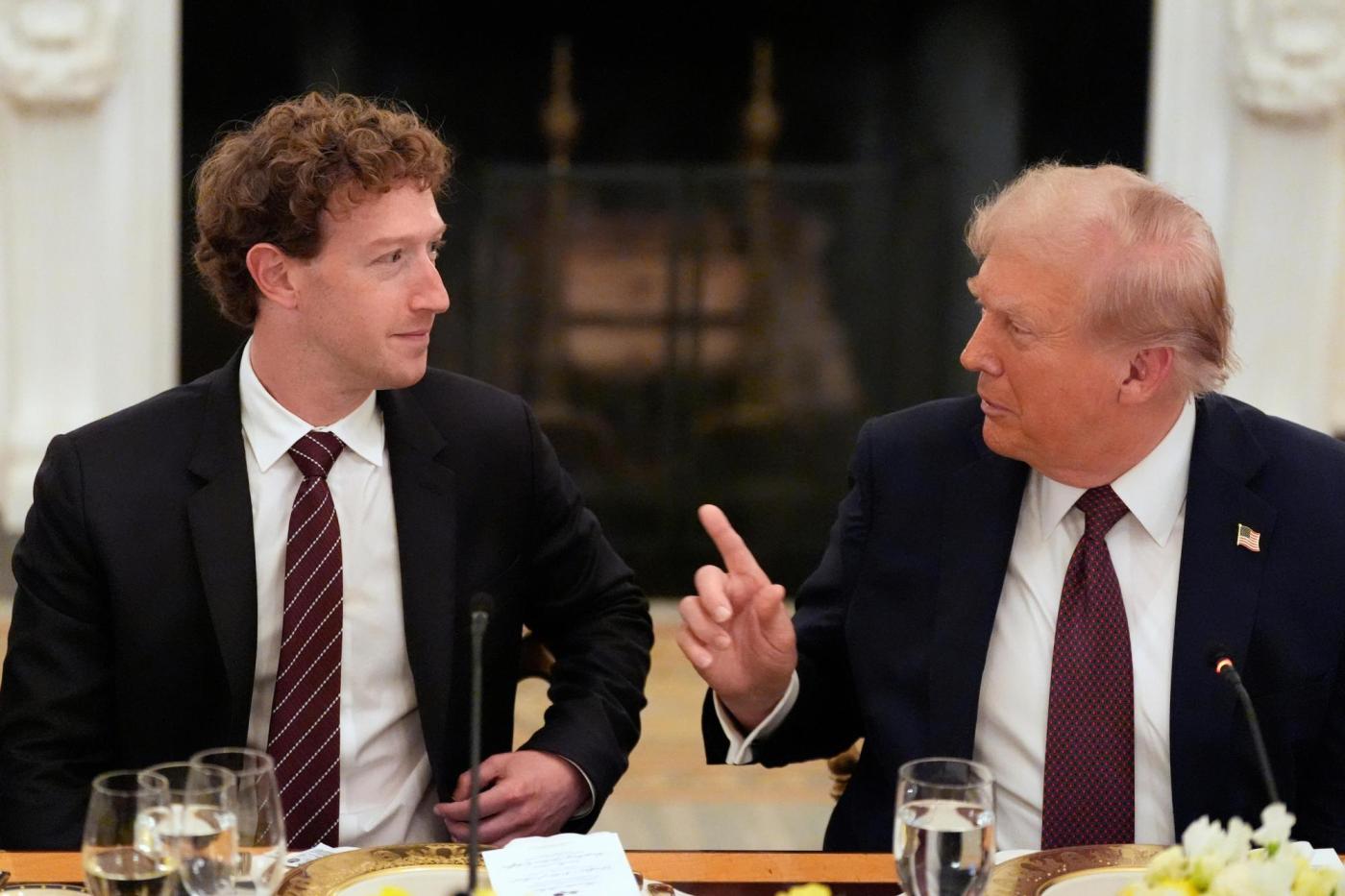
At a September dinner with tech billionaires, Trump said it was an honor to be surrounded by the likes of Bill Gates, Tim Cook, Sergey Brin and Mark Zuckerberg.

FILE – President Donald Trump shakes hands with Apple CEO Tim Cook in the Oval Office, Aug. 6, 2025, in Washington. (AP Photo/Alex Brandon, File)

“There’s never been anything like it,” Trump said. “The most brilliant people are gathered around this table. This is definitely a high-IQ group and I’m very proud of them.”

The White House said the previous Biden administration had alienated the business community to the detriment of the economy. “President Trump’s pro-growth policies and friendly relationships with industry titans, on the other hand, are securing trillions in investments that are creating jobs and opportunities for everyday Americans,” White House spokesman Kush Desai said.

Last month, Trump celebrated a charitable contribution of $6.25 billion to the “Trump” investment accounts for children by Michael Dell. It was a chance to talk about economic inequality — but also another opportunity for Trump to showcase his relationship with billionaires.

FILE – President Donald Trump shakes hands with Michael Dell as his wife Susan looks on, during an event on “Trump Accounts” for kids in the Roosevelt Room of the White House, Dec. 2, 2025, in Washington. (AP Photo/Evan Vucci, File)

Trump takes phone calls from billionaires and CEOs to chat about business, politics and interests such as his planned White House ballroom. He regularly peppers his speeches with shoutouts to Nvidia founder Jensen Huang, whose net worth was estimated by Forbes at roughly $162 billion as of Sunday.

He’s installed billionaires in his inner circle such as Commerce Secretary Howard Lutnick (net worth: $3.3 billion) and Special Envoy Steve Witkoff (net worth: $2 billion). He put Elon Musk (net worth: $780 billion) in charge of slashing government payrolls before a dramatic falling-out and, later, a public reconciliation.

White House press secretary Karoline Leavitt at a briefing last month portrayed Trump’s own status as a billionaire as a positive for him with voters.

“I think it’s one of the many reasons they reelected him back to this office, because he’s a businessman who understands the economy and knows how to fix it,” she said.

Trump slams UK deal to hand over Chagos Islands after he previously backed it

posted in: All news | 0

By JILL LAWLESS, Associated Press

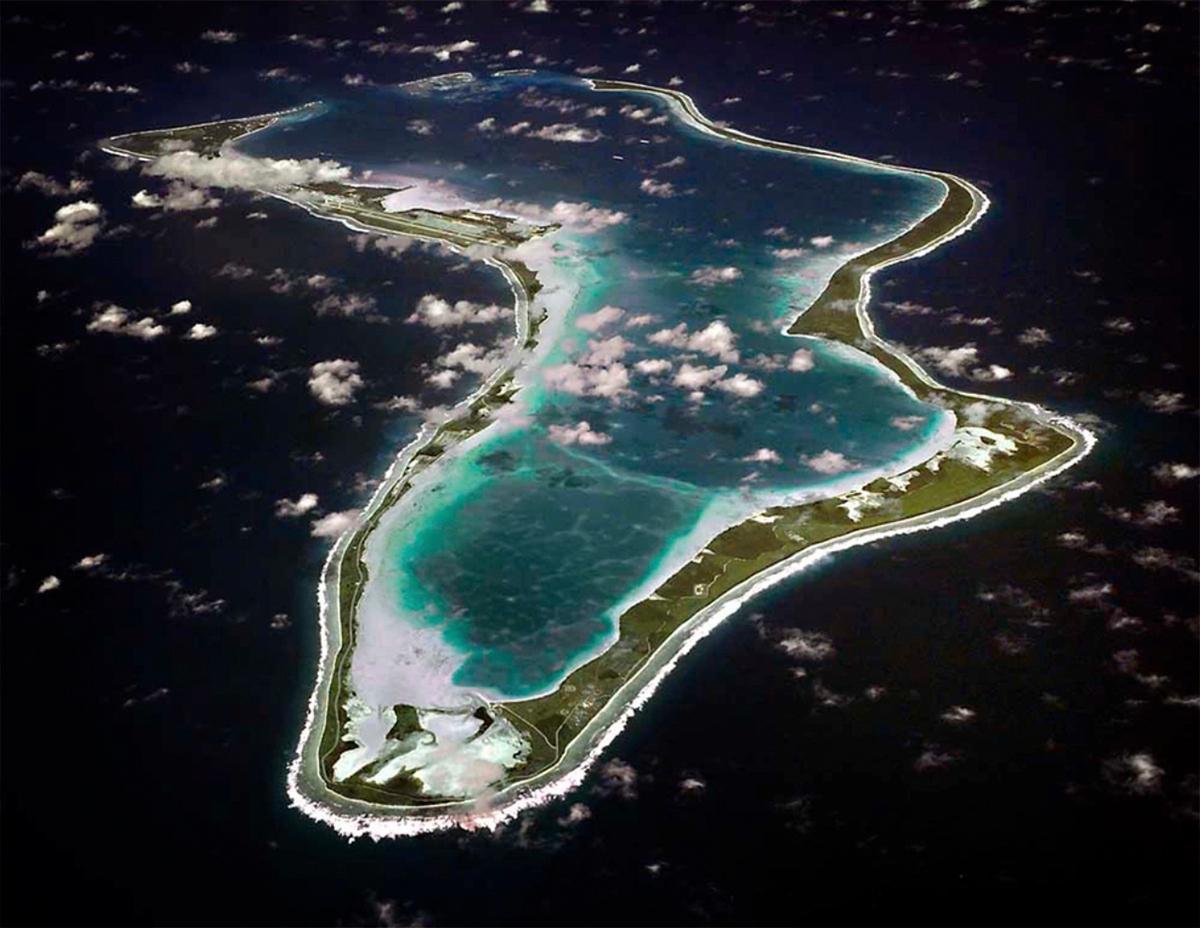
LONDON (AP) — A startled British government on Tuesday defended its decision to hand sovereignty of the Chagos Islands to Mauritius, after U.S. President Donald Trump attacked the plan, which his administration had previously supported.

Trump said that relinquishing the remote Indian Ocean archipelago, home to a strategically important American naval and bomber base, was an act of stupidity that shows why he needs to take over Greenland.

President Donald Trump speaks with reporters after arriving at Palm Beach International Airport, Monday, Jan. 19, 2026, in West Palm Beach, Fla. (AP Photo/Julia Demaree Nikhinson)

“Shockingly, our ‘brilliant’ NATO Ally, the United Kingdom, is currently planning to give away the Island of Diego Garcia, the site of a vital U.S. Military Base, to Mauritius, and to do so FOR NO REASON WHATSOEVER,” he said in a post on his social media platform Truth Social. “There is no doubt that China and Russia have noticed this act of total weakness.”

“The UK giving away extremely important land is an act of GREAT STUPIDITY, and is another in a very long line of National Security reasons why Greenland has to be acquired,” Trump said.

The blast from Trump was a rebuff to efforts by Prime Minister Keir Starmer to calm tensions over Greenland and patch up a frayed trans-Atlantic relationship. Starmer on Monday called Trump’s statements about taking over Greenland “completely wrong,” but called for the rift to be “resolved through calm discussion.”

Remote but strategic

The United Kingdom and Mauritius signed a deal in May to give Mauritius sovereignty over the Chago Islands after two centuries under British control, though the U.K. will lease back Diego Garcia where the U.S. base is located, for at least 99 years.

Related Articles


Top EU official questions Trump’s trustworthiness over Greenland tariff threat


Trump’s voice in a new Fannie Mae ad is generated by artificial intelligence, with his permission


Judge refuses to block new DHS policy limiting Congress members’ access to ICE facilities


How abortion coverage threatens to prevent a congressional deal on health care subsidies


Christian leaders urge protecting worshippers’ rights after protesters interrupt service

The U.S. government welcomed the agreement at the time, saying it “secures the long-term, stable, and effective operation of the joint U.S.-U.K. military facility at Diego Garcia.”

U.K. Cabinet Minister Darren Jones said Tuesday that the agreement would “secure that military base for the next 100 years.”

In recent years, the United Nations and its top court have urged Britain to return the islands to Mauritius, and the British government says it’s acting to protect the security of the base from international legal challenge.

A government spokesperson said that “the U.K. will never compromise on our national security,” and “this deal secures the operations of the joint U.S.-U.K. base on Diego Garcia for generations, with robust provisions for keeping its unique capabilities intact and our adversaries out.”

But the deal has met strong opposition from British opposition parties, which say that giving up the islands puts them at risk of interference by China and Russia.

Islanders who were displaced from the islands to make way for the U.S. base say they weren’t consulted and worry the deal will make it harder for them to go home.

Strong opposition

Legislation to approve the agreement has been passed by the House of Commons, but faced strong opposition in Parliament’s upper chamber, the House of Lords, which approved it, while also passing a “motion of regret” lamenting the legislation. It’s due back in the Commons on Tuesday for further debate.

Conservative Party leader Kemi Badenoch criticized Starmer’s Labour Party government over the agreement.

Badenoch said in an X post that Trump is right and that Starmer’s “plan to give away the Chagos Islands is a terrible policy that weakens UK security and hands away our sovereign territory. And to top it off, makes us and our NATO allies weaker in the face of our enemies.”

Reform UK leader Nigel Farage, an ally of the president said: “Thank goodness Trump has vetoed the surrender of the Chagos islands.”

The U.S. has described the Diego Garcia base, which is home to about 2,500 mostly American personnel, as “an all but indispensable platform” for security operations in the Middle East, South Asia and East Africa.

The Chagos Islands have been under British control since 1814, when they were ceded by France. Britain split the islands away from Mauritius, a former British colony, in 1965, and evicted as many as 2,000 people from the islands so the U.S. military could build the Diego Garcia base.

An estimated 10,000 displaced Chagossians and their descendants now live primarily in Britain, Mauritius and the Seychelles. Some have fought unsuccessfully in U.K. courts for many years for the right to go home.

The U.K.-Mauritius deal calls for a resettlement fund to be created for displaced islanders to help them move back to the islands — apart from Diego Garcia.

US futures and other world shares sink on worries over Trump’s push to claim Greenland

posted in: All news | 0

By YURI KAGEYAMA, Associated Press Business Writer

TOKYO (AP) — U.S. futures fell sharply and European markets shed more than 1% on tensions driven by the Trump administration’s new tariff threats over Greenland.

Related Articles


NYSE working on a new platform for trading digital tokens around the clock


Hours after ABC News ran a story about Mischief Toy Store, ICE agents arrived at their door


How to conduct your own portfolio makeover


Inequality and unease are rising as elite Davos event opens with pro-business Trump set to attend


What to know about the annual World Economic Forum meeting in Davos

France’s CAC 40 slipped 1.2% to 8,014.42, while Germany’s DAX lost 1.5% to 24,581.44. Britain’s FTSE 100 shed 1.3% to 10,068.04.

The future for the S&P 500 sank 1.8% while that for the Dow Jones Industrial Average dropped 1.6%.

Trump said Saturday that he would charge a 10% import tax starting in February on goods from Denmark, Norway, Sweden, France, Germany, the United Kingdom, the Netherlands and Finland because of their opposition to American control of Greenland.

Trump’s threats have sparked outrage and a flurry of diplomatic activity across Europe, as leaders consider possible countermeasures, including retaliatory tariffs and the first-ever use of the European Union’s anti-coercion instrument.

Meanwhile, U.S. Treasury Secretary Scott Bessent, speaking on the sidelines of the World Economic Forum annual meeting in Davos, Switzerland, asserted that America’s relations with Europe remain strong. He urged trading partners to “take a deep breath” and let tensions driven by the tariff threats over Greenland “play out.”

In Asian trading, Tokyo’s benchmark Nikkei 225 lost 1.1% to 52,991.10 after Prime Minister Sanae Takaichi called a snap election for Feb. 8.

Yields on long-term Japanese government bonds surged after Takaichi indicated Monday she planned to dissolve parliament and hold an election, aiming to capitalize on her strong public opinion ratings. She also has proposed temporarily suspending the food tax.

Expectations that Takaichi will take a renewed electoral mandate to raise government spending have revived worries over Japan’s national finances, pushing yields sharply higher, while prices of such investments have fallen as investors sold their holdings. The yield on the 40-year government bond surged to a record 4% on Tuesday, while yields on other long-term bonds also have been surging to decades-high levels.

Chinese markets also declined. Hong Kong’s Hang Seng gave up 0.3% to 26,487.51, while the Shanghai Composite ended nearly unchanged at 4,113.65.

In South Korea, the Kospi dropped 0.4% to 4,885.75, while Australia’s S&P/ASX 200 lost 0.7% to 8,815.90.

Taiwan’s Taiex gained 0.4% and the Sensex in India declined 0.8%.

“Geopolitical events will remain in focus today, particularly any talks that may take place in Davos,” said Michael Brown, a senior research strategist at Pepperstone, referring to the World Economic Forum.

This week will bring more corporate earnings in the U.S. and an update on inflation preferred by the Federal Reserve for making policy decisions.

The U.S. Federal Reserve’s next policy meeting is in two weeks. It’s expected to keep its benchmark interest rate unchanged, as it strives to balance a slowing jobs market with inflation, which remains above the Fed’s 2% goal. The Bank of Japan has a monetary policy board meeting ending later this week.

In other dealings early Tuesday, U.S. benchmark crude oil lost 49 cents to $58.95 per barrel. Brent crude, the international standard, shed 33 cents to $63.61 a barrel.

The U.S. dollar fell to 157.83 Japanese yen from 158.09 yen. The euro rose to $1.1716 from $1.1645.

AP Business Writer Elaine Kurtenbach contributed to this report.