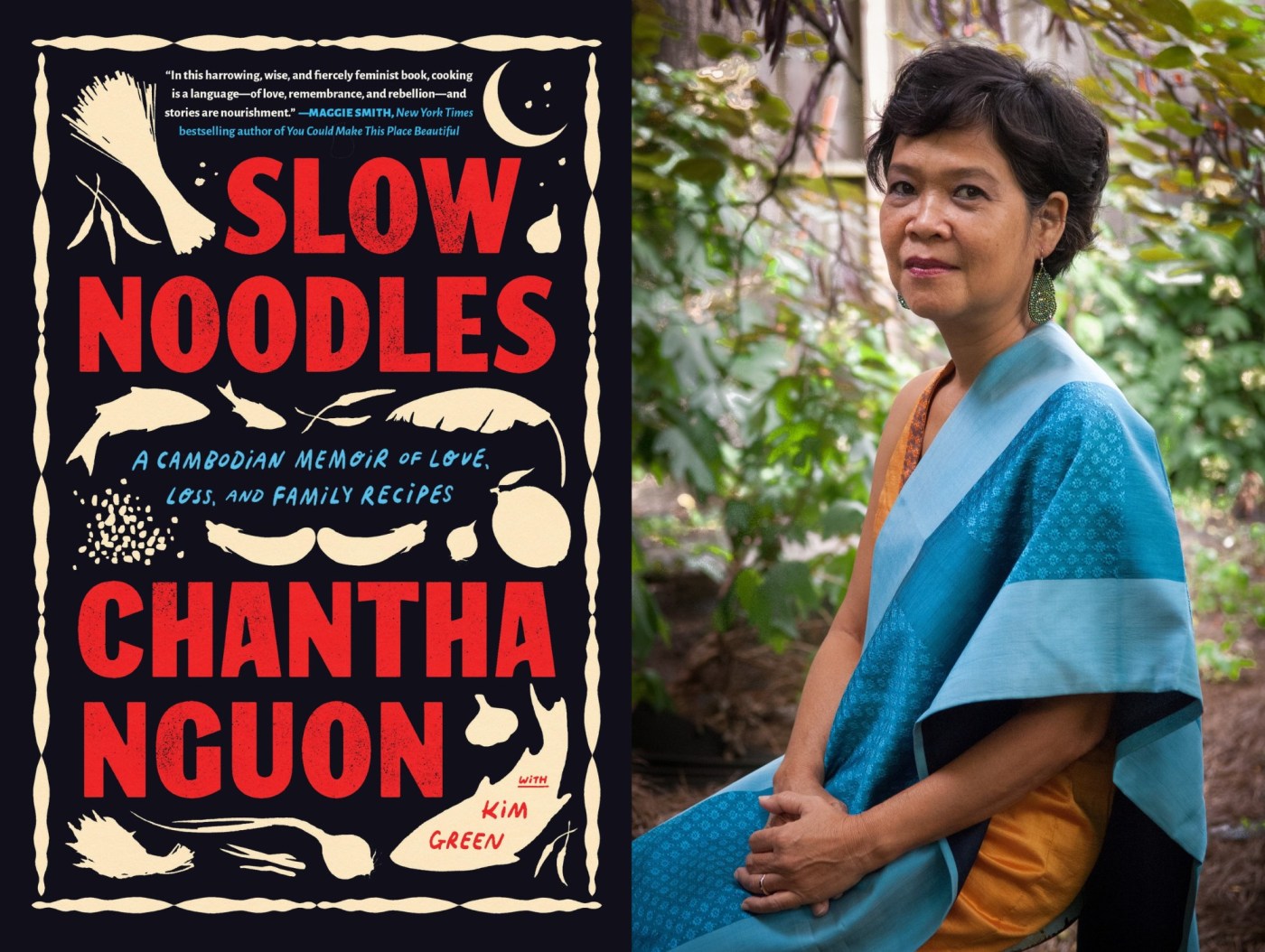
How ‘Slow Noodles’ helped a mother tell of escaping the Cambodian genocide

posted in: News | 0

When her children were younger, Chantha Nguon would often share stories from her life during meals. But they weren’t always the easiest memories to recount.

As a child, Nguon had been uprooted from her home in Cambodia. Though she made it out of the country and into Vietnam to escape the genocide being inflicted by the Khmer Rouge, more hardships followed.

In her memoir “Slow Noodles,” co-written with Kim Green, Nguon recounts not only these struggles but also her efforts to help those who currently face poverty and hunger the cofounder of Mekong Blue and Stung Treng Women’s Development Center in Cambodia.

She shares her experiences, in part, through a collection of recipes.

“In Cambodia, we have a saying, we don’t lift our shirt to show our skin,” Nguon says on a recent video call from Phnom Penh. Despite her reticence, Nguon knew that she needed to tell her story to her children. “Maybe the children – my children’s generation – they don’t know what happened to their parents, but I want my children to appreciate what they have today,” she says.

Moreover, Nguon’s personal memories are part of the greater, collective history of the terror inflicted by the dictator Pol Pot and the Khmer Rouge in the 1970s.

“That’s a very important part of the book – to tell the world about how to lose your home and become a refugee, to show the world that the Khmer Rouge, Pol Pot, tried to erase our culture,” says Nguon. “But I am the living proof that we don’t accept that and we have to survive and we have to rebuild our country.”

“Slow Noodles” refers in part to the approach to cooking that Nguon’s own mother undertook. “She despised shortcut cooking,” Nguon recalls. “Slow noodles is her dish. She made a noodle by hand, by a small piece of dough and she rolled it into a noodle one by one.”

Similarly, she says, slow noodles is a way of life. “You need extra patience, and especially hope,” says Nguon. It’s a practice she adopted after her return to Cambodia in the early 1990s, where she began working with women impacted by poverty and hunger.

“I looked around and I saw, especially women, they are so vulnerable. They are so poor and they don’t know what to do,” she says. After years of working with Doctors Without Borders, Nguon started her own organization. “We need time to rebuild our life after loss with whatever tools we have, but slow noodles is to go opposite of instant noodles,” she says. “You need time and you need patience and you need hope and you have to do it yourself.”

For Nguon, food and memory go together. “Food is the best of what I remember about my mother and my sister,” says Nguon. “The memory of my mother and my sister and the love of their cooking, it helped me to survive through the harshness, the hardship.”

She adds, “Memory about food is memory about family. It comes together.”

While writing “Slow Noodles,” Nguon and Green would focus on the story in the morning; then in the afternoon, they’d cook. “I realized that to say it out loud is therapy, because it became my belief that everything good will be taken away from me,” says Nguon, adding that, when she had children, she had prepared herself to be separated from them. “After I worked with Kim, it helped me slowly let it go.”

Nguon’s daughter, Clara Kim, is the audiobook narrator of “Slow Noodles.” Kim, who is based in London, says that she volunteered for the gig, despite never having recorded an audiobook before because it’s her mother’s story.

“It’s interesting because I heard a lot of the stories that are not even included in the book since I was very young, but it was never in order,” she says on a recent video call. “To be honest with you, some of the stories are incredibly sad. For example, if we were sitting down at a meal, it could be a really funny, happy story or it could be incredibly difficult. I never really knew which one to expect.”

Reading “Slow Noodles” gave Kim a chronological sense of the stories that she had heard earlier in life. She also learned new details. “The scene where she’s describing her mother’s death. I had never heard that before,” she says. “I can understand why. It’s incredibly difficult for her to talk about that.”

Related Articles

Entertainment |


Who is Jeremiah Brent? Meet the new ‘Queer Eye’ design expert following Bobby Berk’s exit

Entertainment |


Wolfgang Van Halen says he’s surprised by quick success

Entertainment |


What to watch: ‘Shogun’ a worthy remake of classic series

Entertainment |


Pop culture-inspired travel is a serious trend in 2024

Entertainment |


‘Mea Culpa’ review: In Tyler Perry’s Chicago, attorney-client privileges include sex and painting lessons

The book also gave Kim a sense of her father’s life. “Unlike my mom who talked a lot about her past, my father did not,” she says. “I learned everything about his past through the book, which gave me a newfound respect for him and also to understand all the things that he’s gone through as well.”

Kim hopes that “Slow Noodles” will resonate with younger readers whose parents may have gone through similar situations. “It doesn’t have to be Vietnamese refugees or Cambodian refugees,” she says, adding that wars and refugee crises persist throughout the world today.

She also hopes that the book will give people a better understanding of Cambodian culture and food, while noting that people often immediately associate the country with the Khmer Rouge. “I don’t want that to be our legacy,” she says. “I want people to know that our food is delicious. I want them to try to look for Cambodian food. I want Cambodian food to be as popular as Thai food.”

As for Nguon, the book also offers an example for navigating through difficulty.

“I hope the reader will see that it’s a recipe to find strength and also, with my own example, losing everything is not the end of your life. It’s not the end of the story,” she says. “You can always get it back slowly, like the way my mother made the slow noodles.”


‘Elsbeth’ review: ‘The Good Wife’ spinoff tries (and fails) to be a quirkier version of ‘Columbo’

posted in: News | 0

Memorable guest characters were a hallmark of “The Good Wife” during its seven-season run on CBS from 2009 to 2016, and Elsbeth Tascioni was one of the more distinctive. Quirky and easily distracted, she was underestimated and therefore a formidable advocate (or foe) in the courtroom. Played by Carrie Preston with an offbeat cadence and winning sincerity, Elsbeth was a terrific contrast to the glossier, more outwardly sophisticated lawyers in her midst. She worked like gangbusters in small doses. But can a character like that carry an entire show?

“Elsbeth” attempts an answer.

CBS’s latest procedural makes some key changes to her circumstances. She’s no longer based in Chicago (the setting for “The Good Wife” and the show’s first spinoff “The Good Fight”) but has relocated to New York to provide her services as an “outside observer” monitoring the police department after one too many wrongful arrest lawsuits.

But instead of using her legal background and impressive intelligence to weed out corruption or excessive force, creators Michelle and Robert King, along with showrunner Jonathan Tolins, have Elsbeth working in concert with the police, nosing around crime scenes and interviewing witnesses until she solves the case.

It’s a premise that borrows from shows like “Monk” or “Psych” or “Elementary” — long-running successes, all — but the execution leaves much to be desired. “Elsbeth” follows the cat-and-mouse formula of “Columbo,” with a murder unfolding at the top of each episode. This requires a certain amount of storytelling skill to pull off because the audience is already ahead of the main character. We know whodunit. The thrill is in watching our sleuth outsmart the culprit through a combination of deductive reasoning and sly but seemingly harmless questioning of the guilty party. And yet there’s nothing about Elsbeth’s approach or methods that feels intentional — or draws you in.

Her gung-ho presence should make her a ringer, with her fluttery affectation and tote bags loaded up on each arm — no criminal would clock her as a serious threat to their scheme. Elsbeth isn’t lacking self-awareness either, she knows she’s a bit of an oddball. This should create a more interesting dynamic than it does. If only she had a point of view or signature strategy. Something. She bumbles from one observation to the next with her confidant/chaperone, a patrol officer played by Carra Patterson. Every so often they report to Wendell Pierce’s doubting police captain.

Preston is as talented as they come, but she has little to work with here. Patterson and Pierce are given even less. This can’t be creatively fulfilling for anyone, with Elsbeth reduced to a collection of tics and unbridled enthusiasm. What happened to those fantastic chess moves that once defined her as a lawyer?

From left: Carrie Preston as Elsbeth Tascioni and Wendell Pierce as Captain Wagner in “Elsbeth.” (Elizabeth Fisher/CBS)

If you squint, you can see glimmers of the show’s potential. The Kings have a knowing and entertaining interest in pop culture and riff on it in ways that are just this side of camp. One episode is centered around a “Real Housewives”-esque series called “Lavish Ladies.” Another is a parody of “Only Murders in the Building.” The guest stars are first-rate and haveing a ball, from Linda Lavin to Jane Krakowski to Jesse Tyler Ferguson to Stephen Moyer, Preston’s old pal from “True Blood.”

But as a show, “Elsbeth” seems uninterested in capturing the humor, intelligence and fun of the Kings’ previous endeavors. Even with her perpetually sunny disposition, it makes no sense that Elsbeth would be so eager and wide-eyed to embed with the police after a 30-year career as a defense attorney. She may seem flaky at first glance, but she was never the simple-minded naif we see here.

I’ve been rewatching “The Good Wife” recently and am reminded how great the show was for most of its run. Rarely did it take itself too seriously, and it did a better job than most at threading the needle between its case-of-the-week format and servicing longer ongoing storylines. It was — and remains — smarter and tangier than almost anything else on television.

It also had a healthy suspicion of law enforcement. So why turn the wonderfully original Elsbeth into this? It’s baffling to see the Kings embrace such blatant copaganda.

“Elsbeth” — 1.5 stars (out of 4)

Where to watch: 9 p.m. Thursdays on CBS

Nina Metz is a Tribune critic.

How HBO’s ‘The Regime’ creates comedy from an authoritarian regime

posted in: News | 0

Imagine a world where a country’s leader lived a wildly self-indulgent lifestyle and dictated what was to be considered true, and the leader’s followers either cravenly indulge this or blindly believe it all.

No, this isn’t a documentary. HBO’s “The Regime” may have a bland title, but the fictional series, which premieres March 3, is a wild ride, a dark and absurdist satire of authoritarianism, that finds the funny in the sinister and the brutality in the outlandish. 

Set in a fictional Central European country, it centers on the chancellor, Elena Vernham (a mesmerizing, deeply weird Kate Winslet) who rules according to her whims and her paranoia. (She fears her dead father’s disapproval, visiting his glass coffin to pathetically plead her case.)

When she brings in the violent, possibly unhinged army corporal Herbert Zubak (Matthias Schoenaerts) as an aide, sparks fly. He becomes her advisor on everything from his awful country diet to foreign policy, creating new layers of chaos in the palace and the country.   

The show’s creator, Will Tracy, honed his political comedy chops writing for “The Onion News Network” and “Last Week Tonight With John Oliver” and refined his skills writing about power and wealth (and tantrums) on “Succession” and his film, “The Menu.”

He spoke recently by video about the central relationship and the geopolitics, the laughs and the fears. This interview has been edited for length and clarity. 

Q. This is obviously a political show, but it also feels like you were creating the most toxic version of the Sam and Diane dynamic from “Cheers.” 

Herbert originally was a narrative device for the audience to enter this world – a simple country guy who asks, “What is all this?” and “Who are these people? – and he meets everybody, but around page 15 in the pilot, he just faded into the ensemble. 

But I was having trouble making Elena emotionally accessible and the story felt mainly bureaucratic and political. Then I realized he was interesting and had the idea that he might actually have something to say and what he says makes her feel very powerful. 

So just going back to old precepts of how watchable television works, it became a kind of love story like Sam and Diane. There’s a way in which they make themselves feel for little glimpses like the best version of themselves even though it is an incredibly non-traditional and toxic love story.

Q. Elena has a ruthlessness when it comes to holding onto power; she will sacrifice everyone and everything. There are obviously real-life parallels but how do you make the point without making it too on the nose?

We were interested in making a show that had something to say and felt relevant to our world without feeling like a polemic or didactic in any way. Obviously, humor helps with that. And the characters are not emotionally expressive; they’re very presentational and masked, which helps because they would not get on a soapbox and say what they’re thinking about politics because that would not be in their best interest to do so. 

Q. Keplinger, the imprisoned former chancellor, says of Elena that her behavior is born of pain and “you turn their pain to anger and then use it as a cudgel.” But he also says of her, Herbert and their followers that “Broken people love broken people,” which is not so far from Hillary Clinton’s “deplorables” perspective. 

Exactly. Keplinger is a representation of the leftist exasperation, “Why do you people love her and not me?” We were being careful to remember that about the left – he’s certainly the preferable option but he is quite craven and needy and narcissistic in his own specific way. 

Q. Do you feel any empathy for Elena’s cabinet members as they accommodate and appease in ways we’ve seen in real life? 

It’s hard for me to feel that. There’s a story that they tell themselves that they’re doing this for virtuous reasons. But there’s opportunism baked into that feeling of, “I’m going to be the steady hand in there” and sometimes what that means is “I can be that in case this guy gets booted.” They all want to be in pole position. It happens until the moment in which it becomes impossible. And then they’ll do anything to protect themselves. They’ll throw anyone or any idea under the bus to survive. 

I was also inspired a bit by reading about Hitler’s big four cabinet and how even when the Soviets were just days from the bunker and all was lost, there was still a sense they were kind of still positioning themselves, they wanted Papa H to like them the best. 

Q. What did you learn from your days writing for The Onion News and “Last Week Tonight”? Obviously, “Succession” feels like a natural bridge from there to here. 

I think it still stems from The Onion in a way. We were writing these insane, impossible comic stories, but remembering all throughout, even down to the editorial voice style, that it had to have this veneer of verisimilitude. It had to look, sound and feel real, even if what you’re describing is insanity. 

Practically speaking, you also have to do your research to give it the flavor and the structure of how these real-world processes work. And on “Succession” as we’ve seen so many times recently, what would never happen has happened in politics and media and business, so we felt emboldened by that. 

Q. How did you balance the humor with everyone’s outlandish but often brutal behavior and the realism of the geopolitics?

One thing I learned just in my research is just when you think you’ve written something ridiculous and over the top about an authoritarian leader, you read about real-life figures and think, “Boy, maybe we didn’t push it enough.”

Related Articles

Entertainment |


Who is Jeremiah Brent? Meet the new ‘Queer Eye’ design expert following Bobby Berk’s exit

Entertainment |


Wolfgang Van Halen says he’s surprised by quick success

Entertainment |


What to watch: ‘Shogun’ a worthy remake of classic series

Entertainment |


Pop culture-inspired travel is a serious trend in 2024

Entertainment |


‘Mea Culpa’ review: In Tyler Perry’s Chicago, attorney-client privileges include sex and painting lessons

The world of the show is so extreme because the character is so extreme and so powerful and has access to unlimited kinds of material resources – Elena can create her own reality, and then everyone around her has to pretend as though it is reality. To me, that is an inherently funny, absurd, dark situation. 

The comedy is ingrained in the subject matter and the challenge is remembering that there’s real fear and cruelty and pain that comes out of the world that she creates. We have to remember that she’s a dangerous figure and we owe it to ourselves, especially in the world we live in now, to try to make the geopolitics and the consequences of all that feel real and not like a joke. 

Wisconsin Supreme Court rejects Democrats’ congressional redistricting challenge

posted in: Politics | 0

By SCOTT BAUER (Associated Press)

MADISON, Wis. (AP) — The liberal-controlled Wisconsin Supreme Court on Friday rejected a Democratic lawsuit that sought to throw out the battleground state’s congressional maps, marking a victory for Republicans who argued against the court taking up the case.

The decision leaves the state’s current congressional district boundaries in place for the November election.

The decision not to hear the congressional challenge comes after the court in December ordered new legislative maps, saying the Republican-drawn ones were unconstitutional. The GOP-controlled Legislature, out of fear that the court would order maps even more unfavorable to Republicans, passed ones drawn by Democratic Gov. Tony Evers. He signed those into law on Feb. 19 and urged the court to take up the congressional map challenge.

The Elias Law Group, which filed the congressional challenge on behalf of Democratic voters, said the court’s decision on the legislative maps opened the door to them revisiting the other maps.

But the court declined to take up the case. It did not give a reason in the unsigned order.

Justice Janet Protasiewicz did not participate. There was a request for her to recuse, but Protasiewicz said she didn’t participate because she wasn’t on the court when the case was originally brought.

Two of the court’s conservative members, Chief Justice Annette Ziegler and Justice Rebecca Bradley, wrote that although the case was rightfully rejected, “it likely won’t be long until the new majority flexes its political power again to advance a partisan agenda despite the damage inflicted on the independence and integrity of the court.”

The court faced a tight deadline to act in time for the November election. Wisconsin’s elections commission has said district boundaries must be set by mid-March to meet deadlines for elections officials and candidates. Candidates can start circulating nomination papers on April 15 for the Aug. 13 primary.

In the legislative maps ruling, the state Supreme Court said the earlier conservative-controlled court was wrong in 2021 to say that maps drawn that year should have as little change as possible from the maps that were in place at the time. The lawsuit argued that decision warranted replacing the congressional district maps that were drawn under the “least change” requirement.

Six of the state’s eight congressional seats are held by Republicans. In 2010, the year before Republicans redrew the maps, Democrats held five seats compared with three for Republicans.

Only two of the state’s current congressional districts are seen as competitive.

Western Wisconsin’s 3rd District is represented by Republican U.S. Rep. Derrick Van Orden, who won an open seat in 2022 after longtime Democratic Rep. Ron Kind retired.

And southeastern Wisconsin’s 1st District, held by Republican Rep. Bryan Steil since 2019, was made more competitive under the latest maps but still favors Republicans.

Both seats have been targeted by national Democrats.

The current congressional maps in Wisconsin were drawn by Evers and approved by the state Supreme Court. The U.S. Supreme Court in March 2022 declined to block them from taking effect.