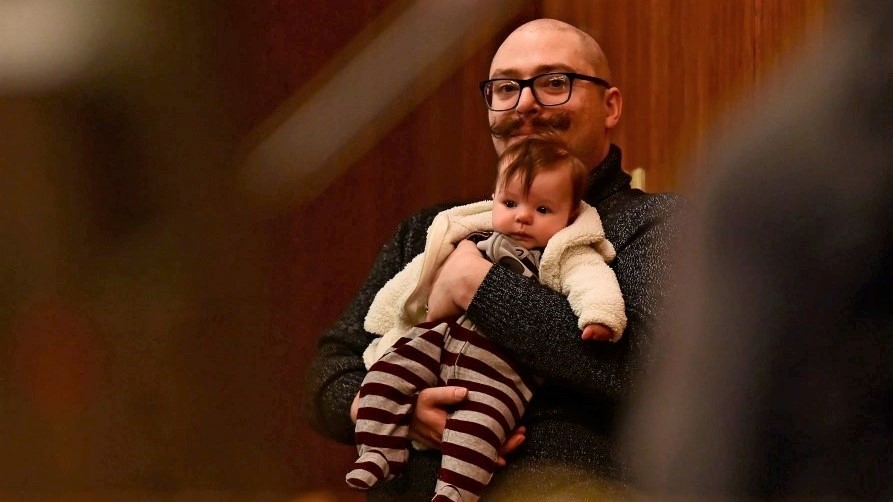
With his 15-month-old daughter Tlameha in hand, Daniel Cox explained to a crowd of sympathetic onlookers that quality child care hasn’t just become prohibitively expensive — it’s also hard to find. His family landed on the waitlist at three different centers.
In the meantime, “we are paying more than our mortgage for child care costs,” said Cox, during a forum at the Rondo Community Library on Dale Street a week ago.
To supervise his young daughter, Cox has worked from home and relied on the help of extended family to look after Tlameha while his wife goes into the workplace, luxuries he acknowledges not every family with young kids can access.
He believes a question on St. Paul’s November ballot could make all the difference for thousands of the city’s low-income families. The ballot language, approved 5-2 by the St. Paul City Council last July, calls for a dedicated fund for subsidies for early child care and early education through a 10-year property tax levy, which would grow annually over that period.
Grants for child care
Childcare advocates gather in front of St. Paul City Hall on Wednesday, March 22, 2023. (John Autey / Pioneer Press)
The fund, which could be administered by a new city department, would issue grants intended to make care for thousands of the city’s youngest children free for low-income families and available on a sliding scale for families at higher incomes.
The grants are intended to help families afford child care, open up new child care spots and help child care providers obtain licensure or complete training to meet program standards.
Given that more than one-fourth of the city’s schoolchildren live under the federal poverty level, organizers say the idea has drawn wide-ranging support.
“These are some of the easiest persuasion conversations you’ll ever find,” said Cox, campaign manager for SPARK, the “St. Paul All Ready for Kindergarten” coalition of early learning advocates backing the ballot initiative.
Ballot question language: “In order to create a dedicated fund for children’s early care and education to be administered by a City department or office that provides subsidies to families and providers so that early care and education is no cost to low-income families and available on a sliding scale to other families, and so as to increase the number of child care slots and support the child care workforce, shall the City of Saint Paul be authorized to levy property taxes in the amount of $2,000,000 in the first year, to increase by the same amount each year following for the next nine years ($4,000,000 of property taxes levied in year two, $6,000,000 in year three, $8,000,000 in year four and so on until $20,000,000 of property taxes are levied in year ten)?
BY VOTING ‘YES’ ON THIS BALLOT QUESTION, YOU ARE VOTING FOR A PROPERTY TAX INCREASE.”
A range of reaction
The proposal has garnered a range of reaction from some of the city’s most progressive voices, dividing even some self-proclaimed child advocates. Concerned about locking in 10 years of property tax increases for an untested municipal program in a single vote, St. Paul Mayor Melvin Carter and city council President Mitra Jalali have both come out firmly against the idea as it’s currently designed.
The mayor, who has backed a number of previous children’s initiatives, vetoed the ballot language last July, only to have his veto overridden by the city council a few weeks later. Carter maintains that the language, as written, “authorizes” but does not require his office to implement the child care subsidy program. He said it would cost far more to effectively set up than its budget would allow.
“They’ll just find out pretty quickly there’s not the pathway around this office that they thought there was,” said Carter, in a brief interview in late February.
Another burden for new homebuyers, property taxpayers?
Many child care centers have faced a fiscal cliff, of sorts, as federal funding provided through the American Rescue Plan Act runs dry.
During a news conference at St. Paul City Hall on Wednesday, Aug. 16, 2023, St. Paul Mayor Melvin Carter explains why he vetoed a ballot measure that would establish preschool and child care grants for low-income St. Paul residents. Later that afternoon, the seven-member St. Paul City Council overrode his veto. (John Autey / Pioneer Press)
Citing workplace shortages, declining enrollment during the pandemic and cost concerns, St. Catherine University in St. Paul recently informed parents it would close its 93-year-old Early Childhood Center in late May.
Still, some critics have said a child care subsidy program would be better administered by the state, county or school district, rather than by the city, which does not maintain a social services department and may have to create an entirely new office. That would entail spending extra money hiring auditors or inspectors to prevent fraud and abuse in an area in which the city has no expertise.
They’ve also noted that the child care subsidy program, as currently described, does not actually mandate an early learning component, and child care providers would not have to be rated by a rating system such as Parent Aware.
Property tax increases
If approved in November, the special property tax levy would be structured to raise $2 million in its first year, $4 million in the second year, $6 million in the third year and so on, reaching $20 million by year 10. SPARK organizers have estimated the median-value home would shoulder $20 in added property taxes in the first year, and $200 by year 10.
That’s left critics to question whether the property tax increases would hurt the very group they intend to support — moderate-income residents — by putting homeownership further out of reach for first-time homebuyers. Housing costs are already viewed as burdensome for too many people in the Twin Cities, and St. Paul’s tax levy is likely to come under added pressure as the retail sector continues to contract due to factors like online shopping.
Meanwhile, office buildings and even some luxury apartments appear to be losing value in the era of remote work, which could further shift the cost of everyday municipal services onto homeowners through future property tax increases.
The mayor’s position
The subsidy proposal has put some progressive advocates in the awkward position of seemingly opposing aid to families in need. The mayor has long prided himself on his outreach to vulnerable children, including forgiving library fines, extending hours and free sports and other activities at city recreation centers, and launching a CollegeBound St. Paul program that offers $50 college savings accounts for newborns.
Before being elected mayor in 2017, Carter was the founding board chair of the school-centered St. Paul Promise Neighborhood, director of the Minnesota Office of Early Learning, and executive director of the Minnesota Children’s Cabinet under former Gov. Mark Dayton.
Still, after the 5-2 council vote last summer to support the ballot language, Carter released a statement saying he had “significant concerns with the lack of details available for what would be a brand new program with a budget that rivals our citywide library system.”
“While I appreciate the ambition behind this well-intentioned initiative, the city’s focus should remain on meeting critical needs like repairing roads and caring for individuals experiencing homelessness, which have gone under-resourced for far too long,” the mayor wrote.
‘A public good’
The SPARK board is chaired by Halla Henderson, a member of the St. Paul school board, and also has drawn backing from state Rep. Dave Pinto, City Council Member Nelsie Yang and Council Member Rebecca Noecker, among others in attendance at last week’s forum.
The speakers noted that academic studies have long established the positive impact of early education on childhood brain development, but a slew of state-backed programs — the Child Care Assistance Program (CCAP), Head Start/Early Head Start and pre-K offered through St. Paul Public Schools — maintain sizable waitlists.
“This is a public good,” said Pinto, taking the microphone at the forum. “There is nothing with greater potential in the entire universe than a brand new human brain. But it needs that nurturing, that support.”
More than half the children in St. Paul live within 185% of the federal poverty level, the threshold used by the state of Minnesota to indicate need for means-tested early learning scholarships, which are in high demand.
How it might work
The state Legislature approved significant funding increases to programs serving children up to 5 years of age last year, but an independent analysis by economist Rob Grunewald found that the city would need an additional $39 million per year to provide early learning supports to all St. Paul children up to 2 years of age within the 185% poverty threshold.
The mayor has pointed out that the $2 million generated in the first year of the program would barely scratch the surface of that need, and would still fall far short in year 10.
“A $120 million program cannot be implemented with $20 million,” said Carter, laying out figures on a whiteboard during an impassioned public presentation against the ballot language last August.
The city’s Early Learning Legislative Advisory Committee, established in September 2022, was the first to call for the creation of a city-driven child care and early learning program funded by a new, dedicated public revenue source. The program would be designed to prioritize families with the most need using a point system that considers factors like income, homelessness, foster care status and having parents under 21, according to the council resolution ordering a special ballot this November.
The program would allow families to access care and apply for financial assistance through a single application or online finder tool. Providers located in St. Paul would be eligible for subsidies to open up new spots, free of charge or on a sliding scale to parents, though a waiver process could also fund providers located outside the city in extenuating circumstances.
Eligible providers would include Head Start and Early Head Start, licensed family child care, licensed child care centers and legal non-licensed providers, including legal non-licensed family, friend and neighbor caregivers. The city council would consider how to support other family, friend and neighbor caregivers, according to the council resolution.
The goal would be to fund programs with a variety of schedules to meet families’ needs, from part-time care to year-round, full and extended-day care. The subsidies could also support providers in obtaining licensure and meeting program standards, and they would be aimed at supplementing — not supplanting — funding available from other sources, such as state early learning scholarships.
As for oversight, the resolution calls for the program to be “held accountable for fiscal and program performance according to clearly defined performance indicators and annual financial audits,” though it remains to be seen what those indicators would be and who would oversee the audits.
Related Articles
Linda Marie Thayer: I was an ICU nurse for 35 years. Let people have a legal choice in how they leave this world
Letters: To deter carjackers and assault? Issue personal bodycams at a low price
Joe Soucheray: What the thousands who lined the streets knew
Shot fired at Ramsey County sheriff’s deputy pursuing vehicle in St. Paul, police say
St. Paul defense attorney avoids prison on sexual misconduct charges; victim: ‘I live in fear’