Thanks to MacKenzie Scott, Angie Alexander moved into her first house last May.
Alexander closed on her house in St. Paul’s Payne-Phalen neighborhood through a new special-purpose credit program at Twin Cities Habitat for Humanity. The nonprofit organization leveraged Scott’s funds to give 100 Black families up to a $50,000 down payment for their first home.
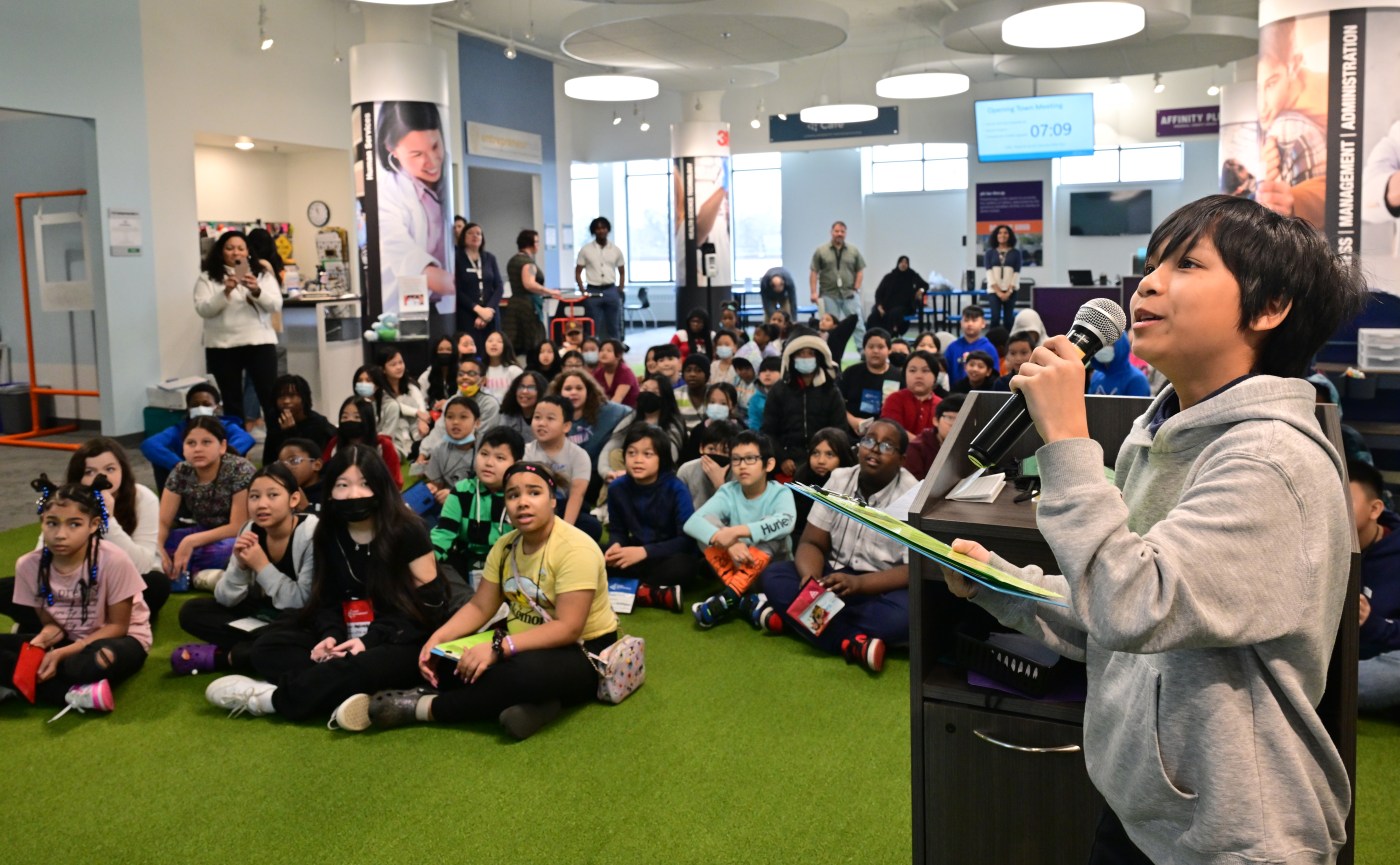
Thanks to Scott, who has become a major philanthropist since her divorce from Amazon founder Jeff Bezos, a group of fifth-graders from Frost Lake Elementary School in St. Paul got to spend a recent school day learning how to cash a paycheck, run a business and vote at Junior Achievement North’s JA BizTown.
Junior Achievement North is using money from Scott to help bring every fifth-grade student from St. Paul Public Schools to BizTown. During her visit, Ava Harrington, 11, of St. Paul, found out that being CEO of Delta Air Lines is a pretty good gig. “The best part is working together, having good ideas together and free flights to anywhere in the world,” she said.
Billionaire philanthropist MacKenzie Scott publicized some $2.1 billion that she’s made in charitable donations since November 2022 in a post Dec. 6, 2023, on her website Yield Giving. (Evan Agostini/Invision/AP, File)
Thanks to Scott, Brittany Pinales was hired last fall to be the director of Big Futures at Big Brothers Big Sisters Twin Cities, where she will help the youth-mentoring organization create programs designed to help young people explore and pursue future career success.
Scott, who has made substantial gifts to organizations that work with historically marginalized race, gender and sexual-identity groups, has donated more than $16.5 billion to more than 1,900 nonprofits since 2020, including more than $116 million to 24 Minnesota-based nonprofits.
Before giving to an organization, Scott’s team does “quiet research to identify (nonprofits) working to advance the opportunities of people in underserved communities,” according to Yield Giving, the philanthropic organization established by Scott in 2022. She makes only unrestricted gifts — leaving it to each recipient to use their grants how they see fit.
“It demonstrates a level of trust and confidence that says, ‘We see you; we see your work and the deep impact it’s having, and we believe in what you’re doing,’” said Marisa Williams, CEO of Girl Scouts River Valleys, which received a $4.2 million gift from Scott in 2022.
Scott may be able to give at a greater scale because she gives unrestricted gifts, said Christopher Wong Michaelson, a professor of ethics and business law at the University of St. Thomas.
“It leaves the hard work of deciding how best to spend those funds up to the beneficiary rather than the benefactor,” he said. “One reward of this strategy is that real issue experts get to decide what to do with the money, but one risk is that it gives the benefactor less control over how the money is spent.”
Scott remains one of the wealthiest women in the world, despite her generosity, “so she is probably not giving up an opportunity to live a comfortable life,” Michaelson said.
Four local nonprofit leaders recently shared with the Pioneer Press how their organizations are using Scott’s donations to transform their organizations. The transcripts have been edited for clarity and conciseness.
Habitat for Humanity
Twin Cities Habitat for Humanity’s work on closing the gap in homeownership for Black households led to a record $13.5 million donation from Scott in March 2022 — the single largest gift ever given to the organization.
Historically, Minnesota has one of the widest racial disparities in homeownership in the U.S., with 77 percent of white households owning homes compared to 42 percent of households of color. That number drops to 25 percent when it’s limited to Black homeowners, said Cathy Lawrence, the organization’s chief of staff.
Cathy Lawrence (Courtesy of Twin Cities Habitat for Humanity)
Habitat for Humanity has been working to dismantle systemic discrimination in Black homeownership “from redlining to racial covenants to predatory lending to building freeways through neighborhoods,” Lawrence said. “All of these things have been a barrier to saving for a down payment, getting a loan and affording a home.”
Habitat officials have spent about $2.5 million of Scott’s gift to date to advance Black homeownership in the metro area and to advance the organization’s diversity, equity and inclusion work — internally and externally, Lawrence said, with plans to scale the advancing Black homeownership program over the next several years.
The money for the down payments is for foundational Black households, “U.S.-born folks who have been traditionally, historically shut out of banking and mortgages,” Lawrence said.
Alexander, for example, was able to buy a three-bedroom, two-bathroom home in St. Paul’s Payne-Phalen neighborhood for herself and her 11-year-old son. After growing up in an apartment in South Minneapolis and 10 years of renting in Roseville, Alexander, 30, says it’s a blessing to own her own home.
Angie Alexander and her Pomeranian, Bruno, pose outside Alexander’s house in St. Paul’s Payne-Phalen neighborhood on Friday, March 1, 2024. (Courtesy of Angie Alexander)
“I’m the first person in my family to own my own home,” said Alexander, who works in Woodbury and is a student at St. Paul College. “The best part is having the freedom to do whatever I want with it. I can do the back yard the way I want to. I’m going to put in a flower garden and plant some vegetables. My son likes zucchini, and maybe I’ll have some cucumbers.”
Owning her own home means Alexander, who is studying to be a surgery technician, can finally have a dog. Her Pomeranian, named Bruno, joined the family in December.
Alexander said she hopes Scott realizes how grateful she is. “I didn’t think I would be able to afford a home until I got out of school,” Alexander said. “I am so thankful for what she’s done for me and my son and for all the others and the Habitat community. She is amazing.”
In addition to the down-payment assistance, the Black homeowners “requested a cohort model of financial coaching because of the financial trauma that they have endured,” Lawrence said. “They wanted to share their trials and tribulations and go arm in arm with people who have suffered the same indignities.”
The organization also plans to invest about $500,000 of Scott’s gift in its internal diversity-equity-and-inclusion efforts, Lawrence said, including the hiring of additional staff to work directly with clients.
Habitat officials originally were asked to provide three years of annual reports explaining how the Scott money would be spent. About six months later, however, Scott’s representatives said those reports would no longer be required.
“That would seem like it’s a good thing,” Lawrence said. “I mean, it’s less work for us, but at the same time we don’t get to share these stories — we don’t get to inspire her to continue to invest in the work, so it’s a little bit of a Catch-22 in my mind that we weren’t able to do that.”
One fascinating aspect of the gift: Scott’s representatives gave Habitat officials the choice of whether they even wanted the $13.5 million. “They wanted to ensure that organizations could handle it, and that we had the capacity to deal with it,” she said.
The organization also was given the option of taking the money in a lump sum or have it parceled out over a three-year period. Lawrence talked to President and CEO Chris Coleman about it. “I said, ‘Do we want to take it over three years? How would that make our financials look?’” she said. “He was, like, ‘I want all the cash, and I want it now.’”
The generous gift has not affected donations, she said.
“We have found that donors have been inspired by it,” she said. “It did not cause any decrease in giving. They know that if MacKenzie Scott felt that we’re a worthwhile place to invest money, then they can do that, too. It was a real endorsement of the work.”
Representatives of Scott have told Habitat officials that the $13.5 million donation was a one-time gift, but Lawrence and other organization officials are hopeful that more money may follow.
“We’re hoping that she understands the impact, and that she would want to continue to have us scale,” she said. “What she’s allowing us to do is make that vision come alive, become a reality, especially for certain families.”
That Scott placed no restrictions on how to spend the money is “amazing,” Lawrence said. “There were no strings attached. She trusted us to do the work. That really is disrupting philanthropy. Unfortunately, we haven’t seen too many more philanthropists follow in her stead and do this, but we can always hold out hope.”
Junior Achievement North
As the mayor of JA BizTown, Justin Htoo, 10, of St. Paul, speaks to his fellow Frost Lake Elementary fifth-graders at Junior Achievement North, one of several local organizations that have benefited from donations from philanthropist MacKenzie Scott. (John Autey / Pioneer Press)
One of Justin Htoo’s first acts as mayor of Junior Achievement North’s BizTown last month was to give a speech and lead the BizTown pledge. The pledge emphasized the importance of telling the truth, helping others, obeying the rules and paying taxes in BizTown, a student-sized town on the second floor of Junior Achievement North’s building on University Avenue in St. Paul. BizTown teaches hands-on lessons in economic concepts, workplace skills, and personal and business finances.
In his speech, Justin encouraged his fellow Frost Lake fifth-graders to vote on what animal should be the mascot of BizTown. “Voting is a very important part of citizenship and a great way to make a difference in your community,” he said.
Scott in 2022 gave $1.9 million to Junior Achievement North, which serves 106,000 students in Minnesota, North Dakota and western Wisconsin.
Sara Dziuk (Courtesy of Junior Achievement North)
The organization has used $1 million of her gift to create a fund to support its experiential learning programs “so more schools and students will be able to participate,” said Sara Dziuk, the organization’s president and CEO. “It is our most expensive program to run, so we rely on philanthropy — as well as a contribution from schools or families — to cover that expense for each student.”
It costs $80 for a student to attend JA BizTown and JA Finance Park; Junior Achievement pays the majority of that cost through fundraising and a new grant from the state of Minnesota. The Scott money is being used to help offset the cost for each school district, she said.
“We are working to stretch the gift as far as we can to reach students across the region,” Dziuk said. “Every little bit helps each school district.”
The Scott money is helping the organization bring every St. Paul eighth-grader and every Minneapolis ninth-grader, along with many other school districts, to JA Finance Park this year. In addition, every fifth-grader in St. Paul Public Schools and Minneapolis Public Schools is slated to participate in JA BizTown next year, she said.
“That’s what we are working towards,” Dziuk said. “Having the Scott fund allows us to offset some of that expense and makes it more affordable for schools or for families.”
Junior Achievement North also is using money from the Scott gift to bring students from other cities in the metro area and greater Minnesota through the programs “so that we can make sure that any student in any school who is interested in this experiential learning opportunity can benefit from it,” she said.
Students participate in a three-week curriculum in their classroom before coming to Junior Achievement for the day. “It’s just incredible to have 150 students bustling around — listening to a student-run radio station and taking their checks and depositing them at a bank and going to a cafe and having their lunch and voting for a student mayor and giving to philanthropy,” she said.
The organization is using some of Scott’s gift — about $700,000 — to support its strategic program growth initiatives over the next three years, including the hiring of five additional full-time staff. It also has used some of Scott’s money to create a BizTown pop-up — a mobile BizTown experience — to use in North Dakota and greater Minnesota, and plans to add an additional 25 job-shadow experiences for high school students in the metro area, she said.
Small plane crash in yard of Afton home kills two onboard
Fox Weather’s Ian Oliver visits Minneapolis for Special Olympics cold plunge fundraiser
U.S. House observes moment of silence for fallen first responders from Burnsville
St. Paul Public Library launching new Mobile Library
St. Paul enters into citywide trash hauling negotiations. Public Works to service difficult routes.
The job-shadow experience involves taking a classroom or a grade level to a corporate environment like Cargill, U.S. Bank or United Healthcare. “They have a chance to see firsthand what it looks like to work in these different organizations,” Dziuk said. “They learn about all of the different jobs that can be available. It’s a fantastic experience for students to be exposed to different careers and industries.”
The donation also is being used for technology upgrades, building maintenance and marketing. “We wanted to have some dollars to make some key investments, so we’ve done things like we ordered 50 new laptop computers so that we can have better technology within our learning labs for that simulation experience,” she said.
“This is a transformative gift, but it’s transformative only when it’s additive,” Dziuk said. “It’s opened doors for us in terms of the impact we can have, but we need to continue to look for philanthropic support and identify partnerships that will allow us to expand our work further. This gift gave us momentum. It gave us fuel and traction in the community so that we can raise more money and grow programming in support of students.”
Think Small
Officials from Think Small, a Little Canada-based nonprofit that works in early-childhood education, aren’t sure how Scott found out about the organization. She gave Think Small $2 million last fall.
“It’s very secretive. We don’t know who her spies are here,” said Tracy Nordstrom, president of the organization’s board. “But we feel very fortunate, obviously, that she recognizes the importance of early-childhood learning, and she recognizes Think Small is a leader in Minnesota.”
Tracy Nordstrom (Courtesy of Tracy Nordstrom)
The nonprofit looks at ways to train and support early educators, with a special emphasis on early literacy. “Our goal is that every kid in Minnesota shows up in kindergarten ready to learn, ready to read, ready to lead,” she said.
Think Small is using Scott’s donation as seed money — “we call it the sourdough starter” — for a $10 million campaign, Nordstrom said.
The organization’s $10 million “innovation and advocacy fund” will magnify parents’ voices in policymaking and help provide more quality child care options throughout the state, Nordstrom said.
“Think Small will continue to do what Think Small has been doing all along, which is to innovate and to advocate in the early-childhood space,” she said. “We will continue to innovate based on research and what each community needs to improve quality and improve access for early childhood — that’s nutrition, that’s home-visiting nurses, that’s child care during the day for little kids, that’s preschool, that’s coaching for all the providers, that’s continuing education for anybody who’s in the early childhood world, all of that.”
Scott’s $2 million gift has already inspired an additional $3 million in local contributions, she said.
“It’s like the bread is rising, you know? That’s what it feels like to me,” Nordstrom said. “It felt like a tremendous affirmation to have somebody outside of Minnesota recognize the 50-plus years of work that Think Small has done in early childhood. We wanted to open it up and say, ‘Who wants to join us and who wants to join MacKenzie Scott to put some more money in here? What can we innovate? What can we expand, and what can we do with this money moving forward?’”
Think Small plans to use money from the fund to expand its Think Small Institute, which helps early-childhood educators gain professional development opportunities and individualized coaching support from experts in child development. The institute expanded online during COVID, she said, and can now reach folks throughout the state.
“The pandemic really forced us to put everything online — just like every other business — and what we realized is, ‘Hey, we are pretty good at this. We can reach out to Crookston. We can have folks in Moorhead. We can have people up in Warroad participating in our programming, our coaching, training all of that online,’” she said.
An estimated 30,000 children in Minnesota have “zero access” to high-quality early-learning experiences, ages 0 to 5, according to Nordstrom. “They’re either in a child care desert, there’s no quality child care nearby, or they simply can’t afford it,” she said. “The $2 million sounds like a ton of money, but we are just beginning to reach those 30,000 kids, so it’s delightful and not adequate. So I say, ‘Give me your $500, give me your $5. Let’s keep the energy going, and let’s reach as many kids as we can.’”
Nordstrom said she has been amazed by the “cross section” of causes that Scott has been supporting with her foundation.
“The commonality is that they all build community and build opportunity,” she said. “It’s racial equity, it’s education, it’s community building, it’s all this stuff, which, you know, is what I can tell, in my analysis, is just building humanity, and it’s supporting the possibility of being our best selves. That’s a positive, joyful, wonderful thing.”
Big Brothers Big Sisters Twin Cities
The $6 million that Scott gave to Big Brothers Big Sisters Twin Cities is the largest donation in the youth-mentoring organization’s 104-year history.
The gift was part of a $122.6 million contribution Scott gave to Big Brothers Big Sisters of America and to local affiliates. The Twin Cities chapter is using the money “to revamp the organization in a way that will create greater impact” and recruit more mentors, especially male volunteers, said Pat Sukhum, CEO of Big Brothers Big Sisters Twin Cities.
Pat Sukhum (Courtesy of Big Brothers Big Sisters Twin Cities)
“The dollars are really being transformational,” he said. “They are absolutely redefining and pivoting how we are approaching community and the work we’re doing. It’s an incredible opportunity for youth-centered impact.”
The timing of the gift, which the organization received in May 2022, couldn’t have been better, said Sukhum, who was named CEO in June 2021.
The organization had recently moved into its new headquarters in North Minneapolis, and officials “were right in the midst of saying, ‘We need to go out and get a lot more community feedback and input into our program,’” Sukhum said. “We had a new leader and a new space, and we were in a new community, and now we have these dollars to bring it to life.”
Big Brothers Big Sisters officials ended up talking to more than 700 community members, including hundreds of “Bigs, Littles and families,” Sukhum said.
“We had to make some big pivots after that,” he said. “We found that we had room to grow. We’re over 100 years old, and if you don’t evolve over 100 years, you’re going to become irrelevant to the community. The community input really sparked us to say, ‘OK, we’ve got to redefine who we are.’ We were coming into a strategic-planning phase, and we really approached it in a much bigger way. How do we really gather voice? How do we pull in our participants?”
Eight-five percent of the youth served by Big Brothers Big Sisters Twin Cities are youth of color; 55 percent are Black. The organization’s commitments to justice, equity, diversity and inclusion align with Scott’s support of equity and the needs of underrepresented people, Sukhum said. “She speaks often — and supports often — organizations focused on youth development.”
The organization has allocated $3 million of Scott’s gift to the investments identified in its strategic plan. “We really want to look at these MacKenzie Scott dollars as transformational, right?” Sukhum said. “We don’t want to put $6 million in a bank and have it just grow interest.”
The $6 million has allowed Big Brothers Big Sisters Twin Cities “to invest with pace,” he said. “Historically, it has been a scramble. It was, ‘Let’s do a one-off thing because we have limited resources.’ We had a scarcity mentality. What MacKenzie Scott allows us to do is approach our decisions with a value-based mentality, an investment-based mentality.”
Twelve to 15 new staff will be hired to support the strategic plan — hires that will initially be paid for with dollars that came from Scott, he said.
“We plan to write a formal letter, ‘Dear Ms. Scott,’ and show our thanks and gratitude for what she is doing in our community,” he said. “She is transforming lives. We want her to know how we’re putting these dollars to work and how we speak of it in a transformational way. We hope it can be inspirational to other organizations, inspirational to community building, and to other funders and how they give.”
MacKenzie Scott Minnesota donations
MacKenzie Scott has given more than $116 million to these 24 Minnesota nonprofits, according to Scott’s website, yieldgiving.com.
She gave $28 million in 2023:
Southside Community Health Services, $2.6 million (2023)
Project for Pride in Living, $7 million (2023)
City of Lakes Community Land Trust, $10 million (2023)
Hmong American Partnership, $2 million (2023)
Way to Grow, $2 million (2023)
Think Small, $2 million (2023)
BWJP, $2.5 million (2023)
She gave at least $43 million in 2022:
Girl Scouts of Minnesota and Wisconsin River Valleys, $4.2 million
Boys and Girls Clubs of the Twin Cities, $4.8 million
Big Brothers Big Sisters Twin Cities, $6 million
Big Brothers Big Sisters of Central Minnesota, $1.5 million
Red Lake Nation Boys & Girls Club, undisclosed amount
Twin Cities Habitat for Humanity, $13.5 million
Dakota Medical Foundation, $10 million
Boys and Girls Club of White Earth, $1.25 million
Junior Achievement North, $1.9 million
She gave $33 million in 2021:
YMCA of the North, $18 million
Penumbra Theatre, $5 million
Greater Minnesota Housing Fund, $7 million
YWCA St. Paul, $3 million
And she gave at least $12 million in 2020:
Duluth Area Family YMCA, undisclosed amount
YMCA of Cass and Clay Counties, $10 million
Esperanza United, undisclosed amount
YWCA of Cass and Clay Counties, $2 million
SPNN cable access finds new roommates in Sahan Journal, Listen Up! Youth Radio at Vandalia Tower site in St. Paul
Application open: Eagan nonprofits welcome to apply for community support grants
‘Heroic actions’ of law enforcement meant safety for family in Burnsville home, says relative of gunman’s girlfriend
Donation platform announced for families of Burnsville’s fallen first responders as second vigil is held
JoAnn Clark introduces Black kids to Black colleges. She’s being honored by Harding High School.