Oscars 2024: Who will win? Who should win?

posted in: News | 0

Questions abound about this year’s Oscars.

Will odds-on-favorite Christopher Nolan win his first director’s trophy?

Will “Killers of the Flower Moon’s” Lily Gladstone score a win and make Oscar history?

Will the telecast be more playful and less painful than this year’s Golden Globes?

Heck, we have as many questions as we did after watching “Anatomy of Fall.”

And the main question is this: Will the Academy toss viewers a surprise or two during its 96th Oscars presentation on March 10? We hope so, surprises are (usually) fun. The show starts at 4 p.m. — an hour earlier than usual — on ABC with late-night TV funnyman Jimmy Kimmel returning for a fourth time as host.

Many figure it’s a fait accompli that Nolan’s “Oppenheimer,” which amassed more nominations (13) than any other film, will continue its chain reaction and dominate Hollywood’s biggest night. Should it, though?

There are other vitally important issues that concern us, including:

When, exactly, is Ryan Gosling performing “Barbie’s” Oscar-nominated song “I’m Just Ken”? (It better not be while we’re refreshing our Cosmos!)
Will Messi, the 7-year-old border collie who stars in “Anatomy of a Fall,” be a presenter?
Will East Bay filmmaker Sean Wang’s adorable grandmothers — who star in his nominated short documentary “Nǎi Nai and Wài Pó” — make an appearance up on stage should that film win?

We are glad to note the Academy has already answered another burning question: Yes, they are bringing back the routine — executed to great effect in 2009 — of having the five past winners in all four acting categories introduce the nominees in the performance categories this year.

In short, the ceremony needs to create some indelible moments this year to enliven what’s shaping up as a predictable yawner of an awards show, with few categories truly up for grabs.

In the meantime, here are our predictions for what/who will win Sunday night, and what/who should win.

Best picture

The nominees: “American Fiction,” “Anatomy of a Fall,” “Barbie,” “The Holdovers,” “Killers of the Flower Moon,” “Maestro,” “Oppenheimer,” “Past Lives,” “Poor Things,” “The Zone of Interest”

What will win: This is hardly a Chiefs/49ers nail biter. Let’s shake it down anyway. “American Fiction” meted out stinging truths about a publishing industry that isn’t nearly as woke as it likes to think it is, and in the process made us laugh and cry over issues of race, sexuality and family. It’s good enough to score an upset — just not tonight. “Anatomy of a Fall” is a mystery that raises more questions than it answers, a no-no for Hollywood, which prefers resolution over opaqueness. “Barbie” transformed a Mattel doll into a feminist statement. It’s a clever concept and a clever movie, but it’s not enough to win. “The Holdovers” warmed hearts and souls, but will have to be satisfied with likely evolving into a holiday movie tradition. The laborious length of “Killers of the Flower Moon” (3 and … a … half … hours … ), not to mention Leonardo DiCaprio’s prosthetic teeth, gave us the fidgets. No one’s going to pick up the baton for “Maestro.” No one. “Past Lives” featured a subtle build with a gale-force emotional ending. Oscar prefers writ-large movies with more exclamation points. “Poor Things” is way too naughty and outside the box for the pious Oscar crowd. And “The Zone of Interest” is unlike any other movie, making it too nontraditional and nonconforming for the win. That leaves Christopher Nolan’s prestige title “Oppenheimer” sitting ever so pretty with a lock on the prize.

What should win: “The Zone of Interest.” Jonathan Glazer’s unique creation about a family that lives next door to Auschwitz is an unsettling classic in the making. It serves as a historical testament and a reminder that the mundanity of evil can make all of us complacent to, and complicit in, the horrors of mass cruelty. It’s a staggering work of genius. And it has almost no chance of winning.

Best actor

Nominees: Paul Giamatti (“The Holdovers”), Cillian Murphy (“Oppenheimer”), Jeffrey Wright (“American Fiction”), Bradley Cooper (“Maestro), Colman Domingo (“Rustin”)

Who will win: Giamatti turned a grousing prof with a lazy eye and some secrets into a joy to behold. But character actors playing everyday people — no matter how good they are — rarely snare an Oscar in the top acting categories. Wright brought his thespian skills and gravitas to his literary fussbudget role and it was a seamless performance. It could score an upset, but we doubt it. Cooper gave it his all but he wasn’t always on the nose with his portrayal of Leonard Bernstein take. (Too soon?) Without that electrifying turn from Domingo as a largely overlooked gay civil rights pioneer, “Rustin” would have been just an OK biopic. He’s dynamite, but the performance and film has no awards season traction going. So that leaves Murphy. As he’s known to do, he flung himself fully into the part of the enigmatic J. Robert Oppenheimer, father of the atomic bomb. He was good, but he’s been better. Doesn’t matter. He’ll win.

Who should win: Wright. As an indignant and pompous author whose outrage lands him an accidental bestseller, Wright made a prickly character relatable, even likable.

Best actress

Nominees: Annette Bening (“Nyad”), Lily Gladstone (“Killers of the Flower Moon”), Sandra Hüller (“Anatomy of a Fall”), Carey Mulligan (“Maestro”), Emma Stone (“Poor Things”)

Who will win: Bening dove into her role (even becoming quite the swimmer) to play the larger-than-life Diana Nyad. Expect her to feel the sting not from a nasty jellyfish, but from yet another loss come Oscar night (she’s already 0 for 4 on best actress nominations). Hüller delivered a deliciously ambiguous performance as the did-she-or-didn’t-she wife of a writer who has died in a mysterious fall. It’s way too nuanced to win. Mulligan played a spouse in love with a man who could never be entirely devoted to her. It was crushing to behold, but the movie was more preoccupied with its bigger moments than with fleshing out its characters — including hers. Stone’s already won an Oscar and that erodes her odds, even if her re-animated girl-to-woman Bella is a piece of physical and emotional acting brilliance. This will be Lily Gladstone’s night. She was the best thing about “Killers,” which was too preoccupied with its male characters. Another factor in her favor is a win would maker her the first Native American to take home the acting prize.

Who should win: Stone. Hers was one mad dervish of a performance that demonstrated an extraordinary commitment — even creating that funky walk and that weird diction. How Bella changes incrementally throughout the film makes for a performance for the ages. Stone, who won best actress for “La La Land,” has never been better.

Best Supporting Actor

The nominees: Sterling K. Brown (“American Fiction”), Robert De Niro (“Killers of the Flower Moon”), Robert Downey Jr. (“Oppenheimer”),  Ryan Gosling (“Barbie”), Mark Ruffalo (“Poor Things”)

Who will win: Too many great performances (Charles Melton in “May December” and Willem Dafoe in “Poor Things”) received the cold shoulder from Oscar in this category. But let’s handicap what we’ve got. Brown did something extraordinary as a recently out gay man who’s burdened and burnt by a father’s scorn. Not gonna happen. De Niro channeled his past roles to play a crime boss who orchestrated the Osage Indian murders, and it wasn’t much of a stretch. Gosling was hilarious as clueless Ken, but it was simply a fun performance, not a great one. Ruffalo played a sleazebag ever so well, but he sounded the same note throughout. That leaves showstopper Downey Jr., who tore up the scenery as a duplicitous politician. (Isn’t that an oxymoron in this election year?)

Who should win: Downey Jr. Without that greatest showman on Earth’s performance, “Oppenheimer” would have deflated like a leaking balloon during the final lap. He kept us riveted.

Best Supporting Actress

Nominees:  Emily Blunt (“Oppenheimer”), Danielle Brooks (“The Color Purple”), America Ferrera (“Barbie”), Jodie Foster (“Nyad”), Da’Vine Joy Randolph (“The Holdovers”)

Who will win: We love Blunt, but hers was one of the most underwritten female roles of last year. If Oprah can’t land an Oscar, don’t expect Danielle Brooks to stick that award landing for the same role. Ferrera delivered a feminist monologue that rallied audiences and elicited applause, but there wasn’t much else to her performance. Foster took the one-note role of a coach/former lover and swam laps around everyone else in the film. But she’s won before, and the competition out of the water here is too strong. This will be Randolph’s year. There was nothing half-baked about her tender performance as a cook and grieving mom trying to get through the holidays.

Who should win: Randolph. No contest. There was so much emotion in her every move.

Best Director

Nominees: Justine Triet (“Anatomy of a Fall”), Martin Scorsese (“Killers of the Flower Moon”), Christopher Nolan (“Oppenheimer”), Yorgos Lanthimos (“Poor Things”), Jonathan Glazer (“The Zone of Interest”)

Who will win: Triet’s “Anatomy” fan base keeps on expanding — just not enough. Scorsese’s been here 10 times before, even won once. But he won’t win here. Lanthimos choreographed a feminist Frankenstein tale with brilliant, so-alive madness, but his film’s too perverse for Oscar. Glazer gave us a real crawl-under-your-skin living nightmare filled with the sounds of violence. But his unique approach will probably disconnect with some voters. This is Nolan’s year. His “Oppenheimer” is a big movie about a game-changing event and person. He’s a shoo-in.

Who should win: Glazer. He created a movie unlike any other. There is no one else in this category that can claim the same, except for Lanthimos, and Glazer’s work was better.

Contact Randy Myers at soitsrandyt@gmail.com.

THE 96th ACADEMY AWARDS

When: 4 p.m. PST

Where: ABC, also streaming on ABC.com, Hulu Live TV, YouTubeTV, AT&T TV,  FuboTV, oscar.com

Host: Jimmy Kimmel
Recipe: Korean hand-torn noodle soup with chicken lifts the spirit

posted in: News | 0

Gretchen McKay | Pittsburgh Post-Gazette (TNS)

If it’s homemade, you really can’t lose with chicken noodle soup, can you?

One of the world’s most beloved comfort foods, a bowl of the nourishing liquid instantly makes you feel better when you’re sick or lonely, and is just so warm and soothing when it’s still a little chilly outside.

It can be ladled into a cup to enjoy on the living room couch, or be paired with bread and a salad for a quick and casual supper. Sliced carrots add a bit of color and crunch and who would say no to a finishing sprinkle of flaky salt.

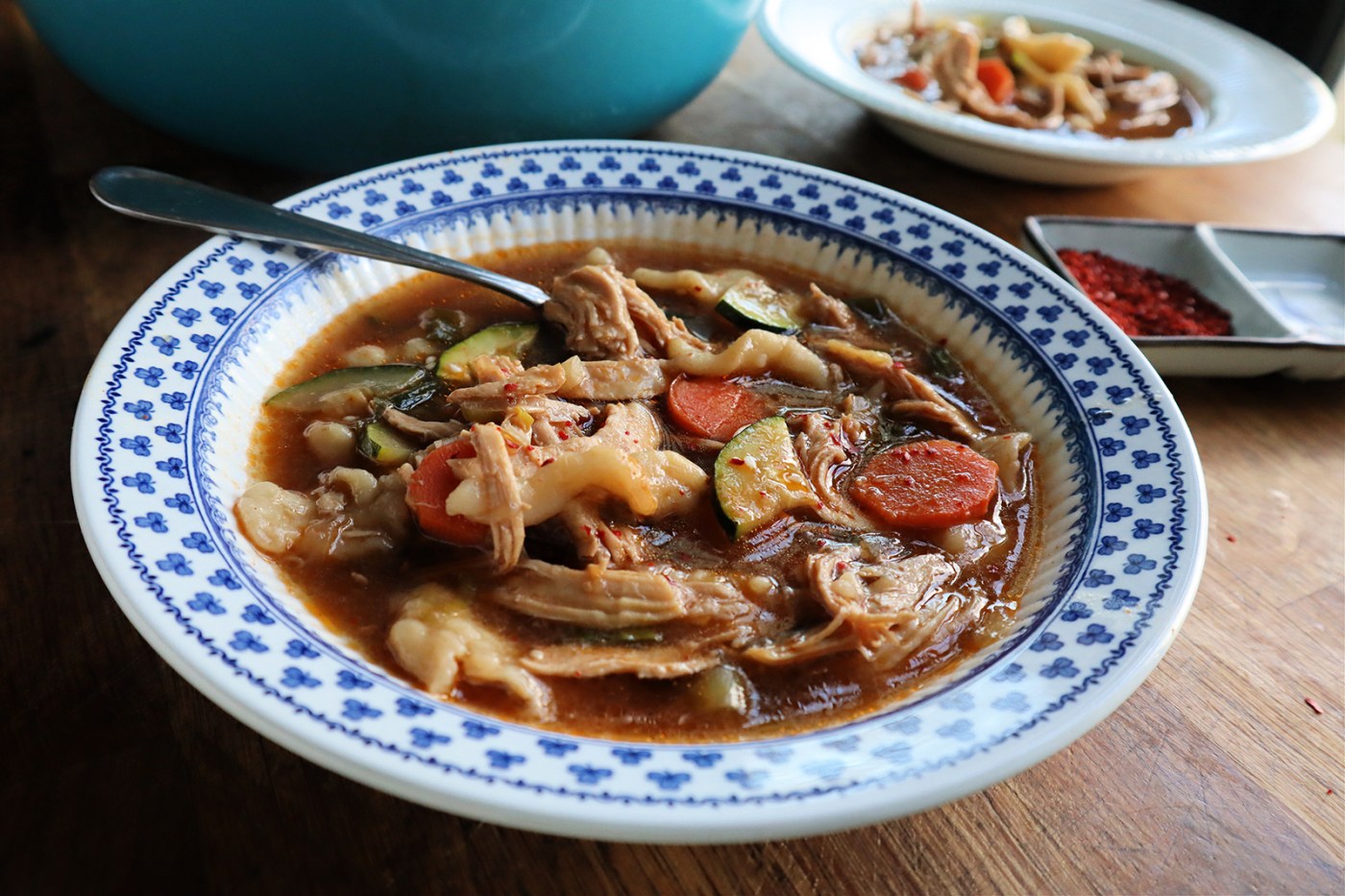
This deliciously simple recipe from Milk Street for sujebi, a traditional Korean noodle soup, achieves the perfect balance of umami and spice. It combines shredded chicken breast, carrots and sliced zucchini in a rich and satisfying broth flavored with onion, garlic and three staples you’ll find in every Korean kitchen: soy sauce, chili paste (gochujang) and chili flakes (gochugaru).

Fresh, hand-torn noodles that take just minutes to make with flour and water add a lovely chewy texture to the soup, which has a slight (but absolutely terrific) kick. My soup probably had a little bit more chicken than called for since the bone-in chicken breasts were really big, but there still was enough broth to keep the dish from turning in to a stew.

The noodles only need a few minutes to cook in the simmering broth; you’ll know they’re done when they float to the top.

Seasoned with gochugaru, gochujang and soy sauce, this spicy chicken soup with hand-pulled noodles is packed with umami. (Gretchen McKay/Pittsburgh Post-Gazette/TNS)

Korean Hand-Torn Noodle Soup with Chicken

PG tested

1 cup all-purpose flour, plus more for dusting

Kosher salt and black pepper

1 3/4 — 2 pounds bone in, skin-on chicken breasts

1 medium yellow onion, chopped

4 scallions, thinly sliced, whites and greens reserved separately

4 medium cloves garlic, minced

3 tablespoons soy sauce, divided

4- 5 teaspoons gochujang (Korean fermented chili paste)

1 tablespoon toasted sesame oil

1 tablespoon white sesame seeds, toasted

1/4 teaspoon gochugaru (Korean chili flakes), optional

2 medium carrots, peeled and cut into 1/4 -inch rounds

1 medium zucchini, quartered lengthwise and cut crosswise 1/4 -inch thick

Make dough: In large bowl, stir together flour and 1/2 teaspoon salt. Make a well in the center of the flour and add 1/3 cup water.

Using a silicone spatula or wooden spoon, begin incorporating the flour by starting at the center and gradually drawing in more, until a shaggy dough forms. Don’t add more water even if it feels dry at first; it will hydrate during kneading and after a few minutes become supple and tender.

Using the heel of your palm, knead the dough in the bowl, swiping along the sides to incorporate dry bits. Lightly flour the counter and turn the dough onto it.

Lightly flour your hands and knead until dough is smooth, about 4 minutes. Form dough into a bowl, wrap in plastic wrap and let rest at room temperature while you make the soup.

Make soup: In large pot, combine 2 1/2 quarts water, chicken, onion, scallion white, garlic, 1 tablespoon soy sauce, 1 teaspoon salt and 1/2 teaspoon pepper. Bring to a simmer over medium-high, cover partially and simmer until a skewer inserted in the thickest part of the chicken meets no resistance, about 25 minutes.

Meanwhile, in a small bowl, stir together scallion greens, remaining 2 tablespoons soy sauce, gochujang, sesame oil, sesame seeds and gochugaru, if using. Set aside.

When chicken is done, transfer to large plate. Add carrots to broth and bring to a simmer over medium-high. Cook, uncovered and stirring occasionally until carrots are tender, about 10 minutes.

Meanwhile, use 2 forks to shred the chicken into bite-sized pieces; discard the skin and bones.

Unwrap the dough. Working beside the pot, hold dough in one hand. With your other hand, pull and stretch small sections of the dough, flattening it between your thumb and forefinger, then tear off a piece roughly 1 1/2 inches long. Drop the piece into the broth.

Continue until you have used all the dough. Stir in the zucchini and shredded chicken. Return to a simmer and cook, stirring occasionally, until noodles are tender and zucchini is tender-crisp, about 3 minutes.

Off heat, stir in the gochujang-sesame mixture, then taste and season with salt and pepper.

Serves 4-6.

— 177milkstreet.com

©2024 PG Publishing Co. Visit at post-gazette.com. Distributed by Tribune Content Agency, LLC.

City Hall Announces Near-Elimination of Benefits Case Backlog As Challenges Persist

posted in: News | 0

While advocates who specialize in public benefits have called for these backlogs to be cut, they say New Yorkers who rely on cash and food support are not yet out of the woods. 

Adi Talwar

A supermarket in Inwood.

Mayor Eric Adams’ administration on Monday announced significant progress toward eliminating its backlogs of cash and food assistance cases, ahead of a court-ordered deadline of March 31. 

Yet while advocates who specialize in public benefits have called for these backlogs to be cut, they say New Yorkers who rely on this support are not out of the woods, and continue to have a hard time with their applications, despite an overall increase in recipients.

For example, attorneys in court with the administration say they plan to explore possible connections between the decreased cash assistance backlog and a surge last year in such applications being denied for procedural reasons—mostly for failure to complete a mandatory phone interview, which users say can be difficult due to lengthy wait times.

“We can certainly be pleased with them meeting their deadlines and also simultaneously concerned that more people are being denied and that they’re not maintaining a phone system that’s accessible,” said Abby Biberman, associate director of the Public Benefits Unit at New York Legal Assistance Group (NYLAG). 

As of Feb. 29, the Department of Social Services (DSS) had just 1,154 overdue applications and recertification requests from New Yorkers seeking cash assistance to cover rent and other needs—a share of whom are also seeking food aid—down from a peak of 46,000 in July. 

Among those only seeking Supplemental Nutrition Assistance Program (SNAP), or food stamps, the backlog was 411 cases by the end of February, down from 4,000 last summer. SNAP-only cases are processed on a separate track from their cash assistance counterparts and have been less delay-plagued overall. 

Under federal and state law, all SNAP and cash assistance applications and recertifications must be processed by the Human Resources Administration (HRA), part of DSS, within 30 days. Anything pending beyond that threshold is considered delayed.

Delayed processing can have serious consequences for applicants—from hunger to missed rent payments that can put families at risk of eviction. 

On Monday, DSS attributed the reduced backlog to streamlined recertification processes, increased staffing—including close to 1,000 new workers in the past year— and changes to the mandatory interview process for cash assistance recipients. 

While SNAP-only applicants have had an on-demand phone line for interviews since 2015, cash applicants had to conduct interviews in-person until the pandemic hit. Initially, these applicants had to wait for the city to call. But in April 2023, HRA began phasing in on-demand interviews for them.  

“As a result of technological enhancements, investments in staffing, and strategic process changes, DSS is on track to eliminate backlogs impacting processing delays for cash assistance and SNAP benefits, and the agency is better positioned to handle unprecedented caseloads in the future,” DSS Commissioner Molly Wasow Park said in a statement. 

The pandemic prompted a surge in demand for cash assistance, according to DSS, and the number of people receiving cash aid is now 510,000, up 25 percent from the beginning of the Adams administration. About 1.73 million New Yorkers receive SNAP, including many cash recipients. 

Monday’s backlog data is distinct from DSS’ timeliness rate, most recently reported for the months of July through October of 2023. During that period, just 14.3 percent of cash assistance applications were processed on time, alongside 41.6 percent of SNAP cases (including SNAP-only and those associated with a cash assistance case). 

“While it’s positive the administration reduced HRA’s extensive backlog of SNAP and cash assistance applications as part of a court ordered process, it is the failure to meet the requirement that these benefits are processed on-time that must also be addressed,” said Deputy Council Speaker Diana Ayala in a statement Monday. 

DSS stressed that the most recent timeliness data encompassed the summer months when the agency was still experiencing peak backlogs. 

Meanwhile, benefits applicants and advocates continue to report issues with HRA’s phone lines—both the InfoLine, which people can call for general information, and the interview lines. 

“Across the board we’ve been continuing to see people having significant issues with the process in general, in terms of being able to complete interviews, [and] being able to get their recertifications processed,” said Helen Strom, benefits and homeless advocacy director at the Safety Net Project at the Urban Justice Center. 

In January, City Limits reported that cash assistance rejections for failure to complete an interview made up 45 percent of all denials in the third quarter of 2023, exceeding 43,000. 

For comparison, in three quarters-worth of data available before the pandemic, interview-related denials absent a scheduled appointment made up no more than 5 percent of the total. 

In a June court filing, Jill Berry, first deputy commissioner at DSS, described plans for a computer program to more expediently reject a “cohort” of cases in which applicants fail to complete their interviews within 30 days, despite receiving reminder notices—what she called a “significant contributor” to the case backlog.

“We don’t know exactly the relationship between [the denial surge] and the data released this morning, but it is something we want to be cautious about and continue to investigate,” said Emily Lundgren, a staff attorney at the Legal Aid Society, on Monday. 

Along with Biberman of NYLAG, Lundgren is representing benefits recipients in the federal lawsuit Forest v. City of New York. A preliminary injunction in that case set DSS’ backlog-clearing deadlines. 

Eliminating the backlog was just one, preliminary objective of the lawsuit, according to Lundgren and Biberman. Their team is still collecting discovery from the city, and plans to explore possible issues with the interview process, as well as how DSS accepts and tracks documents that applicants must submit along with their applications. 

According to DSS, the shift to online application processes during the pandemic made it easier for New Yorkers to start the application process, resulting in more applications overall and more incomplete applications that are ultimately denied.

But advocates stressed that, in their experience, applicants seldom drop an application once they begin the process, as the benefits they are seeking are needed to feed their children, and buy necessities like toothpaste and school supplies. 

“I don’t think it’s a process you’re just going to begin and engage with without the determination to follow through,” Lundgren said.

To reach the reporter behind this story, contact Emma@citylimits.org. To reach the editor, contact Jeanmarie@citylimits.org

Want to republish this story? Find City Limits’ reprint policy here.

Column: Rat Hole Park? Second City Stadium? It’s never too early to name the new White Sox Park.

posted in: News | 0

Everyone is giddy for the new White Sox ballpark in the South Loop, even without the team or the city announcing any details about their plans.

Kudos to the Sox for getting fans excited for opening day, even if it’s Opening Day 2030, and to Mayor Brandon Johnson, who figures to be long gone before the first shovel hits the ground on the ballpark construction.

If we’re rushing toward an agreement to make Chairman Jerry Reinsdorf’s new pet project come to fruition, we might as well start thinking about the naming rights.

Guaranteed Rate Field, the name of the current ballpark, never has caught on since replacing U.S. Cellular Field, which was widely known as “the Cell.” U.S. Cellular Field replaced “new Comiskey Park,” the original name in 1991 which honored the demolished ballpark across the street. Former owner Charles Comiskey named the ballpark after himself, an idea that Reinsdorf assuredly won’t copy.

No matter what name it went by, many fans still referred to the Sox’s home as “Sox Park,” an easily remembered name that spans generations.

While we anxiously await Reinsdorf and Johnson’s plan, here are 10 suggestions for the name of the new South Loop ballpark:

1. Manny’s Cafeteria & Delicatessen Stadium

The South Loop’s most beloved restaurant deserves dibs for the new stadium name.

The classic Jewish deli is only a three-minute drive down Roosevelt Road from the proposed stadium site, and figures to be as popular for pregame dining as McCuddy’s once was for pregame drinking.

2. Rat Hole Park

The Rat Hole Preservation Society, our nickname for those anonymous do-gooders in Roscoe Village who helped save the city’s latest tourist attraction from vandalism, needs to set up a GoFundMe page for the naming rights.

The Rat Hole is a rodent-shaped crater in a sidewalk that somehow became as famous as the Bean. The Sox could even get creative and design a park with the same imprint. Rat Hole Park would be a perfect destination for a ballgame in Chicago and would honor both our favorite rodents and our history of corrupt politicians.

The only problem might be that some Sox fans already refer to Wrigley Field as “the rat hole.”

3. The 78

The area around Clark Street and Roosevelt Road is already called “the 78″ based on someone’s idea that it eventually would become the 78th neighborhood in Chicago.

“The 78″ could also be seen as an homage to the 1978 White Sox, a team that had the misfortune of following the popular ‘77 group known as the “South Side Hit Men.” Without “rent-a-players” Richie Zisk and Oscar Gamble, the stars of the Hit Men, the Sox plunged to a 90-loss season. They did however manage to acquire Claudell Washington in a trade for Bobby Bonds, and the outfielder’s inability to play hard inspired the famous banner in right field: “Washington Slept Here.”

4. Obama Yards

The world’s most famous Sox fan is former President Barack Obama, though he once called Comiskey Park “Comiskey Field” in an interview with Bob Costas.

Obama’s presidential library currently is under construction in Jackson Park and could use a bookend a few miles north. One Sox fan publicly pleaded with Reinsdorf in a Chicago Tribune op-ed to sell the team to Obama, but first things first. Naming the stadium after Obama might even convince him to attend some games.

5. Loop Park

Getting people to go back to the Loop again might be easier if it meant going to a ballpark by the same name, and the former classic rock radio station called “the Loop” would be an appropriate tie-in for nostalgic Sox fans.

A statue of Steve Dahl blowing up disco albums would look nice in center, commemorating one of the most celebrated moments in Sox history.

6. Second City Stadium

The Second City improv theater includes some of the most recognized names in comedy over the years, from John Belushi and Dan Aykroyd to Tina Fey and Stephen Colbert.

In the mid ‘90s I asked Second City alum George Wendt, a South Side Sox fan who played Norm on “Cheers,” to give his theory on the team’s attendance issues in the new Comiskey Park.

“Maybe you could’ve put it on the free TV versus cable TV thing a few years back,” Wendt replied. “But now they’re on WGN sometimes, so I don’t know. It seems like emigres to Chicago, the postgraduates who settle here in the suburbs, north or south, become Cubs fans. It seems like to be a Sox fan, you have to be born and raised on the South Side.”

That might still be true today.

7. This Space for Rent Field

A temporary solution while the Sox try to find a sponsor from the cryptocurrency world.

8. Ozzie Guillen Field

The manager of the only Sox team to win a championship since 1917 doesn’t have a statue in Guaranteed Rate Field. To make amends, the Sox could name the new ballpark after Guillen, who currently works as an analyst for NBC Sports Chicago and provides unfiltered commentary on the team’s issues.

“Meet you at ‘the Oz’” sounds like a good way to start a day.

9. Taylor Swift Stadium

Being associated with the world’s biggest pop star seemed to work well for the NFL. The Sox could use the boost in attendance, even if Reinsdorf has to pay Swift for the use of her name.

10. Sox Park

Well, this is what it will eventually be called no matter what it’s named, so why not just cut to the chase?

()