Chicago Bears hire Eric Washington — ‘a great communicator with elite leadership skills’ — as defensive coordinator

posted in: News | 0

For the first time since September, Chicago Bears coach Matt Eberflus will have a separate defensive coordinator on his staff.

The Bears announced Saturday that they hired Buffalo Bills assistant head coach and defensive line coach Eric Washington to be their new DC. Washington previously coached with the Bears from 2008-10 under Lovie Smith and served as the defensive line coach in 2010 with defensive coordinator Rod Marinelli, an Eberflus mentor.

Washington coached the Bills defensive line since 2020 and was promoted to senior defensive assistant in 2022 and assistant head coach in 2023. He has two years of defensive coordinator experience with the Carolina Panthers in 2018-19 under Ron Rivera. Before that, he coached the Panthers defensive line for seven seasons.

The Bills defense ranked in the top 10 in multiple categories in 2023, including total yards and passing yards allowed per game, sack rate, interception rate and points allowed per game.

Washington is considered a strong teacher and leader who is detailed in his focus on fundamentals and will be able to help the coaching staff schematically, a source said.

“He is a great communicator with elite leadership skills and he will enhance our current defensive staff,” Eberflus said in a statement Saturday. “His track record speaks for itself with coordinator experience as well as expertise in the area of defensive line.”

Eberflus did not fill the defensive coordinator position in September when Alan Williams resigned for what sources told the Tribune was conduct-related reasons, though Eberflus did add senior defensive analyst Phil Snow to help scout opponents. Eberflus took over play calling, and with the help of the addition of defensive end Montez Sweat, helped the defense turn around from a rough start.

Eberflus said this month that he still was determining whether he would continue to call plays after bringing in a coordinator, but NFL Network reported Saturday that the expectation is Eberflus will remain in that role.

“It’s something I’ve stated I love to do,” Eberflus said this month. “But as we talk to these candidates, we’re going to keep everything open right now.”

Washington will help ease the load for Eberflus, who noted during the season he was working later nights to fill both roles. Eberflus said he was looking for a coordinator with high character who was a strong motivator. He wanted someone who could lead the defensive room while Eberflus addresses other areas of the team.

“My family and I are beyond excited to be returning to the Chicago Bears,” Washington said in a statement. “It is humbling to have the opportunity to contribute to one of the most esteemed sports organizations in the world.”

While the Bears fired five offensive coaches — including coordinator Luke Getsy — when their 7-10 season ended, Eberflus opted to keep the defensive staff intact. Washington joins a group that includes cornerbacks coach/defensive passing game coordinator Jon Hoke, defensive line coach Travis Smith, linebackers coach Dave Borgonzi and safeties coach Andre Curtis.

The Bears finished 12th with 324.2 yards allowed per game and had the top-ranked rushing defense, allowing just 86.4 yards per game on the ground. They also finished with a league-best 3.57% interception rate after totaling 22 interceptions to go with six fumble-recovery takeaways.

Their passing defense, ranked 25th with 237.8 yards allowed per game, and their league-worst 4.86% sack rate need improvement.

Washington joins what the Bears hope is an ascending group. He played tight end at Grambling State and also coached defensive line at Northwestern (2004-07) and Ohio (2001-03).

The Bears reportedly interviewed at least three other coaches to join their defensive staff: former Green Bay Packers defensive coordinator Joe Barry, Tennessee Titans assistant head coach/defensive line Terrell Williams and Titans defensive pass game coordinator Chris Harris.

Washington will be the Bears’ third major hire since the season ended. They have announced the additions of offensive coordinator Shane Waldron and quarterbacks coach Kerry Joseph. They still need to hire running backs and wide receivers coaches.

()

Biden’s closest allies are stepping up pressure on White House to do more to ease suffering in Gaza

posted in: Politics | 0

By FARNOUSH AMIRI and ELLEN KNICKMEYER (Associated Press)

WASHINGTON (AP) — More of President Joe Biden’s top Senate allies are demanding that the U.S. act directly to ease Palestinian civilian suffering in Gaza and are joining calls to cut military aid if Israeli Prime Minister Benjamin Netanyahu refuses to change course.

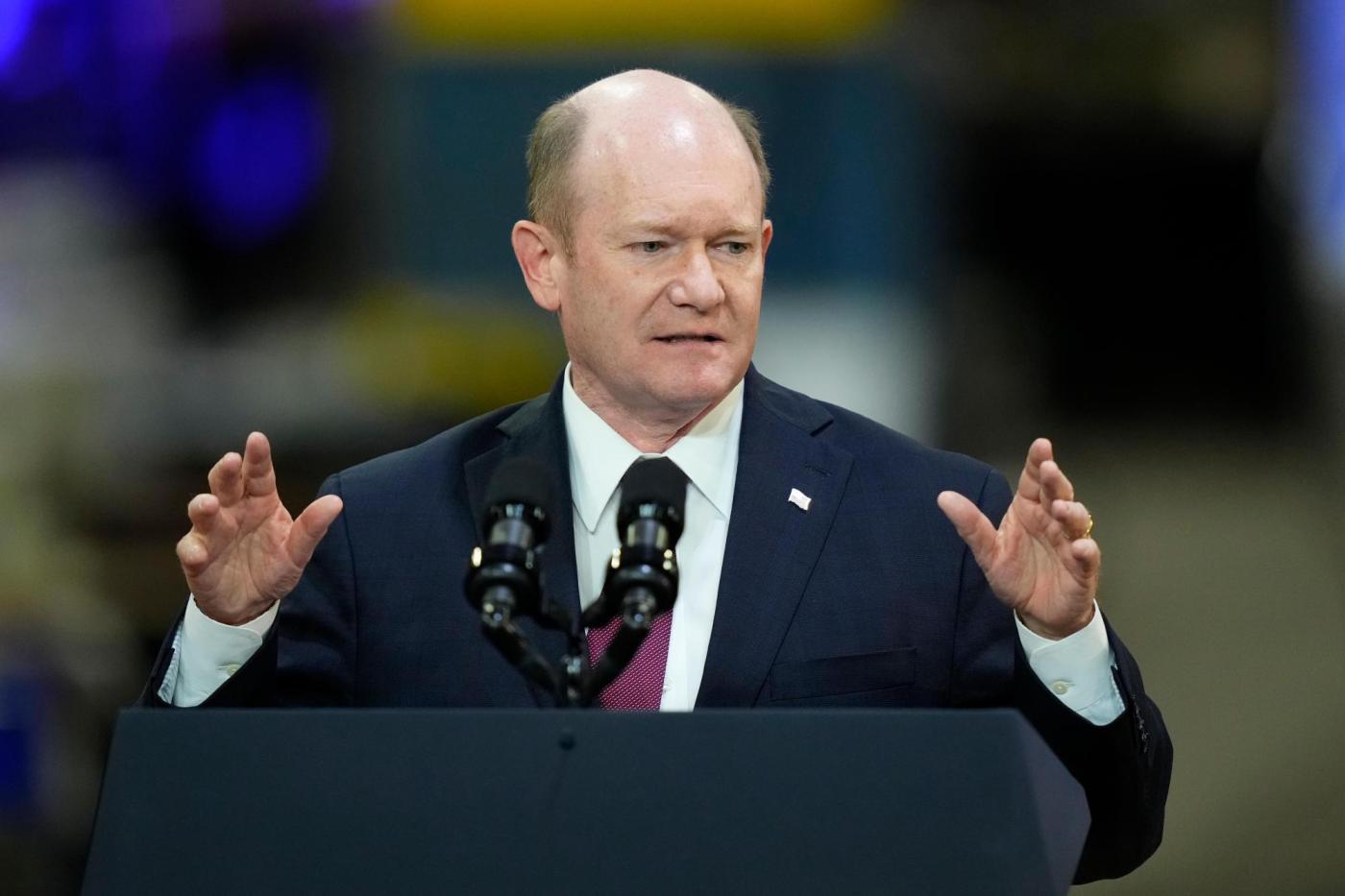
What had been dissent from independent Sen. Bernie Sanders and a small group of progressive Democrats has swelled in response to the soaring death toll in Gaza. Now even Biden’s closest confidant in Congress, Chris Coons, says it is time to get tougher with Netanyahu’s government on how it conducts the war.

Israel continues to enjoy bipartisan support in Congress, and the prospect of military aid being reduced is uncertain despite the clout that these more mainstream Democrats wield. But tensions could be evident Thursday as Biden speaks to Congress about the conflict in his State of the Union address.

The war in Gaza isn’t the only Mideast issue creating dissent within the party. Some Democrats are pursuing legislation to compel the administration to seek Congress’ permission to continue military strikes against the Houthis in Yemen, setting up a possible showdown over the authority to wage war. The Houthis are attacking shipping in the Red Sea in what they say is a show of support for Palestinians during the nearly five-month war in Gaza.

Still, the Senate Foreign Relations Committee and the Democratic caucus as a whole have largely held off on taking action on the U.S. role in the Middle East conflicts. That’s despite growing concern — and rising political opposition nationally, especially among Muslim and Arab American voters — over the Biden administration’s support for Israel’s war in Gaza, and over Netanyahu’s perceived shrugging off of U.S. demands to do more to spare Palestinian civilians and to allow in more aid.

Congressional Democrats are reluctant to be seen as challenging the Democratic president’s handling of the conflict, mindful that criticism could further weaken Biden in his uphill reelection campaign against former President Donald Trump.

The killings of more than 100 Palestinians last week during a rare delivery of food helped spur more Biden allies in the Senate to speak out. Israel says its forces fired warning shots amid the chaos of the aid delivery. Witnesses and medical workers told The Associated Press many of the victims were shot when Israeli forces fired into crowds of hungry people.

In the last few days alone, Coons, a senator from Biden’s home state of Delaware, called for the U.S. to cut military aid to Israel if Netanyahu goes ahead with a threatened offensive on the southern city of Rafah without significant provisions to protect the more than 1 million civilians sheltering there. Sen. Jack Reed, head of the Senate Armed Services Committee, appealed to Biden to deploy the U.S. Navy to get humanitarian aid to Gaza. Biden ally Sen. Tim Kaine challenged the U.S. strikes on the Houthis as unlikely to stop the Red Sea attacks. And the most senior Democrat in the Senate called for Israel to “change course.”

“Israel needs to understand that the casualties they’ve inflicted on the people of Gaza — the devastation they have caused — cannot continue,” Patty Murray of Washington, the senate pro tempore, said in a blistering speech on the chamber floor. “It is not in line with American interests, nor does it make Israel safer.”

Continuing U.S. military support for Israel at current levels “becomes untenable when Israel demonstrates they are unwilling to listen to us,” Coons told cable networks after the killings during the failed aid distribution.

The National Security Council pointed to Biden’s own warnings about the looming Rafah offensive and support for a possible sea route to deliver aid. It did not answer questions about whether the administration has altered its opposition to cutting military aid to Israel or to seeking Congress’ permission for its strikes on the Houthis.

Lawmakers have sent at least a half-dozen letters to the administration calling for changes in the conduct of the war since the start of the year. The administration said this week it is actively exploring one possibility, pushed by Reed, to open a sea route for humanitarian aid. The U.S. began air drops to Gaza civilians last week, getting around Israeli restrictions blocking much of the aid delivery by land.

Biden’s allies in Congress are trying to drive home the message that Netanyahu’s conduct of the war is not in U.S. interests, Sen. Elizabeth Warren, a Massachusetts Democrat, said. Biden and top aides have appealed privately and publicly to Israel for more precision in airstrikes and drone attacks, which have been killing whole families in crowded neighborhoods. Netanyahu also has publicly ruled out the U.S. goal of eventual Palestinian statehood.

“The conversations between senators and the White House are vigorous and frank” regarding the war and Netanyahu, Warren told the AP. “We would not be serving our president to do otherwise.”

The Senate Foreign Relations Committee has not marked up legislation related to the region since the war began. And only this past week did the panel hold hearings on the growing Middle East conflicts. Two congressional aides, who spoke to The Associated Press on the condition of anonymity to discuss private meetings, said the chairman, Democratic Sen. Ben Cardin of Maryland, told the committee late last year that no legislation related to the Middle East would move until the war in Gaza is over.

Another congressional aide familiar with the discussions said that in the aftermath of the Hamas attack on Oct. 7 that set off the war, Cardin urged caution on taking any immediate legislative action that would negatively affect the Israeli effort on the ground.

In a statement to the AP, Eric Harris, a spokesperson for the committee, did not directly respond to a question about the lack of legislative action but said the “committee continues to be actively engaged in conducting oversight on Middle East policy, including the ongoing conflict in Gaza, the humanitarian crisis, and efforts to free hostages abducted by Hamas — including American hostages.”

The committee cited classified bipartisan briefings it had held, meetings with heads of state and other influential figures, and other key policy advocacy by Cardin, including his leadership in getting Jacob Lew confirmed as U.S. ambassador to Israel.

Meanwhile, on the other side of the Capitol, the House Foreign Affairs Committee has sent over bipartisan bills on the Middle East, including many that would target Iranian officials over Iran’s support to Hamas, the Houthis and other armed groups that have stepped up attacks on U.S. and other targets.

Back on the Senate side, notably, it was a subcommittee of the Foreign Relations Committee, rather than the full committee, that summoned two senior Biden administration officials to answer questions about the strikes to try to quell Houthi attacks on international shipping routes.

Sen. Chris Murphy, a Connecticut Democrat, who led the session, said later he was working to gather support from other senators for legislation to compel the administration to seek congressional approval to continue the strikes, in line with his reading of the War Powers Act.

Kaine, a Virginia Democrat, suggested only an end to the fighting in Gaza was likely to calm the region.

“U.S. involvement in another war in the Middle East would reflect that we’ve learned virtually nothing over the last 25 years.,” Kaine said of the U.S. strikes targeting Houthis. “This is the kind of a thing that can lead us to slip or slide into a war.”

America worries about health costs — and voters want to hear from Biden and Republicans

posted in: News | 0

Julie Appleby and Phil Galewitz | KFF Health News (TNS)

President Joe Biden is counting on outrage over abortion restrictions to help drive turnout for his reelection. Former President Donald Trump is promising to take another swing at repealing Obamacare.

But around America’s kitchen tables, those are hardly the only health topics voters want to hear about in the 2024 campaigns. A new KFF tracking poll shows that health care tops the list of basic expenses Americans worry about — more than gas, food and rent. Nearly 3 in 4 adults — and majorities of both parties — say they’re concerned about paying for unexpected medical bills and other health costs.

“Absolutely health care is something on my mind,” Rob Werner, 64, of Concord, New Hampshire, said in an interview at a local coffee shop in January. He’s a Biden supporter and said he wants to make sure the Affordable Care Act, also known as Obamacare, is retained and that there’s more of an effort to control health care costs.

The presidential election is likely to turn on the simple question of whether Americans want Trump back in the White House. (Nikki Haley, the former South Carolina governor and U.S. ambassador to the United Nations, remained in the race for the Republican nomination ahead of Super Tuesday, though she had lost the first four primary contests.) And neither major party is basing their campaigns on health care promises.

But in the KFF poll, 80% of adults said they think it’s “very important” to hear presidential candidates talk about what they’d do to address health care costs — a subject congressional and state-level candidates can also expect to address.

“People are most concerned about out-of-pocket expenses for health care, and rightly so,” said Andrea Ducas, vice president of health policy at the Center for American Progress, a Washington, D.C.-based progressive think tank.

Here’s a look at the major health care issues that could help determine who wins in November.

Abortion

Less than two years after the Supreme Court overturned the constitutional right to an abortion, it is shaping up to be the biggest health issue in this election.

That was also the case in the 2022 midterm elections, when many voters rallied behind candidates who supported abortion rights and bolstered Democrats to an unexpectedly strong showing. Since the Supreme Court’s decision, voters in six states— including Kansas, Kentucky, and Ohio, where Republicans control the legislatures — have approved state constitutional amendments protecting abortion access.

Polls show that abortion is a key issue to some voters, said Robert Blendon, a public opinion researcher and professor emeritus at the Harvard T.H. Chan School of Public Health. He said up to 30% across the board see it as a “personal” issue, rather than policy — and most of those support abortion rights.

“That’s a lot of voters, if they show up and vote,” Blendon said.

Proposals to further protect — or restrict — abortion access could drive voter turnout. Advocates are working to put abortion-related measures on the ballot in such states as Arizona, Florida, Missouri, and South Dakota this November. A push in Washington toward a nationwide abortion policy could also draw more voters to the polls, Blendon said.

A surprise ruling by the Alabama Supreme Court in February that frozen embryos are children could also shake up the election. It’s an issue that divides even the anti-abortion community, with some who believe that a fertilized egg is a unique new person deserving of full legal rights and protections, and others believing that discarding unused embryos as part of the in vitro fertilization process is a morally acceptable way for couples to have children.

Pricey Prescriptions

Drug costs regularly rank high among voters’ concerns.

In the latest tracking poll, more than half — 55% — said they were very worried about being able to afford prescription drugs.

Biden has tried to address the price of drugs, though his efforts haven’t registered with many voters. While its name doesn’t suggest landmark health policy, the Inflation Reduction Act, or IRA, which the president signed in August 2022, included a provision allowing Medicare to negotiate prices for some of the most expensive drugs. It also capped total out-of-pocket spending for prescription drugs for all Medicare patients, while capping the price of insulin for those with diabetes at $35 a month — a limit some drugmakers have extended to patients with other kinds of insurance.

Drugmakers are fighting the Medicare price negotiation provision in court. Republicans have promised to repeal the IRA, arguing that forcing drugmakers to negotiate lower prices on drugs for Medicare beneficiaries would amount to price controls and stifle innovation. The party has offered no specific alternative, with the GOP-led House focused primarily on targeting pharmacy benefit managers, the arbitrators who control most Americans’ insurance coverage for medicines.

Costs of Coverage

Health care costs continue to rise for many Americans. The cost of employer-sponsored health plans have hit new highs in the past few months, raising costs for employers and workers alike. Experts have attributed the increase to high demand and expensive prices for certain drugs and treatments, notably weight loss drugs, as well as to medical inflation.

Meanwhile, the ACA is popular. The KFF poll found that more adults want to see the program expanded than scaled back. And a record 21.3 million people signed up for coverage in 2024, about 5 million of them new customers.

Enrollment in Republican-dominated states has grown fastest, with year-over-year increases of 80% in West Virginia, nearly 76% in Louisiana, and 62% in Ohio, according to the Centers for Medicare & Medicaid Services.

Related Articles

Health |


Minnesota native who fixed foot pain with amputation shares journey on TikTok

Health |


Health care workers push for their own confidential mental health treatment

Health |


Post-pandemic vaccine hesitancy fueling latest measles outbreak

Health |


Measles Q&A: Do I need a booster? And other answers

Health |


France becomes the only country to explicitly guarantee abortion as a constitutional right

Public support for Obamacare and record enrollment in its coverage have made it politically perilous for Republicans to pursue the law’s repeal, especially without a robust alternative. That hasn’t stopped Trump from raising that prospect on the campaign trail, though it’s hard to find any other Republican candidate willing to step out on the same limb.

“The more he talks about it, the more other candidates have to start answering for it,” said Jarrett Lewis, a partner at Public Opinion Strategies, a GOP polling firm.

“Will a conversation about repeal-and-replace resonate with suburban women in Maricopa County?” he said, referring to the populous county in Arizona known for being a political bellwether. “I would steer clear of that if I was a candidate.”

Biden and his campaign have pounced on Trump’s talk of repeal. The president has said he wants to make permanent the enhanced premium subsidies he signed into law during the pandemic that are credited with helping to increase enrollment.

Republican advisers generally recommend that their candidates promote “a market-based system that has the consumer much more engaged,” said Lewis, citing short-term insurance plans as an example. “In the minds of Republicans, there is a pool of people that this would benefit. It may not be beneficial for everyone, but attractive to some.”

Biden and his allies have criticized short-term insurance plans — which Trump made more widely available — as “junk insurance” that doesn’t cover care for serious conditions or illnesses.

Entitlements Are Off-Limits

Both Medicaid and Medicare, the government health insurance programs that cover tens of millions of low-income, disabled, and older people, remain broadly popular with voters, said the Democratic pollster Celinda Lake. That makes it unlikely either party would pursue a platform that includes outright cuts to entitlements. But accusing an opponent of wanting to slash Medicare is a common, and often effective, campaign move.

Although Trump has said he wouldn’t cut Medicare spending, Democrats will likely seek to associate him with other Republicans who support constraining the program’s costs. Polls show that most voters oppose reducing any Medicare benefits, including by raising Medicare’s eligibility age from 65. However, raising taxes on people making more than $400,000 a year to shore up Medicare’s finances is one idea that won strong backing in a recent poll by The Associated Press and NORC Center for Public Affairs Research.

Brian Blase, a former Trump health adviser and the president of Paragon Health Institute, said Republicans, if they win more control of the federal government, should seek to lower spending on Medicare Advantage — through which commercial insurers provide benefits — to build on the program’s efficiencies and ensure it costs taxpayers less than the traditional program.

So far, though, Republicans, including Trump, have expressed little interest in such a plan. Some of them are clear-eyed about the perils of running on changing Medicare, which cost $829 billion in 2021 and is projected to consume nearly 18% of the federal budget by 2032.

“It’s difficult to have a frank conversation with voters about the future of the Medicare program,” said Lewis, the GOP pollster. “More often than not, it backfires. That conversation will have to happen right after a major election.”

Addiction Crisis

Many Americans have been touched by the growing opioid epidemic, which killed more than 112,000 people in the United States in 2023 — more than gun deaths and road fatalities combined. Rural residents and white adults are among the hardest hit.

Federal health officials have cited drug overdose deaths as a primary cause of the recent drop in U.S. life expectancy.

Republicans cast addiction as largely a criminal matter, associating it closely with the migration crisis at the U.S. southern border that they blame on Biden. Democrats have sought more funding for treatment and prevention of substance use disorders.

“This affects the family, the neighborhood,” said Blendon, the public opinion researcher.

Billions of dollars have begun to flow to states and local governments from legal settlements with opioid manufacturers and retailers, raising questions about how to best spend that money. But it isn’t clear that the crisis, outside the context of immigration, will emerge as a campaign issue.

(KFF Health News, formerly known as Kaiser Health News (KHN), is a national newsroom that produces in-depth journalism about health issues and is one of the core operating programs of KFF — the independent source for health policy research, polling and journalism.)

©2024 KFF Health News. Distributed by Tribune Content Agency, LLC.

WWII veteran, retired Ramsey County deputy dies weeks after 100th birthday

posted in: News | 0

Herb Gustafson’s family was planning a big celebration for his 100th birthday, but his health rapidly declined after he reached the century milestone. The special menu intended for his party will instead be served at his funeral buffet.

The World War II veteran and retired Ramsey County sheriff’s deputy had been living an active and independent life. Just before his birthday last month, he turned too quickly and fell in his apartment. He died Friday.

After his fall, he underwent surgery for a broken hip. The doctor told the family, “Your dad’s strong, he should do just fine,” said daughter Kristy DuBois. He was determined to get back to living on his own at Applewood Pointe in Woodbury, a senior cooperative where he was a longtime resident.

Up until then, Gustafson woke up at 5 a.m. daily and went to lift weights at Applewood Pointe’s gym.

After surgery for his broken hip, Gustafson was in transitional care. He wasn’t feeling well and wound up back in the hospital, where tests showed cancer.

He’d been diagnosed with lymphoma last fall. He had a tumor removed then and radiation treatment, and the doctor told him the cancer would likely come back in another part of his body. “We didn’t realize it was going to be so soon,” DuBois said.

His family brought him back home to Applewood Pointe in Woodbury last Wednesday on hospice care.

“Once he realized he was home, he started perking up and within half an hour he was telling me to call all these people, they were his card-playing buddies, he said. They just happened to be all the single women in the building,” DuBois said with a chuckle. “So he had a steady stream of women coming through to visit him.”

Gustafson’s family was by his side when he passed away Friday.

Grew up in St. Paul

Gustafson was born Feb. 10, 1924, and grew up in St. Paul. After graduating from Monroe High School, he served in the Army from 1943 to 1946 and was stationed in New Guinea and the Philippines.

He returned to St. Paul, where he worked for the St. Paul school district for 16 years as the storekeeper and buyer for the schools’ trade shops. He was a Ramsey County sheriff’s deputy from 1969 to 1989. And he had a 70-year hobby of photography, winning international awards for his artistic photos.

He and Rose, who Gustafson was married to for 64 years when she died in 2011, raised their four children in St. Paul and later moved to Vadnais Heights.

Gustafson works out in the exercise room at Applewood Pointe on Feb. 6, 2024. (John Autey / Pioneer Press)

“He was very kind and generous, and he just enjoyed life,” DuBois said. “He wanted to stay active. He still had all of his mental faculties, even up until the end. I attribute that to him staying engaged with people and being independent and wanting to have people around him.”

Gustafson’s family had been planning a big birthday party at Applewood Pointe for after his Feb. 10 birthday and, after his Feb. 6 fall, they intended to hold it at a later date.

The menu was to be appetizers from around the world because Rose and Herb Gustafson had traveled extensively.

“Instead of having your typical funeral buffet, I’m going to keep the menu from the party,” DuBois said. “It was something he was looking forward to.”

Funeral arrangements are being finalized. In addition to DuBois, Gustafson is survived by his children, Karen Gustafson, Kathy Bidney and Aric Gustafson, along with his grandchildren and great grandchildren.

Related Articles

Local News |


John Marboe: Remembering a musical soul, Ron Evaniuk

Local News |


Friends and family pay tribute to northwest Minnesota conservation champion

Local News |


Humorously morose comedian Richard Lewis, who recently starred on ‘Curb Your Enthusiasm,’ dies at 76

Local News |


Vietnam vet dies a month after reported assault at Harriet Island Regional Park

Local News |


Obituary: Art Kaemmer, of St. Paul was pediatrician, philanthropist and ‘Alice the Gorilla’