
‘Damsel’ review: Millie Bobby Brown stars in dark fantasy lacking a pulse

posted in: News | 0

“Damsel” is very proud of the way it subverts our expectations of a fairy tale.

“There are many stories of chivalry, where the heroic knight saves the damsel in distress,” star Millie Bobby Brown declares in the opening narration of the fantasy film, hitting Netflix this week. “This is NOT one of them.”

That is true, for “Damsel” is a tale in which the princess must save herself.

It also is a movie that asks too much of Brown, the talented young actress we’ve watched grow up in Netflix’s popular science-fiction-meets-horror series “Stranger Things” and who’s delighted in two previous Netflix movies, 2020’s “Enola Holmes” and its likewise enjoyable 2022 sequel, “Enola Holmes 2.”

She has had a lot of on-screen help carrying the dramatic weight of those projects. In Damsel,” however, despite notable cast mates in Angela Bassett and Robin Wright, Brown is asked to haul almost all of it.

Related Articles


Movie Review: ‘Kung Fu Panda 4’ is a sweet, fun and well executed passing of the torch


Best cameo? Best hat? Ahead of the Oscars, AP hands out its own awards


‘The Gentlemen’ review: Guy Ritchie’s small-screen take fun but forgettable


‘Spaceman’ review: Sandler stars in so-so film for grown-ups about inner journey


What to watch: ‘Shogun’ a worthy remake of classic series

Perhaps she could, were the screenplay by Dan Mazeau (“Fast X”) much stronger and the direction of Juan Carlos Fresnadillo (“28 Weeks Later)” better than acceptable.

With these key components at the levels they are, “Damsel” is a mildly entertaining time-passer, one likely to appeal to a younger demographic — an audience perhaps ready to graduate from basic princess tales to something a little darker and at least a little more interesting.

Brown’s Elodie is no princess when we meet her but instead a simple girl from a simple family living in a place where people are starving and freezing, she and her sister, Floria (Brooke Carter), gathering what they can for kindling. When a letter arrives from Queen Isabelle (Wright), proposing Elodie be wed to her son, Prince Henry (Nick Robinson, “Love, Simon”), Elodie’s father, Lord Bayford (Ray Winstone, who’s also on Netflix this week in the series “The Gentlemen”), and stepmother, Lady Bayford (Bassett), are excited about the promised bounty that will be given to them in exchange.

Although Elodie initially feels this is not reason enough to marry, she dutifully accepts her fate.

“The union will save us,” she allows. “I’ve made my peace with it — my happiness is a small price to pay for the future of my people.”

Upon the family’s arrival in the queen’s opulent realm, however, there are signs all is not what it seems. (Hint: That probably has something to do with the fire-breathing dragon we encounter in the film’s prologue.) While the viewer is beaten over the head with reasons to fear for Elodie, she mostly brushes off any concerns and marries the prince, who, to be fair, seems like an OK chap.

Millie Bobby Brown and Nick Robinson appear in a scene from “Damsel.” (Courtesy of Netflix)

Without giving away further details, know that our heroine will come face to face with the dragon (voiced by the unmistakable Shohreh Aghdashloo) — who has reason to be furious with the royals — and must fight to survive the dragon’s hunt inside a cavernous maze. (That Elodie will find herself in such an environment is foreshadowed by the revelation she draws mazes as a hobby. Do Mazeau or Fresnadillo use Elodie’s gift for maze design in any kind of clever way as the adventure unfolds? No, not really. “Damsel” just isn’t that kind of movie.)

Elodie makes a couple of illuminating discoveries within the caverns, but it would help the film’s momentum if she encountered, say, a collection of communicative cave people — a few new characters to help carry things along. As it stands, it’s mainly a lot of Elodie, intermittently chatting with the vengeful dragon.

Millie Bobby Brown stars as Elodie in “Damsel.” (Courtesy of Netflix)

To say that “Damzel” moves in fits and starts may be too kind.

Brown, whose movie credits also include MonsterVerse entries “Godzilla: King of the Monsters” (2019) and sequel “Godzilla vs. Kong” (2021) and is also counted among this movie’s executive producers, is not the problem here, giving a performance that crosses Ts and dots Is. She simply isn’t so good as to be the solution, either.

Again, no one else gets much screen time, but it is fun to see Wright as an evil queen given that many first knew her as Princess Buttercup in 1987’s “The Princess Bride.” She brings some of her fierce “House of Cards”/Claire Underwood energy to “Damsel,” but that doesn’t move the needle.

Robin Wright portrays Queen Isabelle in “Damsel.” (Courtesy of Netflix)

Considering some of its tasty ingredients, you wait for “Damsel” to find a way to lift itself out of its below-average realm, like a dragon rising to rain fire on the poor souls below. Alas, though, that spark never comes.

‘Damsel’

Where: Netflix.

When: March 8.

Rated: PG-13 for sequences of strong creature violence, action, and bloody images.

Runtime: 1 hour, 49 minutes.

Stars (of four): 2.
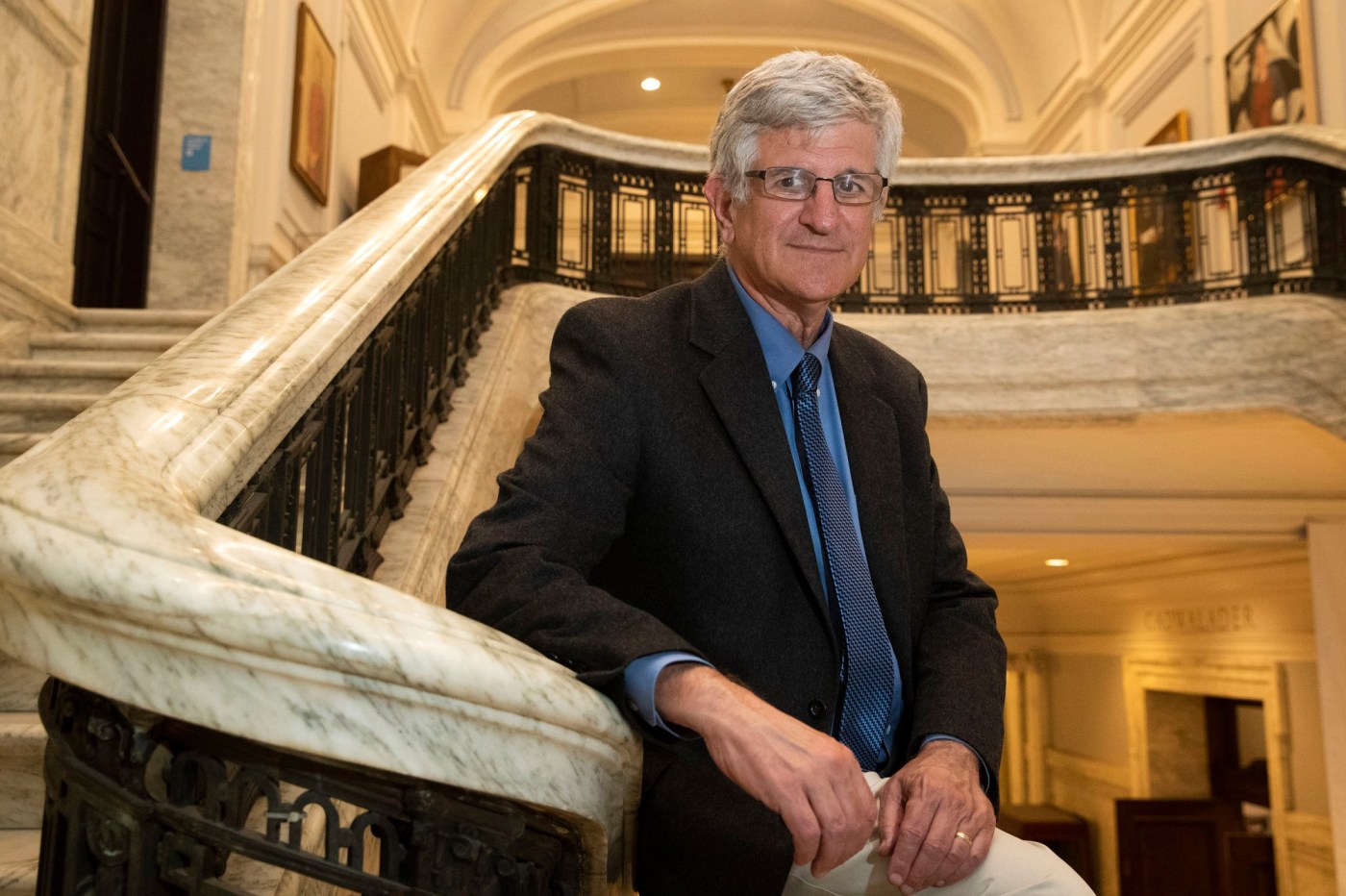
Paul Offit looks back on COVID-19, misinformation, and how public health lost the public’s trust in new book

posted in: Politics | 0

Abraham Gutman | (TNS) The Philadelphia Inquirer

PHILADELPHIA — Trust in public health agencies declined during the COVID-19 pandemic, as misinformation about vaccines and the virus proliferated on social media. But did the public health agencies themselves also play a role in the decline of their credibility?

Paul Offit had a front-row seat to federal public health agencies’ pandemic response. A pediatrician and vaccine developer from the Children’s Hospital of Philadelphia, Offit is a member of the FDA’s vaccine advisory committee, which played a critical role in reviewing COVID vaccine research and advising the FDA on vaccine safety.

In his new book, “Tell Me When It’s Over: An Insider’s Guide to Deciphering Covid Myths and Navigating Our Post-Pandemic World,” Offit chronicles the first years of the pandemic, explains the science of COVID, and traces the rise of anti-vaccine movement and misinformation. He also blames those charged with protecting the nation’s health of taking action against evidence — and in doing so undermining public trust.

He says public health agencies made mistakes in key moments, such as when the FDA fast tracked in 2020 the authorization of an antimalaria drug with risk of fatal heart side effects that didn’t work against COVID. At the time, President Donald Trump called the medication a “game changer” and promoted it as a COVID treatment. The FDA revoked the authorization a few months later.

“People lost faith in the FDA,” Offit said. “People saw that you could twist the FDA’s arm.”

The Inquirer spoke to Offit about his new book, and what steps public health agencies can take to reclaim the public’s trust.

Best of times, worst of times

The pandemic saw significant scientific advancement. Scientists were able to produce a safe and effective vaccine to protect against a new virus within a year — a feat that can take more than 10 years. Offit called the vaccine “the greatest” medical achievement in his lifetime.

At the same time, more people grew suspicious of vaccines, and their mistrust continued to grow through last fall, according to surveys by the Annenberg Public Policy Center at the University of Pennsylvania. In the center’s most recent survey, 71% agreed that vaccines approved in the U.S. are safe, down from 77% in April 2021.

The way public health agencies and elected officials communicated also contributed to the public’s loss of faith, Offit said.

He criticized the response to a July 4, 2021, celebration in Provincetown, Mass. After thousands of people attended the event, nearly 350 fully vaccinated men were among those who developed COVID. Only four of those vaccinated were hospitalized, and the rest developed mild or no symptoms.

Offit saw a success: the vaccines were working.

But the Centers for Disease Control and Prevention used the term “breakthrough infection” to describe the incident, a phrasing choice that Offit said implied failure to offer protection.

Another mixed message came in August 2021: President Joe Biden promoted booster shots for American adults even though boosters had not been approved by the FDA yet.

A month later, the FDA advisory committee overwhelmingly voted against the recommendation to offer boosters to people under age 65, because there wasn’t enough evidence at the time that an extra dose would improve protection to people of all ages.

The conflicting messages added to public distrust, Offit said.

The FDA began expanding the eligibility for boosters in Nov. 2021, and currently recommends that everyone over a ge 6 months receive an extra shoot.

Neither the FDA nor the CDC responded to request for comment about Offit’s criticism. A spokesperson for the FDA shared a statement saying the agency stands by the safety and effectiveness of the COVID vaccines.

Admitting mistakes and going on offense

Rebuilding trust in public health agencies won’t be easy, Offit said. But he has some ideas for how to move forward.

Science and knowledge are always evolving, which means the best advice experts can offer may change. Public health agencies shouldn’t shy away from that fact and should do more to explain the scientific process, Offit said.

“You have to trust the American public to at least tell them the truth,” he said. “It’s OK to make your best guess and get it wrong, but say that.”

Offit also wants to see public health agencies more aggressively responding to anti-vaccination claims and other misinformation. When misinformation is spread, public health agencies should spend resources on campaigns disputing the claims with science.

People who advocate against vaccines “harm children,” he said, pointing to the recent measles outbreaks in the U.S, and he wants public health agencies to portray them as such.

“Hammer back,” Offit said.

©2024 The Philadelphia Inquirer, LLC. Visit at inquirer.com. Distributed by Tribune Content Agency, LLC.

Foreigners trapped in violence-torn Haiti wait desperately for a way out

posted in: Society | 0

By DÁNICA COTO (Associated Press)

SAN JUAN, Puerto Rico (AP) — Dozens of foreigners, including many from the U.S. and Canada, are stranded in Haiti, desperately trying to leave the violence-torn country where anti-government gangs are battling police and have already shut down both of the country’s international airports.

They were in Haiti for reasons ranging from adoptions to missionary and humanitarian work. Now, they are locked down in hotels and homes, unable to leave by air, sea or land as Haiti remains paralyzed by the mayhem and the gangs’ demands that Prime Minister Ariel Henry resign.

“We are seriously trapped,” said Richard Phillips, a 65-year-old from the Canadian capital, Ottawa, who has traveled to Haiti more than three dozen times to work on projects for the U.N., USAID and now, a Haitian nonprofit called Papyrus.

After arriving in Haiti in late February, Phillips flew to the southern coastal city of Les Cayes to teach farmers and others how to operate and repair tractors, cultivators, planters and other machinery in an area known for its corn, rice, peas and beans.

Once his work was done, Phillips flew to the capital, Port-au-Prince, only to find that his flight had been canceled. He stayed at a nearby hotel, but the gunfire was relentless, so moved on to a safer area.

“We are actually quite concerned about where this is going,” he told The Associated Press by phone. “If the police force collapses, there’s going to be anarchy in the streets, and we might be here a month or more.”

Scores of people have been killed in the gang attacks that began Feb. 29, and more than 15,000 people have been left homeless by the violence.

Earlier this week, Haiti’s government extended a state of emergency and nightly curfew to try and quell the violence, but the attacks continue.

Gangs have burned police stations, released more than 4,000 inmates from Haiti’s two biggest prisons and attacked Port-au-Prince’s main airport, which remains closed. As a result, the prime minister has been unable to return home after a trip to Kenya to push for the U.N.-backed deployment of a police force from the East African country.

Phillips said he has exhausted all options to leave Haiti by air, noting that a helicopter operator couldn’t get insured for such a flight and a private plane pilot said that approach would be too risky. As for trying to trek to the neighboring Dominican Republican: “It’s possible we could walk miles and miles to get to a border, but I’m sure that’s dangerous as well.”

Despite being stuck, Phillips said he remains calm.

“I’ve been shot at many times in Haiti and have bullet holes in my truck,” he said. “Personally, I’m kind of used to it. But I’m sure other people, it’s quite traumatic for them.”

Yvonne Trimble, who has lived in Haiti for more than 40 years, is among the U.S. expats who can’t leave.

She and her husband are in the northern coastal city of Cap-Haitien, waiting for a private evacuation flight for missionaries that had already been canceled once.

“We’re completely locked down,” she said by phone. “This is the worst I’ve seen it. It’s total anarchy.”

Trimble noted how a mob surrounded the airport in Cap-Haitien recently and began throwing rocks and bottles following a rumor that the prime minister was going to land.

She and her husband are scheduled to fly out next week courtesy of Florida-based Missionary Flights International.

The company’s vice president of administration, Roger Sands, said Missionary Flights International has received up to 40 calls from people hoping to leave or remain on standby.

“We’re getting phone calls constantly,” he said. “The big concern is that every time people see an airplane, they think the prime minister is coming back to the country, and there’s a large segment of the society that doesn’t want that to happen. So we don’t want to be the first ones in.”

It’s not clear when Haiti’s two international airports will reopen.

“This is difficult for us,” Sands said. “We hate seeing our planes on the ground when there’s need.”

A missionary couple who declined to provide their names due to safety reasons said they have been living in Haiti for several years but won’t leave because they’re in the middle of adopting a 6-year-old boy.

“There is no choice to be made. We’re here as family,” the woman said.

Meanwhile, her husband was supposed to fly to the U.S. last week for medical care since he has Type 1 diabetes and has developed a neuropathy that causes severe pain in his legs and back, and muscle-wasting in his legs, making it difficult to move.

For now, the four appointments he made are on hold.

“It’s a little frustrating,” he said.

Also unable to leave are Matt Prichard, a 35-year-old from Lebanon, Ohio, and his family. Prichard, COO of a missionary, has two children — an infant and toddler — with his Haitian wife, as well as an 18-year-old son.

The rest of his family hasn’t been able to get documents to enter the U.S. yet, so they will all stay in southern Haiti for now.

“We unfortunately seem to be stuck,” he said.

Prichard noted that his son is stressed out by the situation, telling him he should leave because ‘this isn’t a good place for you. Just get out of here.’

But Prichard said, “As a father, you can’t leave your kids or your family.”

He said the local grocery store has nearly run out of basic goods and gas has been hard to find.

“The expat community here is really our solace,” he said. “It’s that connection, those relationships, that really are getting us through.”

Whistleblower accuses Aledade, largest US independent primary care network, of Medicare fraud

posted in: Society | 0

Fred Schulte | (TNS) KFF Health News

A Maryland firm that oversees the nation’s largest independent network of primary care medical practices is facing a whistleblower lawsuit alleging it cheated Medicare out of millions of dollars using billing software “rigged” to make patients appear sicker than they were.

The civil suit alleges that Aledade Inc.’s billing apps and other software and guidance provided to doctors improperly boosted revenues by adding overstated medical diagnoses to patients’ electronic medical records.

“Aledade did whatever it took to make patients appear sicker than they were,” according to the suit.

For example, the suit alleges that Aledade “conflated” anxiety into depression, which could boost payments by $3,300 a year per patient. And Aledade decided that patients over 65 years old who said they had more than one drink per day had substance use issues, which could bring in $3,680 extra per patient, the suit says.

The whistleblower case was filed by Khushwinder Singh in federal court in Seattle in 2021 but remained under seal until January of this year. Singh, a “senior medical director of risk and wellness product” at Aledade from January 2021 through May 2021, alleges the company fired him after he objected to its “fraudulent course of conduct,” according to the suit. He declined to comment on the suit.

The case is pending and Aledade has yet to file a legal response in court. Julie Bataille, Aledade’s senior vice president for communications, denied the allegations, saying in an interview that “the whole case is totally baseless and meritless.”

Based in Bethesda, Maryland, Aledade helps manage independent primary care clinics and medical offices in more than 40 states, serving some 2 million people.

Aledade is one of hundreds of groups known as accountable care organizations. ACOs enjoy strong support from federal health officials who hope they can keep people healthier and achieve measurable cost savings.

Aledade was co-founded in 2014 by Farzad Mostashari, a former health information technology chief in the Obama administration, and has welcomed other ex-government health figures into its ranks. In June 2023, President Joe Biden appointed Mandy Cohen, then executive vice president at Aledade, to head the Centers for Disease Control and Prevention in Atlanta.

Aledade has grown rapidly behind hundreds of millions of dollars in venture capital financing and was valued at $3.5 billion in 2023.

Mostashari, Aledade’s chief executive officer, declined to be interviewed on the record.

“As this is an active legal matter, we will not respond to individual allegations in the complaint,” Aledade said in a statement to KFF Health News. “We remain focused on our top priority of delivering high-quality, value-based care with our physician partners and will defend ourselves vigorously if needed in a court of law.”

The lawsuit also names as defendants 19 independent physician practices, many in small cities in Delaware, Kansas, Louisiana, North Carolina, Pennsylvania, and West Virginia. According to the suit, the doctors knowingly used Aledade software to trigger illegal billings, a practice known in the medical industry as “upcoding.” None has filed an answer in court.

More than two dozen whistleblower lawsuits, some dating back more than a decade, have accused Medicare health plans of overcharging the government by billing for medical conditions not supported by patient medical records. These cases have resulted in hundreds of millions of dollars in penalties. In September 2023, Cigna agreed to pay $37 million to settle one such case, for instance.

But the whistleblower suit filed against Aledade appears to be the first to allege upcoding within accountable care organizations, which describe part of their mission as foiling wasteful spending. ACOs including Aledade made headlines recently for helping to expose an alleged massive Medicare fraud involving urinary catheters, for instance.

Finding the ‘Gravy’

Singh’s suit targets Aledade’s use of coding software and guidance to medical practices that joined its network. Some doctors treated patients on standard Medicare through the ACO networks, while others cared for seniors enrolled in Medicare Advantage plans, according to the suit.

Medicare Advantage is a privately run alternative to standard Medicare that has surged in popularity and now cares for more than 30 million people. Aledade has sought to expand its services to Medicare Advantage enrollees.

The lawsuit alleges Aledade encouraged doctors to tack on suspect medical diagnoses that paid extra money. Aledade called it finding “the gravy sitting in the [patient’s] chart,” according to the suit.

The company “instructed” providers to diagnose diabetes with complications, “even if the patient’s diabetes was under control or the complicating factor no longer existed,” according to the suit.

Some medical practices in Delaware, North Carolina, and West Virginia billed the inflated code for more than 90% of their Medicare Advantage patients with diabetes, according to the suit.

The lawsuit also alleges that Aledade “rigged” the software to change a diagnosis of overweight to “morbid obesity,” which could pay about $2,500 more per patient. Some providers coded morbid obesity for patients on traditional Medicare at 10 times the national average, according to the suit.

“This fraudulent coding guidance was known as ‘Aledade gospel,’” according to the suit, and following it “paid dividends in the form of millions of dollars in increased revenue.”

These tactics “usurped” the clinical judgment of doctors, according to the suit.

‘No Diagnosis Left Behind’

In its statement to KFF Health News, Aledade said its software offers doctors a range of data and guidance that helps them evaluate and treat patients.

“Aledade’s independent physicians remain solely responsible for all medical decision-making for their patients,” the statement read.

The company said it will “continue to advocate for changes to improve Medicare’s risk adjustment process to promote accuracy while also reducing unnecessary administrative burdens.”

In a message to employees and partner practices sent on Feb. 29, Mostashari noted that the Justice Department had declined to take over the False Claims Act case.

“We recently learned that the federal government has declined to join the case U.S. ex rel. Khushwinder Singh v. Aledade, Inc. et al. That’s good news, and a decision we wholeheartedly applaud given the baseless allegations about improper coding practices and wrongful termination brought by a former Aledade employee three years ago. We do not yet know how the full legal situation will play out but will defend ourselves vigorously if needed in a court of law,” the statement said.

The Justice Department advised the Seattle court on Jan. 9 that it would not intervene in the case “at this time,” which prompted an order to unseal it, court records show. Under the false claims law, whistleblowers can proceed with the case on their own. The Justice Department does not state a reason for declining a case but has said in other court cases that doing so has no bearing on its merits.

Singh argues in his complaint that many “unsupported” diagnosis codes were added during annual “wellness visits,” and that they did not result in the patients receiving any additional medical care.

Aledade maintained Slack channels in which doctors could discuss the financial incentives for adding higher-paying diagnostic codes, according to the suit.

The company also closely monitored how doctors coded as part of an initiative dubbed “no diagnosis left behind,” according to the suit.

___

(KFF Health News, formerly known as Kaiser Health News (KHN), is a national newsroom that produces in-depth journalism about health issues and is one of the core operating programs of KFF — the independent source for health policy research, polling and journalism.)

©2024 KFF Health News. Distributed by Tribune Content Agency, LLC.