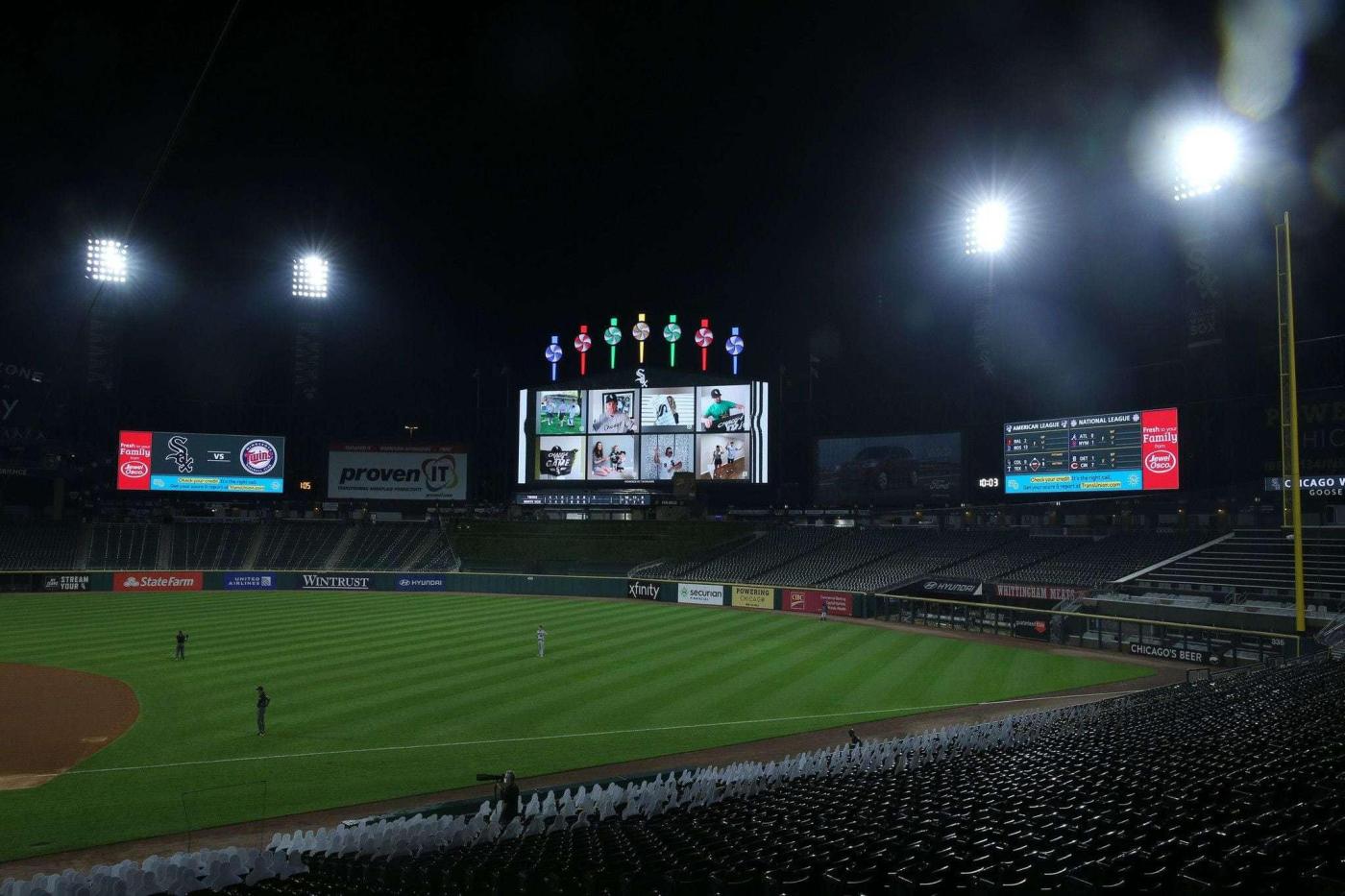
Column: Rat Hole Park? Second City Stadium? It’s never too early to name the new White Sox Park.

posted in: News | 0

Everyone is giddy for the new White Sox ballpark in the South Loop, even without the team or the city announcing any details about their plans.

Kudos to the Sox for getting fans excited for opening day, even if it’s Opening Day 2030, and to Mayor Brandon Johnson, who figures to be long gone before the first shovel hits the ground on the ballpark construction.

If we’re rushing toward an agreement to make Chairman Jerry Reinsdorf’s new pet project come to fruition, we might as well start thinking about the naming rights.

Guaranteed Rate Field, the name of the current ballpark, never has caught on since replacing U.S. Cellular Field, which was widely known as “the Cell.” U.S. Cellular Field replaced “new Comiskey Park,” the original name in 1991 which honored the demolished ballpark across the street. Former owner Charles Comiskey named the ballpark after himself, an idea that Reinsdorf assuredly won’t copy.

No matter what name it went by, many fans still referred to the Sox’s home as “Sox Park,” an easily remembered name that spans generations.

While we anxiously await Reinsdorf and Johnson’s plan, here are 10 suggestions for the name of the new South Loop ballpark:

1. Manny’s Cafeteria & Delicatessen Stadium

The South Loop’s most beloved restaurant deserves dibs for the new stadium name.

The classic Jewish deli is only a three-minute drive down Roosevelt Road from the proposed stadium site, and figures to be as popular for pregame dining as McCuddy’s once was for pregame drinking.

2. Rat Hole Park

The Rat Hole Preservation Society, our nickname for those anonymous do-gooders in Roscoe Village who helped save the city’s latest tourist attraction from vandalism, needs to set up a GoFundMe page for the naming rights.

The Rat Hole is a rodent-shaped crater in a sidewalk that somehow became as famous as the Bean. The Sox could even get creative and design a park with the same imprint. Rat Hole Park would be a perfect destination for a ballgame in Chicago and would honor both our favorite rodents and our history of corrupt politicians.

The only problem might be that some Sox fans already refer to Wrigley Field as “the rat hole.”

3. The 78

The area around Clark Street and Roosevelt Road is already called “the 78″ based on someone’s idea that it eventually would become the 78th neighborhood in Chicago.

“The 78″ could also be seen as an homage to the 1978 White Sox, a team that had the misfortune of following the popular ‘77 group known as the “South Side Hit Men.” Without “rent-a-players” Richie Zisk and Oscar Gamble, the stars of the Hit Men, the Sox plunged to a 90-loss season. They did however manage to acquire Claudell Washington in a trade for Bobby Bonds, and the outfielder’s inability to play hard inspired the famous banner in right field: “Washington Slept Here.”

4. Obama Yards

The world’s most famous Sox fan is former President Barack Obama, though he once called Comiskey Park “Comiskey Field” in an interview with Bob Costas.

Obama’s presidential library currently is under construction in Jackson Park and could use a bookend a few miles north. One Sox fan publicly pleaded with Reinsdorf in a Chicago Tribune op-ed to sell the team to Obama, but first things first. Naming the stadium after Obama might even convince him to attend some games.

5. Loop Park

Getting people to go back to the Loop again might be easier if it meant going to a ballpark by the same name, and the former classic rock radio station called “the Loop” would be an appropriate tie-in for nostalgic Sox fans.

A statue of Steve Dahl blowing up disco albums would look nice in center, commemorating one of the most celebrated moments in Sox history.

6. Second City Stadium

The Second City improv theater includes some of the most recognized names in comedy over the years, from John Belushi and Dan Aykroyd to Tina Fey and Stephen Colbert.

In the mid ‘90s I asked Second City alum George Wendt, a South Side Sox fan who played Norm on “Cheers,” to give his theory on the team’s attendance issues in the new Comiskey Park.

“Maybe you could’ve put it on the free TV versus cable TV thing a few years back,” Wendt replied. “But now they’re on WGN sometimes, so I don’t know. It seems like emigres to Chicago, the postgraduates who settle here in the suburbs, north or south, become Cubs fans. It seems like to be a Sox fan, you have to be born and raised on the South Side.”

That might still be true today.

7. This Space for Rent Field

A temporary solution while the Sox try to find a sponsor from the cryptocurrency world.

8. Ozzie Guillen Field

The manager of the only Sox team to win a championship since 1917 doesn’t have a statue in Guaranteed Rate Field. To make amends, the Sox could name the new ballpark after Guillen, who currently works as an analyst for NBC Sports Chicago and provides unfiltered commentary on the team’s issues.

“Meet you at ‘the Oz’” sounds like a good way to start a day.

9. Taylor Swift Stadium

Being associated with the world’s biggest pop star seemed to work well for the NFL. The Sox could use the boost in attendance, even if Reinsdorf has to pay Swift for the use of her name.

10. Sox Park

Well, this is what it will eventually be called no matter what it’s named, so why not just cut to the chase?

()

Study shows daylight saving time has minimal effect on heart health

posted in: Society | 0

Vincent Jacobbi | Mayo Clinic News Network (TNS)

ROCHESTER, Minn. — A recent Mayo Clinic study examining the effects of daylight saving time (DST) on heart health suggests that the impact is likely minimal.

In the nationwide study, researchers applied an advanced statistical model to look for any connections between DST and serious cardiovascular problems, including heart attacks and strokes. The study looked at 36,116,951 adults aged 18 and up across most U.S. states. (Arizona and Hawaii were excluded since these states do not observe DST.)

Researchers focused on the week directly after the spring and fall DST transition, when clocks are set either an hour forward or backward.

“We looked at five years across the U.S., and what we found is that it’s unlikely that there is a clinically meaningful difference in cardiovascular health due to daylight saving time,” says Benjamin Satterfield, M.D., Ph.D., a cardiovascular diseases fellow and lead author of the study.

Researchers found 74,722 adverse cardiovascular events occurred throughout the study during the spring and fall DST transition. An adverse cardiovascular event was documented when a person was hospitalized with a primary diagnosis of a heart attackstrokecardiogenic shock or cardiac arrest.

“These cardiovascular events are common health conditions, so this led to the question of whether this is more than would be expected if this had not followed the daylight saving time transition,” says Dr. Satterfield.

The observance of daylight saving time varies around the world. Countries that move clocks forward or back one hour may do so on different dates, and some do not observe daylight saving time at all.

In the Mayo Clinic study, the Monday and Friday following the spring DST transition showed a statistically slight increase in the rates of cardiovascular events — but when looking at all the data, researchers did not see the rise as clinically significant, he said.

Related Articles

Health |


One twin was hurt, the other was not. Their adult mental health diverged.

Health |


Union: 1K took part in one-day strike seeking higher wages, better staffing at MN nursing homes

Health |


Say that again: Using hearing aids can be frustrating for older adults, but necessary

Health |


Hacking at UnitedHealth unit cripples a swath of the US health system: What to know

Health |


Stillwater says it shut down a city well more than a year ago after detecting PFAS contamination

Researchers note that the time change practice was intended to align social and work activities with daylight hours and to conserve energy using less artificial lighting. They underscore that making changes to the DST system out of concern for heart health is unnecessary.

“When decisions are made about whether to abolish daylight saving time, there is no need to take concerns regarding heart health into account,” says Bernard J. Gersh, M.B., Ch.B., D.Phil., cardiologist and senior author of the study.

Dr. Gersh and Dr. Satterfield note that the debate over DST includes other aspects of health. For example, Dr. Satterfield said researchers are exploring DST’s effect on mental health and its effect on the rates of motor vehicle accidents.

The Mayo Clinic Robert D. and Patricia E. Kern Center for the Science of Health Care Delivery supported this research. Review the study for a complete list of authors, disclosures and funding.

©2024 Mayo Clinic News Network. Visit newsnetwork.mayoclinic.org. Distributed by Tribune Content Agency, LLC.

Letters: There should be zero deaths from fire in modern buildings

posted in: News | 0

Fire suppression

It was sad to read of John Stevenson’s death attributed to a fire in his apartment. I have always given the statistic that there have been no fatalities due to fire in a building with a working fire-suppression sprinkler system, and this appears to be the case now.

The article states the fire was extinguished by the sprinkler and the dog was unharmed, however the occupant died in the hospital of fire-related injuries caused by his smoking and use of oxygen. It does not say when he died, but attributes his death to the fire.

With the advances in fire prevention and detection as well as automatic extinguishment by built-in fire protection, there should be zero deaths from fire in modern buildings.

Jan Gasterland, St. Paul
The writer is retired firefighter and building-code officer


Small steps for travelers

The Minneapolis-Saint Paul airport has committed to environmental sustainability with highly ambitious goals for 2030. While I believe the airports’ objectives to be lofty, their goals are respectable. Airplane passengers should be aware of these new goals and encouraged to contribute.

Airplane travel makes up a significant portion of many people’s carbon footprint, so it’s only sensible to contribute to sustainability efforts.

As a frequent patron of MSP, I often find myself falling into the convenience of products with single-use packaging, which I then feel guilty about using. While MSP has implemented many sustainability initiatives, the excessive sale of products with single-use packaging, such as plastic water bottles, is unacceptable. Travelers can take small steps such as bringing a reusable water bottle to the airport and filling it up at the fountain.

Olivia Tuisl, Minneapolis


Quick cognitive testing

I get a physical every year. Several years ago the doctor started giving me a test that measures my cognitive ability and whether further testing is needed. You’re told three simple words; like “table,” “season” and “leader” and asked to remember them. Then you’re given a blank sheet of typing paper and asked to draw a clock face on that paper, fill in the numbers and draw the hands to represent 10 minutes after 11. You are then immediately asked to write the three words you were asked to remember, under the clock. If you can write these three words, you get to try again next year. If you can’t remember the words or instructions, further testing is suggested. The entire process takes less than two minutes.

Jim Feckey, Mendota Heights

Related Articles

Letters to the Editor |


Letters: To deter carjackers and assault? Issue personal bodycams at a low price

Letters to the Editor |


Letters: Meet these 3 housing goals, St. Paul Council

Letters to the Editor |


Letters: Here’s one reason for front license plates

Letters to the Editor |


Letters: Don’t let repeat offenders keep repeating, Minnesota

Letters to the Editor |


Letters: The office isn’t the only way to make strong relationships and a good career

Quiet quitting. RTO. Coffee badging. What this new vocabulary says about your workplace

posted in: News | 0

Samantha Masunaga and Sean Greene | (TNS) Los Angeles Times

Abygail Liera sympathized when she first read about people who were “quiet quitting,” refusing to go above and beyond at their jobs.

But it wasn’t until a few months later that she understood.

The resident of Los Angeles’ Winnetka neighborhood got a new boss and was expected to train him, but when she asked for a raise, she said she was told, “We’ll see.” Her boss discouraged open and honest feedback, making her work environment feel toxic and disrespectful.

“I remember reading it, and I’m like, ‘Damn, this sucks that people have to go through this,’ ” said Liera, 32, of the news article on quiet quitting. “At the same time, I was like, ‘Oh, I don’t know what that feels like.’ But now I do.”

Since the pandemic, work-related phrases such as “quiet quitting” or “Great Resignation” have taken over the internet — and are now part of our everyday vocabulary. Social media is filled with work-related memes and videos that describe “rage applying” or “lazy girl jobs.” People share tips on Reddit about how to effectively — and surreptitiously — “polywork,” or hold multiple jobs at the same time.

This proliferation of workplace lingo is more than a fad: It’s a viral language showing how workers are trying to hold onto the power they suddenly gained during the pandemic, workplace experts say.

After March 2020, workers were able to leverage the tight labor market to get what they want. But recent layoffs across a number of industries have shown that the balance of power between employee and employer today is, at best, a constantly tilting seesaw.

The job cuts and mandatory return-to-office policies imply that companies are gaining the upper hand on their employees, yet the persistence of hybrid work policies may show that workers have made a permanent mark on how work gets done in the future.

Employment data suggest that a growing number of people are prioritizing work-life balance in a more meaningful way or, increasingly cynical about traditional work arrangements, are tailoring those structures to work for them.

“As cynicism grows with the status-quo aspects of work, it feels like this push-and-pull between management and workers,” said Eric Anicich, associate professor of management and organization at USC’s Marshall School of Business.

“This idea of disliking your boss and hating your job is as old as time,” Anicich said. “Now we have a certain language for it, and there’s a certain way of tapping into a community of people who feel the same way that we haven’t had in the past.”

Pandemic epiphanies, burnout and coining a new term

For 10 years, Alisha Miranda juggled two careers — a 9-to-5 job in creative and digital agencies and, in her spare time, freelance journalism.

But by June 2021, she’d had enough.

Working from home during the pandemic blurred the lines between work and her personal life, exacerbating a years-long feeling of burnout. Miranda had toiled for years at her day job without receiving a promotion or a pay raise, despite indications from her managers that one was coming. She even continued working while grieving the deaths of loved ones from COVID-19. The final straw came when a large ad campaign she’d been working on was suddenly pushed back indefinitely.

“I can’t picture doing this for one more day,” Miranda, 38, remembers telling herself. “I have got to go.”

Miranda joined the historic wave of millions of U.S. workers who left their jobs in 2021 and 2022 because of high levels of burnout or “pandemic epiphanies,” in which about two-thirds of employees took a step back and reconsidered the role of work in their lives.

Add to that the increased prevalence of remote work, which finally allowed workers to have some measure of control over their schedule, and it’s no wonder there was a wave of resignations, said Anthony Klotz, an associate professor of organizational behavior at the UCL School of Management in London, who coined the term “Great Resignation.”

Klotz has spent his career studying how and why people quit their jobs. In an interview with a reporter in 2021, Klotz said he expected to see a wave of resignations after the initial shock of the pandemic. He had previously discussed his theory with his wife, describing it to her as the “Great Resignation” and just so happened to use the term in his chat with the reporter. It caught fire.

“There was this pressure that the economy was going to reopen, and everybody was going to get back to life as it was,” he said. “It gave people something to grab onto and feel like, ‘I’m not alone.’ We need a pause about what we learned here, we can’t just go back to the way things were.”

As Liera, the Winnetka resident, was grappling with her difficult work situation, her younger sister Daisy was independently having her own pandemic epiphany.

Daisy Liera quit her job during the Great Resignation and has a new outlook on work-life balance since the pandemic. (Dania Maxwell/Los Angeles Times/TNS)

The Burbank, California, resident knew she needed a reset after working for months in a pressure-cooker workplace run by a boss who seemed to have “no care about health safety measures” during the pandemic. She started getting stomachaches, couldn’t sleep at night and would count down the minutes until her lunch break or until she could leave for the day.

She quit her job, found a new one at a legal assistance organization and eventually went to grad school to focus on organizational psychology. As the daughter of immigrants, Liera said her parents’ ethic of hard work and working multiple jobs to support the family made her feel that she had to make the most of all of the opportunities her parents gave her and “use it to show that we were able to do it.”

“Prior to the pandemic, I was very like, ‘I need to get a job, I need to stay with a job, and I need to be good at my job all the time,’ which is one thing that led to my anxiety,” said Liera, 28, who now works for the city of Los Angeles. “After the pandemic and after leaving my job and going back to grad school, I de-prioritized work.”

Usually, the company is the one with power over workers because bosses can fire them at any moment. But the word “resignation” shifts that power to workers, giving them control over their own job, Klotz said. That applies, too, to other viral work phrases, such as “bare minimum Mondays.”

After Miranda, the journalist, quit her job, she went to work for a startup wine magazine. Her new colleagues were nice and “super supportive,” and the improved work-life balance meant she could focus more on freelance writing. (The magazine ran out of funding in 2022.)

Now freelancing full time, Miranda says she’s more intentional about the work she takes.

“I only want to pursue projects that are rewarding and things that I’ll be happy with, money aside,” she said.

Doing only what’s required of you, and no more

After her boss started cracking down, Abygail Liera cut back on her productivity and started typing emails at a snail’s pace or revising them six or seven times, and dialing phone numbers with extra care.

“My work ethic is going to reflect on your leadership,” she recalled thinking.

Eventually Liera’s “quiet quitting” turned into actual quitting. She left her job in December and is now looking for a new gig.

Although the job market has been discouraging, hearing from former co-workers about the problems at her old office confirms to her that she made the right choice.

The term “quiet quitting” is difficult to define, said Yongseok Shin, an economics professor at Washington University in St. Louis. Although some interpret it as a way to increase work-life balance, others define it as a way to recoup unpaid or unappreciated hours of service.

Intrigued by the viral term, Shin and his colleagues conducted research on whether the number of hours employees worked contributed to the tight labor market.

In his research on the phenomenon, Shin and colleagues found that from 2019 to 2023, workers voluntarily reduced the number of hours they worked. In that time, the average employed person worked about 31 fewer hours per year. This came after employees had spent the previous six years working an average of 17 extra hours per year.

The reduction was greater among educated men in their prime, who worked an average of 44.3 fewer hours per year over the same time period. Women reduced their working hours by an average of 14.6 hours per year, on average, a consequence of gender disparities in caregiving responsibilities.

In essence, these workers were reducing the intensity of their work and reassessing their relationship to their jobs, whether it was cutting back on weekend hours or potentially decreasing their work in response to a lack of appreciation at the office, Shin said.

“These people can afford to do this because they’re valued employees,” he said. “But if your bosses work fewer hours, that’s good for everybody, right? If your boss is less of a workaholic, other people in the organization will feel more comfortable working fewer hours.”

But don’t mistake this for a nationwide shift in work-life balance. Shin said the U.S. has a long way to go before catching up with countries in Europe, which champion more generous benefits such as paid family leave, sick leave and vacation.

The battle over remote work continues

After Bryan Wilson was laid off from his job in higher education, he pivoted full time to audio production — a choice that allowed him to work from home for the first time.

The flexibility was game-changing. He and his wife were able to split child-rearing responsibilities for their two kids while also spending more time together, planning meals and eating healthy. Remote work also allowed Wilson, 39, to apply for more jobs outside the limits of his Auburn, Alabama, home, where audio jobs are few and far between.

“There is relatively no market for audio production outside of major cities,” Wilson said. “I want to do this work because I’m really good at this work, and this is work I love, but where do I find it? During the pandemic … it was really easy to find that work.”

No pandemic-era office battle has been as fierce as that between the work-from-home and return-to-office camps. And 2024 doesn’t look like the end of it.

Last year, a group of economists published a paper in the National Bureau of Economic Research tracking millions of online job listings and whether they permitted remote or hybrid work.

Before the pandemic, the share of U.S. job postings that said new employees could work remotely one or more day per week was less than 4% in 2019. Over the next three years, that share would triple, according to the latest available data on the researchers’ website, WFH Map.

While census data show the number of employed people working remotely began to fall in 2021, a “new normal” of remote and hybrid work has emerged, said Peter John Lambert, an economist at the London School of Economics and co-creator of WFH Map.

Based on job postings and survey data, Lambert said he sees no evidence that hybrid work will soften in the coming year.

“Both employers and workers seem to find this partial flexibility to be the best of both worlds, providing flexibility to workers but allowing for in-person teamwork during on-site days,” Lambert said. “While workers learned this quickly, it has taken business a bit longer to realize the huge benefits to offering workers flexibility.”

Right in the middle of this is the term “coffee badging,” which was popularized by video conferencing company Owl Labs and describes a way for employees to meet their in-office mandate but spend as little time as possible in the workplace.

According to the company’s report, 58% of hybrid workers say they are already “coffee badging,” with an additional 8% saying they’re interested in trying it out.

For Wilson, as interest rates shot up and layoffs roiled media companies, those remote audio production opportunities dried up. Wilson currently works two part-time jobs in audio, which is not enough to keep him out of debt. He’s now looking for local, in-person jobs while he finishes certifications in tech and cybersecurity, a field he picked, in part, because of its prevalence of remote work opportunities.

He’s curious whether the ubiquity of remote work will return when the economy improves and companies again face pitched battles to attract new hires.

“That, I think, will be the real test of whether remote work can be normalized,” Wilson said. “When the money is flowing again … will they be offered remote jobs? I’m definitely going to keep my eye on that.”

When one job of $150,000 is not enough

Since the pandemic began, wealth advisor Fernando Reyes has been hearing from clients that they were taking on second or even third jobs.

It’s not a novel concept — people have always worked multiple jobs to make ends meet. What’s new is that Reyes’ clients were highly paid aerospace workers, tech employees and mortgage brokers, people who earn annual salaries ranging from at least $150,000 to $400,000. Although their salaries seem high by any measure, these clients said they needed to take on additional work to help pay mortgages or send their kids to college.

Working an additional 20 to 30 hours a week can provide an extra $50,000 to $60,000 of household income, Reyes said. Today, he’s seeing higher rates of polyworking than ever before in his 20-year career.

“What used to be a comfortable income now is not so comfortable anymore,” said Reyes, who works for EP Wealth Advisors and is based in Torrance, California. “You’re seeing more educated people doing this, more tech workers, more people with college degrees, master’s degrees, doctorates even.”

According to U.S. Census Bureau economists, rates of multiple jobholders have increased over the last two decades.

A 2020 analysis found that, on average, 7.2% of workers held more than one job between 1996 and 2018. In that time period, the rate of multiple jobholders increased by 1 percentage point, to 7.8% of all employed people at the beginning of 2018.

The trend was influenced by economic fluctuations: People were less likely to hold multiple jobs during recession.

The rise of remote work since the pandemic has also changed the calculus for many workers — if they don’t have to commute to an office, adding another, typically contract, job is much easier. Oftentimes, the employers don’t know their shared employee is moonlighting.

Sometimes, the impetus for a second job is the state of the economy. One mortgage loan worker Reyes knows went from earning more than $1 million a year to making $40,000 last year as home sales and refinancing cratered amid the hike in interest rates.

“People have to live,” Reyes said. “Everybody wants to buy a home, everybody wants to buy a car, everybody wants to go to school, everybody wants to take a vacation. How do you pay for it all?”

For the majority of multiple jobholders, their side gigs made up about 25% of their total income, according to the Census Bureau analysis of Longitudinal Employer-Household Dynamics data. For lower earners, the share was closer to 30%. Surprisingly, high-earning polyworkers — those making at least $113,200 in 2018 — brought in a fourth of their earnings from second jobs.

Financial adviser Lazetta Rainey Braxton encourages her clients, particularly those from underrepresented backgrounds, to polywork and diversify their income streams. She noted the racial and gender pay disparities that plague many workers, such as Black women earning about 62 cents to the dollar compared with white men.

“We’re starting at a deficit, right? If we commit to just one institution, and know we’re already behind 38 cents, we’ve got to do polywork to make up the 38 cents,” said Braxton, founder and chief executive of Lazetta and Associates. “And if we don’t, the wealth gap is going to continue.”

©2024 Los Angeles Times. Visit at latimes.com. Distributed by Tribune Content Agency, LLC.