Roseville police call in backup as fights break out among groups of youth; 3 injured

posted in: News | 0

As large groups of young people gathered in Roseville Thursday night, fights broke out and three people sustained non-life threatening injuries, police said.

Roseville police called in five other agencies to assist during the incident, which included 100 to 200 people at a fast food restaurant, fights and a glass door broken.

It began at Roseville Area High School, which the school said was hosting a student-sponsored cultural event. It drew a large crowd of non-Roseville Area High School youth and young adults, Principal Jen Wilson wrote in a Friday message to district staff and families.

At the event’s conclusion, “the large crowd gathered in the parking lot and refused to leave school grounds,” Wilson wrote. “RAHS leadership in partnership with the RAHS school resource officer and Roseville Police Department ordered the crowd to leave school grounds. Upon leaving school property, it’s reported that some of the attendees moved to businesses near HarMar Mall and Rosedale Center — resulting in ongoing disturbances that required police intervention.”

When police were at the school, “a number of fights broke out” and officers dispersed the group, said Roseville Deputy Police Chief Joe Adams.

Then, police were called to Chick-fil-A on Snelling Avenue near County Road B West. A large number of people were fighting in the lobby, Adams said.

A person sustained an injury to their arm from a sharp edge, believed to be a knife, Adams said. Two other people arrived at a hospital, also with wounds from sharp objects. Officers found knives at the scene.

It “was extremely chaotic,” Adams said.

Around the same time, police received another call reporting shots fired in the area of Raising Cane’s outside Roseville Center, but officers didn’t find anyone there or evidence of a shooting, Adams said.

No one was arrested or cited, and the investigation continues.

Related Articles

Crime & Public Safety |


Bloomington teen pleads guilty in West St. Paul girl’s drug overdose

Crime & Public Safety |


Wisconsin man gets more prison time in slaying, dismemberment of St. Paul man

Crime & Public Safety |


Charges: Texas bandits swipe nearly 19K worth of graphing calculators from eight east-metro Target stores

Crime & Public Safety |


Three more charged with sending $2.2M in fentanyl pills to Twin Cities hidden in stuffed animals

Crime & Public Safety |


Burnsville man gets 15 years for drug trafficking

Why are clocks set forward in the spring? Thank wars, confusion and a hunger for sunlight

posted in: News | 0

By JAMIE STENGLE (Associated Press)

ALLAS (AP) — Once again, most Americans will set their clocks forward by one hour this weekend, losing perhaps a bit of sleep but gaining more glorious sunlight in the evenings as the days warm into summer.

Where did this all come from, though?

How we came to move the clock forward in the spring, and then push it back in the fall, is a tale that spans over more than a century — one that’s driven by two world wars, mass confusion at times and a human desire to bask in the sun for a long as possible.

There’s been plenty of debate over the practice, but about 70 countries — about 40% of those across the globe — currently use what Americans call daylight saving time.

While springing the clocks forward “kind of jolts our system,” the extra daylight gets people outdoors, exercising and having fun, says Anne Buckle, web editor at timeanddate.com, which features information on time, time zones and astronomy.

“The really, really awesome advantage is the bright evenings, right?” she says. “It is actually having hours of daylight after you come home from work to spend time with your family or activities. And that is wonderful.”

Here are some things to know so you’ll be conversant about the practice of humans changing time:

HOW DID THIS ALL GET STARTED?

In the 1890s, George Vernon Hudson, an astronomer and entomologist in New Zealand, proposed a time shift in the spring and fall to increase the daylight. And in the early 1900s, British home builder William Willett, troubled that people weren’t up enjoying the morning sunlight, made a similar push. But neither proposal gained enough traction to be implemented.

Germany began using daylight saving time during World War I with the thought that it would save energy. Other countries, including the United States, soon followed suit. During World War II, the U.S. once again instituted what was dubbed “war time” nationwide, this time year-round.

In the United States today, every state except Hawaii and Arizona observes daylight saving time. Around the world, Europe, much of Canada and part of Australia also implement it, while Russia and Asia don’t currently.

INCONSISTENCY AND MASS CONFUSION

After World War II, a patchwork of timekeeping emerged across the United States, with some areas keeping daylight saving time and others ditching it.

“You might have one town has daylight saving time, the neighboring town might have daylight saving time but start it and end it on different dates and the third neighboring town might not have it at all,” says David Prerau, author of the book “Seize the Daylight: The Curious and Contentious Story of Daylight Saving Time.”

At one point, if riders on a 35-mile (56-kilometer) bus ride from Steubenville, Ohio, to Moundsville, West Virginia, wanted their watches to be accurate, they’d need to change them seven times as they dipped in and out of daylight saving time, Prerau says.

So in 1966, the U.S. Congress passed the Uniform Time Act, which say states can either implement daylight saving time or not, but it has to be statewide. The act also mandates the day that daylight saving time starts and ends across the country.

Confusion over the time change isn’t just something from the past. In the nation of Lebanon last spring, chaos ensued when the government announced a last-minute decision to delay the start of daylight saving time by a month — until the end of the Muslim holy month of Ramadan. Some institutions made the change and others refused as citizens tried to piece together their schedules. Within days, the decision was reversed.

“It really turned into a huge mess where nobody knew what time it was,” Buckle says.

WHAT WOULD IT BE LIKE IF WE DIDN’T CHANGE THE CLOCKS?

Changing the clocks twice a year leads to a lot of grumbling, and pushes to either use standard time all year, or stick to daylight saving time all year often crop up.

During the 1970s energy crisis, the U.S. started doing daylight saving time all year long, and Americans didn’t like it. With the sun not rising in the winter in some areas till around 9 a.m. or even later, people were waking up in the dark, going to work in the dark and sending their children to school in the dark, Prerau says.

”It became very unpopular very quickly,” Prerau says.

And, he notes, using standard time all year would mean losing that extra hour of daylight for eight months in the evenings in the United States.

A NOD TO THE EARLY ADOPTERS

In 1908, the Canadian city of Thunder Bay — then the two cities of Fort William and Port Arthur — changed from the central time zone to the eastern time zone for the summer and fall after a citizen named John Hewitson argued that would afford an extra hour of daylight to enjoy the outdoors, says Michael deJong, curator/archivist at the Thunder Bay Museum.

The next year, though, Port Arthur stayed on eastern time, while Fort William changed back to central time in the fall, which, predictably, “led to all sorts of confusion,” deJong says.

Today, the city of Thunder Bay is on eastern time, and observes daylight saving time, giving the area, “just delightfully warm, long days to enjoy” in the summer, says Paul Pepe, tourism manager for Thunder Bay Community Economic Development Commission.

The city, located on Lake Superior, is far enough north that the sun sets at around 10 p.m. in the summer, Pepe says, and that helps make up for their cold dark winters. Residents, he says, tend to go on vacations in the winter and stay home in the summer: “I think for a lot of folks here, the long days, the warm summer temperatures, it’s a vacation in your backyard.”

Wild remain Marc-Andre Fleury’s playoff contender

posted in: News | 0

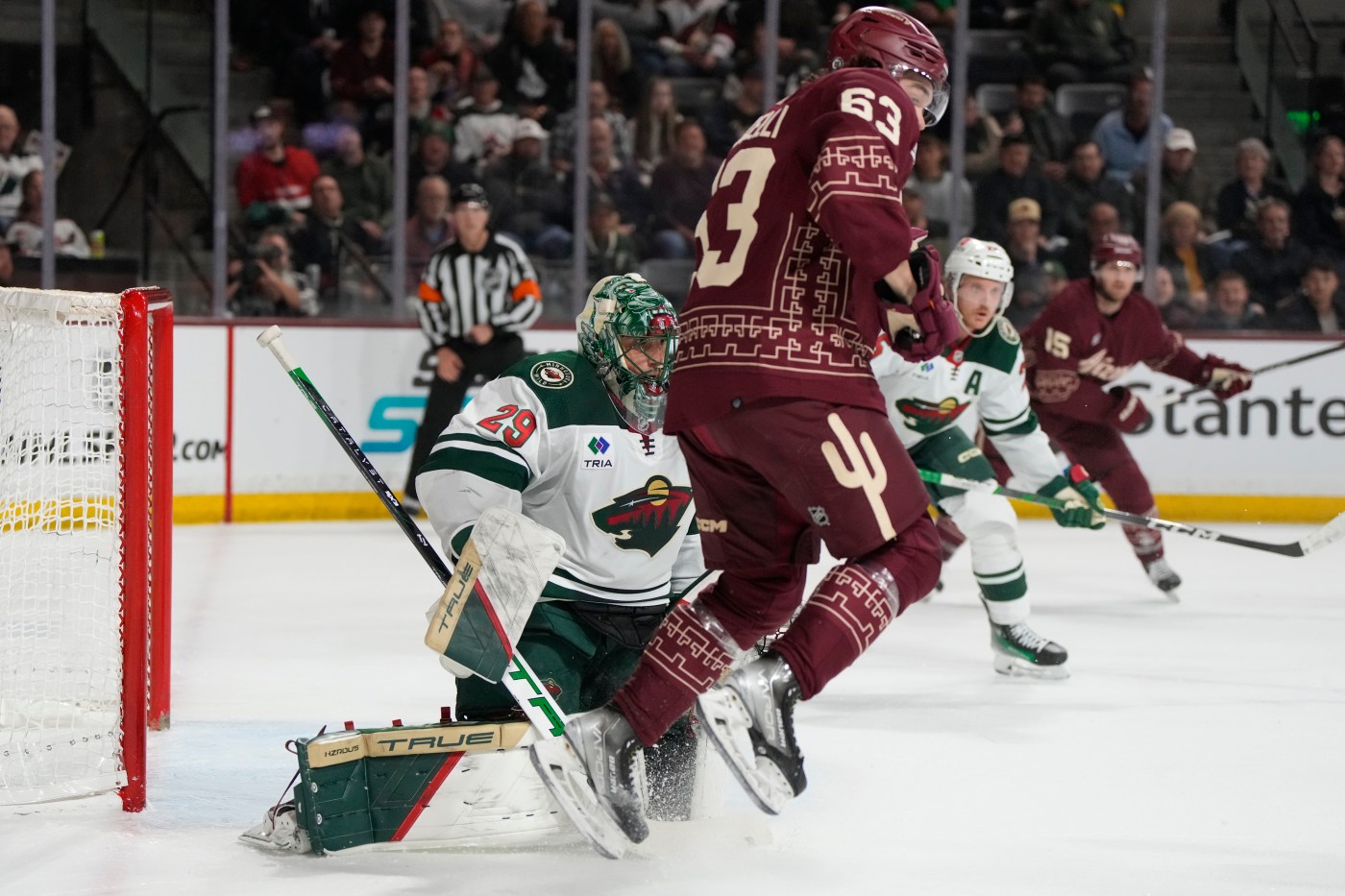
DENVER — There were a few Wild players who didn’t know whether they’d still be Wild players by Friday afternoon. Marc-Andre Fleury was not one of them.

The future hall of fame goaltender who passed 1,000 NHL games and moved into second place on the career victories list this season, made it clear to Wild general manager Bill Guerin that he didn’t want to finish the season anywhere else ahead of Friday’s 2 p.m. CST trade deadline.

Fleury, who turned 39 in November, has a no-trade clause in a two-year, $7 million contract extension that expires after the season, but Guerin didn’t need the veteran to veto a trade. He just didn’t entertain any.

Asked after backstopping a 5-2 victory at Arizona on Thursday whether he had any second thoughts about going to a contender, Fleury said, “We’re a little behind, obviously, but still battling.”

With two straight victories going into Friday’s 8 p.m. puck drop at Colorado, the Wild are, in fact, still in a playoff chase but, as Fleury noted, “a little bit behind” — although they picked up two points on sliding Vegas on Thursday and are now seven out of the West’s second wild card spot.

Fleury has been a big reason. After stopping 23 of 25 shots on Thursday — many of which left Arizona players shaking their heads — Fleury is 6-2-0 with a .921 save percentage and 2.16 goals-against average in his past 10 appearances.

His march into NHL history has been the highlight of a disappointing season, which started with a 5-10-4 thud that cost Dean Evason his job. And his mein, a rare combination of intense competitiveness and amiable personality, has been a beacon in a sometimes dark dressing room.

“To have the chance to play in front of him is special,” veteran forward Ryan Hartman said after Fleury played in his 1,000th NHL game on New Year’s Eve, a 4-2 loss to Winnipeg at Xcel Energy Center.

During fall camp, Fleury said he will decide whether to retire at season’s end, something he has reiterated a few times throughout the season, his 20th. With three Stanley Cup championships, 557 career victories — second only to childhood idol Martin Brodeur’s 691 — and 1,015 games played, he has nothing unchecked on the bucket list. But he also has been playing well, still flashing the form that made him a living hockey legend.

On Thursday, he kept the Wild in the game with a series of highlight reel saves until the Wild got four third-period goals, two of them empty-netters, to put the Coyotes away.

In the first period, he pivoted right to rob Dylan Guenther on a one-timer, leaving the Arizona wing to smack his stick on the ice and shake his head. Later, he stopped Michael Carcone on a two-on-one, making the save on his one-timer from the corner of the crease.

And Fleury’s decision to stick with the Wild and chase a longshot playoff hope has meant a lot to teammates who look up to him.

“It’s huge,” said Zach Bogosian, who scored a timely goal to tie Thursday’s game 2-2 and cap a three-goal flurry in the first two minutes of the third period. The Wild watched popular teammate Brandon Duhaime leave for Colorado before Thursday’s morning skate, and were unsure who else might be headed out before Friday’s deadline.

“Everyone cares about each other in this room, and we understand that there are certain things that are out of players’ control,” said Bogosian, who signed a two-year, $2.5 million contract extension on Wednesday. “Obviously, we love Flower, and he’s played awesome for us every time he’s in the net.”

Fleury started the season as backup/mentor to Filip Gustavsson, but with his recent play, he has been the team’s best goalie as it fights to stay alive for a fourth consecutive playoff appearance.

“It’s been fun, playing those games, and winning some games and feeling good, feeling like I can help a bit,” he said. “I can’t say I’ve changed much. Just keep battling, keep talking to the goalie coach. Nothing special, I think.”

But it has been.

Related Articles

Minnesota Wild |


John Shipley: Wild have few trade options, but maybe Bill Guerin will surprise us

Minnesota Wild |


Marc-Andre Fleury starts strong, finishes stronger as Wild beat Penguins, 3-2

Minnesota Wild |


Wild goalie Marc-Andre Fleury moves into second place on NHL career wins list

Minnesota Wild |


Wild’s Marc-Andre Fleury has first chance to pass Patrick Roy

Minnesota Wild |


Big saves, late heroics push Wild past Columbus, and Marc-Andre Fleury into the record book

How Cameron Knowles has built up Loons — and how it contrasts to Adrian Heath

posted in: News | 0

MLS Cup-winning head coach Wilfried Nancy knew it was coming and still had trouble stopping it.

Minnesota United’s high-pressing tactic was employed in the season-opening win over Austin FC two weeks ago, and it was again rolled out versus Nancy’s Columbus Crew in the Loons’ home opener last Saturday. With a week to prepare, it still posed problems for the 2023 trophy winners.

“The opposition (MNUFC) did a good job to press us, and we didn’t want to start slow, but they put a lot of pressure,” Nancy told reporters after a 1-1 draw with Minnesota. “… We could have done better, but it was because of the opposition, they pressed us really well.”

United has been working on its new front-foot tactic since the beginning of preseason in early January. The directive from new Chief Soccer Officer Khaled El-Ahmad has been implemented by interim head coach Cameron Knowles.

Knowles will lead the Loons (1-0-1) for the last time against Orlando City (0-1-1) at Inter & Co Stadium at 6:30 p.m. Saturday.

New permanent head coach Eric Ramsay takes over next week, including an introductory news conference at Allianz Field on Wednesday. Knowles, meanwhile, appears in line to take become an assistant coaching rule under Ramsay.

Knowles has shown himself in a good light during his caretaker stint. He has done so with the help of a clear weekly plan.

“As players, we crave habits and we crave consistency,” said defensive midfielder and captain Wil Trapp. “And when you have consistent ways of doing things through the week, it’s really nice for us to know what to expect.”

One day at a time

Knowles was asked by the Pioneer Press to described the weekly routine:

Monday morning is a recovery sessions for the previous game’s starters, while supplemental work is put into players who didn’t see the bulk of the match’s minutes.

Monday afternoon holds a video review session of the game — key moments, things done well and areas for improvement.

Tuesday morning is a classroom session with video focused on how the upcoming opponent plays with the ball, meaning how MNUFC will set up a plan to press them and find counter-attacking moments.

Tuesdays on the field have been the longest training sessions of each week to start the season. They work on what they just went over inside. “High volume, physical day for us,” Knowles said.

Wednesday is a new off day for first-team players.

Thursday mornings include another video session focused on how the opponent will set up out of possession, meaning how the Loons can try to exploit their opponent. The Loons then train this lesson on the field.

Friday is a refresher course on the key points for the week and an activation of players’ bodies in a lighter practice the day before the game.

“We try to layer those things throughout the week, so it’s not just one dump of information at one time,” Knowles explained. “They are getting little bites of it and just topping it up as needed throughout the week.”

Knowles explained why it has been defense-first to start each week.

“I just think the way that we want to defend and the physical toll on it,” Knowles said. “If we can get the guys recovered from the game, and we are far enough away from the next game to put that physical load into them, that’s the way we have been building up the week so far.”

Trapp has appreciated Knowles’ classroom-to-field approach.

“For me, I don’t want to say it’s coaching 101, but it’s a way that players respond and I’ve always responded to extremely well,” Trapp said. “For us that really enjoy being visual learners and be able to walk it all through, it’s perfect. I think that is a reason why the team has adapted so well because it’s super clear. Here are the moments where we can hunt the ball when we want to create those pressing moments and then we are going to go do it.”

That doesn’t mean it will be perfect in each game. After the opening 20 minutes Saturday, Columbus got its footing and created the better scoring chances. Loons goalkeeper Dayne St. Clair kept the Crew off the scoreboard until the 59th minute when Cucho Hernandez scored.

The Loons didn’t quit, bringing on five substitutes and continuing to press until Tani Oluwaseyi scored the equalizing goal in the 95th minute.

Comparison to Heath

The elephant in the (class)room is how the first team approached the week’s buildup under former manager Adrian Heath.

“I love Adrian,” Trapp continued. “Everyone has their own way of doing things, right? You are seeing the younger generation of coaches that have gone through the pro license and have done all this stuff recently, or more recently like Cam has. This is more of the model they are taking up.”

Trapp, who was with the Columbus Crew from 2013-19 and Inter Miami in 2020, said his first year with MNUFC in 2021 was the least amount of group video sessions he watched as a pro.

The Loons brought in David Handgraff as a video analyst in 2022 and the amount of video sessions increased for MNUFC into last season. Cam has laid out clear communication and responsibilities for players, while Heath was not as scripted with his counter-attacking style.

References checked

When news of Ramsay’s hire by MNUFC spread two weeks ago, Trapp received text messages from two assistant coaches he previously worked under in Miami: Anthony Pulis, a current MLS assistant at Real Salt Lake, and Brett Uttley, now the head coach of Austin FC II.

Pulis and Uttley know Ramsay. They earned their UEFA pro license with Ramsay as a sort of mentor.

“They said first and foremost as a person, incredible,” Trapp relayed. “Still trying to figure out what the style of play will be, but I think Cam is distilling that down for us anyway.

“But more importantly just the way (Ramsay) is. How driven he is, how determined he is,” Trapp added. “Everything I’ve heard, read and talked to people about is quality.”

The Loons are completing a final step in a transition from an old-school manager in Adrian Heath, 63, to a new-school approaches from Knowles, 41, and then Ramsay, who will be the youngest coach in MLS at age 32.

“It’s a total pendulum swing away from where we were,” Trapp said. “I’ve taken this stance that I’m not going to judge anything until you get your eyes on it and you can formulate your own opinions. Having those assumptions (of Ramsay) ahead of time makes us feel better, but it doesn’t really matter until you are on the field with the guy.”

Related Articles

Soccer |


Christian Ramirez has ‘chills’ in first away game at Minnesota United

Soccer |


Minnesota United’s entanglement as MLS downsizes role in U.S. Open Cup

Soccer |


Minnesota United scores in 95th minute for 1-1 draw with Columbus Crew

Soccer |


Loons vs. Columbus: Keys to the match, big storylines and a prediction

Soccer |


New Loons leader Khaled El-Ahmad shares vision for club, details on hiring Eric Ramsay as head coach