Opinion: The Harmful Impact of Invasive Child Welfare Investigations

posted in: News | 0

“These rates of over-investigation are state-sanctioned family policing. Even where investigations are warranted and allegations are substantiated, the investigative process is often coercive and traumatic, indelibly harming the children the investigations intend to protect.”

Adi Talwar

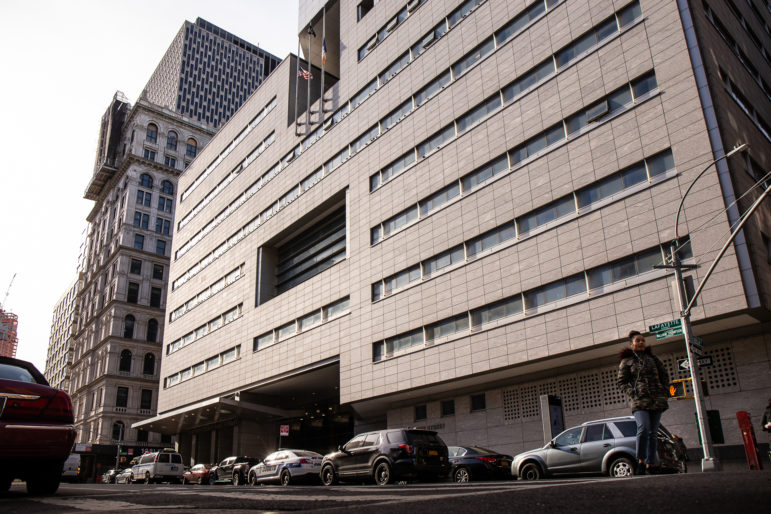
New York County Family Court at 60 Lafayette Street in Manhattan.

CityViews are readers’ opinions, not those of City Limits. Add your voice today!

Imagine you are 10 years old; a child abuse investigator bangs on your door at 3 a.m., demanding to search your home and threatening to take you from your parents. Imagine the investigator did this without a warrant—and that when your parent felt they had no choice but to let them in, they strip-searched you. Think this can’t happen here? This nightmare is reality for nearly 100,000, mostly Black and brown children, in New York City annually.

Earlier this month, the NYC Family Policy Project released a bombshell report demonstrating, in no uncertain terms, that New York investigates far too many children and families for suspected abuse or neglect. The report comes just days after the filing of a class action lawsuit, Gould, by parents suing New York City for violating their Fourth Amendment Rights in coercively and systematically conducting warrantless searches of their homes. As attorneys for children, we applaud these efforts to shine light on a pernicious problem.

Each year, nearly 100,000 children are subject to investigation by the Administration for Children’s Services (“ACS”). ACS only substantiates—finds that it is more likely than not maltreatment occurred—approximately 23 percent of its investigations a year. This suggests nearly 77,000 children endure unnecessary investigation by ACS annually. These rates of over-investigation are state-sanctioned family policing. Even where investigations are warranted and allegations are substantiated, the investigative process is often coercive and traumatic, indelibly harming the children the investigations intend to protect.

ACS’ primary mandate is to protect NYC’s children. Investigating allegations of abuse and neglect is necessary and—if done properly—critical to carrying out that mandate. Unfortunately, the aggressive and coercive tactics ACS employs to investigate, and the volume of children and families that it investigates, have created an apparatus that harms more children than it protects.

During an investigation, which lasts 60 days, ACS workers regularly enter and search through children’s homes in the middle of the night, threaten family separation, show up unannounced in their schools, and interview countless individuals connected to their lives. Regardless of the allegations or age of the child, ACS frequently interrogates and strip searches the child at least once, and often multiple times.

In a study conducted by ACS and then shelved, an ACS investigator likened an investigation to “being stopped and frisked for 60 days” and “[c]aseworkers said they felt pressured to push their way into people’s homes without advising parents of their rights.” Needless to say, such tactics are harmful for children, but there is also a plethora of social science research that establishes these harms. Even the ACS Commissioner, Jess Dannhauser, acknowledged that “investigations are often disruptive, stressful and can be traumatic.”

The coercive, traumatic nature of ACS investigations is particularly disturbing when accounting for race. Nearly one out of every two Black children in New York City has been, or will be, the subject of an ACS investigation by the time they turn 18. These numbers alone are an urgent cry for change.

Like their parents, children have a Fourth Amendment right to be protected from unreasonable searches. Nevertheless, ACS seeks warrants in a mere 0.4 percent of investigations. It is unfathomable that emergency circumstances or meaningful parental consent—exceptions to the warrant requirement— exist in 99.6 percent of investigations. The numbers paint a clear picture of consent routinely obtained through coercion and an abuse of emergency powers.

Action by New York is long overdue. The following six recommendations are necessary first steps. First, the State Central Register (“SCR”), which receives all allegations of abuse and neglect in New York, must strengthen the screen-out process—disregarding allegations that do not meet the agency’s own requirements for investigation.

Second, New York must pass the Anti-Harassment in Reporting Bill which requires those who report abuse or neglect to identify themselves to deter false reporting. Third, New York must pass the Family Miranda Bill, which requires child welfare investigators to advise parents of their rights at initial contact, absent an emergency. Fourth, child welfare investigators must seek a warrant prior to investigating a family’s home whenever feasible.

Fifth, New York must move toward the elimination of mandated reporting, because most professionals now mandated to report would still report suspected abuse or neglect, and legal penalties incentivize over reporting. Finally, child welfare investigators must minimize the use of harmful, traumatic investigative tactics such as middle of the night home visits and strip-searching children.

Child welfare investigations in New York City are currently hurting more children than they are helping. We hope that the NYC Family Policy Project’s report and the Gould litigation, compel New York to re-examine the family regulation system, overhaul the investigative apparatus, and put the wellbeing of children and families first.

Dawne Mitchell is chief attorney of the Juvenile Rights Practice at The Legal Aid Society. Melissa Friedman is director of child welfare training with the Juvenile Rights Practice at The Legal Aid Society. Daniella Rohr is a staff attorney with the Immigration Law Unit’s Youth Project at The Legal Aid Society

Businesses are ready for April’s total solar eclipse with celestial-themed doughnuts and beer

posted in: News | 0

By WYATTE GRANTHAM-PHILIPS (AP Business Writer)

NEW YORK (AP) — Eclipse-themed beer. Jewelry and ornaments. And doughnuts that capture the sun’s disappearing act with the help of buttercream frosting.

With April 8’s total solar eclipse right around the corner, businesses are ready for the celestial event that will dim skies along a generous path across North America.

There are oodles of special eclipse safety glasses for sale, along with T-shirts emblazoned with clever slogans and other souvenirs — just like the last time the U.S. got a big piece of the total solar eclipse action in 2017.

Hotels and resorts along the prime path are luring in visitors with special packages and Southwest and Delta are selling seats on eclipse-viewing flights. Cities, museums and parks are staging watch parties to draw in tourists as well as residents.

“This is a special event and … the travel industry certainly is in a very good spot,” said Jie Zhang, a marketing professor at the University of Maryland’s business school. She also noted the eclipse craze arrives at a time when consumers are continuing to ramp up spending on new experiences.

Closer to eclipse day, there are likely to be more special products and promotions from national brands springing up, like Moon Pie’s “eclipse survival kit,” made up of four mini versions of the chocolate snack and two pairs of eclipse glasses.

Small businesses within the eclipse’s 115-mile-wide (185-kilometer-wide) path of totality appear to be leading the charge so far. Online shops and local vendors have put together a full array of creative, limited-edition merchandise: earrings, baby onesies, ornaments, games, banners and more.

Some towns and business owners have been anticipating the celestial event and huge crowds for years.

After the 2017 eclipse, “I marked my calendar,” said Sam McNulty, co-founder of Market Garden Brewery in Cleveland, which is in the eclipse path this time and will see nearly four minutes of dimmed skies.

Last year, McNulty’s team brewed a hazy IPA called “The Totality” to help drum up interest in the eclipse. The on tap debut was a success, and the brewery was soon approached by local grocer Heinen’s to partner for a canned collaboration.

In the coming weeks, “thousands and thousands” of cans are set to hit store shelves, McNulty said — adding they decided to go big because of how rare the event is. Cleveland won’t be in the path of totality again for a long time — not until 2444.

“I don’t want to have to wait 420 years to brew the next batch of cans,” he joked. “So we made a very large one this time.”

The eclipse-themed beverages don’t stop at beer. Big Cuppa, a coffee shop in Morrilton, Arkansas, also has a full eclipse menu with a handful of specialty drinks. Its “Moon Pie Frappa” is a blended Moon Pie drink flavored with dark chocolate and toasted marshmallow.

Big Cuppa co-owner Joseph Adam Krutz said that he’s excited to greet customers and the many new faces set to travel through town next month. Krutz said his shop has been gearing up for a while along with other businesses in downtown Morrilton. He drives by a countdown clock each day.

“We’re prepared. Bring it on,” Krutz said.

And don’t forget the snacks. In Ohio’s Butler County, a shop called The Donut Dude will have an “Eclipse Donut Special” that shows the eclipse’s stages as the sun disappears behind the moon.

The special goes on sale later this month and consists of seven filled-doughnuts with rolled buttercream, two galaxy-themed cake doughnuts and safety glasses so customers can watch the event while snacking away.

“We’re anticipating a lot of fun,” co-owner Glen Huey said.

Since the doughnut shop is closed on Mondays, Huey is looking forward to watching the spectacle as it passes over his town between Cincinnati and Dayton.

Related Articles

Business |


Skywatch: Celestial signs of spring

Business |


Another dangerous amoeba has been linked to neti pots and nasal rinsing. Here’s what to know.

Business |


Hidden COVID virus found more than a year after infection

Business |


Skywatch: The winter hounds

Business |


Measles Q&A: Do I need a booster? And other answers

In the U.S., Texas has the best odds for clear skies and the state expects to be swarmed with tourists. With a prime location, eateries in the town of Grapevine have a multitude of offerings: a “Blackout Dinner” at Hotel Vin and a “Solar Eclipse Shake” at Son of a Butcher.

Many businesses along the path of totality are offering special events leading up to the eclipse, too.

New York’s Cayuga Lake Wine Trail is promoting “Sips to the Eclipse” for the weekend ahead of April 8. Guests will be able to visit 10 wineries for tastings — some of which are offering additional attractions like an eclipse eve tarot card reading, special slushies and half-moon cookies.

Katherine Chase, executive director of the wine trail, said the promotion was planned in anticipation of all the people coming to the Finger Lakes region for the eclipse.

“The wineries can go as big or as little as they’d like to entice folks to come,” she said.

‘There’s no place like home’ for Dorothy’s ruby slippers — finally!

posted in: News | 0

“Then close your eyes and tap your heels together three times and think to yourself, ‘There’s no place like home, there’s no place like home, there’s no place like home.’”

— Glinda the Good Witch to Dorothy in “The Wizard of Oz”

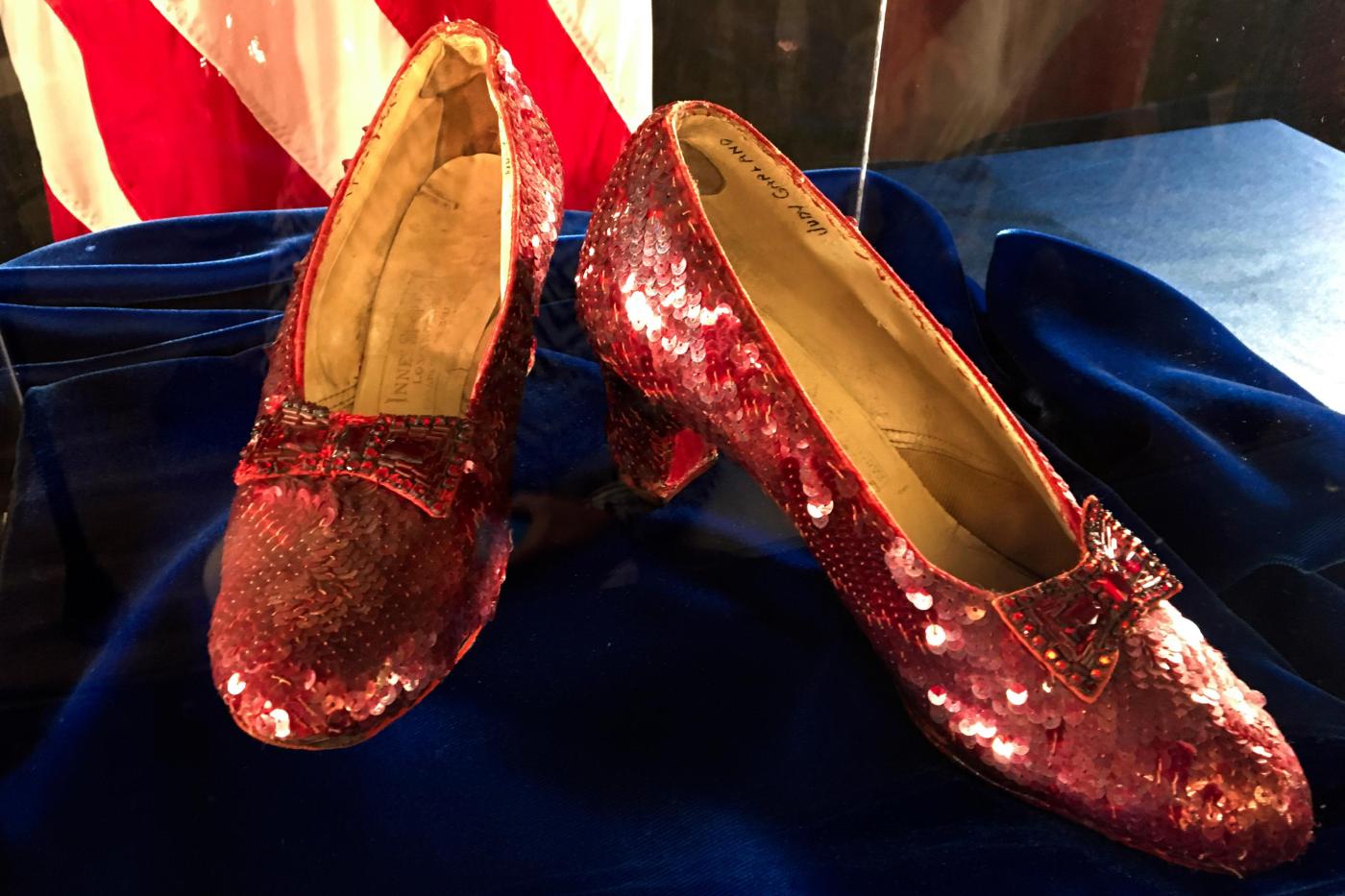
A pair of ruby slippers finally made it home, authorities announced on Monday.

The slippers, featured in the 1939 film ,”The Wizard of Oz” and stolen from the Judy Garland Museum in Grand Rapids, Minn., in 2005, were returned to the rightful owner, Michael Shaw.

The news comes days after a second man was charged in connection to the theft. Jerry Hal Saliterman, 76, of Crystal, had his first court appearance on Friday in federal court in St. Paul.

Earlier, the man who stole the slippers, Terry Jon Martin, 76, pleaded guilty in October and was sentenced in January.

The sparkly homecoming of the slippers were announced by Alvin M. Winston Sr., special agent in charge of the Minneapolis Division of the FBI, and Andy Morgan, chief of police for the Grand Rapids Police Department, in a news release issued by the U.S. Department of Justice.

“We are incredibly honored to return the ruby slippers to their rightful owner,” Winston said. “Beyond the glittering allure of the
shoes lies a testament to the FBI’s unyielding commitment to preserving the everlasting legacy of cherished memorabilia. This piece of cinematic history has been returned to Mr. Shaw through the diligent efforts of our dedicated agents, professional staff, and invaluable partners.”

“Recognizing the catastrophic loss to both Mr. Shaw and the countless fans of this piece of American cinema history, the Grand Rapids Police Department is extremely pleased that the slippers have been returned to Mr. Shaw,” Morgan said via the news release. “The collaboration between all partnering agencies cannot be overlooked or minimized. The countless hours of dedicated investigative efforts by current GRPD staff, retired staff, our partners at the FBI and the many other assisting agencies made the return possible.”

Judy Garland, immortalized as Dorothy Gale in the classic movie, danced her way down the yellow brick road in several pairs of red slippers during the film’s production. Garland’s portrayal of Dorothy and her longing to find her way home has spoke to
audiences for generations, making the ruby slippers an enduring symbol of American film history.

These sequined shoes, known as the “traveling pair,” were one of the last remaining sets used in the 1939 film, and their disappearance in 2005 from the Judy Garland Museum in Grand Rapids left a void in both cinema history and the heart of a community proud to call itself Garland’s birthplace.

The return ceremony, held at the Judy Garland Museum, was a restoration of justice, authorities said, a healing of wounds inflicted on both Shaw and the museum itself.

“The Judy Garland Museum survived the impact of this violation and is grateful to be a part of the homecoming,” said John Kelsh, founding director of the Judy Garland Museum, in the statement. “We continue to serve visitors from around the world; expect a Ruby Slipper Crime exhibit in our future.”

During the ceremony, in Garland’s childhood home, the ruby slippers were placed on their original pedestal — reclaiming, authorities said, not just an artifact but rekindling the museum’s identity as a guardian of Garland’s legacy.

“When Shaw, accompanied by his niece, laid eyes on the slippers for the first time in nearly two decades, he likened the experience to a heartfelt reunion with a long-lost friend,” the news release stated.

He then had the opportunity to meet Special Agent Christopher Dudley and Chief Morgan, who dedicated countless hours to the case and ensured the safe return of the iconic slippers. Agent Dudley surprised Shaw by not only returning the ruby slippers but also presenting him with the single red sequin that was left at the scene of the crime almost twenty years ago.

“’It was incredibly rewarding and fitting to see Mr. Shaw reunited with the Ruby Slippers, at Judy Garland’s home, accompanied by his friends on the museum staff,” said Special Agent Dudley in the news release. “It is a privilege for the FBI and our Art Crime Team to work alongside law enforcement partners who truly value the importance of protecting our nation’s cultural heritage.”

Both the museum and Shaw expressed their deep gratitude to the FBI and Grand Rapids Police Department for their commitment and tenacity.

“To some,” the statement read, “these slippers were not just shoes; they were the embodiment of magic, nostalgia, and the dreams of countless moviegoers who identified with Dorothy’s adventure down the yellow brick road.”

As the investigation is ongoing, the FBI had no further comment at this time.

Related Articles

Crime & Public Safety |


Stolen ‘Wizard of Oz’ ruby slippers will go on an international tour and then be auctioned

Crime & Public Safety |


Second man charged in connection with 2005 theft of ruby slippers worn in ‘The Wizard of Oz’

Crime & Public Safety |


Two teens arrested after shootout in St. Paul Cub Foods parking lot Sunday morning

Crime & Public Safety |


Shots fired near Dar Al-Farooq Center in Bloomington after a dispute

Crime & Public Safety |


New program gives St. Paul-Ramsey County sex assault victims more options — and control

Gulf Coast Petrochemical Buildout Draws Billions in Tax Breaks For Polluters

posted in: News | 0

A booming petrochemical buildout on the Gulf Coast has drawn billions of dollars in public subsidies from state tax abatement programs despite regular violations of pollution permits, according to a new report released Thursday. 

The Environmental Integrity Project, an environmental nonprofit based in Texas and Washington, D.C., compiled data on all U.S. plastics projects built, expanded or proposed since 2012, almost all of them along the Gulf Coast. 

The report identified 50 plastics complexes built or expanded in the last 12 years, 33 in Texas. Together they have drawn a total of $1.65 billion in property tax breaks through the state’s Chapter 313 program for energy and manufacturing companies, which the state legislature replaced last year with a new but similar program. 

That’s a tiny dent in Texas’ $250 billion annual tax revenue, but it’s just one visible slice of the total concessions corporations receive to do business in Texas, and it represents lost income that would have gone primarily to the state’s public schools, which are struggling with shortfalls in teachers and funding. 

Now, companies are proposing to build an additional 42 plastics plants, 24 of them in Texas, according to the 73-page EIP report, “Feeding the Plastics Industrial Complex.”

“The industry is expanding rapidly, and more communities are being asked to consider public subsidies,” it said. “None of the state programs we examined require industries to follow the terms of their state pollution control permits.”

While Texas hosts the most new plastics production, the most generous tax breaks come from neighboring Louisiana, among the nation’s poorest states, where three projects alone drew $6.5 billion in local discounts since 2013. All operating projects considered in the EIP report claimed a total of $9 billion in exchange for commitments to economic development and job growth. 

That money would have otherwise funded local schools and public services, said Alexandra Shaykevich, research manager at the Environmental Integrity Project. Instead, it’s given to highly profitable corporations that are often foreign-owned and likely would have located near the nation’s major oil and gas resources with or without local tax incentives, according to her group’s report. 

Most facilities reviewed by the EIP reported repeated violations of their pollution permits, Shaykevich said, but those violations never jeopardized their tax subsidies.

“I think if companies can’t obey the law they shouldn’t be rewarded with taxpayer money,” she said. “We would certainly advocate for making subsidies conditional on compliance.”

The American Chemistry Council and the Texas Chemistry Council, which represent the plastics business, did not immediately respond to requests for comment. 

Texas Sen. Charles Schwertner, chair of the Senate Committee on Business and Commerce, said the state’s  tax incentive program “bolsters economically distressed communities and enhances its competitive advantage in attracting vital industries.” 

“The program ensures that the Texas economic miracle continues to thrive by offering quality employment opportunities for Texans and investments in our communities,” Schwertner said. 

Ivan Armando Flores/Texas Observer

Gulf Coast Expansion 

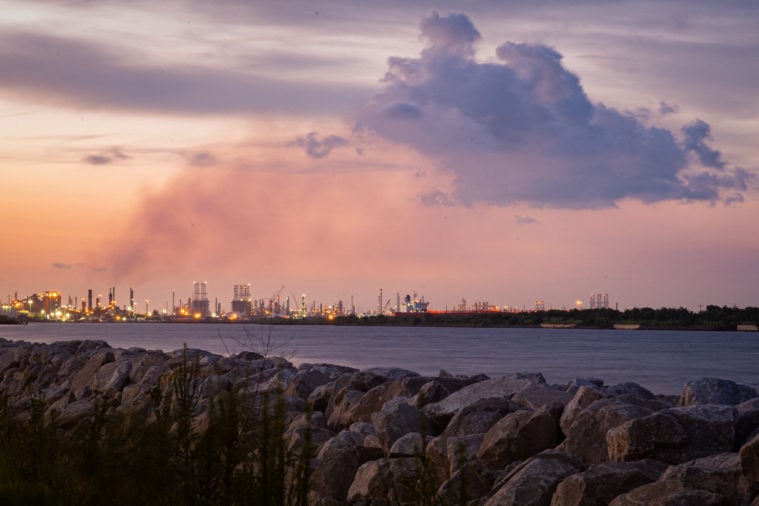
The recent growth in Gulf Coast petrochemicals, which include plastics, are a result of the ongoing boom in hydraulic fracturing upstream in the Eagle Ford Shale and Permian Basin of Texas. Pipelines carry oil and gas hundreds of miles to the coast, where refineries and chemical plants produce commercial products and load them onto ships for sale overseas. 

The United States . remains a world leader in petrochemical production and export thanks primarily to these industries, said Joe Powell, executive director of the Energy Transition Institute at the University of Houston.

“We’ve got really good energy prices here on the Gulf Coast because of fracking,” he said. “That makes the U.S. Gulf Coast a really good investment opportunity, especially in petrochemicals.”

Within plastics, he said, most recent growth has come from ethane crackers, facilities that turn natural gas into ethylene, which, according to the American Chemistry Council, can be made into polymers that are “used to manufacture fibers, bins, pails, crates, bottles, piping, food packaging films, trash liners, bags, wire and cable sheathing, insulation, surface coatings for paper and cardboard, and a wide variety of other products.” 

The U.S. is the top exporter of ethylene polymers, much of which go to China, the world’s top importer.

Powell, a former chief scientist for Shell, the global energy company, said years of rapid expansions have brought a glut of ethylene to market and left the Gulf Coast overbuilt in the short term, which he called “typical of the chemical business.”

But in the long term, robust demand for plastics is expected to grow. The Paris-based Organisation for Economic Co-operation and Development predicts global plastics demand will triple between 2019 and 2060. Much of that supply will come from Texas. 

High demand for plastics and other petrochemicals will support a growing share of fossil fuel production, said Tom Sanzillo, a director of financial analysis at the Institute for Energy Economics and Financial Analysis, as major sectors like transportation fuels and power generation shift to more sustainable forms of energy. 

Proposed Projects in Texas

For its report, the EIP drew on public records, including permit applications and company announcements, to compile a list of currently proposed plastics projects. Their data shows a wave of new development is still planned for the Texas coast, including seven new complexes and 20 expansions at existing complexes. 

For example, it said Formosa Plastics, a $460 billion Taiwanese company, has proposed to build a new vinyl chloride reactor, which produces material for PVC plastic, at its 2,500-acre Point Comfort complex on Lavaca Bay. (The company has quietly advanced other expansion plans lately, as well.) 

At neighboring Matagorda Bay, German petrochemical manufacturer Roehm plans to turn greenfields into a new plant to produce methyl methacrylate, a component of common construction plastics. 

In Corpus Christi, a joint Singaporean-Taiwanese-Mexican venture plans to build a new manufacturing complex for polyethylene terephthalate, a common plastic in disposable packaging, named “Project Jumbo.” The complex, proposed by the companies Indorama, Far Eastern New Century and Alpek, will also include a desalination plant to pull seawater from Nueces Bay. 

Near Houston, ExxonMobil plans three major expansions at its massive Baytown complex: a new cracking furnace, expansion of its polypropylene plant and a new hydrogen plant to power those and other units.

The highest concentration of proposed new plastics complexes surrounds Port Arthur, a small city ringed in heavy industry that boasts some of the last available ship channel waterfront on the Gulf. There, Motiva Enterprises, owned by the government of Saudi Arabia, has proposed a new ethylene unit consisting of eight furnaces next to its existing Port Arthur refinery. Ethylene is produced by heating natural gas or petroleum to above 800 degrees Celsius, which produces a mixture of gases from which ethylene is separated.

Texas-based companies Energy Transfer, Enterprise Products Partners and Chevron Philipps Chemical have also proposed new complexes of ethylene and polyethylene units in the area. 

“Our local government and our state government welcomes this activity, but the people who live in the shadows of the industry are the ones who continue to suffer,” said Hilton Kelley, 63, a community organizer from Port Arthur. “In most of these situations around the nation, you will find that it’s people of color.”

Forty-three percent of Port Arthur residents are Black, more than three times the statewide average. Much of the city is in the 95th percentile nationally for both the volume of toxic air pollution released and resulting cancer risk, according to the U.S. Environmental Protection Agency.

“We’re just like a dumping ground,” said Kelley. “A large number of my friends and relatives have died from cancer.”

But despite the abundance of multibillion-dollar industries in Port Arthur, median household income is 37 percent less than Texas as a whole while its poverty rate is nearly double.

“Even if the community speaks out, permits are almost never denied,” she said. “We’re constantly showing them the problems, we just get ignored and they get the permits.”

State Tax Abatement Programs

In its report, the EIP found at least two-thirds of the 50 recently completed plastics projects it reviewed nationally received tax abatements through state or local governments. 

Of the top four recipients, three were in Louisiana, drawing a combined $4.6 billion from the state’s Industrial Tax Exemption Program since 2013, and one was in Pennsylvania, a massive Shell ethylene plant in Beaver County outside Pittsburgh, which drew $1.65 billion from Pennsylvania’s Resource Manufacturing Tax Credit. All were owned, in part or in full, by corporations from Asia, Africa or Europe.

The fifth top recipient was Dow Chemical’s Freeport chemical complex in Brazoria County, which received $393 million in operating discounts since 2013 through Texas’ Chapter 313 tax abatement program. Dow did not immediately respond to a request for comment. 

“It sounds like a lot of money. But in this game that some people would call interstate competition for growth and others would call corporate welfare, it’s not an overwhelming amount,” said Mike Kraten, director of accounting program initiatives at the University of Houston’s Bauer College of Business. “I think anyone would agree that this has become par for the course.”

Chapter 313, one of many tax abatement programs in Texas, represents a small slice of the total incentives that companies may receive to invest here. The biggest concessions are typically custom-negotiated in private between company lobbyists and state or local governmental development offices, Kraten said. 

Chapter 313 drew criticism from both Republicans and Democrats in Texas. The conservative think tank Texas Public Policy Foundation called it“unnecessary and wasteful.”Texas doesn’t need to offer tax incentives, critics argued, because its oil and gas fields mean companies will locate here anyway. 

Last year, the Texas Legislature replaced the Chapter 313 program with a similar program called Chapter 403, which the think tank Every Texan called “better in some ways, worse in others.” 

According to Dick Lavine, a senior analyst at Every Texan, two 403 agreements have been signed to date. Meanwhile, the Texas comptroller’s office shows 872 tax abatement agreements still active under Chapter 313.

Last year, an analysis by the Houston Chronicle showed those outstanding agreements will cost Texas taxpayers $31 billion in lost revenue over the next 30 years. 

Regular Violations of Pollution Permits 

These subsidies are awarded irrespective of companies’ history of compliance with environmental law, the EIP report found. Of the plastics plants it considered, 84 percent had self-reported violations of their pollution permits to state environmental regulators. 

“They seldom face penalties and never have their public subsidies revoked, no matter how frequent their environmental permit violation,” the report said. 

For example, it cited Gulf Coast Growth Ventures, a huge, new plastics plant outside Corpus Christi, jointly owned by the Saudi Basic Industries Corp. and ExxonMobil, the world’s largest private oil company, which posted a record $56 billion profit in 2022. 

Located in the town of Gregory, which is 90 percent Hispanic, the project secured in 2017 a $249 million tax break from the Gregory-Portland Independent School District for the period between 2022 and 2032.

Then, between 2021 and 2022, the facility reported 10 unpermitted pollution releases totaling 560,802 pounds due to equipment failure, emergency flaring or unplanned shutdowns. During one incident in 2022, the glow of burning ground flares was visible from 20 miles away for days, according to the Corpus Christi Caller Times

The plant also incurred 63 violations from Texas’ environmental regulator in less than two years, according to the EIP report. 

“These include failure to comply with limits for pollutants such as nitrogen oxide and carbon monoxide, failure to properly sample and analyze discharges of stormwater from the site, and failing to properly operate and monitor its flares,” the report said. 

ExxonMobil did not immediately respond to a request for comment. 

All of the top seven U.S. plastics plants that incurred legal penalties for Clean Air Act violations between 2020 and 2023 were in Texas, the report found. 

Brandy Deason, climate justice coordinator for the nonprofit Air Alliance Houston, which collaborated on the report, said public subsidies shouldn’t go to companies that harm public health beyond what their pollution permits allow. 

Before Air Alliance Houston, she worked at commercial laboratories in Louisiana and Texas that analyzed air samples from industrial operators for their reports to regulators. That’s where she realized what sorts of vapors wafted from refineries and chemical plants—things like benzene, butadiene and all manner of volatile organic compounds. 

“I saw the air pollution first hand. I ran it through the instruments. I did the reports,” she said. “I saw a lot of pollution.”

What frustrates her most, she said, was the pointlessness of much of it. While many plastics are now used in construction and high-grade medical gear, much more goes to single-use packaging that wasn’t present in the world just a few decades ago. 

And, she said, campaigns by Air Alliance Houston and its allies to slow the pace of plastics expansions authorized by Texas regulators have been largely ineffective. 

“Even if the community speaks out, permits are almost never denied,” she said. “We’re constantly showing them the problems, we just get ignored and they get the permits.”