Cargo ship hits Baltimore’s Key Bridge, bringing it down. Rescuers are looking for people in water

posted in: News | 0

By LEA SKENE (Associated Press)

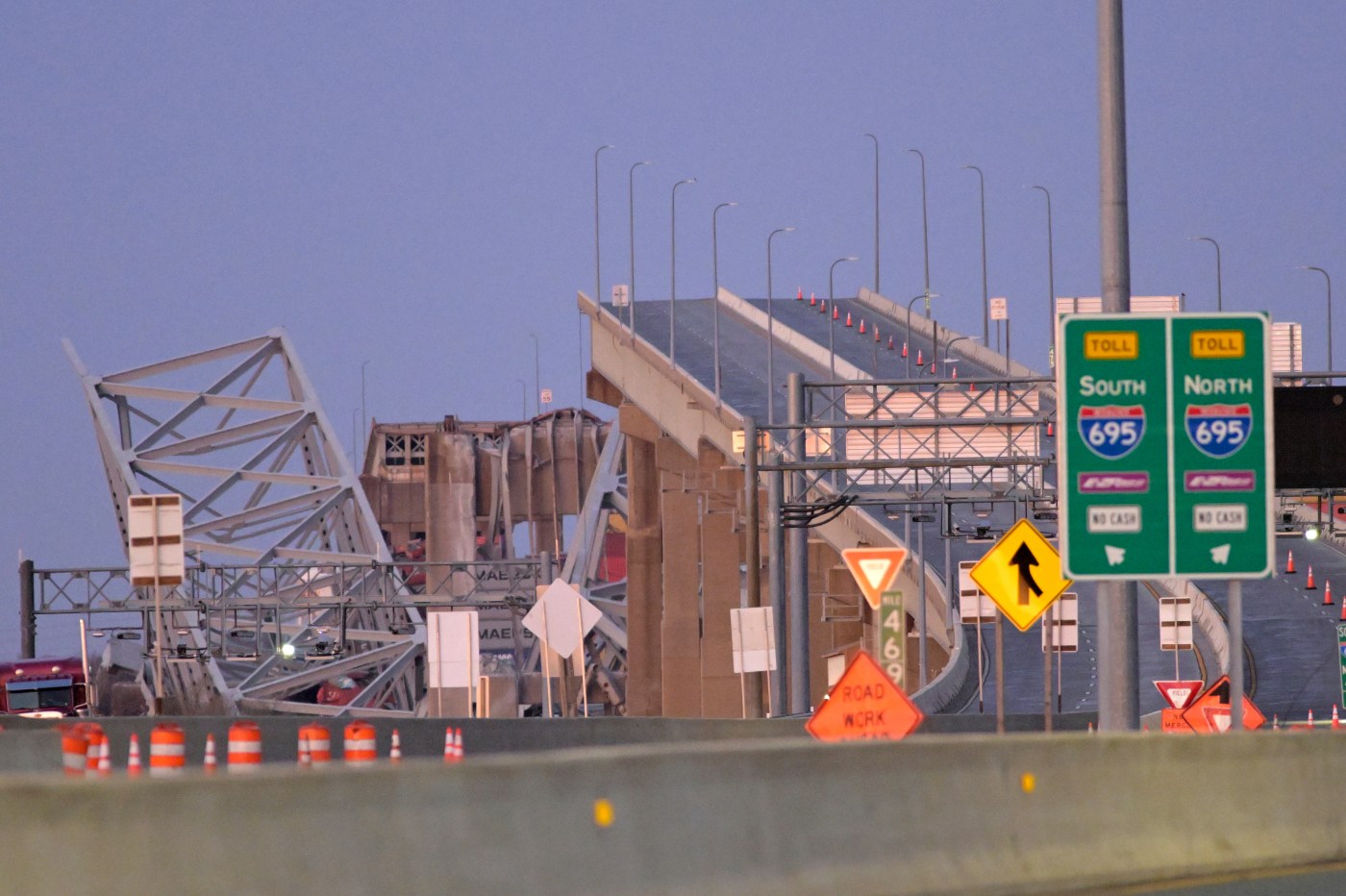
BALTIMORE (AP) — A container ship rammed into a major bridge in Baltimore early Tuesday, causing it to snap and plunge into the river below. Several vehicles fell into the chilly waters, and rescuers were searching for survivors.

Two people were rescued from the waters under the Francis Scott Key Bridge, one in serious condition, according to Baltimore Fire Chief James Wallace. He said authorities “may be looking for upwards of seven people” but said that number could change. It was not clear if the two rescued were included in the seven.

It was not immediately clear what caused the cargo ship to crash into the bridge long before the busy morning commute in what one official called a “developing mass casualty event” in a major American city just outside of Washington.

The ship crashed into one of the bridge’s supports, causing the structure to snap and buckle at several points and tumble into the water in a matter of seconds — a shocking spectacle that was captured on video and posted on social media. The vessel caught fire, and thick, black smoke billowed out of it.

“Never would you think that you would see, physically see, the Key Bridge tumble down like that. It looked like something out of an action movie,” said Baltimore Mayor Brandon Scott, calling it “an unthinkable tragedy.”

Sonar has indicated that there are vehicles in the water, where the temperature was about 47 degrees Fahrenheit (8 degrees Celsius) in the early hours of Tuesday, according to a buoy that collects data for the National Oceanic and Atmospheric Administration.

Earlier, Kevin Cartwright, director of communications for the Baltimore Fire Department, told The Associated Press that several vehicles were on the bridge at the time of the collapse, including one the size of a tractor-trailer truck. The bridge came down in the middle of night when traffic would be lighter than during the day when thousands of cars traverse the span.

Cartwright called the collapse a “developing mass casualty event,” though he didn’t know at the time how many people were affected.

He added that some cargo appeared to be dangling from the bridge, which spans the Patapsco River at the entrance to a busy harbor. The river leads to the Port of Baltimore, a major hub for shipping on the East Coast. Opened in 1977, the bridge is named for the writer of “The Star-Spangled Banner.”

Maryland Gov. Wes Moore declared a state of emergency and said he was working to get federal resources deployed. The FBI was also on the scene.

Synergy Marine Group — which owns and manages the ship called the Dali — confirmed the vessel hit a pillar of the bridge at about 1:30 a.m. while two pilots were in control. It said all crew members, including the pilots, were accounted for and there are no reports of any injuries.

The Dali was headed from Baltimore to Colombo, Sri Lanka, and flying under a Singapore flag, according to data from Marine Traffic. The container ship is about 985 feet (300 meters) long and about 157 feet (48 meters) wide, according to the website.

In 2001, a freight train carrying hazardous materials derailed in a tunnel in downtown Baltimore and caught fire, spewing black smoke into surrounding neighborhoods and forcing officials to temporarily close all major roads into the city.

___

This story has been corrected to reflect that the ship does not appear to have sunk.
Robert F. Kennedy Jr. is expected to announce his VP pick for his independent White House bid

posted in: Politics | 0

By JONATHAN J. COOPER (Associated Press)

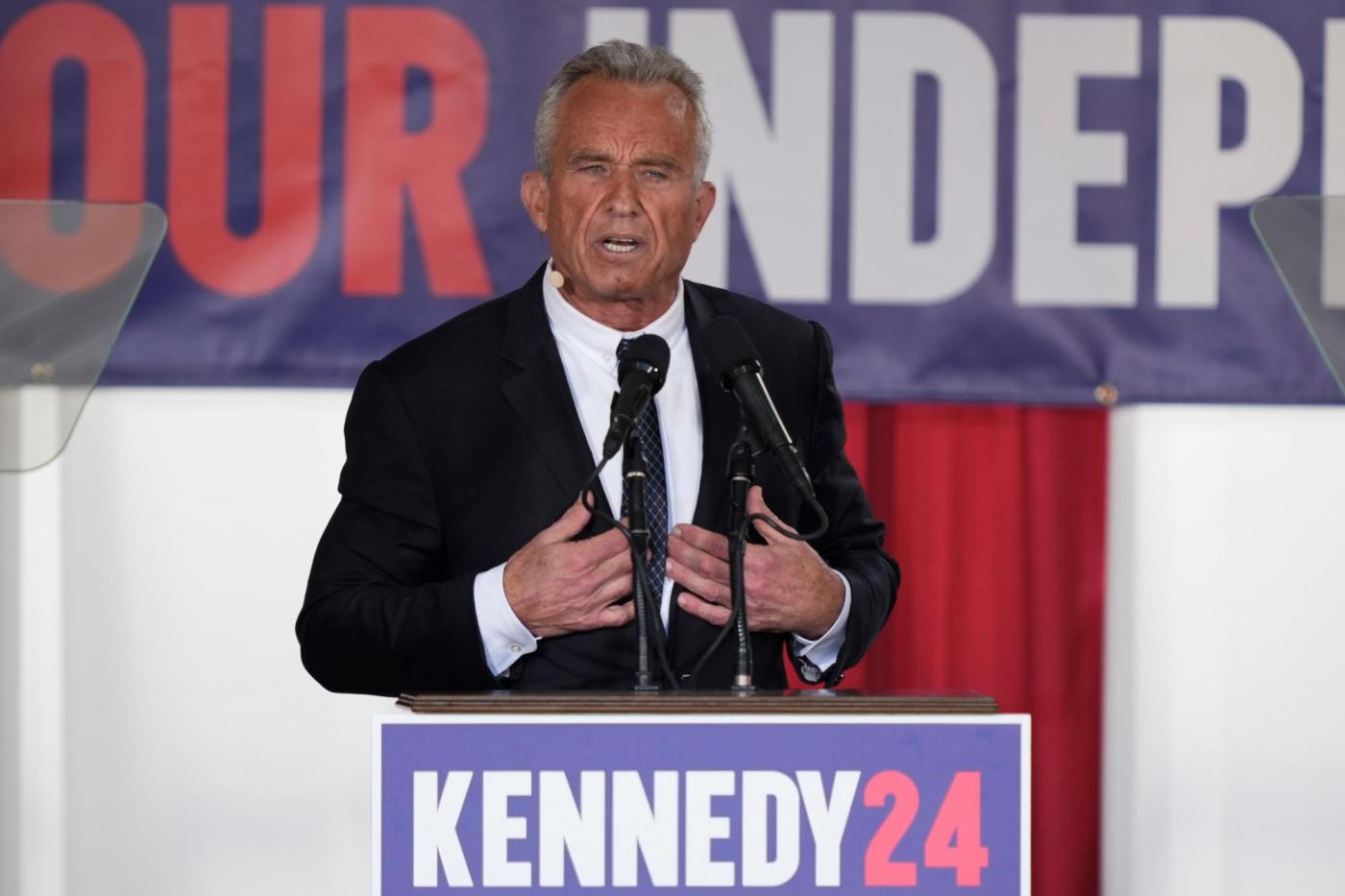
OAKLAND, Calif. (AP) — Robert F. Kennedy Jr. plans to announce his running mate Tuesday as he races to secure a place on the ballot for his independent campaign for president.

In advance of an event Tuesday in Oakland, Kennedy and his aides have circulated the names of several contenders, including celebrities with no political experience. Those names include NFL quarterback Aaron Rodgers and “Dirty Jobs” star Mike Rowe as well as former Minnesota Gov. Jesse Ventura. Speculation most recently has centered on Nicole Shanahan, a lawyer and philanthropist who bankrolled a Super Bowl ad for Kennedy.

“This announcement is really going to shake up the political establishment,” Kennedy said in a video he posted on social media last week.

Kennedy’s campaign has spooked Democrats, who are fighting third-party options that could draw support from President Joe Biden and help Republican former President Donald Trump. As they head into a 2020 rematch, Biden and Trump are broadly unpopular with the U.S. public and will compete for the votes of people who aren’t enthusiastic about either of them.

Without the backing of a party, Kennedy faces an arduous task to get on the ballot, with varying rules across the 50 states. He’s picking a running mate now because about half of the states require him to designate one before he can apply for ballot access.

The requirement is already bedeviling Kennedy’s ballot access effort in Nevada, where Democratic Secretary of State Francisco Aguilar said in a March 7 letter to independent candidates that they must nominate a vice presidential candidate before collecting signatures. The letter came days after Kennedy’s campaign announced he’d collected enough signatures in the state. If Aguilar’s opinion survives a likely legal challenge, Kennedy will have to start again in collecting just over 10,000 signatures in the state.

“This is the epitome of corruption,” said Paul Rossi, a Kennedy campaign lawyer, in a statement Monday, accusing Aguilar of doing the bidding of the Democratic National Committee.

Kennedy has secured access to the ballot in Utah. He and an allied super PAC, American Values 2024, say they’ve collected enough signatures to qualify in several other states, including swing states Arizona, Nevada and Georgia, but election officials there have not yet signed off.

Kennedy is a descendant of a storied Democratic family that includes his father, Robert F. Kennedy, who was a U.S. senator, attorney general and presidential candidate, and his uncle former President John F. Kennedy.

He began his campaign as a primary challenge to Biden but last fall said he’d run as an independent instead.

Kennedy was a teenager when his father, known as RFK, was assassinated during his own presidential campaign in 1968. RFK Jr. built a reputation of his own as an activist, author and lawyer who fought for environmental causes such as clean water.

Along the way, his activism has veered into conspiracies and contradicted scientific consensus, most infamously on vaccines. Some members of his family have publicly criticized his views. Dozens of Kennedy family members sent a message when they posed with Biden at a St. Patrick’s Day reception at the White House in a photo his sister Kerry Kennedy posted to social media.

RFK Jr. is leveraging a network of loyal supporters he’s built over years, many of them drawn to his anti-vaccine activism and his message that the U.S. government is beholden to corporations.

The Democratic National Committee, meanwhile, is gearing up to take on Kennedy and other third-party options, including No Labels, a well-funded group working to recruit a centrist ticket. The effort is overseen by veteran strategist Mary Beth Cahill, whose resume includes chief of staff to the late Sen. Edward M. Kennedy of Massachusetts, another of RFK Jr.’s uncles.

Many Democrats blame Green Party candidates for Al Gore’s loss to George W. Bush in 2000 and Hillary Clinton’s loss to Trump in 2016.

Related Articles

National News |


Mifepristone access is coming before the US Supreme Court. How safe is this abortion pill?

National News |


Murphy, Sperling: How a California climate win could end up destroying rainforests — and what to do about it

National News |


David French: America’s most overlooked political divide is also its most revealing

National News |


How St. Paul’s Woke Coach pushes through discomfort to strengthen office culture

National News |


Jane Eisner: How should we read the texts of Purim and Passover this year?

Wild rookies Brock Faber, Marco Rossi continue to impress

posted in: News | 0

Even if the Wild’s pursuit of a Western Conference playoff spot comes up empty, this season has had its share of bright spots, including the team’s general improvement since a late-November coaching change, to Marc-Andre Fleury chasing and catching NHL history.

Don’t forget Brock Faber and Marco Rossi, who have played so much and so well this season that it’s easy to forget they’re playing their first full NHL season.

With 11 regular-season games remaining, Faber ranks second in points (40) among NHL rookies and Rossi ranks second in rookie goals (20), with each trailing Chicago’s Connor Bedard — the No. 1 overall pick in last summer’s entry draft. If they take their regular spots in the lineup on Thursday against the San Jose Sharks in a 7 p.m. puck drop at Xcel Energy Center, Faber and Rossi will remain on pace to be the first Wild rookies to play a full 82-game season.

Rossi already ranks second in goals by a rookie in team history, two more in 71 games than Marian Gaborik, the franchise’s first draft pick, scored in 71 games in 2000-01. Faber has demolished the franchise rookie mark for assists, set last year by Calen Addison, with 33. Jordan Greenway owns the rookie record for games played with 81 in 2018-19.

“For your team moving forward, that’s certainly something that has to happen,” coach John Hynes said. “Particularly in the salary cap era where you have to be able to have young guys come into your lineup — lots of times, on entry level contracts.”

In last Saturday’s 5-4 overtime loss to St. Louis, the Wild played four rookies: Faber, Rossi, Marat Khusnutdinov and Adam Beckman. Rossi had two goals, Faber added the tying goal in the third and an assist.

“To have younger players in your lineup and play important roles, and not only just play but be real productive players for you, it’s certainly good for them as individuals and their confidence levels as players,” Hynes said.

Minnesota has struggled to get over the hump in its pursuit of a fourth straight postseason appearance — counting the abridged 2020 COVID-19 season — but it still has a pulse. Its six points behind eighth-place Vegas before Monday night’s games. It’s a faint pulse, but it’s a pulse, especially with two more games against Vegas on the schedule, starting Saturday at the X.

But even if the Wild fall short, there are reasons to feel good about the future, such as the team’s 29-18-5 record since Hynes replaced Dean Evason as coach on Nov. 28. And Faber and Rossi, both of whom are on the books for less than $1 million next season, are bargains for a team that will still be dealing with $14.7 million in dead cap space from the Zach Parise and Ryan Suter buyouts.

Rossi won’t catch Kirill Kaprizov’s rookie goals record of 27, but he’s only the second Wild rookie to score 20 goals in a season with the two he scored against St. Louis.

Asked about the accomplishment, Rossi said, “If we would have won the game it would be different. Yeah, it’s nice. I try to help the team.”

Faber won’t catch Kaprizov’s rookie points record of 51, but the former Gophers star has been nothing short of a revelation — a big, responsible defenseman who runs the top power-play unit and already displays the maturity that makes players a captain.

“He’s mature in a lot of ways,” Hynes said. “I think he’s physically mature, to be able to play the way that he plays and handle the situations he’s been in this year as a first-year pro, but I also think when I talk to him, I think he’s a great teammate. He’s coachable. He’s accountable to himself, but he’s also accountable I think to the team game.

“It’s hard to find … that combination sometimes as a young guy, but he has it.”

MN lawmakers advance $541M in new spending, including $109M for property forfeiture settlement

posted in: News | 0

Democratic-Farmer-Labor lawmakers are advancing about a half billion dollars in new spending on top of Minnesota’s current two-year budget.

While the Legislature already passed a new $72 billion budget in 2023, this year, lawmakers are making additional tweaks and adding spending.

In an even-numbered year at the Legislature, the biggest order of business for lawmakers is traditionally a public works borrowing bill. But they can also pass what’s known as a supplemental budget, which carries additional spending decisions to fine-tune the running two-year budget.

Gov. Tim Walz.

Last Monday, DFL Gov. Tim Walz pitched a supplemental budget of $226 million that included a $45 million boost to a child tax credit for lower-income families.

But that amount has grown. In an agreement with DFL legislative leaders announced Friday, the sides settled on about $477 million in additional spending for the current two-year cycle, and another $62 million in 2026-2027. Walz, House Speaker Melissa Hortman and Senate Majority Leader Erin Murphy signed off on the proposal.

“Our supplemental budget agreement makes needed short-term investments, builds on the work done last session, and maintains the state’s fiscal stability,” Murphy said in a statement last week.

Fine-tuning details

Sen. Erin P. Murphy, DFL-St. Paul. (Courtesy of the Minnesota Senate)

The House Ways and Means Committee on Monday advanced the supplemental budget goals on a party-line vote with all Republicans opposed.

Those goals will give other committees a framework as they work to fine-tune the details of last year’s $72 billion budget, which used most of a $17.5 billion surplus.

“What you see in front of us is a prioritization of high needs … while also balancing the future of our state budget,” said House Ways and Means Chair Liz Olson, DFL-Duluth.

The supplemental budget aims to leave the state’s $2.9 billion rainy day fund intact — extra padding which should allow the state to keep the budget balanced.

By far the biggest item in the supplemental budget now moving forward is about $109 million for a court related to property forfeitures. Walz’s initial supplemental budget did not include the settlement.

Last year the U.S. Supreme Court unanimously ruled Hennepin County had violated 94-year-old Geraldine Tyler’s Constitutional rights when it seized her Minneapolis condo due to back property taxes, sold it and pocketed the profits.

State law permitted the practice, but in the wake of the Supreme Court decision, counties will have to reimburse property owners in similar circumstances to the tune of about $109 million as part of a class action settlement related to the case. Lawmakers continue to work on a fix to Minnesota’s property forfeiture laws.

Other items

Besides a large chunk of cash for the Tyler settlement, some bigger spending areas in the agreement between DFL leaders and the governor include education, public safety and taxes. Among them:

• K-12 education, $61 million.

• Children and families, $58 million.

• Tax cuts and credits, $58 million.

• Health and human services, $57 million.

• Capital investment $40 million.

• Judiciary, $39 million.

• Public safety, $32 million.

There’s also $16 million for struggling rural emergency medical service providers across the state.

Spending constraints

Minnesota Management and Budget in February projected a $3.7 billion surplus for the state, though budget officials warned too much additional spending could result in shortfalls in the future as the state is currently spending more money than it is taking in.

Lawmakers can approve a maximum of $2.2 billion during this legislative session without risking a deficit in the future. The supplemental budget does not exceed that amount, though minority Republicans have raised concerns about additional spending on top of a record budget that grew government spending by 38% over the last two-year budget.

Rep. Pat Garofalo, R-Farmington.

Rep. Pat Garofalo, R-Farmington, said spending backed by DFLers was ultimately unsustainable and cast doubt on whether a DFL majority would practice restraint on spending in the next budget cycle. He said the state would have to cut spending by about $5 billion to meet a budget goal of around $66 billion in 2026-2027.

During Monday’s Ways and Means hearing, he said the GOP would back shifting resources, but could not get behind this year’s new spending goals.

“The idea that the government of Minnesota doesn’t have enough money and is not spending enough money, and needs to do more is simply not in conjunction with the mathematical reality,” he said.

Related Articles

Politics |


Proposed ban on bird hatching in Minnesota schools gets amendment following outcry

Politics |


Joe Soucheray: Reckless car thieves, streetlamp wreckers … we’re tired of this

Politics |


Dave Thune: We need to support our public-safety people every day

Politics |


Letters: Why would we think a zoning sledgehammer is the right tool for Minnesota?

Politics |


Letters: Words and their varied meanings matter in Minnesota’s End of Life debate